Find out exactly how much soil your raised bed needs in cubic feet, cubic yards, and 1.5 cu ft bags.
Raised Garden Soil Calculator
🌱 Soil formula: Length × Width × Depth (inches ÷ 12) = Cubic feet per bed. Multiply by number of beds. 27 cubic feet = 1 cubic yard.
💡 Pro tip: Standard raised bed depth: 10-12 inches for vegetables. Fill with 60% topsoil, 30% compost, 10% perlite/vermiculite for optimal drainage.
How much soil does a raised garden bed need?
A standard 4 × 8 ft raised bed with a 12-inch depth needs 32 cubic feet of soil, or about 1.2 cubic yards. That works out to roughly 22 bags at the common 1.5 cubic foot bag size. Multiply length × width × depth (in feet) to get cubic feet for any bed, then divide by 27 to convert to cubic yards.
The raised garden bed soil calculator above does this math for you. Enter your bed dimensions, pick a soil mix, and you get the total volume plus a breakdown of topsoil, compost, and aeration material to buy.
Quick reference: soil volume by bed size
| Bed size (L × W × D) | Cubic feet | Cubic yards | 1.5 cu ft bags |
| 4 × 4 × 6 in | 8 | 0.30 | 6 |
| 4 × 4 × 12 in | 16 | 0.59 | 11 |
| 4 × 8 × 6 in | 16 | 0.59 | 11 |
| 4 × 8 × 12 in | 32 | 1.19 | 22 |
| 4 × 8 × 18 in | 48 | 1.78 | 32 |
| 4 × 12 × 12 in | 48 | 1.78 | 32 |
| 3 × 6 × 10 in | 15 | 0.56 | 10 |
| 2 × 8 × 12 in | 16 | 0.59 | 11 |
Order roughly 10% extra. Soil compacts after the first watering and again after the first season, so a bed filled flush to the top usually settles two to three inches in month one.
What is the best soil mix for raised garden beds?
The most reliable raised garden bed soil mix is 60% topsoil, 30% compost, and 10% aeration material like perlite, vermiculite, or coarse sand. This blend holds moisture without staying soggy, feeds plants for a full season, and stays loose enough for roots to push through.
Three mixes cover almost every situation:
- Standard Mix (most vegetables, herbs, flowers)
- 60% topsoil
- 30% compost
- 10% perlite, vermiculite, or coarse sand
Use this for general vegetable beds, salad greens, peppers, tomatoes, and pollinator gardens.
- Mel’s Mix (square foot gardening)
- 1/3 compost (blend of at least 5 sources if possible)
- 1/3 peat moss or coconut coir
- 1/3 coarse vermiculite
Mel Bartholomew, who created the square foot gardening method, designed this mix for shallow beds (6 inches) and high-density planting. It is lighter and drains fast, so you water more often.
- Heavy-feeder Mix (corn, squash, brassicas, root crops)
- 50% compost
- 25% topsoil
- 25% aged manure or worm castings
Use this when you are growing crops that pull a lot of nutrients out of the soil in one season. Top up with fresh compost every spring.
Skip these as base layers
- Pure potting mix — too light, holds too much water in deep beds, and gets expensive
- Pure native soil — compacts hard, drains poorly, often weed-seed heavy
- Pure compost — too hot for seedlings and slumps badly after watering
How deep should a raised garden bed be?
Eight to twelve inches works for most vegetables. Root crops like carrots, beets, parsnips, and daikon need at least twelve inches, and eighteen is better.
| Plant type | Minimum depth | Better depth |
| Lettuce, spinach, herbs | 6 in | 8 in |
| Tomatoes, peppers, beans | 12 in | 18 in |
| Carrots, beets, turnips | 12 in | 18 in |
| Potatoes, sweet potatoes | 18 in | 24 in |
| Asparagus, rhubarb (perennial) | 18 in | 24 in |
Deeper is almost always better. Root systems run wider and deeper than people expect, and a deeper bed buys you a margin of error on watering and feeding.
If you are building from scratch, look at the full build guide on raised bed sizing, soil, edging, and cost before you buy lumber.
How to fill a raised garden bed cheaply
Quality soil mix runs about $8 to $12 per cubic foot in bagged form, so a 4 × 8 × 12-inch bed costs $250 to $380 to fill all the way with bagged soil. You can cut that bill in half with a layered fill method.
The hugelkultur fill (works for any bed 12 inches or deeper)
- Bottom third — woody debris. Stack logs, branches, untreated wood scraps, twigs, and corn stalks in the bottom 4 to 6 inches. This rots down slowly, feeds the bed for years, and replaces soil you would otherwise buy.
- Middle third — green and brown. Add grass clippings, leaves, straw, kitchen scraps, manure, and shredded cardboard. Pack it down.
- Top third — finished soil mix. Fill the top 6 to 8 inches with your standard mix. This is the layer roots actually grow in for the first season.
The bottom layers compress as they break down, so plan to top the bed up by 2 to 4 inches every spring for the first two years.
Bulk vs bagged soil cost
Buying soil by the cubic yard from a landscape supplier costs about $30 to $50 per yard. One cubic yard equals 27 cubic feet, which beats bagged prices by 50 to 70 percent when you are filling beds bigger than 24 cubic feet total. Below that, bagged is more practical because of delivery minimums.
Raised bed soil vs garden soil vs topsoil
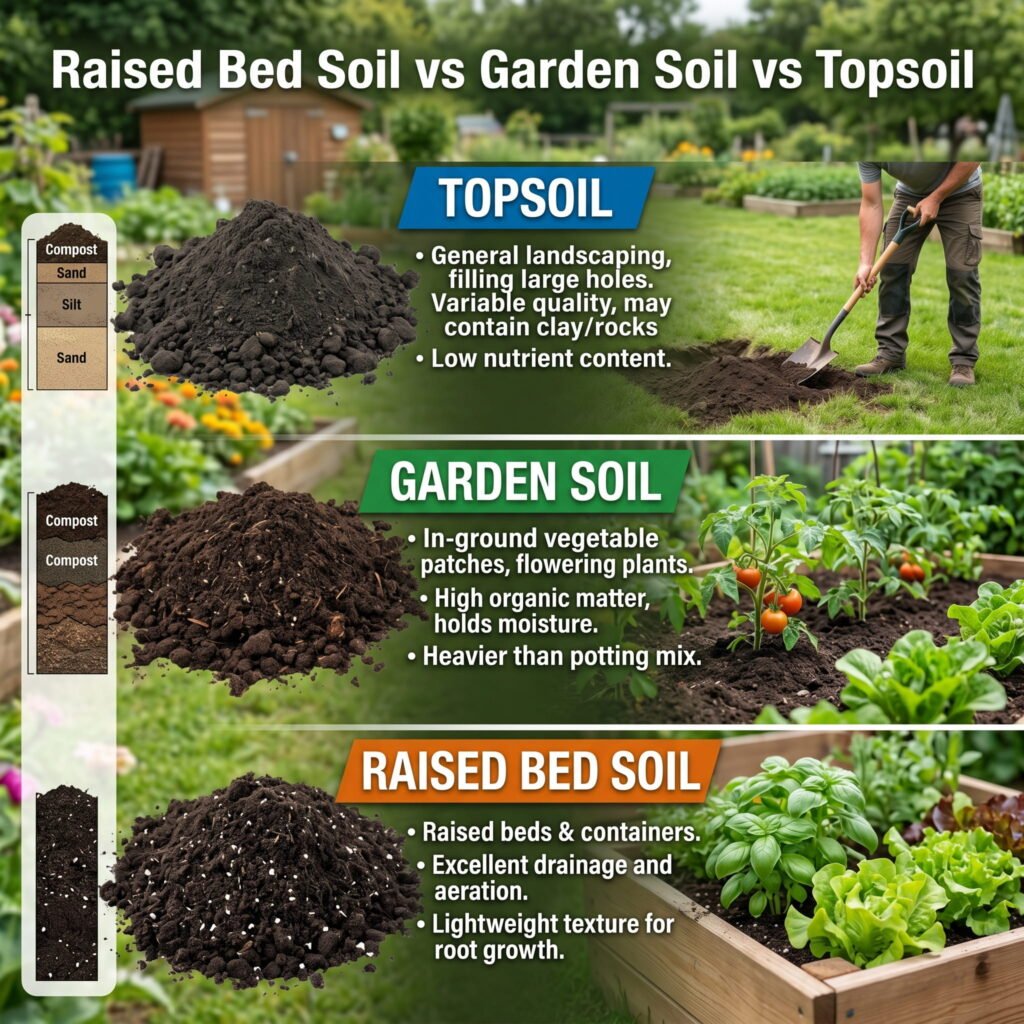
These three labels show up on the same shelf and they are not the same product.
| Product | What it is | Use it in raised beds? |
| Raised bed soil | Pre-blended mix of topsoil, compost, and aeration | Yes — works as the full fill |
| Garden soil | Topsoil plus a small amount of organic matter | Yes — as the base, but amend with compost |
| Topsoil | Native dark soil scraped from somewhere | Yes — only as part of a mix, not on its own |
| Potting mix | Peat or coir, perlite, no actual soil | No — for containers, not raised beds |
| Compost | Decomposed organic matter | Yes — as 25 to 30 percent of the mix |
Raised bed soil is the most convenient option because the work is done for you, but it costs more per cubic foot than building your own blend. If you are filling more than one bed, mixing your own topsoil and compost saves money and lets you adjust the ratio.
How many bags of soil do I need?
Soil at retail is most often sold in 1.5 cubic foot bags. To get the bag count, divide your total cubic feet by 1.5.
- 16 cubic feet ÷ 1.5 = 11 bags
- 32 cubic feet ÷ 1.5 = 22 bags
- 48 cubic feet ÷ 1.5 = 32 bags
Bag sizes vary. Miracle-Gro Raised Bed Soil ships in 1.5 cubic foot bags. Some store brands sell 1 cubic foot or 2 cubic foot bags. Check the bag, not the price tag, when you compare brands. Two 1-cu-ft bags at $4 each is the same price as one 2-cu-ft bag at $8, and a 1.5-cu-ft bag at $7 is the cheaper deal.
The calculator at the top of this page returns your total in cubic feet so you can divide by whatever bag size your store carries.
Common mistakes when filling a raised garden bed
Filling with pure compost. Compost is fertilizer, not soil. A bed filled with 100 percent compost slumps by 30 to 50 percent in the first season and the high nutrient load can burn seedlings.
Skipping aeration. Without perlite, vermiculite, or sand, the mix packs down within months. Roots stop spreading, water pools on the surface, and the bed underperforms by year two.
Ignoring settling. Soil drops 2 to 4 inches in the first six weeks. Order an extra 10 percent. If you fill flush to the top, you will be hunting bags in July to top it back up.
Using treated lumber underneath. Cardboard or landscape fabric between treated wood and soil is fine, but old creosote or arsenic-treated wood leaches into the soil and into your food.
Forgetting drainage. A raised bed sitting on solid clay or concrete still needs an exit for water. Drill drainage holes or place the bed on permeable ground.
How to measure your bed if it’s not a rectangle
Circular beds: π × radius² × depth, all in feet. A 4-foot-wide round bed at 12 inches deep is 3.14 × 2² × 1 = 12.57 cubic feet.
L-shaped or U-shaped beds: split the bed into rectangles, calculate each one separately, and add the totals.
Tapered or sloped beds: average the top and bottom widths, then use the standard formula.
The calculator at the top of this page is set up for rectangular beds, which covers about 95 percent of designs. For anything irregular, use the formulas above and run each rectangle through the calculator separately.
Frequently asked questions
Can you use garden soil in raised beds?
Yes, but not on its own. Garden soil is heavier and lower in organic matter than dedicated raised bed mix. Use it as 50 to 60 percent of the blend, then add 30 percent compost and 10 percent aeration material like perlite or coarse sand. Straight garden soil packs down hard and drains poorly in a raised bed.
How much soil do I need for a 4×8 raised bed?
A 4 × 8 ft bed needs:
- 6 inches deep: 16 cubic feet (about 11 bags at 1.5 cu ft each)
- 12 inches deep: 32 cubic feet (about 22 bags)
- 18 inches deep: 48 cubic feet (about 32 bags)
Order 10 percent extra to account for settling after the first watering.
What is the cheapest way to fill a raised garden bed?
Use a hugelkultur-style layered fill: woody debris in the bottom third, mixed green and brown organic material in the middle, and your finished soil mix in the top 6 to 8 inches. This cuts your bagged soil cost by 40 to 50 percent on a 12-inch-deep bed and feeds the bed for years as the bottom layers break down.
Is raised bed soil the same as potting soil?
No. Raised bed soil contains real topsoil, holds more water, and weighs more. Potting soil is built for containers — it is lighter, drains faster, and is made from peat or coir, perlite, and bark. Potting soil in a raised bed dries out too fast and gets expensive at depth. Use raised bed soil or a topsoil-compost-aeration blend.
How deep should soil be in a raised garden bed?
Fill the soil to within 1 to 2 inches of the top edge. For total depth, plan on at least 8 inches for greens and herbs, 12 inches for most vegetables, and 18 inches for root crops and large plants like tomatoes or potatoes. Deeper beds are easier to keep watered and grow better roots.
How do I calculate cubic yards for a raised bed?
Multiply length × width × depth (all in feet) to get cubic feet, then divide by 27. A 4 × 8 ft bed at 1 foot deep is 32 cubic feet, which divides to 1.19 cubic yards. The calculator above returns both numbers automatically.
Calculate your soil needs in seconds
Plug your bed dimensions into the raised garden bed soil calculator at the top of this page. You will get the total cubic feet, cubic yards, and number of bags to buy, plus a mix breakdown for the soil ratio you choose. If you are building your first bed, pair this with the step-by-step raised bed build guide to size the frame and pick edging before you order soil.
Got an odd-shaped bed or a fill question the calculator did not cover? Drop it in the comments — I read every one.