You woke up with a strange image still in your head: a staircase collapsing, an exam you never studied for, a face you haven’t seen in years. You probably typed something like dreammeaning.com USA into a search bar, hoping for a quick answer. This guide explains what dream meaning websites actually offer, where dream interpretation came from, and what sleep science says about dreaming. It also shows how to use a dream dictionary without taking it too literally. By the end, you will have a simple method for reading your own dreams.
What People Want From a dreammeaning.com USA Search
A search like this usually comes from someone with a specific, practical question. They are not looking for a lecture on neuroscience. They want to know what a particular dream symbol, such as a snake, a flood, or a late-night phone call, might signify, and they want it explained in plain English.
Dream meaning websites meet that need in three main ways. Some are A-to-Z dictionaries where you look up a single symbol. Some are articles that explore a theme in depth, like flying or falling. A growing number use artificial intelligence to respond to a dream you describe in your own words.
This is an informational search. The reader is curious and often a little unsettled, but not ready to buy anything. A useful article, or a useful site, should therefore explain the symbol, give context for the interpretation, and be honest about what is known and what is only tradition or opinion.
The History of Dream Dictionaries and Dream Interpretation
People have tried to decode dreams for thousands of years. One of the earliest systematic efforts was the Oneirocritica by Artemidorus of Daldis, a Greek author writing in the second century AD. He classified dreams and their supposed meanings, and many modern dream dictionaries still follow the same basic format.
Dream interpretation took a new direction in 1899, when Sigmund Freud published The Interpretation of Dreams. Freud argued that dreams disguise unconscious wishes, and that a dream’s visible story hides a deeper meaning. Carl Jung later disagreed with parts of Freud’s approach. He saw dreams as a way for the psyche to restore balance, and he linked many recurring images to shared symbols he called archetypes.
On the popular side, American readers have long relied on printed dream books. One widely known example is Gustavus Hindman Miller’s 10,000 Dreams Interpreted, first published in 1901, which still influences how many online dictionaries phrase their entries. Knowing this lineage helps you read modern dream sites more critically. Many of their “meanings” are inherited traditions, not research findings.
What Science Says About Why We Dream
Researchers have not settled why we dream, and anyone claiming a single answer is overselling. Several theories compete, and each explains part of the picture.
The activation-synthesis hypothesis, proposed by J. Allan Hobson and Robert McCarley in 1977, suggested that dreams come from random brain activity during sleep, which the brain then weaves into a story. Later models give the brain a more active role. The continuity hypothesis, associated with psychologist G. William Domhoff, holds that dreams largely reflect our waking concerns, relationships, and preoccupations. Antti Revonsuo’s threat simulation theory proposes that dreaming evolved partly to rehearse responses to danger, which could help explain why chase and fear dreams are so common.
Dreams occur most vividly during rapid eye movement (REM) sleep, but they also happen in other sleep stages, usually with less vivid imagery. Adults cycle through sleep stages roughly every 90 minutes, so a full night includes several dream periods, even if you remember only one.
What does this mean for dream dictionaries? The research supports the idea that dreams often draw on your own life, emotions, and memories. It does not support the idea that a snake or a tooth has one fixed meaning for everyone.
How Dream Meaning Websites and Dream Dictionaries Work
Most dream meaning sites fall into one of three formats. Understanding each helps you judge what you are getting.
Symbol Dictionaries
A symbol dictionary lists dream elements alphabetically and gives a short interpretation for each. This format is fast and easy to use, which explains its popularity. Its weakness is that it treats every dreamer the same. A dream about water means something different to a competitive swimmer than to someone who nearly drowned as a child.
Long-Form Dream Theme Articles
Articles on themes such as being chased, losing teeth, or dreaming about a former partner can explore more than one possible reading. Good ones separate traditional interpretations from psychological ones and tell you which is which. They work best when you want to understand a recurring pattern rather than a single symbol.
AI Dream Interpretation Tools
Newer tools let you type out a dream and receive a tailored interpretation, sometimes with a built-in journal. They can be useful for generating questions and prompts. Their output should be treated as one possible reading, not a diagnosis, because a model has no access to your actual life, only the words you give it.
Common Dream Meanings and What They Often Symbolize
Certain dream themes show up again and again in dream research and on dream websites. The table below summarizes how dictionaries commonly describe them, along with a question that can help you connect the dream to your own situation. These are interpretive traditions, not proven facts.
| Dream theme | Common dictionary reading | Question to ask yourself |
| Falling | Loss of control or insecurity | Where in my life do I feel unsupported? |
| Being chased | Avoiding a problem or emotion | What am I trying not to face right now? |
| Teeth falling out | Anxiety about appearance, aging, or communication | Am I worried about how others see me? |
| Flying | Freedom, ambition, or escape | Do I feel limited or newly empowered? |
| Being unprepared for a test | Fear of being judged or evaluated | What performance am I anxious about? |
| Water | Emotions, with calm or turbulent water reflecting mood | How did the water feel in the dream? |
| Showing up late or missing a flight | Worry about missed opportunities | What deadline or choice feels pressing? |
Notice that the right-hand column does more work than the middle one. A dictionary entry gives you a starting hypothesis. Your own experience decides whether it fits.
How to Interpret Your Dreams Step by Step (Including Dream Journaling)
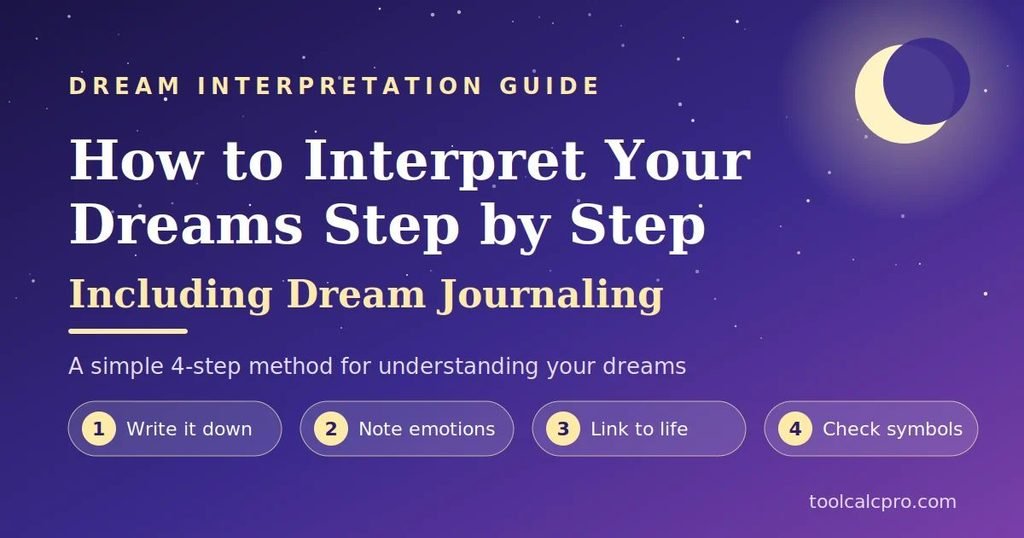
You do not need special training to reflect on a dream in a useful way. The following method borrows from common practice in dream journaling and psychology-informed reflection. A journal is the foundation, because it turns scattered impressions into patterns you can actually see.
Write Down the Dream Immediately
Details fade within minutes of waking, so keep a notebook or phone note within reach. Record the date, the setting, the people, what happened, and anything that seemed odd. Fragments are fine. A single image written down is worth more than a full story you forgot.
Small habits help with recall. Keeping a regular sleep schedule, limiting heavy alcohol use before bed, and lying still for a moment after waking can make dreams easier to remember. Alcohol and some medications can affect REM sleep, so if your dreams change suddenly after you start a new medication, mention it to your doctor or pharmacist.
Note the Emotions
Write down how you felt, both inside the dream and on waking. Many dream researchers consider emotion more informative than imagery. A dream about a dog that left you frightened tells a different story than one that left you comforted.
Connect It to Your Waking Life
Dreams often recycle recent events, conversations, or worries, sometimes in distorted form. Ask what in your past week the dream might be echoing. After a few weeks of entries, reread them and look for repeats, such as the same setting, a recurring person, or a common feeling like being rushed or watched. Those repeated elements usually say more than any single dream.
Check Symbols Against a Dream Dictionary
Now look up a symbol or two, but treat the result as one option among several. If a meaning makes you think “yes, that fits,” it is worth exploring. If it feels wrong, that is useful information too. Most dreams call for no action at all. Occasionally, a dream puts words to a worry you had been avoiding, and that can prompt a conversation or a decision.
Dream Dictionary vs. Journal vs. AI vs. Therapist: Which Works Best?
A dictionary is only one tool. Each approach has strengths and limits, and combining them usually works better than relying on any single one.
| Approach | Best for | Main limitation |
| Dream dictionary lookup | Quick ideas about a specific symbol | Ignores your personal context |
| Personal reflection and journaling | Spotting patterns and emotions over time | Requires consistency and honesty |
| AI-assisted interpretation | Generating questions and alternative readings | Cannot know your life; may sound more certain than it is |
| Working with a therapist | Distressing, recurring, or trauma-related dreams | Costs time and money |
For most people, a sensible combination is a journal plus an occasional dictionary lookup. A licensed professional becomes more important when dreams are tied to distress, trauma, or poor sleep.
Limits of Online Dream Interpretation and How to Spot Unreliable Claims
Dream websites can be enjoyable and thought-provoking, but a few cautions are worth keeping in mind.
Be wary of absolute claims. If a site says a dream “always means” something, or predicts illness, death, money, or relationship outcomes, treat that as entertainment. No scientific evidence shows that dream symbols reliably predict future events.
Watch for unclear sourcing. A trustworthy article tells you whether an interpretation comes from Freud, Jung, folklore, modern psychology, or the author’s own view. If it never says, you cannot judge how much weight to give it.
Be careful with your privacy. If you use a site or app that asks you to submit dreams, read its privacy policy first. Dreams can contain personal details about relationships, health, and fears, so consider what you are comfortable sharing and storing online.
Finally, do not let an interpretation increase your anxiety. If a reading leaves you more worried, step back. A dream is not a verdict on your life.
Getting the Most From dreammeaning.com USA and Dream Meanings
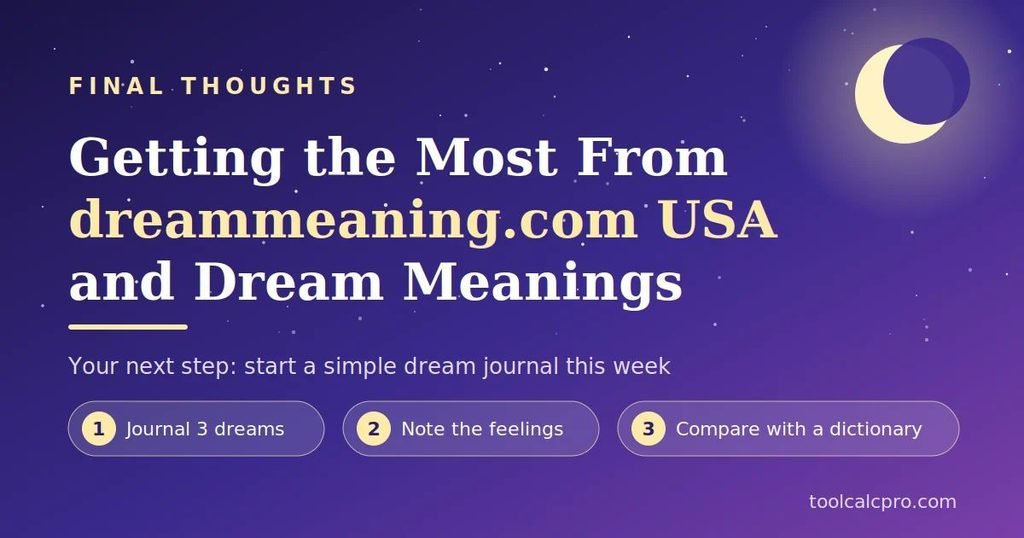
Searching for dreammeaning.com USA is, at its heart, a search for a way to make sense of something strange and personal. Dream dictionaries and interpretation sites can give you vocabulary and a place to start. The research on dreaming suggests, though, that the most reliable guide to a dream’s meaning is your own life: your emotions, memories, and current concerns.
A good next step is to start a simple dream journal this week. Write down your next three dreams, note how each one felt, and then look up a symbol or two. Compare what the dictionary says with what you already know about yourself. That comparison is where real insight tends to happen.
Disclaimer
This article is for general information and entertainment. It is not medical or psychological advice. If your dreams or nightmares are frequent, deeply distressing, or interfering with your sleep or daily life, consider speaking with a doctor, sleep specialist, or licensed mental health professional. In the US, the 988 Suicide and Crisis Lifeline is available by call or text at 988 if you are in crisis.
Frequently Asked Questions About dreammeaning.com USA and Dream Meanings
Do dreams really have hidden meanings?
Sometimes dreams reflect real emotions and concerns, which is why reflecting on them can be useful. Science has not shown that specific symbols carry universal, fixed meanings, so interpretations are best treated as ideas to consider rather than facts.
Are dream dictionaries accurate?
Dream dictionaries reflect traditions and interpretive schools, not laboratory findings. They can offer helpful starting points, but their accuracy depends on how well an entry fits your own experience.
Why do I forget most of my dreams?
The brain is less able to store new memories during sleep, and dream recall fades quickly after waking. Writing down your dream immediately, even in fragments, noticeably improves how much you remember.
Can AI interpret my dreams?
AI tools can suggest themes and questions to think about, and some also double as dream journals. They cannot know your personal history, so treat their output as a conversation starter instead of a definitive answer.
When should I worry about my dreams?
Occasional strange or unpleasant dreams are normal. If you have frequent nightmares, dreams tied to a traumatic event, or sleep problems that affect your daytime functioning, talk to a healthcare professional. Treatments such as imagery rehearsal therapy are used for nightmare disorder.