A research dossier for a target company pulls everything you know about an organization into one document: what it sells, how it earns money, who runs it, what could go wrong, and what you should do next. If you are preparing a sales pitch, weighing an acquisition, studying a competitor, or heading into a final-round interview, scattered notes and a dozen open browser tabs rarely lead to confident decisions. This guide explains what belongs in a company dossier, where to find reliable U.S. sources, how to build the document step by step, and how to keep your research accurate and ethical.
What a Research Dossier for a Target Company Is (and Isn’t)
A research dossier is a structured file that collects verified information about one organization and interprets it for a specific purpose. It differs from a basic company profile, which lists facts such as headquarters, headcount, and products. A dossier ties those facts to a decision you need to make.
The word “target” matters. You are not researching the company out of curiosity; you want something from it or about it, whether that is a contract, an investment, a partnership, a competitive edge, or a job offer. That purpose decides what you include, how deep you go, and what you leave out.
A dossier also differs from formal due diligence. Due diligence in a transaction is usually handled by lawyers, accountants, and advisers, and it often relies on confidential documents the target shares during negotiations. A dossier is built from the outside in, mostly from public information, and it usually comes first. It tells you whether a deeper review is justified.
When a Company Dossier Is Worth Building
Almost any high-stakes conversation with or about a company benefits from one, but the right depth depends on what is at risk.
| Use case | Core question | Typical depth |
|---|---|---|
| B2B sales and account planning | Why would this company buy, and why now? | Medium |
| Investment screening | Is the business sound and reasonably valued? | Deep |
| Acquisition or partnership screening | Is this a safe and strategic fit? | Deep |
| Competitive intelligence | Where is this rival heading? | Medium to deep |
| Job interview preparation | Is this employer stable, and where is it going? | Light |
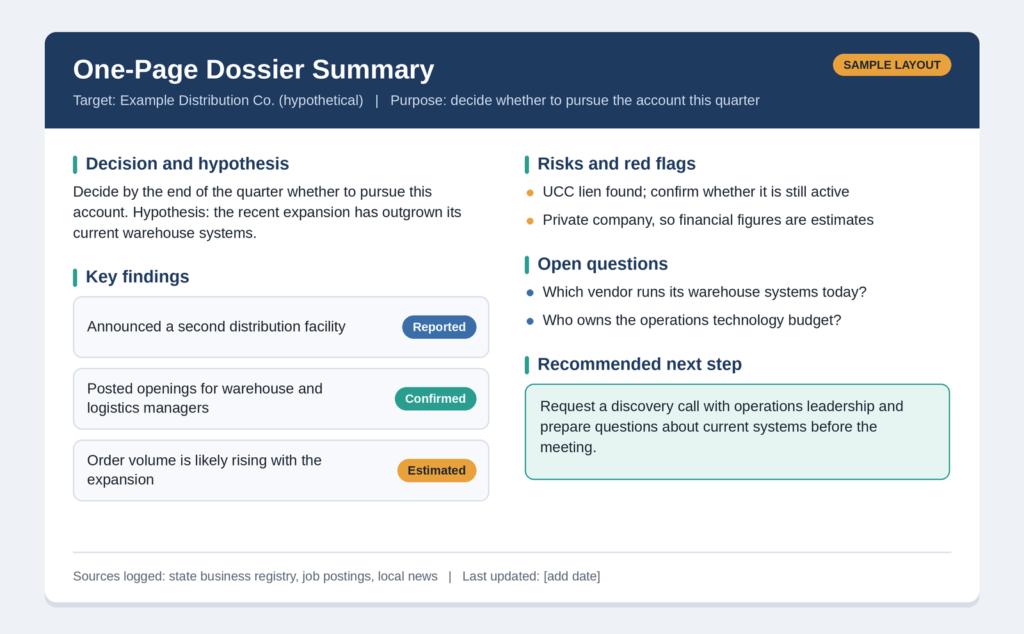
A light dossier may need only a few pages, while an acquisition screen can run far longer. Either way, open with a one-page summary so a busy reader gets the conclusion first.
What to Include in a Company Dossier
Most strong dossiers share the same building blocks. The table lists each one, the question it answers, and where the answer usually comes from.
| Section | What it answers | Typical sources |
|---|---|---|
| Purpose and hypothesis | What decision does this support, and what do I expect to find? | Your own notes, written before research starts |
| Company snapshot | Legal name, ownership, headquarters, size, subsidiaries | State registry, company website, SEC filings |
| Business model | What does it sell, to whom, and how does it earn money? | Annual report, product pages, investor presentations |
| Financial health | Is it growing, profitable, and sensibly financed? | 10-K and 10-Q filings; funding news and credit reports for private firms |
| Leadership and governance | Who decides, and how are they overseen and paid? | Proxy statements, company website, reputable news |
| Market and competition | Who are the rivals, and where does it win or lose? | Industry reports, competitor filings, customer reviews |
| Recent events | Funding, acquisitions, launches, layoffs, leadership changes | Form 8-K reports, press releases, news |
| Legal and reputational risk | Lawsuits, liens, enforcement actions, complaints | Court records, UCC filings, regulator websites |
| Intellectual property | What does it own, and where is its research heading? | USPTO databases, job postings |
| Implications and next steps | What does this mean for my decision? | Your own analysis |
The first and last rows are the ones people skip, and they matter most. Writing down a hypothesis before you start, such as “this company is expanding faster than its operations can handle,” gives you something to test. Without one, research tends to collect confirming evidence and ignore the rest. The final row turns a pile of facts into a recommendation.
Where to Find Information on Public Companies
In the United States, public companies must file regular disclosures with the Securities and Exchange Commission, and the SEC’s EDGAR database gives the public free access to them. EDGAR’s full-text search covers filings since 2001 and lets you filter by filing category, date range, state of incorporation, and the location of principal executive offices.
A few forms carry most of the value. The 10-K is the annual report, and its business description, risk factors, management discussion, and audited financial statements anchor most dossiers. The 10-Q covers each quarter. The 8-K reports material events such as acquisitions, executive departures, and auditor changes. The DEF 14A proxy statement describes the board, executive pay, and shareholder votes, and Form 4 discloses insider transactions.
A sensible reading order is the 10-K’s business and risk sections, then the latest 10-Q, recent 8-Ks, and the proxy statement. Full-text search also works indirectly: search the target’s name across all filings to see where other companies mention it as a customer, supplier, partner, or litigant.
Beyond the SEC, check the company’s investor relations page for earnings presentations and call transcripts, USAspending.gov (the U.S. Treasury’s official record of federal spending) for contracts and grants, and the USPTO’s Patent Public Search and Trademark Search tools for intellectual property. The USPTO retired its older TESS trademark system on November 30, 2023, so guides that still point to TESS are out of date.
How to Research a Private Company
Private companies do not file with the SEC, so you assemble the picture from fragments. Fortunately, those fragments add up.
Start with the Secretary of State business search in the state where the company is incorporated, then repeat it in the states where it operates. These registries typically show entity type, status, formation date, registered agent, and sometimes officers through annual reports. A status such as inactive or revoked deserves an immediate note.
Next, check Uniform Commercial Code filings, which the Secretary of State usually holds. A UCC-1 is a notice of a security interest in personal property, so these records show which lenders have claims on a company’s assets. Amendments and terminations (UCC-3 filings) show whether those claims are still active.
For litigation, PACER covers federal appellate, district, and bankruptcy courts. Access costs $0.10 per page, any single document is capped at $3.00, and fees are waived in a quarter when your charges total $30 or less. State and local courts run separate systems, so also search the counties and states where the company operates.
Two shortcuts are easy to miss. If a public company acquired the private one, the acquirer’s SEC filings may describe the deal. If the company once traded publicly and later went private, its older filings can still be useful. For everything else, such as funding announcements, customer reviews, and press coverage, label what you find as reported or estimated rather than confirmed, because private companies seldom publish audited financials.
Fees and features change, so confirm details on each site before relying on them.
| Source | What it covers | Cost |
|---|---|---|
| SEC EDGAR | Filings by public companies and other registrants | Free |
| State Secretary of State | Entity status, registered agent, annual reports, UCC filings | Basic searches are typically free; fees for certified copies vary by state |
| PACER | Federal appellate, district, and bankruptcy cases | $0.10 per page, $3.00 per-document cap, waived at $30 or less per quarter |
| USPTO | Patents and trademarks | Free |
| USAspending.gov | Federal contracts and grants | Free |
A Step-by-Step Process for Building the Dossier
A repeatable process keeps the work focused and the result trustworthy.
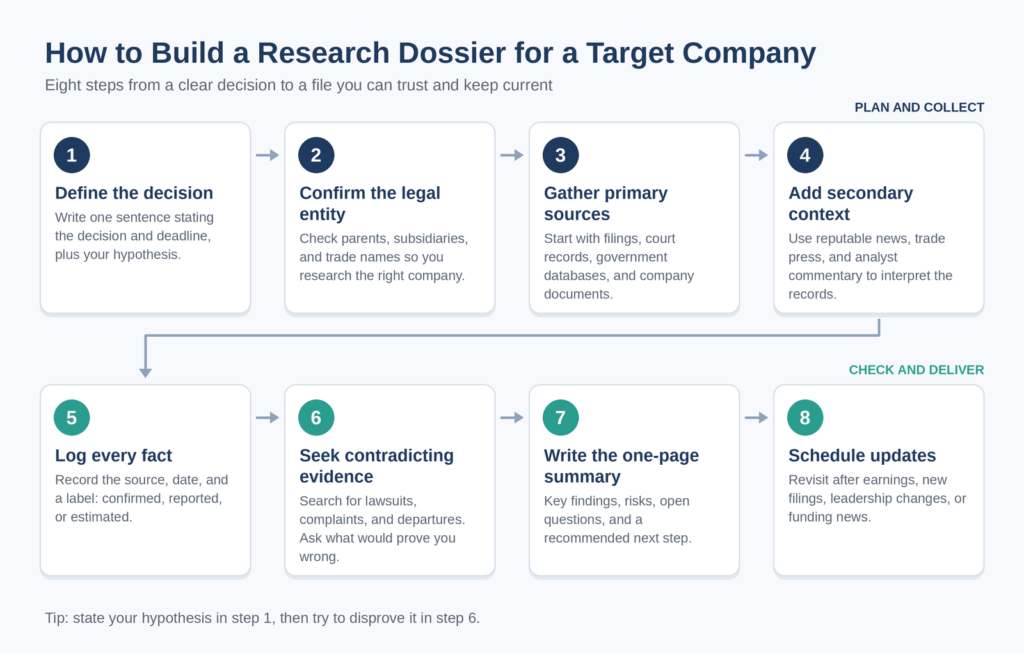
- Define the decision and deadline. Write one sentence, such as “I need to decide whether to pursue this account by the end of the quarter,” and add your hypothesis.
- Confirm the exact legal entity. Large companies have parents, subsidiaries, and trade names, and researching the wrong one produces the wrong financials and lawsuits. The subsidiary list usually appears as an exhibit to a public company’s 10-K, and for private companies the state registry confirms the registered name.
- Gather primary sources first. Filings, court records, government databases, and the company’s own documents come before commentary.
- Add secondary sources for context. Reputable news outlets, trade publications, and analyst commentary explain what the records mean. Job postings and customer reviews reveal priorities and pain points, but they are anecdotal, so treat them as signals rather than proof.
- Log every fact with its source, date, and confidence level. A simple label such as confirmed, reported, or estimated stops guesses from hardening into facts.
- Look for contradicting evidence. Search for lawsuits, complaints, executive departures, and layoffs, and ask what would prove your hypothesis wrong.
- Write the one-page summary. Cover key findings, major risks, open questions, and the recommended next step, then arrange the supporting sections behind it.
- Schedule updates. Decide now when you will revisit the file, because company information goes stale quickly.
Consider a hypothetical case. You sell warehouse software to a regional distributor and suspect its recent expansion has outgrown its systems. You would look for new facility announcements, warehouse and logistics job postings, and any operational problems mentioned in filings or news coverage. You would also look for the opposite, such as a recent multiyear contract with a competing vendor, which would weaken your case.
Judging Source Quality and Spotting Red Flags
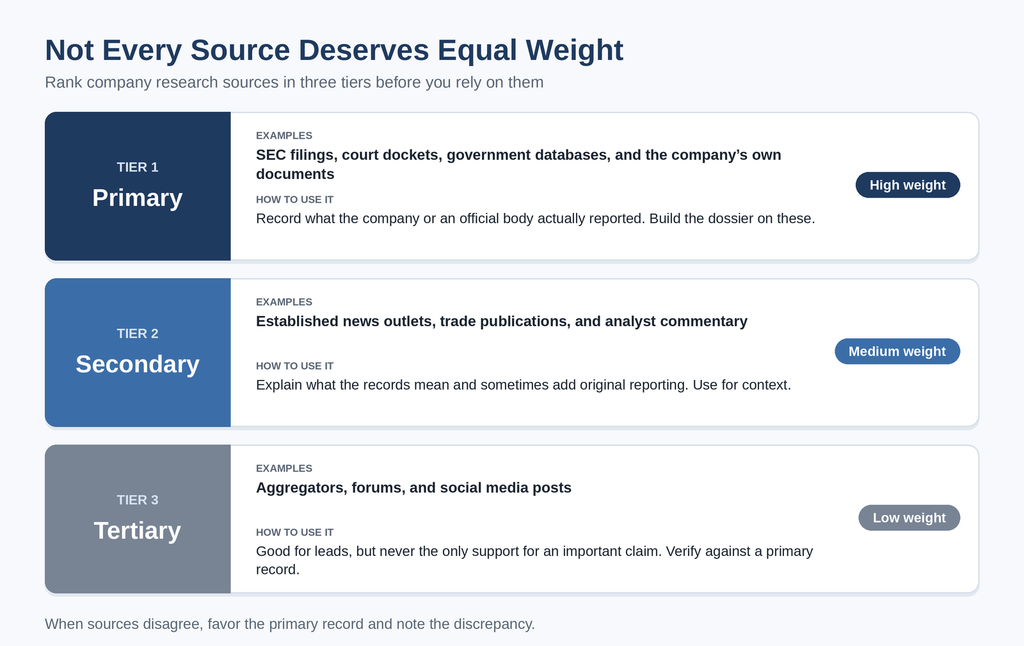
Not every source deserves equal weight. Primary sources, such as SEC filings, court dockets, and government databases, record what the company or an official body actually reported. Secondary sources, such as established news outlets and trade publications, interpret those records and sometimes add original reporting. Tertiary sources, such as aggregators, forums, and social media posts, are useful for leads but should never be the only support for an important claim. When sources disagree, favor the primary record and note the discrepancy.
Certain patterns deserve a closer look. In public companies, they include language expressing substantial doubt about the company’s ability to continue as a going concern, disclosed material weaknesses in internal controls, late-filing notices (Form NT 10-K), changes in the certifying accountant (8-K Item 4.01), and abrupt departures of directors or officers (8-K Item 5.02). In private companies, watch for an inactive or revoked entity status, large or numerous UCC liens, names and addresses that do not match across records, and repeated lawsuits from vendors or employees. A red flag is a prompt for questions, not a verdict, so look for context before drawing conclusions.
Using AI Tools Responsibly and Staying Ethical
AI assistants can summarize long filings, draft outlines, and speed up a first pass. They can also misstate figures, confuse similar company names, or cite sources that do not say what is claimed. Treat any AI-generated fact as a lead, and confirm every number against the original filing or record before it enters your dossier. Check your organization’s policy before pasting confidential material into any tool.
The method matters as much as the content. The Strategic Consortium of Intelligence Professionals (SCIP) maintains a code of ethics that is widely referenced in competitive intelligence. It expects practitioners to disclose their identity and organization before interviews, and SCIP states that obtaining a competitor’s password without authorization is illegal. In practice, rely on public sources, be honest about who you are when you ask questions, and never use deception to obtain confidential information. Keep the focus on the business, too. Executives’ professional roles and public statements belong in a company dossier; their families and home addresses do not.
Conclusion: Start Small and Keep Your Dossier Current
A research dossier for a target company works best when it starts with a clear decision, relies on primary sources, separates facts from estimates, and ends with a recommendation rather than a pile of notes. For public companies, EDGAR gives you free access to the filings that matter most. For private ones, state registries, UCC records, court dockets, and patent and trademark databases fill in much of the picture.
Your next step is simple. Pick one company you need to understand this month, write the one-sentence decision it supports, and build a one-page version using the sources above. Expand it only where the stakes justify more depth, and revisit it after major events such as earnings reports, leadership changes, or new filings.
Disclaimer: This article is general information, not legal, financial, or investment advice. Rules about public records, privacy, and competitive intelligence vary by situation and jurisdiction, so consult a qualified attorney or professional advisor before relying on a dossier for a transaction, investment, or legal decision.
Frequently Asked Questions
What is a research dossier for a target company?
It is a structured document that gathers verified information about one organization and interprets it for a specific decision, such as a sales pitch, an investment, an acquisition, or an interview. Unlike a simple profile, it includes analysis, risks, and a recommended next step.
How long should a company dossier be?
Length should follow the stakes. A few pages is usually enough for sales or interview preparation, while an investment or acquisition screen may need much more. In either case, start with a one-page summary of findings, risks, and next steps.
Where can I find free information about a private company?
Start with the Secretary of State business search in the company’s state of incorporation, then check UCC filings, the USPTO’s trademark and patent databases, and USAspending.gov for federal awards. PACER is inexpensive for light use because fees are waived when quarterly charges are $30 or less. The company’s own website and press coverage fill in the rest.
Is it legal to research a company this way?
Using public records and openly published information is generally lawful. Misrepresenting who you are, accessing accounts without permission, or obtaining confidential information improperly can create legal and ethical problems, so follow your organization’s policies and ask an attorney if you are unsure.
How often should I update a dossier?
Update it before any major meeting or decision, and after significant events such as earnings reports, new 8-K filings, leadership changes, or funding rounds. For active accounts or rivals, a regular quarterly review keeps the file from going stale.