Contents
- Why Mental Health Awareness Colors Matter
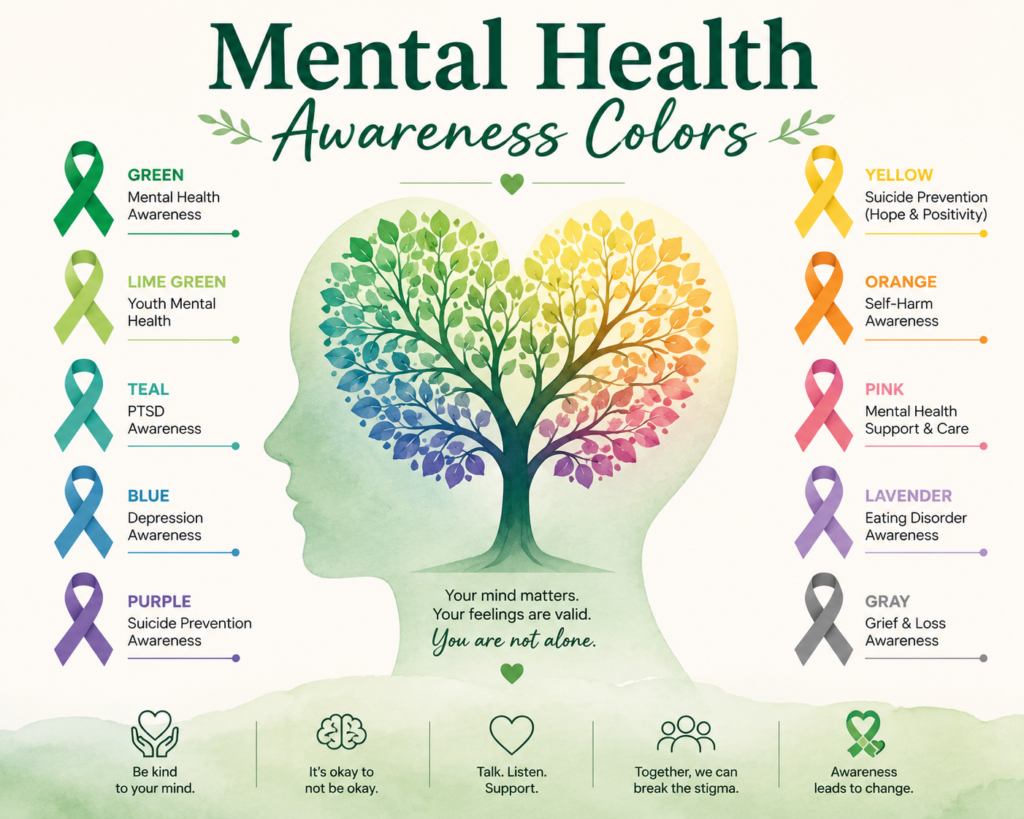
- Quick-Reference Color Table
- Green – The Universal Symbol
- Purple – Suicide Prevention & Domestic Violence
- Teal – Anxiety Disorders & PTSD
- Yellow – Suicide Prevention & Veterans
- Blue – Depression & Advocacy
- Orange – Self-Harm Awareness
- Silver – Brain Disorders
- Lavender / Periwinkle – Eating Disorders
- Key U.S. Mental Health Observance Calendar
- How to Show Support Using These Colors
- Frequently Asked Questions
Mental health awareness colors are among the most powerful, wordless ways to start a conversation about mental well-being. A green ribbon on a lapel, a teal bracelet, a yellow t-shirt during Suicide Prevention Week — each of these small, visible gestures communicates solidarity, reduces stigma, and can encourage someone who is struggling to ask for help.
In the United States, nearly one in five adults experiences a diagnosable mental health condition every year, according to the National Institute of Mental Health. That means awareness symbols are not abstract gestures — they are signals of belonging directed at roughly 57 million Americans. This guide breaks down every mental health awareness color, the condition it represents, when to wear it, and how each symbol came to carry its meaning.
1 in 5U.S. adults lives with a mental illness each year
MayMental Health Awareness Month — since 1949
Oct 10World Mental Health Day observed globally
Why Mental Health Awareness Colors Matter
Awareness ribbons and their colors work as visual shorthand. The moment someone sees a pink ribbon, they think of breast cancer. Red brings HIV/AIDS to mind. Mental health has developed its own rich palette, and each color has been adopted through grassroots movements, nonprofit campaigns, and official health observances.
Colors create instant recognition across language barriers. They invite questions — “what does that ribbon mean?” — that open conversations which might otherwise never happen. For the millions of Americans living with depression, anxiety, PTSD, or eating disorders, seeing someone wear their awareness color sends an unmistakable message: you are not alone, and what you are going through matters.
Did You Know?
Mental Health Month was established in 1949 by Mental Health America. The green ribbon became its official symbol decades later, transforming May into a nationwide display of solidarity. Today, the “Be Seen in Green” campaign encourages individuals, businesses, and landmark buildings across the country to light up in green every May.
Quick-Reference: Mental Health Awareness Colors at a Glance
| Color | Primary Conditions | Key Observance |
|---|---|---|
| Green | General mental health awareness, depression | Mental Health Awareness Month (May) |
| Purple | Suicide prevention, domestic violence, bipolar disorder | Suicide Prevention Month (September) |
| Teal | Anxiety disorders, PTSD, panic disorder | Anxiety & PTSD Awareness Month (June) |
| Yellow | Suicide prevention (civilian & veteran), youth mental health | Suicide Prevention Week (September) |
| Blue | Depression, anxiety awareness, child abuse prevention | Depression Awareness Month (October) |
| Orange | Self-harm awareness, self-injury prevention | Self-Injury Awareness Day (March 1) |
| Silver | Brain disorders, neurological conditions | Brain Awareness Week (March) |
| Lavender / Periwinkle | Eating disorders (anorexia, bulimia, binge eating) | NEDA Awareness Week (February) |
Green — The Universal Mental Health Awareness Color
Green Ribbon
Green is the designated color for mental health awareness across the United States, the United Kingdom, Canada, and Australia. It represents hope, renewal, growth, and the possibility of recovery. During Mental Health Awareness Month every May, advocates wear green ribbons, light buildings green, and share green-branded content to demonstrate solidarity with the 57 million Americans touched by mental illness.
Color psychology helps explain the choice: green is linked to nature, balance, and tranquility. Studies show that the mere presence of green in therapeutic environments can reduce anxiety and promote feelings of calm — a fitting emblem for a movement built on healing.
Mental Health Month — MayWorld Mental Health Day — Oct 10Depression AwarenessBe Seen in Green Campaign
The Mental Health Flag, which uses shifting shades of green transitioning toward yellow, tells a story about individual journeys from darkness toward light — and collective efforts to normalize mental health conversations in workplaces, schools, and communities.
Purple — Suicide Prevention, Domestic Violence & Bipolar Disorder
Purple Ribbon
Purple is one of the most widely recognized mental health awareness colors in the United States. It serves triple duty: as the primary ribbon for suicide prevention, for domestic violence awareness, and as a symbol for bipolar disorder advocacy. Purple and teal together are also used in dual-representation suicide prevention campaigns, often displayed during Suicide Prevention Month in September to honor lives lost and promote hope.
The color’s history in mental health advocacy stretches back to 1989, when early organizations adopted it for substance abuse recovery campaigns. Today, it also represents broader behavioral and emotional health disorders. Organizations addressing both emotional and behavioral conditions frequently incorporate purple because of its dual resonance.
Suicide Prevention Month — SeptemberDomestic Violence Awareness — OctoberBipolar Disorder
Teal — Anxiety Disorders & PTSD
Teal Ribbon
Teal ribbons represent anxiety disorders, PTSD, panic disorder, and sexual assault awareness — conditions that often share trauma-related origins or anxiety-based symptoms. Because anxiety disorders are among the most common mental health challenges in the country, affecting tens of millions of adults, the teal ribbon has gained strong recognition in advocacy communities.
Teal is linked to emotional balance and healing, making it a fitting symbol for those working through trauma. In therapeutic design, teal is associated with clarity and calm — the same qualities that PTSD recovery aims to restore. Community campaigns often pair teal branding with resources for coping skills, stress reduction, and therapy access.
Anxiety DisordersPTSD Awareness Month — JunePanic DisorderSexual Assault Awareness — April
Yellow — Suicide Prevention & Veteran Mental Health
Yellow Ribbon
Yellow is one of the clearest and most established mental health awareness colors. Yellow ribbons appear prominently during World Suicide Prevention Day (September 10) and throughout National Suicide Prevention Week. In the United States, the yellow ribbon carries particular weight in military communities, where it specifically represents veteran suicide prevention — addressing the unique mental health challenges faced by service members and their families.
Yellow is associated with hope, awareness, and urgent action — qualities that align precisely with suicide prevention messaging. The color signals that help is available and that reaching out is a strength, not a weakness.
Suicide Prevention Week — SeptemberVeteran Mental HealthYouth Mental Health
Blue — Depression & Mental Health Advocacy
Blue Ribbon
Blue ribbons are used to acknowledge the mental health impact of depression, addiction recovery, and trauma. When people ask what color is anxiety awareness? — in many campaigns, it is blue, symbolizing serenity, control, and emotional balance. Dark blue in therapeutic design creates an atmosphere of tranquility and stability, which is why blue tones dominate mental health apps and workplace wellness spaces.
Blue also serves in child abuse prevention campaigns, reflecting how childhood trauma is deeply intertwined with adult mental health outcomes. In broader advocacy settings, the blue ribbon is a call for improved mental health policies and accessible care for all Americans.
Depression Awareness Month — OctoberChild Abuse Prevention — AprilAddiction Recovery
Orange — Self-Harm Awareness & Self-Injury Prevention
Orange Ribbon
Orange ribbons support self-harm awareness and self-injury prevention. Many mental health communities use orange to encourage open dialogue about self-injury and to promote better access to supportive services. Self-harm behaviors often accompany depression, anxiety, and trauma-related conditions — making orange an important color in campaigns that address the overlap between mental illness and coping behaviors.
Self-Injury Awareness Day is observed on March 1 each year. Orange’s energy and visibility make it well-suited for awareness campaigns that need to communicate both urgency and compassion simultaneously.
Self-Injury Awareness Day — March 1Self-Harm Prevention
Silver — Brain Disorders & Neurological Conditions
Silver / Grey Ribbon
In North America, silver and grey ribbons are associated with brain disorders and neurological conditions, representing resilience and the ongoing advocacy for research and treatment. Because conditions like traumatic brain injury, Parkinson’s, and certain brain cancers carry significant mental health components, the silver ribbon bridges the gap between neurology and psychiatric care.
Silver is used during Brain Awareness Week each March, coordinated by the Dana Foundation, which works to advance understanding of the brain and neurological conditions across the United States.
Brain Awareness Week — MarchNeurological ConditionsBrain Cancer Awareness
Lavender / Periwinkle — Eating Disorders
Lavender / Periwinkle Ribbon
Periwinkle and lavender ribbons represent eating disorders, including anorexia, bulimia, and binge eating disorder. These ribbons carry special visibility during National Eating Disorders Awareness Week each February, coordinated by organizations supporting eating disorder recovery and research across the United States.
Eating disorders are serious, life-threatening mental illnesses — not lifestyle choices — and lavender’s gentle, compassionate tone speaks directly to the nuanced, sensitive nature of recovery. Campaigns using periwinkle encourage body acceptance, destigmatize help-seeking, and connect individuals to treatment resources.
NEDA Awareness Week — FebruaryAnorexia & BulimiaBinge Eating Disorder
U.S. Mental Health Observance Calendar
Knowing when each awareness month falls helps you plan campaigns, social media content, and community events around the colors that matter most.
Feb
National Eating Disorders Awareness Week — Periwinkle / lavender ribbons. Raises visibility for anorexia, bulimia, and binge eating disorder.
Mar 1
Self-Injury Awareness Day — Orange. A global event encouraging openness about self-harm and pointing people toward support services.
Apr
Sexual Assault Awareness Month — Teal. Also includes anxiety and PTSD awareness campaigns during this month.
May
Mental Health Awareness Month — Green. The biggest mental health observance in the U.S., launched by Mental Health America in 1949. The “Be Seen in Green” challenge runs throughout the month.
Jun
PTSD Awareness Month — Teal. Focuses on trauma-related conditions and connects veterans, first responders, and survivors with resources.
Sep
Suicide Prevention Month — Purple & Yellow. World Suicide Prevention Day is September 10; the full month amplifies the message with events nationwide. Veterans’ suicide prevention uses yellow ribbons.
Oct
World Mental Health Day (Oct 10) — Green. Also Depression Awareness Month (blue) and Domestic Violence Awareness Month (purple) run concurrently.
How to Show Support Using Mental Health Awareness Colors
Wearing a ribbon is just the beginning. Here are meaningful ways to use mental health awareness colors throughout the year:
- Wear a ribbon or bracelet during the relevant awareness month. Green throughout May sends a consistent signal of support.
- Illuminate your home or business in green during Mental Health Awareness Month or teal during PTSD Awareness Month.
- Change your social media profile frame to the relevant color during observance weeks — this simple act reaches your entire network.
- Host a workplace wellness event branded around awareness colors. Color-coded discussions reduce stigma in professional settings.
- Send a color-coded care package to someone navigating a mental health challenge. Small gestures — a green journal, a teal candle — communicate that you see their struggle and support their recovery.
- Donate to or fundraise for organizations like Mental Health America, the National Alliance on Mental Illness (NAMI), or the American Foundation for Suicide Prevention (AFSP).
A Note for Advocates
When using multiple colors, clarity matters. Since some colors — like purple and teal — each have more than 40 individual meanings, always pair your ribbon or color display with a clear message about the specific condition or campaign you are supporting. Context transforms a color into a conversation.
Frequently Asked Questions
What is the main color for mental health awareness?
Green is the primary and most universally recognized color for mental health awareness. It represents hope, renewal, and healing, and is worn during Mental Health Awareness Month every May in the United States.
What color ribbon is for anxiety?
Teal is the ribbon most commonly used for anxiety disorder awareness and PTSD. Blue is also used in some anxiety awareness campaigns, symbolizing serenity and emotional balance. The two colors often appear together in mental health campaigns that address overlapping conditions.
What color represents depression?
Green is worn for general mental health and depression awareness. Blue ribbons are also used in depression-focused campaigns, particularly during Depression Awareness Month in October.
What color is suicide prevention?
Both purple and yellow ribbons are used for suicide prevention. Purple is the primary suicide prevention ribbon worn during Suicide Prevention Month in September. Yellow ribbons are specifically associated with veteran and military suicide prevention efforts.
What color represents PTSD?
Teal is the recognized ribbon color for PTSD awareness in the United States. PTSD Awareness Month is observed each June, where teal ribbons and events connect survivors and service members with support resources.
Can I wear more than one mental health ribbon?
Absolutely. Wearing multiple ribbons shows support for various mental health conditions and demonstrates comprehensive awareness. Many advocates wear different colored ribbons during specific observance months or combine ribbons to represent co-occurring conditions. When doing so, pairing your ribbons with a written or spoken explanation ensures the strongest impact.
What color is the mental health awareness ribbon for eating disorders?
Lavender and periwinkle ribbons represent eating disorders, including anorexia, bulimia, and binge eating disorder. National Eating Disorders Awareness Week in February is the primary observance period for this ribbon.