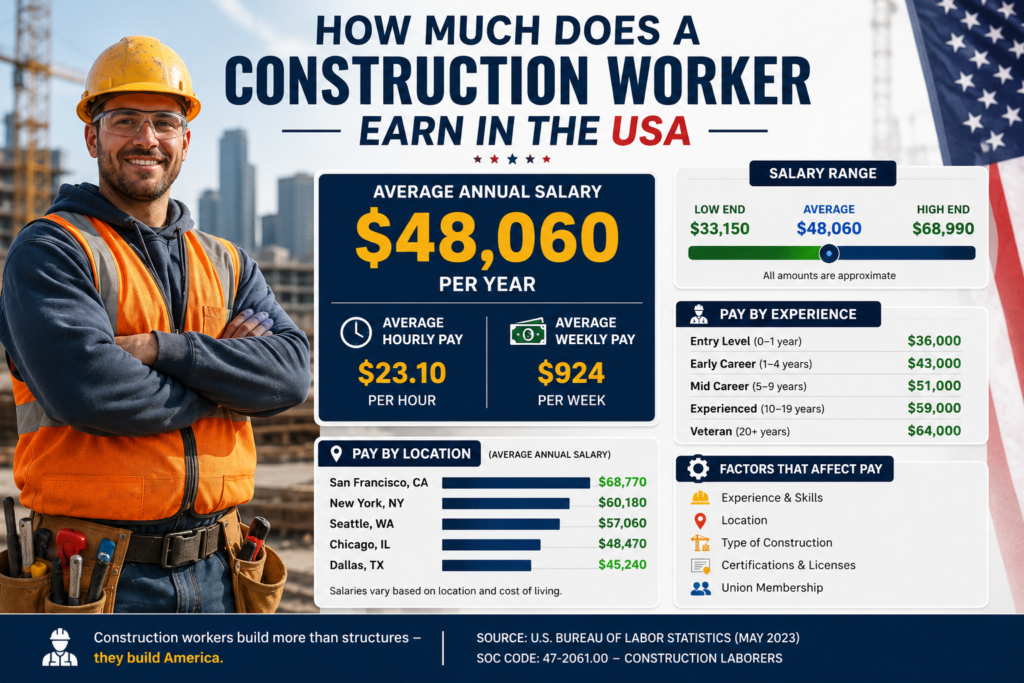
If you’ve ever wondered how much does a construction worker earn in the USA, you’re not alone. Whether you’re considering a career in construction, hiring workers, or just curious about blue-collar wages, this guide breaks down everything — from national averages to state-by-state comparisons, experience levels, specialties, and tips to increase your pay.
What Is the Average Construction Worker Salary in the USA?
The construction worker salary in the USA varies depending on the source and methodology, but here’s a reliable snapshot for 2026:
| Data Source | Average Annual Salary | Avg. Hourly Rate |
| ZipRecruiter (June 2026) | $52,333 | $25.16/hr |
| ERI SalaryExpert | $52,582 | $25/hr |
| Salary.com (May 2026) | $44,207 | $21/hr |
| Glassdoor (May 2026) | ~$54,000 (midpoint) | ~$26/hr |
| Indeed (April 2026) | $41,791 | ~$20/hr |
| NCW (Feb 2026) | $46,050 | $22.14/hr |
Key Takeaway: The national average falls roughly between $44,000 and $53,000 per year, depending on experience, location, and specialization. Entry-level workers start around $33,000–$39,000, while senior or specialized workers can earn $75,000–$105,000+ annually.
Construction Worker Salary by Experience Level
Your years on the job are one of the biggest drivers of your construction worker salary in the USA. Here’s how pay scales with experience:
| Experience Level | Average Annual Salary | Hourly Rate |
| Entry Level (0–1 year) | $33,610 – $39,000 | $17 – $19/hr |
| Mid-Level (1–3 years) | $39,157 – $46,000 | $19 – $22/hr |
| Experienced (3–8 years) | $46,000 – $58,000 | $22 – $28/hr |
| Senior Level (8+ years) | $58,647 – $75,560 | $28 – $36/hr |
| Top Specialists | $90,000 – $105,000+ | $43 – $50/hr |
How to Move Up the Pay Scale Faster
- Complete an apprenticeship program — certified apprentices earn 40–60% more than unskilled laborers
- Obtain OSHA certifications — OSHA-10 and OSHA-30 cards are highly valued by employers
- Learn specialized trades — electricians, plumbers, and welders earn significantly above average
- Join a union — union construction workers typically earn 20–30% more than non-union peers
- Relocate to high-paying states — geography alone can add $10,000+ to your annual salary
How Much Does a Construction Worker Earn by State?
Location is one of the most powerful factors in determining your construction worker salary USA. States with stronger union presence, higher costs of living, and active infrastructure projects pay significantly more.
Top 10 Highest-Paying States for Construction Workers (2026)
| State | Average Annual Salary |
| District of Columbia | $48,946 |
| California | $48,761 |
| Massachusetts | $48,111 |
| Washington | $47,934 |
| New Jersey | $47,916 |
| Alaska | $47,854 |
| Connecticut | $47,244 |
| New York | $46,997 |
| Hawaii | $46,205 |
| Rhode Island | $45,834 |
Lowest-Paying States
States like Alabama average as low as $26,915 per year — a stark contrast to high-paying coastal states. The difference between the highest and lowest-paying states can exceed $25,000 per year for similar work.
Best Cities for Construction Workers
- San Diego, CA — $56,163/year average
- Riverside, CA — $54,973/year average
- Phoenix, AZ — $50,433/year average
- Wasco, CA — 28.4% above the national average
- Nome, AK — Among the top-earning cities nationally
Construction Worker Salary by Specialty or Trade
General laborers earn at the lower end, but skilled tradespeople — the backbone of the construction worker salary USA conversation — earn substantially more.
| Specialty / Trade | Average Annual Salary |
| General Construction Laborer | $41,791 – $46,050 |
| Carpenter | $55,000 – $70,000 |
| Electrician | $65,000 – $90,000 |
| Plumber | $60,000 – $85,000 |
| Welder | $50,000 – $75,000 |
| Heavy Equipment Operator | $55,000 – $80,000 |
| Construction Foreman | $65,000 – $90,000 |
| Construction Manager | $100,000 – $151,202 |
According to Baker Tilly’s 2025 Construction Industry Salary Report, the average salary for construction managers is $151,202, and even construction laborers in high-demand areas like California’s Greater Bay Area average $74,283.
What Factors Affect a Construction Worker’s Salary in the USA?
Understanding what drives the construction worker salary in the USA helps you make smarter career decisions. Here are the major factors:
1. Geographic Location
States with higher costs of living, stronger union activity, and major infrastructure projects consistently pay more. California, New York, and Washington lead the pack.
2. Experience and Seniority
As shown earlier, going from entry-level to senior can nearly double your annual income — from ~$35,000 to ~$75,000+.
3. Union vs. Non-Union Status
Union construction workers benefit from:
- Negotiated minimum wage scales
- Better benefits (health insurance, pension)
- Safer working conditions
- Consistent pay increases tied to contract agreements
4. Specialization and Certifications
The more specialized your skill, the higher your value. Certifications in:
- OSHA Safety Training
- First Aid / CPR
- Crane Operation
- Electrical or Plumbing Licenses
…all add meaningful dollars to your paycheck.
5. Company Size and Type
Top-paying employers for construction workers in 2026 include:
- Turner Construction (private sector)
- DPR Construction
- U.S. General Services Administration (federal government)
- U.S. Army Corps of Engineers
6. Education Level
While a high school diploma is the most common education level for construction workers, vocational training and trade certifications significantly boost earning potential.
Construction Worker Salary Trends: 2025–2026
The construction industry is experiencing notable wage shifts. Here’s what the data shows:
- Wage growth slowed in 2025, with most regions reporting below-average increases, according to Baker Tilly’s annual report
- Companies project 3–4% wage growth in 2026
- Labor shortages persist — an estimated 439,000 unfilled positions create strong leverage for job seekers
- 66% of construction firms increased base pay rates to attract workers (Autodesk/AGC survey)
- 29% of firms added bonuses and incentives for new hires
- Infrastructure spending under the Bipartisan Infrastructure Law continues to fuel construction job growth
Union vs. Non-Union Construction Worker Pay: A Side-by-Side Comparison
| Factor | Union Worker | Non-Union Worker |
| Average Pay | 20–30% higher | Market rate |
| Health Insurance | Usually included | Often out-of-pocket |
| Pension / Retirement | Yes (defined benefit) | Varies |
| Job Security | Higher | Variable |
| Wage Negotiation | Collective bargaining | Individual |
| Pay Raises | Contract-based, predictable | Performance/market-based |
Joining a union — such as the Laborers’ International Union of North America (LIUNA) or the United Brotherhood of Carpenters — remains one of the fastest ways to increase your construction worker salary in the USA.
Steps to Maximize Your Construction Worker Salary in the USA
Follow these actionable steps to boost your earnings:
Step 1: Start with a Trade Apprenticeship Enroll in a registered apprenticeship program through a union or trade school. These programs typically last 3–5 years and provide paid, on-the-job training.
Step 2: Get OSHA Certified OSHA-10 and OSHA-30 certifications are often required for higher-paying federal and commercial projects.
Step 3: Specialize in a High-Demand Trade Electricians, plumbers, and HVAC technicians consistently earn above the general laborer average. Specialization is the single fastest route to a higher construction worker salary USA.
Step 4: Target High-Paying States or Cities If mobility is an option, relocating from a low-wage state like Alabama to California or Washington can add $15,000–$20,000 to your annual income.
Step 5: Pursue Leadership Roles Moving into a foreman, superintendent, or project manager role dramatically increases your earning potential — construction managers average over $150,000 per year.
Step 6: Consider Union Membership Research local unions in your trade area. Union cards often come with immediate pay bumps, better benefits, and long-term job security.
Frequently Asked Questions (FAQs)
Q1: How much does a construction worker earn per hour in the USA?
The average construction worker salary in the USA translates to roughly $20–$26 per hour, depending on the data source. Entry-level workers start around $17/hr, while experienced tradespeople can earn $35–$50/hr or more.
Q2: Do construction workers get overtime pay?
Yes. Most construction workers are entitled to overtime under the Fair Labor Standards Act (FLSA), which requires 1.5x their regular hourly rate for any hours worked beyond 40 per week. During busy project seasons, this can significantly boost annual take-home pay.
Q3: What is the highest-paying construction job in the USA?
Construction managers top the list at an average of $151,202/year (Baker Tilly, 2025). Among trade workers, elevator installers and repairers, boilermakers, and electricians are among the best-compensated.
Q4: Is a construction worker career worth it financially?
Absolutely. The construction worker salary in the USA offers a solid middle-class income with no college debt required. With specialization and experience, workers can comfortably earn $70,000–$100,000+ without a four-year degree.
Q5: How does union membership affect construction worker pay?
Union members typically earn 20–30% more than their non-union counterparts and receive stronger benefits including health insurance, pensions, and paid leave.
Q6: Which state pays construction workers the most?
Based on 2026 data, Washington D.C., California, and Massachusetts are the top-paying locations, with average salaries close to or above $48,000–$49,000 per year.
Q7: Will construction worker salaries increase in 2026?
Yes. Industry surveys project 3–4% wage growth in 2026, driven by ongoing labor shortages, infrastructure spending, and rising demand for skilled tradespeople.
Conclusion: Is Construction a High-Earning Career Path in the USA?
The answer is a clear yes — especially for those who invest in specialization and experience. The average construction worker salary in the USA ranges from $44,000 to $53,000 per year nationally, but with the right certifications, trade skills, and location choices, six-figure incomes are within reach.
Key takeaways from this guide:
- National average: $44,000 – $53,000/year depending on source
- Top earners (managers, specialists): $90,000 – $150,000+
- Best-paying states: California, Washington D.C., Massachusetts
- Fastest ways to increase pay: Specialization, union membership, certifications
- Outlook: Positive — 3–4% wage growth projected for 2026 with strong demand
Whether you’re just starting out or planning your next career move, understanding your earning potential in construction helps you make smarter decisions. The industry rewards hard work, skills development, and strategic geographic choices.