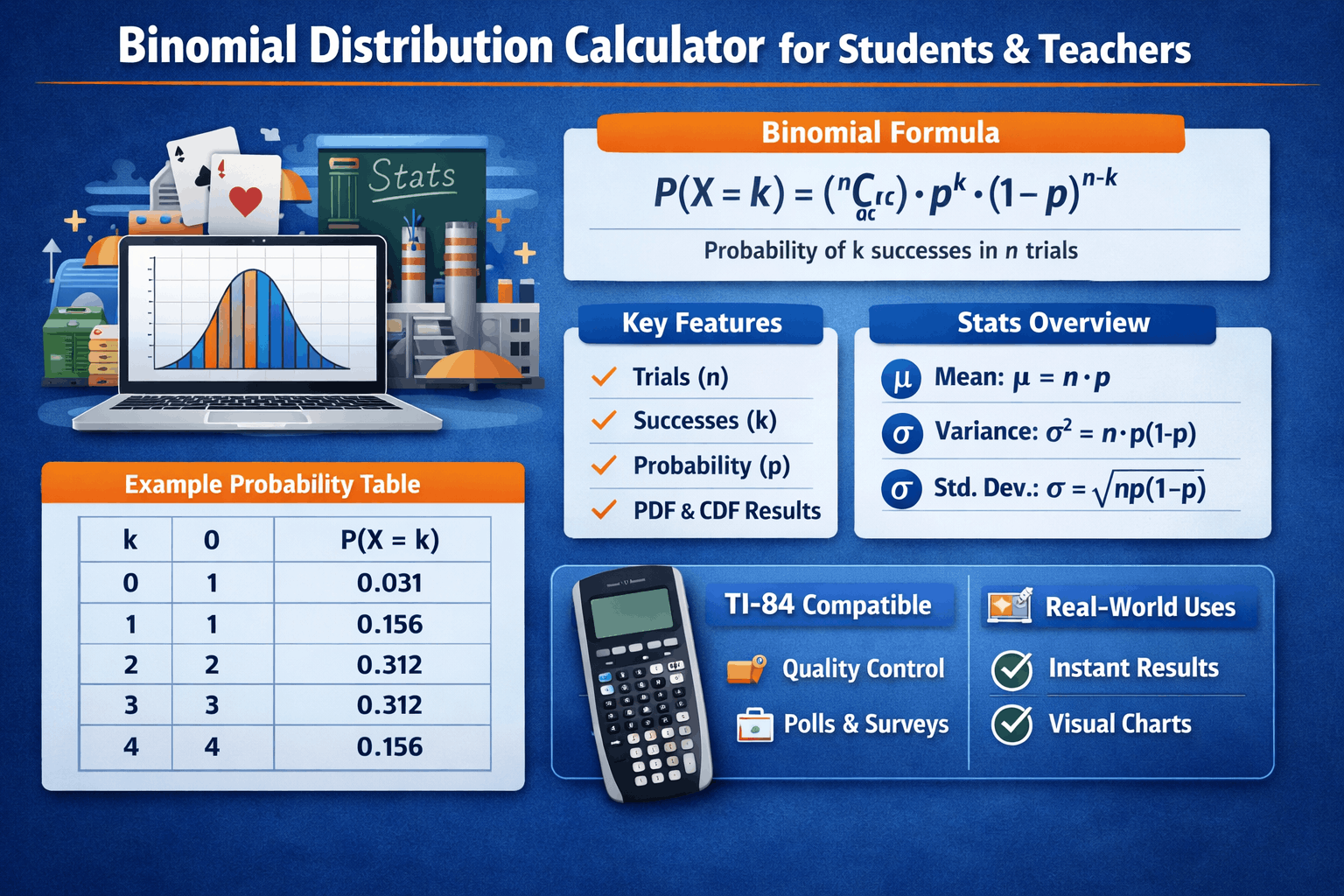
Understanding probability can feel complicated—but with the right tools, it becomes much easier. A binomial distribution calculator helps students and teachers quickly compute probabilities without doing lengthy manual calculations.
This tool is especially useful for AP Statistics, college-level probability courses, and classroom demonstrations across the USA. Whether you’re checking homework or explaining concepts, it saves time and improves accuracy.
What Is a Binomial Distribution Calculator?
A binomial distribution calculator is an online tool that computes the probability of getting exactly k successes in n independent trials, where each trial has the same probability of success (p).
It uses the standard formula:
P(X = k) = (nCk) × pᵏ × (1 − p)⁽ⁿ⁻ᵏ⁾
Example:
If you flip a coin 10 times (p = 0.5), the probability of getting exactly 5 heads is:
P(X = 5) ≈ 0.246
This allows students to verify answers instantly instead of calculating combinations manually.
Key Inputs:
- Number of trials (n)
- Number of successes (k)
- Probability of success (p)
Outputs:
- Exact probability (PDF)
- Cumulative probability (CDF)
- Summary statistics
Binomial Distribution Formula and Basics
Core Formula Explained
The formula:
P(X = k) = (nCk) × pᵏ × (1 − p)⁽ⁿ⁻ᵏ⁾
Where:
- nCk = combinations (ways to choose k successes from n trials)
- p = probability of success
- 1 − p = probability of failure
Requirements for a Binomial Experiment
For a situation to follow a binomial distribution, it must meet these conditions:
- Fixed number of trials (n)
- Each trial is independent
- Probability of success (p) remains constant
- Only two possible outcomes (success or failure)
Example:
✔ Coin tosses
✘ Drawing cards without replacement
Mean, Variance, and Standard Deviation
These values help summarize a binomial distribution:
- Mean (μ) = n × p
- Variance (σ²) = n × p × (1 − p)
- Standard Deviation (σ) = √[n × p × (1 − p)]
Example:
For n = 20 and p = 0.3:
- Mean = 6
- Variance = 4.2
- Standard Deviation ≈ 2.05
How to Use the Binomial Distribution Calculator
Using the calculator is simple and fast:
Step-by-Step Guide:
- Enter number of trials (n)
- Enter number of successes (k)
- Enter probability (p)
- Choose:
- PDF (exact probability)
- CDF (cumulative probability)
- Click calculate
Within seconds, you’ll get:
- Exact probability
- Full probability table
- Visual graph
This is extremely helpful for teachers grading assignments and students checking answers quickly.
Example Probability Table
For n = 5 and p = 0.5:
| k | P(X = k) |
|---|---|
| 0 | 0.031 |
| 1 | 0.156 |
| 2 | 0.312 |
| 3 | 0.312 |
| 4 | 0.156 |
| 5 | 0.031 |
TI-84 Calculator Integration
Common Functions:
- binompdf(n, p, k) → Exact probability
- binomcdf(n, p, k) → Cumulative probability
How to Access:
2nd → VARS → A: binompdf
Example:
For n = 12, p = 0.6, k = 10:
P(X = 10) ≈ 0.0196
This matches results from online calculators, making it perfect for classroom verification.
Real-World Applications
Binomial distribution is widely used in real-life scenarios:
1. Quality Control
- Factory defects (n = 50, p = 0.02)
- Helps detect production issues early
2. Elections & Polling
- Predict voting outcomes
- Example: n = 100 voters, p = 0.52
3. Education
- Quiz pass/fail probability
- Performance analysis
Frequently Asked Questions (FAQ)
What is the binomial distribution formula?
It calculates the probability of exactly k successes:
P(X = k) = (nCk) × pᵏ × (1 − p)⁽ⁿ⁻ᵏ⁾
How do I use a binomial calculator?
Just enter n, k, and p, then choose PDF or CDF to get instant results.
What does TI-84 binompdf do?
It calculates the exact probability of getting k successes.
When should I use a calculator instead of a table?
- Use tables for small values
- Use calculators for accuracy and large datasets
What is the binomial series?
It is the expansion of expressions like (1 + x)ⁿ, used in advanced math.
Why Use Our Binomial Distribution Calculator?
Our tool is designed specifically for USA students and teachers, aligned with AP Statistics standards.
Benefits:
- 100% free to use
- No signup required
- Fast and accurate results
- Matches TI-84 calculator outputs
- Includes tables and visual graphs
It’s a reliable solution for both learning and teaching probability concepts effectively.
Final Thoughts
A binomial distribution calculator is more than just a tool—it’s a time-saving solution for mastering probability. Whether you’re a student solving homework or a teacher explaining concepts, it simplifies complex calculations instant.