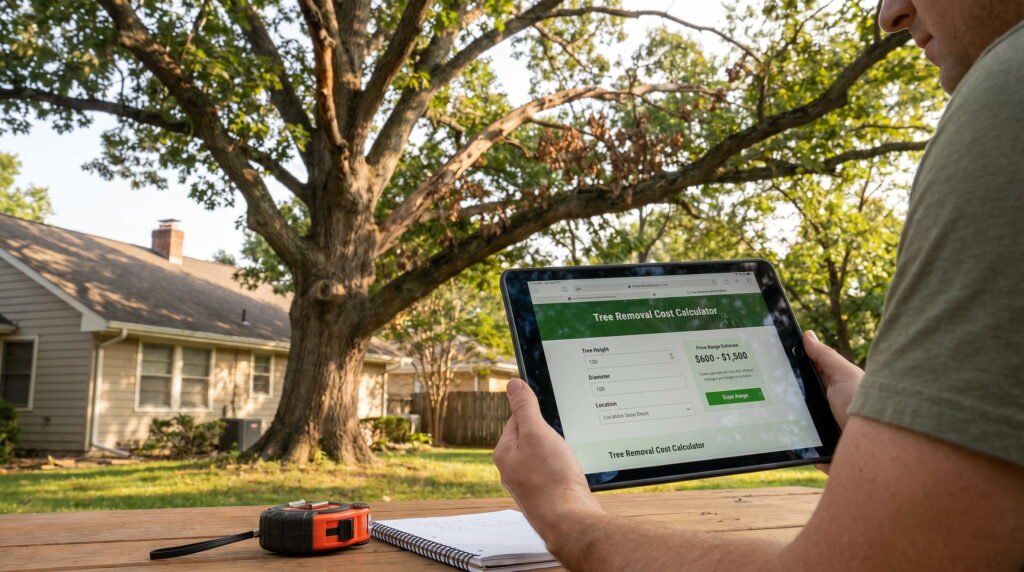
You’ve got a dead oak hanging over your roof, or a pine that’s grown too close to the power line. You need it gone — but before you call anyone, you need a number. That’s where a tree removal cost calculator becomes your first stop, not your last.
The problem is most homeowners go in blind. They get one quote, assume it’s reasonable, and sign. Then they find out the neighbor paid half as much for the same job. A solid tree removal estimate — built on the actual factors pros use — changes that dynamic completely.
This guide walks you through every variable that goes into a tree cutting estimate, shows you real cost ranges by tree size and species, and explains how to build your own rough estimate before anyone sets foot on your property.
What Does Tree Removal Actually Cost?
The national average for tree removal sits between $400 and $1,200, according to HomeGuide’s 2026 cost data. Small, accessible trees can come in as low as $200. Large, complex removals — think a 90-foot oak hanging over a garage — can reach $3,000 or more.
Here’s a quick breakdown by tree size:
| Tree Size | Height | Average Cost Range |
|---|---|---|
| Small | Under 30 ft | $285 – $435 |
| Medium | 30 – 60 ft | $400 – $1,000 |
| Large | 60 – 80 ft | $976 – $2,573 |
| Very large | 80+ ft | $1,160 – $4,000+ |
These ranges come from Xactware pricing data compiled by Thumbtack, which tracks millions of actual project quotes across the country.
One thing that surprises most homeowners: stump grinding is almost never included. That’s an add-on, and it runs $33 to $264 depending on trunk diameter.
How to Use a Tree Removal Cost Estimator
A tree removal cost estimator — whether it’s an online calculator or your own math — works by combining five inputs:
- Tree height
- Trunk diameter
- Tree species
- Location and accessibility
- Add-on services
You don’t need a tape measure for most of this. A rough visual estimate and a few facts about your yard get you close enough to know whether a quote is fair or inflated.
Step 1: Measure (or eyeball) the height
Height is the single biggest driver of cost. Pros use it to calculate equipment needs, crew time, and risk. A 30-foot dogwood and a 70-foot elm are not remotely the same job.
If you don’t have a way to measure, compare the tree to your roofline. A one-story house is roughly 10 feet. Two stories gets you to about 20. Most mature shade trees fall between 40 and 70 feet.
Step 2: Look at the trunk
Trunk diameter at chest height — what arborists call DBH (diameter at breast height) — matters as much as height in some cases. A thick trunk means denser wood, more cutting time, and heavier debris. According to Thumbtack’s pricing guide, a trunk under 12 inches runs $226–$946 to remove on average. A trunk between 12 and 24 inches jumps to $517–$2,132.
Step 3: Factor in where the tree stands
Location affects cost more than most people expect. A tree in open lawn with clear sky access is a straightforward job. A tree wedged between a fence, a shed, and a power line is a different situation entirely.
Top Tier Trees notes that location and accessibility alone can shift the price by 25 to 50 percent. If your tree hangs over a structure, budget toward the high end of your size range.
Tree Removal Estimate by Species
Not all trees cost the same to remove at the same height. Species tells a pro about wood density, root complexity, and how branches grow — all of which change the job.
Pine tree removal cost calculator
Pine trees are tall and often narrow, which actually works in your favor on cost. The wood is softer than hardwoods like oak, and the branch structure is more predictable. A 50-foot pine typically runs $500 to $1,500 to remove, according to Angi. Very tall pines — 80 feet and above — can push $1,500 to $3,000 when cranes are required.
The key variable for pines is height. They grow fast and tall, so a pine that looked manageable five years ago might now be a crane job.
Oak tree removal
Oak is expensive to remove. Dense wood, wide canopy, and heavy branches all add labor time and equipment needs. Expect $200 to $1,000 for smaller oaks, with larger specimens pushing well past $2,000.
Palm tree removal
Palms are different from most trees — heavy trunks, fibrous roots, and no branches to work down from. Removal generally runs $200 to $900, depending on height.
Maple, elm, and other shade trees
Standard shade trees at 40–60 feet typically fall in the $400 to $1,000 range. Trunk width and canopy density push costs up from there.
Large Tree Removal Cost Calculator: What Changes Above 60 Feet
Large tree removal follows different rules than standard jobs. Once a tree gets tall enough that climbers can’t safely section it from the top, cranes come into play.
Crane-assisted removal costs $2,000 to $5,000 or more, according to Acres Per Hour Calculator’s pricing data. That number includes the crane rental itself plus the crew needed to operate it and direct the cut pieces safely to the ground.
A few situations that push jobs into crane territory:
- Trees taller than 70–80 feet with no clear fall zone
- Trees positioned over rooftops, pools, or utility lines
- Dead trees with unpredictable branch integrity
- Trees on steep slopes where a climber can’t work safely
If you’re looking at a large tree removal cost calculator, enter “crane required” as a variable and expect the estimate to jump significantly.
Tree Trimming Cost Calculator
Sometimes you don’t need full removal — you need branches cut back before they cause damage. Tree trimming is a different service with different pricing, and it’s worth knowing the difference before you estimate tree removal when you actually just need a trim.
According to LawnLove, trimming costs $255 to $655 nationally, with an average around $420. Factors that move that number:
- Number of branches — More cuts, more time
- Height of the work — Ladder work vs. aerial lift vs. climber
- Tree species — Dense hardwoods take longer to cut
- Debris disposal — Chipping and hauling adds cost
If branches are near power lines, call your utility company first. Many utilities trim branches that contact lines at no charge to the homeowner.
How to Estimate Tree Removal: The Per-Foot Method
One practical way to estimate tree removal without a full calculator: use the per-foot rate. Most pros price by height when jobs are straightforward.
The current national range is $9.50 to $14.50 per foot, per LawnLove’s 2026 data. That means:
- 30-foot tree: $285 – $435
- 50-foot tree: $475 – $725
- 70-foot tree: $665 – $1,015
- 90-foot tree: $855 – $1,305
These per-foot figures apply to standing trees in reasonable conditions. Add 25–50% for difficult access, and add stump grinding separately if you want the stump gone.
What Adds to the Total? Hidden Costs in a Tree Cutting Estimate
When you review a tree cutting estimate from a contractor, these line items commonly appear — and many homeowners don’t see them coming.
Stump grinding: $33–$264 per stump, based on diameter. This is almost always a separate charge.
Debris removal and hauling: Some companies include this; others charge $70–$95 to haul away or chip the wood. Ask upfront.
Log splitting: If you want firewood from the removed tree, splitting services run $50–$100.
Permits: Many municipalities require permits to remove trees larger than 10 feet. Angi puts permit fees at $60 to $150. Some jurisdictions also require an arborist report to get the permit, which adds an average of $860.
Emergency removal: If a storm drops a tree on your house, expect to pay 2 to 3 times the standard rate for same-day or next-day response.
Travel fees: Rural properties can trigger flat travel fees of $50–$200 or a per-mile charge of around $0.50.
How to Save Money on Tree Removal
Get three quotes, not one
Brandon Nelson, operations manager at Northern Craft Tree Solutions, put it plainly in an interview with Thumbtack: multiple factors go into every estimate, including hazard zones, tree condition, and the number of trees being worked on. No two companies price the same job identically. Three quotes gives you a real market rate.
Schedule in winter
Demand for tree services drops in late winter. According to HomeGuide, prices run 10–20% lower in winter and early spring compared to peak summer and fall months. If the tree isn’t an emergency, a February booking can save a few hundred dollars.
Bundle multiple trees
If you have more than one tree to remove, doing them in the same visit reduces per-tree mobilization costs. Many companies offer volume discounts for 3+ trees.
Skip the stump — temporarily
If budget is tight, skip stump grinding now and add it later as a standalone job. It’s cheaper to grind a stump than to have it done alongside a full removal.
When to Skip the Calculator and Call an Arborist
A tree removal cost calculator gives you a budget range. An arborist gives you facts. For any of the situations below, a professional assessment is worth the call before you touch anything:
- The tree is leaning more than 15 degrees and the lean has changed recently
- More than half the canopy shows dead or dying branches
- Visible trunk cracks, cavities, or missing bark sections
- Fungal growth at the base
- Roots visibly heaving or decaying
- The tree sits within falling distance of a structure, vehicle, or power line
HomeGuide recommends asking any company you hire whether they hold ISA (International Society of Arboriculture) or TCIA (Tree Care Industry Association) certification. It’s also worth confirming they carry liability insurance and workers’ compensation before anyone climbs.
Frequently Asked Questions
How accurate is a tree removal cost calculator?
Online calculators produce ballpark estimates — typically accurate within 20–30% for straightforward jobs. Complex removals near structures, power lines, or on slopes require an in-person assessment to get a reliable number. Use the calculator to sanity-check quotes, not to replace them.
What is the cheapest time of year to remove a tree?
Late winter — February through early March — is typically the lowest-demand period for tree services. You can expect prices 10–20% below peak-season rates. Avoid summer and fall, when storm season drives demand up.
How do I know if I need a permit to remove a tree?
Permit requirements vary by city, county, and sometimes neighborhood association. Most municipalities require permits for trees over 10 feet tall. Check with your local building or planning department before starting any removal — skipping this can result in fines.
Is it cheaper to remove a fallen tree?
Yes, usually. A fallen tree eliminates most of the safety hazards that drive up removal costs. Expect to pay $90–$300 to have a cleanly fallen tree removed, compared to $400–$1,200 or more for a standing one. The exception: if the tree has fallen on a structure or power line, emergency service rates and repair costs apply.
Can I estimate tree removal cost per foot?
Yes. A per-foot estimate works well for standard standing trees. Use $10–$14 per foot as a baseline, then add for difficult access or add-on services like stump grinding and debris hauling.
Estimate Your Project Before You Call
Every tree removal job is different. But you don’t have to go in blind.
Before you call a contractor, run your own estimate: measure the height (or compare it to your roofline), look at the trunk size, note how close it sits to structures, and factor in whether you need stump grinding. That 60-second exercise turns you from a homeowner guessing at prices into someone who can recognize a fair quote when they see one.
For construction and home improvement estimates — from concrete and materials to lighting and project planning — the free tools at ToolCalcPro cover the numbers side of every project. And if your tree removal budget connects to a larger renovation, the Concrete Price Calculator can help you estimate what comes next.
Have a tree removal story — a quote that shocked you, a seasonal discount that saved you, a DIY attempt you’d do differently? Drop it in the comments below. Real numbers from real jobs help everyone budget better.