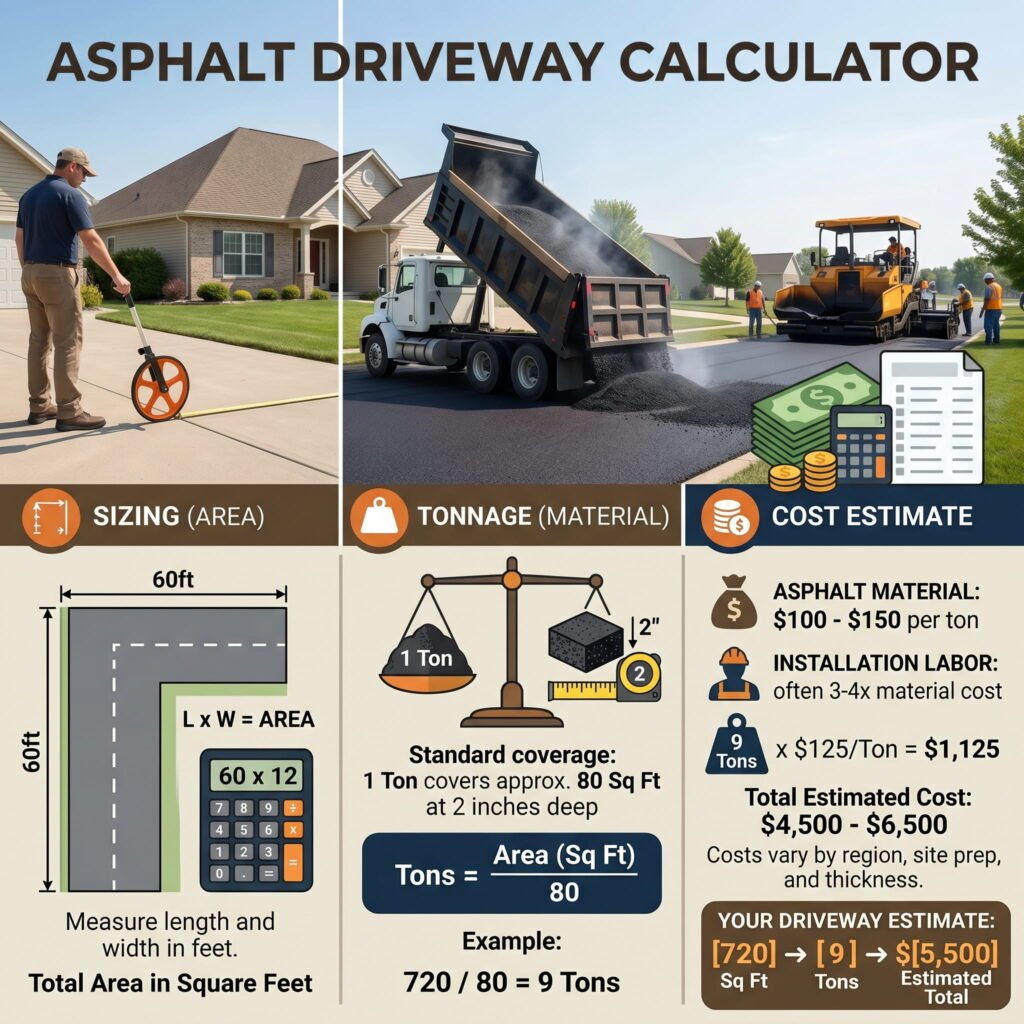
Before you call a paving contractor, running the numbers yourself takes about two minutes and saves you from going into the conversation blind. This guide walks through exactly how an asphalt driveway calculator works, what inputs it needs, and how to interpret the results — so you know whether the quote you get back is reasonable.
If you want to skip ahead and run the calculation now, use the asphalt calculator — enter your driveway dimensions and thickness and it returns tonnage and an estimated material cost immediately.
What you need to measure first
Every asphalt calculation starts with three measurements: length, width, and thickness. Get the first two wrong and the tonnage estimate is useless.
Straight rectangular driveways need just two numbers — measure from the street edge to the garage door for length, and width at the widest point. Both in feet.
Two-car driveways that widen near the garage are easiest to treat as two rectangles: the approach lane and the wider apron. Measure each separately and add the results.
L-shaped driveways follow the same logic — break into the simplest rectangles, measure each section, and add the square footage.
Curved driveways are the trickiest. Walk the center line to measure length. For width, take readings at three or four points and average them. You won’t be perfectly exact, but close enough for ordering — most contractors add 5–10% for waste anyway.
Here are standard driveway dimensions to compare against:
| Driveway type | Typical dimensions | Square footage |
|---|---|---|
| Single-car, short | 40 ft × 10 ft | 400 sq ft |
| Single-car, standard | 100 ft × 10 ft | 1,000 sq ft |
| Two-car, standard | 50 ft × 20 ft | 1,000 sq ft |
| Two-car, wide | 60 ft × 24 ft | 1,440 sq ft |
| Three-car | 60 ft × 30 ft | 1,800 sq ft |
How the asphalt driveway calculator works
Once you have the measurements, the calculator runs this formula:
Tons = (Length × Width × Thickness ÷ 12) × 145 ÷ 2,000
Length and width in feet. Thickness in inches. The 145 is hot mix asphalt’s density in pounds per cubic foot — it’s the industry standard for dense-graded HMA. Dividing by 2,000 converts pounds to tons.
Here’s a worked example: a 55 ft × 22 ft driveway at 2.5 inches.
- Square footage: 55 × 22 = 1,210 sq ft
- Cubic feet: 1,210 × (2.5 ÷ 12) = 252.1 cu ft
- Pounds: 252.1 × 145 = 36,554 lbs
- Tons: 36,554 ÷ 2,000 = 18.3 tons
At $120/ton for hot mix, that’s about $2,196 in material. Not including gravel base, labor, equipment, or delivery.
For quick estimates without the full formula, multiply your square footage by one of these per-sq-ft factors:
| Thickness | Factor (tons per sq ft) |
|---|---|
| 2 inches | 0.0121 |
| 2.5 inches | 0.0151 |
| 3 inches | 0.0181 |
| 4 inches | 0.0242 |
The 1,210 sq ft driveway at 2.5 inches: 1,210 × 0.0151 = 18.3 tons. Same answer, faster math.
Choosing the right asphalt thickness for your driveway
Thickness affects tonnage, cost, and how long the driveway lasts. Most homeowners underestimate how much it matters.
The rule of thumb: 2 inches minimum, 3 inches if anything heavier than a sedan uses it regularly.
Here’s a more precise breakdown:
| Who’s using the driveway | Recommended thickness |
|---|---|
| Passenger cars only | 2 inches |
| Cars and light trucks | 2.5 inches |
| SUVs, full-size pickups | 2.5 inches |
| RVs, trailers, boats | 3 inches |
| Delivery trucks, equipment | 4 inches (commercial spec) |
The cost difference between 2 and 3 inches on a 1,000 sq ft driveway is about 6 extra tons — $540–$900 more in material. Spread over 20 years, that’s $27–$45 per year. For most people, going to 2.5 or 3 inches is an easy call.
One thing the thickness calculation doesn’t include: the gravel base. Most driveways need 4–6 inches of compacted gravel beneath the asphalt layer. That’s calculated and priced separately — it’s not part of the asphalt tonnage number.
New driveway vs resurfacing — the calculation is different
The tonnage you need depends on what you’re actually doing.
New driveway
Full-depth installation means calculating for the complete asphalt layer — typically 2.5–3 inches for residential use. The gravel base goes down first, then the asphalt.
Resurfacing (overlay)
If your existing asphalt has surface cracks but the base underneath is still structurally solid, an overlay of 1.5–2 inches can extend the driveway’s life by 10–15 years at roughly half the cost of replacement.
An 800 sq ft driveway at 1.5 inches (overlay) needs 7.3 tons. The same driveway as a new pour at 2.5 inches needs 12.1 tons. The material cost difference alone is $431–$718 — and that’s before you factor in no excavation or base work.
The catch: overlays only work on driveways where the base is intact. Signs the base has failed — sections that flex or crack when you walk on them, potholes that return within a season, deep alligator-pattern cracking — mean the asphalt has to come out completely. An overlay on a failed base is money wasted.
What the tonnage number means for your budget
Asphalt material runs $90–$150 per ton nationally in 2025, with significant regional variation.
| Region | Material cost per ton |
|---|---|
| Midwest and South | $85–$130 |
| Northeast and West Coast | $120–$180 |
| Rural areas (long haul) | Add $20–$40/ton delivery |
These are material-only prices. The full installed cost — asphalt, gravel base, labor, and equipment — typically runs $3–$7 per sq ft for residential driveways.
For a standard 1,000 sq ft driveway:
| Cost component | Estimate |
|---|---|
| Asphalt material (15 tons @ 2.5 in) | $1,350–$2,250 |
| Gravel base (4 in, installed) | $800–$1,500 |
| Labor and equipment | $1,000–$2,500 |
| Total installed | $3,150–$6,250 |
Use these numbers as a sanity check on contractor quotes. If a quote comes in significantly below this range, ask specifically what’s included — sometimes low quotes exclude the base, delivery, or equipment.
Tonnage reference for common driveway sizes
Quick reference at 2.5-inch thickness (multiply by 0.80 to get 2-inch, by 1.20 for 3-inch):
| Driveway dimensions | Square footage | Tons at 2.5 in | Material cost est. |
|---|---|---|---|
| 20 × 20 ft | 400 sq ft | 6.0 tons | $540–$900 |
| 40 × 12 ft | 480 sq ft | 7.3 tons | $657–$1,095 |
| 50 × 20 ft | 1,000 sq ft | 15.1 tons | $1,360–$2,265 |
| 60 × 20 ft | 1,200 sq ft | 18.1 tons | $1,629–$2,715 |
| 60 × 24 ft | 1,440 sq ft | 21.8 tons | $1,962–$3,270 |
| 60 × 30 ft | 1,800 sq ft | 27.2 tons | $2,448–$4,080 |
| 100 × 20 ft | 2,000 sq ft | 30.2 tons | $2,718–$4,530 |
Calculating asphalt millings instead of hot mix
Recycled asphalt millings are increasingly popular for residential driveways — they cost $50–$100/ton delivered versus $90–$150 for hot mix, and many homeowners install them without a paving crew using a rented plate compactor.
The tonnage calculation starts the same way, but millings are less dense than hot mix: roughly 100–120 lbs per cubic foot versus 145. To adjust, run the standard formula to get a hot mix tonnage estimate, then multiply by 0.75–0.83.
Example: the formula says your driveway needs 15 tons of hot mix. For millings: 15 × 0.80 = 12 tons of millings.
Millings don’t bind into a fully solid surface the way hot mix does. They compact and stabilize over months, especially with traffic and warm weather. That makes them a better fit for low-traffic rural driveways or supplemental parking than a primary family driveway that sees daily use year-round.
FAQ: asphalt driveway calculator
How do I calculate asphalt for a driveway?
Measure length and width in feet, multiply for square footage, then: (sq ft × thickness in inches ÷ 12) × 145 ÷ 2,000 = tons. A 50×20 ft driveway at 2.5 inches comes out to 15.1 tons. At $90–$150/ton, that’s $1,360–$2,265 in material.
How thick should an asphalt driveway be?
2 inches minimum for passenger cars. 2.5 inches for a better long-term result. 3 inches if the driveway carries anything heavy — RVs, trailers, loaded pickups. All of these sit on top of a 4–6 inch gravel base, which is separate from the asphalt calculation.
How many tons of asphalt does a driveway need?
A 1,000 sq ft driveway at 2.5 inches needs about 15 tons. At 2 inches: 12 tons. At 3 inches: 18 tons. For a quick estimate: multiply square footage by 0.0151 for 2.5 inches, or 0.0181 for 3 inches.
What does an asphalt driveway cost per square foot?
Material alone runs about $1.35–$2.25 per sq ft for a 2.5-inch layer. Fully installed — material, gravel base, labor — residential driveways typically run $3–$7 per sq ft. A standard 1,000 sq ft driveway costs $3,000–$7,000 all in.
How do I measure a driveway for an asphalt calculator?
Measure length (street to garage) and width at the widest point, in feet. For L-shapes, split into rectangles and measure each. For curves, walk the center line for length and average the width at a few points.
Can I calculate asphalt millings the same way?
Run the formula as normal to get hot mix tonnage, then multiply by 0.75–0.83. Millings weigh less — about 100–120 lbs per cubic foot vs 145 for hot mix — so you need fewer tons for the same area.
How do I calculate an overlay vs a new driveway?
For an overlay, use 1.5–2 inches as thickness. For a new installation, use 2.5–3 inches. An overlay is only appropriate on a structurally sound base. If the base has failed, you need full removal and replacement — an overlay on a failed base will crack within a season.