Type “raised garden bed clearance” into Google and you’ll get two completely different answers, because the phrase means two completely different things. Some readers want to know how much physical space to leave around and between beds, while others are looking for a discount on an actual raised bed kit. Most articles pick one meaning and ignore the other.
This guide covers both. You’ll get real spacing numbers, pulled from university extension offices and ADA accessibility guidelines instead of guesswork, for walkways, multi-bed layouts, and wheelchair access. Then you’ll get a practical rundown of where raised garden bed kits actually go on clearance, and what to check before you buy one at a discount.
If you already know your bed dimensions, skip ahead to the soil math. If you’re still planning, start with the spacing section below. It’ll save you from a walkway you regret by August.
Two Meanings of “Raised Garden Bed Clearance”
Clearance as a gardening term means the open space required around, above, or underneath a raised bed so you (or a wheelbarrow, or a wheelchair) can actually use it. Clearance as a retail term means a raised bed kit marked down below its normal price, usually at the end of a growing season.
Both meanings show up in search results for this exact phrase, which is why the results look so mixed. Search engines can’t tell which “clearance” you meant until you click something, so they hedge by mixing product listings with planning guides. This guide handles the planning question first, then the shopping question.
How Much Space Should You Leave Around a Raised Bed?
As a starting point, leave 18 to 24 inches between raised beds for basic access, and up to 36 inches if you need room for a wheelbarrow or cart. That’s the short answer. Here’s what actually determines which number applies to you.
Minimum Walkway Width vs. Ideal Width
Eighteen inches is the bare minimum path width between raised beds, and that number gets tight fast. Colorado State University Extension recommends 18 to 24 inches for a standard walkway, enough to kneel, weed, and turn around without stepping into the bed itself.
If you plan to move a wheelbarrow, garden cart, or hose reel through the space, budget for 24 to 36 inches instead. Anything narrower and you’ll be dragging equipment sideways through gaps it doesn’t fit.
Plants don’t respect your walkway lines, either. One raised-bed grower writing for Hobby Farms described tomatoes in two adjacent beds growing so vigorously by the end of summer that the 18-inch gap between them practically disappeared. Plan your minimum walkway at 24 inches if you’re growing anything that sprawls.
Spacing Between Multiple Beds
How much room you leave between two separate beds depends on their shape and your access needs. Use this as a starting point, adapted from spacing guidance at Gardenary and several university extension programs:
| Bed Layout | Minimum Spacing | Notes |
|---|---|---|
| Standard rectangular beds, side by side | 18–24 in | Fine for hand tools and foot traffic only |
| Beds with equipment access (cart, wheelbarrow) | 24–36 in | Needed if you’re hauling soil or mulch through |
| L-shaped or U-shaped beds | 24–36 in | Inner corners need more room to maneuver |
| Beds along a perimeter walkway | 2–3 ft | Standard for a garden you’ll walk around, not just between |
If you’re building more than two beds, resist the urge to save space by tightening every path to the minimum. A garden with 18-inch paths everywhere looks efficient on paper and turns into a maze of trampled soil by July.
Is 18 Inches Enough Clearance Between Beds?
Eighteen inches is enough clearance between raised beds for basic hand-tool access and foot traffic, but it’s the minimum, not the comfortable number. It works if you’re gardening alone, using hand tools only, and growing compact crops that won’t spill over the edges.
It stops being enough the moment you add a wheelbarrow, a second gardener working the same row, or any vining plant. If you’re not sure which category you fall into, build in 24 inches. It costs a few square feet of growing space and saves you a season of frustration.
What Clearance Do You Need for Wheelchair or Mobility Access?
For wheelchair or mobility access, plan on at least 36 inches of pathway width and roughly 27 inches of knee clearance under any raised table bed. Standard walkway numbers assume an able-bodied gardener working upright, and most general gardening guides skip this part entirely.
ADA Pathway and Knee-Clearance Minimums
For a garden path that accommodates a wheelchair or walker, plan on a minimum of 36 inches wide, per the accessible-gardening guidance published by the Northeast ADA Center. That’s the width needed for a wheelchair to travel the path comfortably, not just squeeze through it.
If you’re building a raised table bed, one elevated on legs so a seated gardener can roll underneath, leave at least 27 inches of clearance under the bed for knees, with roughly 30 inches of width and 8 inches of depth in that knee space. These figures come from the 2010 ADA Standards for Accessible Design, adapted for garden use in consolidated ADA raised-bed guidelines.
Accessible Bed Height and Reach Ranges
A wheelchair-accessible raised bed typically sits 24 to 36 inches tall, high enough to reach without bending but low enough for a seated gardener to work comfortably. UC Master Gardeners of Fresno County put the ideal range closer to 28 to 34 inches.
Reach matters as much as height. If the bed is only accessible from one side, keep the width to 24 inches or less. If a gardener can reach it from both sides, you can go wider, since neither side has to cover the full distance alone.
The same logic applies to the L-shaped and U-shaped layouts from the spacing table earlier. Their inner corners already need extra room for a standing gardener, and that gap only grows once you’re accounting for a wheelchair’s turning radius instead of a pair of knees.
How Bed Size and Depth Change Your Clearance Math
Spacing and depth aren’t separate decisions. They’re the same decision viewed from two angles: a deeper bed holds more soil, which means more material moving through the same walkways you just measured.
Why Depth Drives Soil Volume
Every clearance decision you make around a bed connects back to one number: depth. A 6-inch-deep bed for lettuce and herbs needs a fraction of the soil that an 18- to 24-inch bed for tomatoes or carrots needs, and that soil volume is what determines how much material you’re hauling through your walkways in the first place.
Most extension guides, including NC State Extension, cap bed width at 4 feet so you can reach the center from either side without stepping in. Length and depth are more flexible, but they scale your soil order fast.
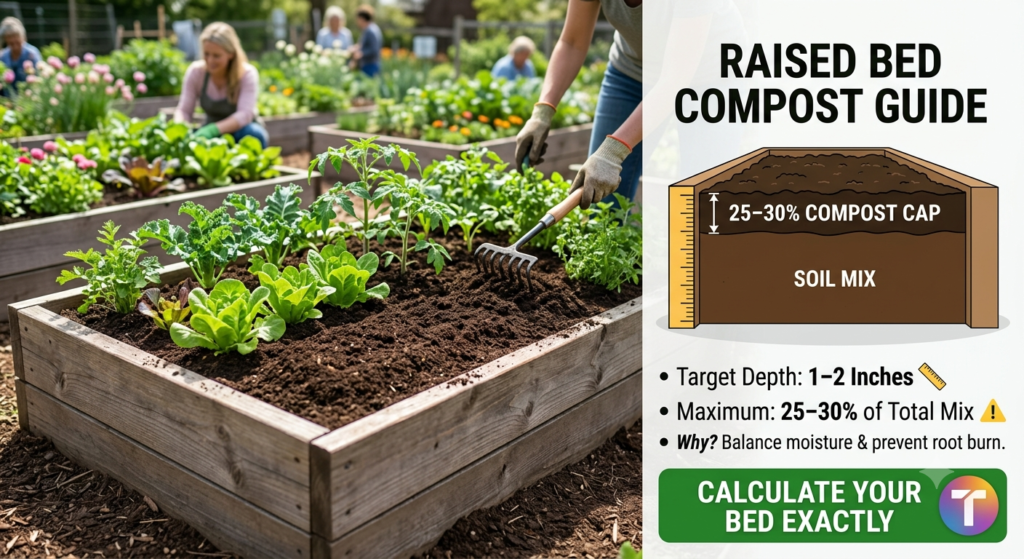
Run your exact length, width, and depth through the Raised Garden Bed Soil Calculator before you order anything. It gives you cubic feet and cubic yards for whichever soil mix you’re using, so you know how many wheelbarrow trips you’re planning for, and whether your walkway width can handle them. If you’re blending your own mix instead of buying pre-bagged soil, the Compost Calculator breaks down how much compost you need for your target ratio.
Path Mulch and Edging Considerations
Bare dirt walkways turn to mud fast, especially in the same 18- to 24-inch paths you’re already trying to keep clear. Wood chips, pine straw, and gravel all work as path cover. Pine straw is the lighter option if you’re moving material by hand instead of wheelbarrow.
Figure out how much you need before you buy it in bulk. The Pine Straw Calculator estimates bale count from your path dimensions. And if you’re still deciding on bed size, edging, or overall budget, our full raised bed build guide walks through lumber, soil mix, and cost per bed in more detail.
Where to Find Raised Garden Beds on Clearance Right Now
If you’re past the planning stage and ready to buy, the good news is raised garden bed kits do go on clearance regularly. The bad news: not on the schedule most people expect.
Best Time of Year to Catch a Sale
Raised bed kits go on clearance most reliably in late summer through early fall, once retailers start moving outdoor inventory before winter. Late spring is the second-best window, right after the initial spring rush clears out early-bird stock and stores start marking down whatever’s left on the shelf.
If you’re shopping mid-season, April through June, expect full price. That’s peak demand, and retailers have no reason to discount when everyone’s buying anyway. Patience is the actual discount strategy here.
What to Check Before Buying a Clearance Kit
A discounted bed is only a good deal if it fits the space and depth you actually planned. Before you buy:
- Confirm the depth matches your crops. A clearance kit that’s only 8 inches deep won’t work for tomatoes or carrots, no matter how good the price is.
- Check the material. Galvanized steel resists corrosion and holds up longer outdoors than untreated wood, and some clearance listings are end-of-line wood kits nearing the end of their shelf life.
- Measure your walkway space against the kit’s footprint. A wider bed than planned eats into the clearance you calculated earlier.
- Check retailer clearance sections directly, not just general search results. Amazon, Home Depot, and Target all run dedicated clearance categories for outdoor and garden, and brands like Vego Garden run their own clearance collections that move faster than general retail listings.
One recent example: a galvanized raised bed kit was discounted 43% off on Amazon in July 2026, dropping from around $40 to $23 for a 4×2×1-foot bed. That’s the kind of markdown worth watching for if the dimensions match your layout.
When Do Raised Garden Beds Go on Clearance?
Raised garden beds go on clearance most often in late summer and early fall, when retailers clear outdoor and garden inventory ahead of winter. A smaller round of discounts also shows up in late spring, after the initial planting-season rush.
If you can wait until August or September to buy, you’ll generally see better markdowns than shopping in April or May. The tradeoff is less growing season left once your bed arrives.
The Bottom Line
“Raised garden bed clearance” turns out to be two questions wearing one search term. If you needed the spacing answer: 18 to 24 inches minimum between beds, 36 inches if you need wheelchair or wheelbarrow access, and more room than you think once plants fill in. If you needed the shopping answer: check retailer clearance sections in late summer, confirm depth and material before you buy, and don’t let a good price talk you into the wrong dimensions.
Either way, the numbers matter more than which question you started with. A bed that’s perfectly spaced but too deep for your soil budget causes the same headache as one that’s cheap but crammed into an 18-inch gap. Before you order soil, lumber, or a discounted kit, run your exact bed size through the Raised Garden Bed Soil Calculator.
It takes less time than reading this article did.
Planning multiple beds? Drop your layout in the comments. Walkway spacing is one of the easiest things to get wrong on paper and the most expensive to fix once the beds are full of soil.
Spacing recommendations in this guide are based on university extension guidelines and ADA accessibility standards. Bring your specific site conditions to a local extension office for the final word.