OSHA compliance, material selection, bulk pricing, and installation — everything a contractor, facility manager, or safety officer needs before ordering.
By Safety Compliance Team~1,200 words7 min read
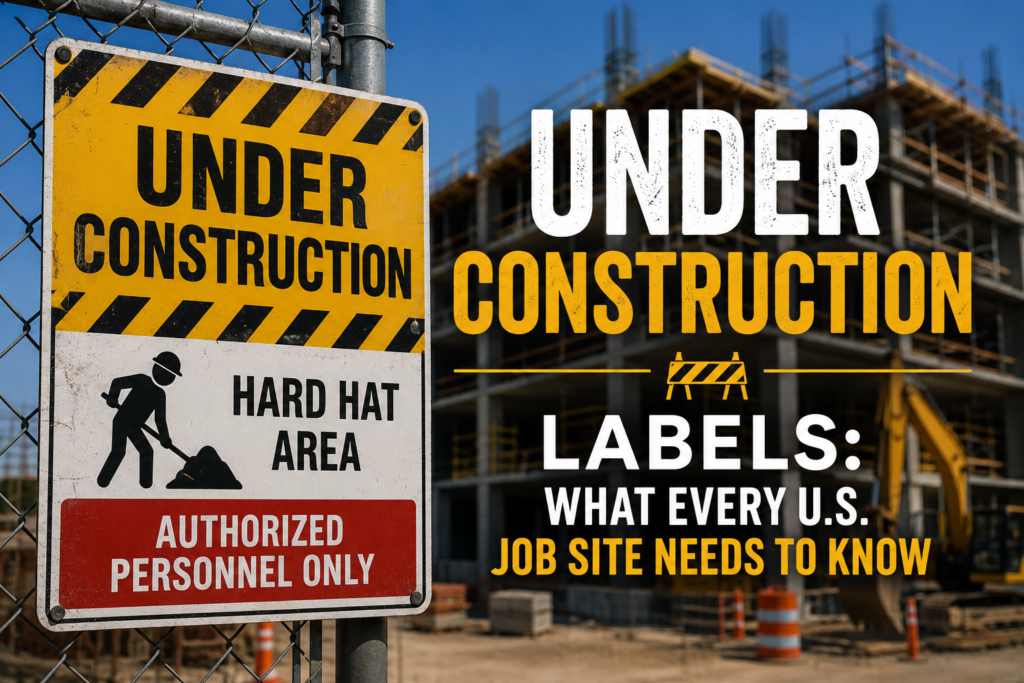
An under construction label is a standardized safety sign, sticker, or decal affixed to construction site entry points, equipment undergoing repair, or areas temporarily closed to unauthorized personnel. In the United States, these labels serve a dual purpose: they communicate hazard status to workers and visitors, and they demonstrate compliance with federal OSHA regulations governing job site communication under 29 CFR 1926.
Whether you are outfitting a single piece of machinery or labeling an entire commercial renovation project, selecting the right label — by material, size, and wording — determines both durability and legal defensibility.
The U.S. construction market reached $3.5 trillion in 2026, with over 4 million active construction businesses. Safety signage compliance is a mandatory cost of doing business across every sector — residential, commercial, civil, and industrial.
OSHA & ANSI Compliance Requirements
Federal OSHA regulations under 29 CFR 1926 (Construction Industry Standards) require that construction areas be clearly identified with appropriate warning signage. Labels must communicate the nature of the hazard clearly enough that an untrained person can understand the risk without additional instruction.
ANSI Z535 is the national standard that governs the format of safety signs and labels. Under this standard, labels are classified by signal word:
- DANGER — Indicates an imminently hazardous situation that, if not avoided, will result in death or serious injury. Red header. Reserved for the most severe hazards.
- WARNING — A potentially hazardous situation that could result in death or serious injury. Orange header. Appropriate for most active construction zones.
- CAUTION — A potentially hazardous situation that may result in minor or moderate injury. Yellow header. Used for lower-risk access restrictions.
- NOTICE — Informational only. Blue header. Used when no physical danger is present — e.g., “Area Under Renovation, Please Use Alternate Route.”
⚖ Compliance Note
OSHA does not mandate a specific “Under Construction” label design, but requires that all safety signs be legible, durable for their environment, and positioned where workers are likely to see them before entering a hazard zone. Labels that fade, peel, or become obscured can result in citation during an OSHA inspection.
Material Comparison: Vinyl, Aluminum & Plastic
Material choice determines how long your labels survive real-world conditions. The three primary materials for U.S. construction labels are pressure-sensitive vinyl, aluminum, and rigid plastic. Each fits a different application profile.
| Material | Outdoor life | Temp range | Adhesive | Best for |
|---|---|---|---|---|
| Vinyl decal Most popular | 3–5 years | -40°F to 220°F | Permanent pressure-sensitive | Equipment surfaces, smooth walls, temporary fencing panels |
| Aluminum | 7–10+ years | Unlimited | Pre-punched for screws / rivets | Permanent site postings, gates, building exterior, OSHA inspection areas |
| Rigid plastic | 3–7 years | -20°F to 180°F | Mounting holes or adhesive backing | Interior construction, retail remodels, medium-term projects |
“In harsh climates — coastal humidity, extreme UV, desert heat — aluminum outlasts vinyl by years. For equipment labeling where the surface moves or flexes, vinyl wins every time.”— Construction Safety Compliance Team
Sizes, Formats & Bulk Options
Under construction labels are manufactured in standard ANSI-compliant sizes. Matching size to viewing distance is critical: a label too small to read from a safe approach distance provides no legal protection.
- 5″ × 3.5″ — Equipment and machinery labels. Forklift decals, control panel notices, small tool enclosures.
- 10″ × 7″ — Interior doors, utility room access points, mid-size equipment.
- 14″ × 10″ — The most common format. Standard job site doors, fencing, and barrier tape frames. Readable from 15–20 feet.
- 18″ × 12″ — High-traffic entry points, exterior site perimeters, roadside construction alerts.
- 24″ × 18″ — Large-scale civil construction, highway work zones, high-visibility staging areas.
Bulk ordering is standard practice for general contractors managing multiple sites simultaneously. Most U.S. suppliers offer volume pricing at 25, 50, 100, and 500+ unit thresholds, with per-unit costs dropping 30–60% at higher quantities. Free shipping is typically available on orders above $25–$30.
Where to Use Under Construction Labels
Proper label placement covers six primary use cases in U.S. construction and facility management:
- Job site entry points — All pedestrian and vehicle access points to an active construction zone must be labeled before work begins. This is the most-cited OSHA requirement.
- Equipment lockout / tagout (LOTO) — Machinery taken offline for service must carry an “Under Construction” or “Out of Service” label per OSHA 29 CFR 1910.147. This applies equally in construction under 1926.417.
- Facility renovation zones — Commercial properties undergoing interior renovation must label all areas inaccessible to customers and non-construction staff.
- Road and utility work — Trenching, utility access, and roadway construction require area demarcation labels in addition to traffic control devices.
- Retail and hospitality remodels — Active businesses undergoing renovation are required to clearly mark construction boundaries from occupied areas.
- Elevator and stairwell shutdowns — Any vertical access point temporarily closed must be labeled at every landing.
How to Apply and Maintain Construction Labels
A label applied incorrectly fails faster and may not adhere long enough to satisfy inspection requirements. Follow these steps for maximum adhesion and longevity.
Clean the surface.
Wipe the application area with isopropyl alcohol (70%+). Remove grease, dust, and moisture. Allow 60 seconds to dry completely before applying.
Apply at the right temperature.
Vinyl adhesives bond best between 50°F and 90°F. Cold surfaces reduce initial tack significantly — warm the surface with a heat gun briefly if working below 50°F.
Peel and press firmly.
Remove the backing liner, apply the label from one edge, and press outward to prevent air bubbles. Use a squeegee or firm card to seat the adhesive.
Secure edges on rough surfaces.
On textured concrete or cinderblock, apply a bead of weatherproof silicone sealant around the label perimeter to prevent edge lifting.
Inspect monthly.
Labels in high-UV environments fade fastest at corners and edges. Replace any label that has faded to the point where the signal word (DANGER / WARNING) is no longer clearly legible at the required viewing distance.
Frequently Asked Questions
What is an under construction label?
An under construction label is an OSHA and ANSI-compliant sign or decal used to identify job sites, restricted areas, and equipment undergoing repair. It alerts workers and the public that a zone is unsafe for unauthorized entry and is a required element of U.S. construction site safety communication under 29 CFR 1926.
Are under construction labels required by OSHA?
Yes. OSHA’s construction standards (29 CFR 1926) require that hazard areas be clearly marked with appropriate signage. Failure to post compliant labels is a citable violation. Labels must be legible, durable, and positioned at or before the point of hazard.
How long do vinyl under construction labels last outdoors?
High-quality vinyl under construction labels are rated for 3 to 5 years of outdoor exposure with UV-resistant inks and laminate. In high-UV environments (desert Southwest, coastal regions), inspect every 6 months and replace any labels showing significant fading or edge lift.
What size under construction label do I need?
The 14″ × 10″ format is the standard for most job site doors and fencing — it is readable from 15 to 20 feet. For equipment and machinery, 10″ × 7″ or 5″ × 3.5″ is appropriate. For high-traffic exterior perimeters and roadside postings, use 18″ × 12″ or 24″ × 18″.
Can I get custom wording on an under construction label?
Yes. Most U.S. label suppliers offer custom printing with your company name, project number, contact information, or site-specific instructions while maintaining OSHA and ANSI-compliant signal word formatting and color codes.
What is the difference between a WARNING and a DANGER label?
Under ANSI Z535, DANGER (red header) is reserved for imminently life-threatening hazards. WARNING (orange header) indicates a potentially severe hazard that is not immediately fatal. For most construction zone access restrictions, WARNING is the appropriate signal word unless active demolition, electrical exposure, or structural collapse risk is present.
Look for labels manufactured domestically. U.S.-made construction labels are produced to tighter quality tolerances, ship faster, and are reliably formatted to current ANSI Z535 and OSHA standards — not to export-market specs that may differ from U.S. requirements.