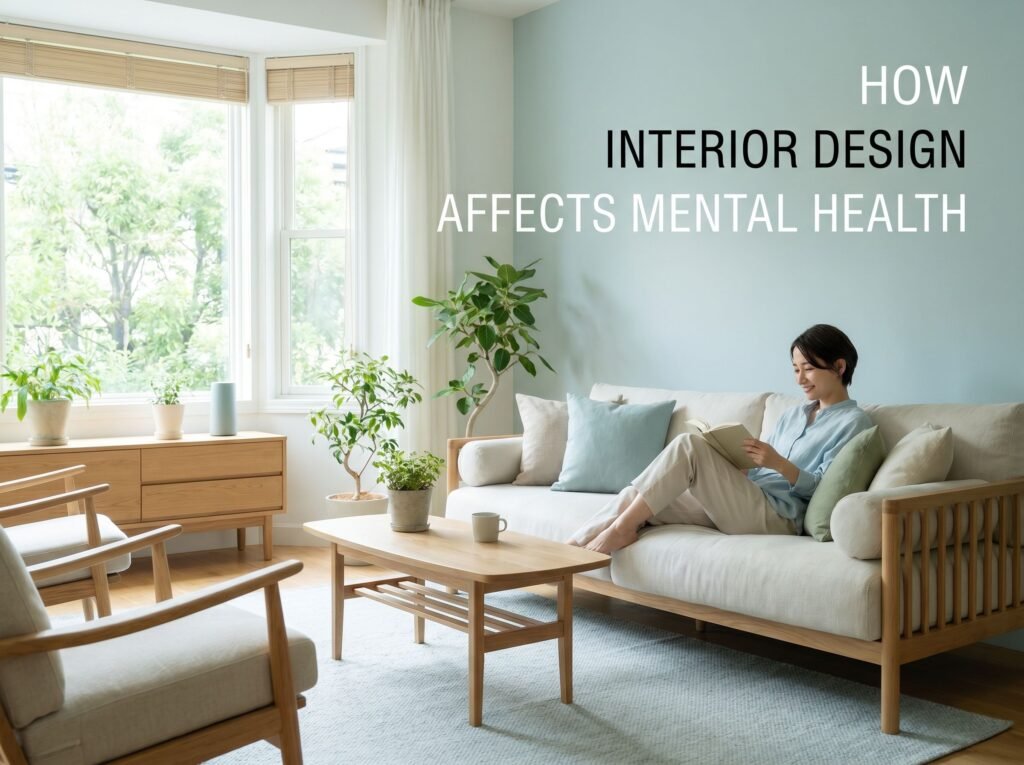
Interior design affects mental health by shaping how your brain processes light, color, sound, space, and visual complexity. Natural light regulates your circadian rhythm and boosts serotonin. Clutter overloads the visual cortex and spikes cortisol. Color temperature triggers measurable hormonal responses. Your environment is not just a backdrop — it’s constantly sending signals that either calm or stress your nervous system.
And here’s the thing: most of us spend more than 90% of our time indoors. That’s not a small variable.
The Science Behind the Space: Environmental Psychology 101
In 1984, researcher Roger Ulrich published a study that sounds almost too simple to be significant. Hospital patients recovering from surgery who had windows facing trees healed faster, needed fewer painkillers, and had shorter stays than patients whose windows faced a brick wall. Same ward, same surgeons, same procedures — different view, different outcome.
That study launched decades of environmental psychology research, and the findings keep stacking up. Research published in Humanities and Social Sciences Communications in 2025 reviewed 64 empirical studies and identified seven key interior design factors that influence health: lighting, thermal comfort, air quality, spatial layout, acoustic quality, barrier-free design, and biophilic elements. Seven factors. All of them changeable.
Dr. Joel Frank, a licensed clinical psychologist and neuropsychologist at Duality Psychological Services, puts it plainly: “A well-designed environment can help us relax and restore, but it can also sharpen our minds, enhance our creativity, and put us in a good mood. Even things as basic as not having enough daylight and fresh air can affect our mood and energy levels in the short term and our health in the long term.”
This isn’t soft science. Your environment is a direct input into your neurochemistry.
Color Psychology: What Each Shade Does to Your Brain
Color is probably the most discussed element in interior design — and the most misunderstood. It’s not that blue is “calming” in some vague, generic sense. The mechanism is specific.
Cool blues in the 450–490 nanometer range have been shown to lower blood pressure and reduce heart rate. That’s why they work in bedrooms and study spaces. Warm yellows stimulate serotonin production, making them effective in kitchens and breakfast nooks — but in excess, particularly at high saturation, they can agitate rather than energize. Green sits in the middle of the visible spectrum, requiring almost no adjustment from the eye, which partly explains why it registers as restful. A 2025 study found hospital patients in rooms with green-accented design reported 20% less pain than those in neutral rooms.
Red is complicated. It increases heart rate and stimulates appetite — genuinely good for dining rooms, genuinely terrible for bedrooms or home offices where you need calm focus.
The application isn’t complicated, but it does require intentionality:
- Bedroom: Cool blues, soft greens, warm whites. Avoid saturated red or orange.
- Home office: Muted greens or soft blues for focus. A warm accent wall adds energy without overwhelming.
- Living room: Warm neutrals with earthy greens or terracotta accents create social comfort.
- Kitchen: Soft yellow or warm cream encourages appetite and morning energy.
One practical tip the internet mostly skips: test colors at different times of day before committing. A swatch that looks perfect at 11am in natural light can feel completely different at 7pm under warm artificial lighting.
Light: The Design Element With the Most Direct Path to Your Biology
Your body runs on a 24-hour internal clock — the circadian rhythm — and natural light is its primary regulator. When light hits the retina, it suppresses melatonin (your sleep hormone) and triggers serotonin production. This is good during the day. At night, it’s the opposite of what you want.
The design implications are significant. Poorly lit spaces disrupt circadian rhythms, which increases risk of depression, anxiety, and sleep disorders. A 2020 study in the Journal of Alzheimer’s Disease Reports found that long-term exposure to circadian-effective light improved sleep, mood, and behavior across subjects — not just in clinical populations.
Practical strategies that work:
- Maximize morning light. East-facing windows are valuable for bedrooms and breakfast areas. If you can’t orient the room, sheer curtains over east windows do more than blackout curtains in west-facing rooms.
- Layer your lighting. Overhead fixtures for tasks, warm ambient lighting for evenings, and no blue-tinted LED exposure after 8pm. Blue light from LED fixtures suppresses melatonin for up to three hours.
- Use mirrors deliberately. A well-placed mirror doesn’t just double the light — it creates a sense of spatial expansion that reduces claustrophobia in small rooms.
People exposed to nighttime artificial light — particularly blue-spectrum light — show a measurable 20% increase in symptoms associated with depression, anxiety, and insomnia. That’s not a scare statistic. That’s your bedside lamp and phone screen.
Clutter: The Silent Cortisol Pump
UCLA researchers conducted a multi-year study of families in their actual homes and measured cortisol levels throughout the day. Mothers in cluttered homes had sustained high cortisol — stress hormone readings comparable, in some cases, to what’s been observed in post-traumatic stress scenarios.
Princeton Neuroscience Institute research explains the mechanism: clutter competes for visual attention, forcing the brain to continuously filter irrelevant stimuli. This isn’t a passive process — it consumes cognitive resources. The result is decision fatigue, reduced focus, and a nervous system that never fully settles.
The answer isn’t minimalism. Minimalism is an aesthetic — and one that doesn’t fit everyone’s life or personality. The answer is organized intentionality. Clutter is stuff without a home; organized belongings that reflect your personality are not the same thing.
Specific strategies that change the math:
- Wall-based storage frees floor space and expands perceived square footage without reducing belongings.
- One-in, one-out rule for high-traffic zones like entryways and kitchen counters.
- Visible organization (open shelving with curated objects) reads as warm and personal rather than chaotic — as long as the arrangement is intentional.
The goal is a space that doesn’t require mental effort to navigate.
Biophilic Design: Why Your Brain Still Expects Nature
Humans evolved over hundreds of thousands of years in natural environments. We’ve lived in cities for maybe 10,000 years. The brain hasn’t caught up. That’s the core argument behind biophilic design: our nervous systems are better calibrated to natural environments, and design that incorporates natural elements reduces the gap.
The evidence holds up under scrutiny. Roger Ulrich’s original window study (mentioned above) has been replicated across dozens of settings. Indoor plants reduce psychological stress — a 2002 study published in the Journal of Environmental Psychology found that participants in rooms with plants completed stressful tasks with lower blood pressure and higher self-reported comfort than those in plant-free rooms.
Natural materials matter too. Wood, stone, linen, and cotton don’t just look warm — they feel different under touch, and tactile experience feeds directly into comfort signals. Smooth, cold synthetic surfaces don’t provide that.
Cultural design traditions understood this long before neuroscience had the vocabulary. Vastu Shastra, the ancient Indian architectural system, emphasizes alignment with natural forces and open spatial flow. Chinese Feng Shui uses similar principles of energy circulation and natural element balance. Western design is arriving at some of the same conclusions through clinical research.
Biophilic design doesn’t require a greenhouse:
- Two or three plant species with different heights create visual interest without maintenance overwhelm.
- A wood element — a dining table, open shelving, a headboard — adds warmth to rooms dominated by synthetic materials.
- A small water feature (tabletop fountain, aquarium) introduces sound variation that the brain registers as natural and calming.
Space, Proportion, and the Ceiling Effect
Here’s a finding that surprises people: ceiling height affects cognitive style. A 2007 study by Joan Meyers-Levy found that rooms with higher ceilings activated freer, more abstract thinking. Lower ceilings promoted focused, detail-oriented thinking. Neither is better — they’re different tools.
Applied to home design, this means the right spatial choices depend on what you want a room to do. Open-plan living areas with high ceilings encourage creativity and relaxed social interaction. A home office with a lower, cozier ceiling might actually help you focus on detailed work.
When ceiling height is fixed, you can work with visual expansion:
- Vertical lines (tall bookshelves, floor-to-ceiling curtains) draw the eye upward and suggest height.
- Pale wall colors and light flooring expand perceived space.
- Furniture scaled to the room — not too large, not too scattered — gives the eye a clear path and reduces subconscious tension.
Acoustic Design: The Element Most Guides Skip
Most interior design content focuses on what you see. But what you hear shapes psychological state just as powerfully — and it’s one of the least addressed design variables for residential spaces.
Hard surfaces (concrete, glass, tile) reflect sound and increase reverberation. Rooms dominated by these materials create an ambient soundscape that keeps the nervous system slightly elevated. Soft surfaces (rugs, curtains, upholstered furniture, cushions) absorb sound and reduce reverberation time. The practical result is a room that feels quieter, even if nothing has changed outside.
The 2025 scoping review in Humanities and Social Sciences Communications specifically identified acoustic quality as one of the seven key interior design factors affecting health. Yet most home design guides say nothing about it.
Simple acoustic improvements:
- A large area rug in the living room reduces echo significantly.
- Heavy curtains (lined, floor-to-ceiling) absorb street noise and reduce internal reverb.
- Upholstered headboards, fabric wall panels, and bookshelves with books all reduce bedroom reverberation and support deeper sleep.
Room-by-Room Mental Health Design Guide
Bedroom: Design for Recovery
The bedroom’s single psychological job is to support sleep and restoration. Every design decision should serve that.
- Color: Muted blues, sage greens, warm whites. Nothing saturated.
- Light: No overhead fluorescents. Bedside warm-bulb lamps (2700K or lower). Blackout curtains if needed — sleep quality degrades in even low ambient light.
- Sound: Rugs, upholstered furniture, heavy curtains. Consider white noise if urban noise is a factor.
- Clutter: Zero-tolerance zone. Storage that keeps surfaces clear is worth the investment.
- Temperature: The optimal sleep temperature range is 65–68°F (18–20°C). Design for it — good airflow, layered bedding, window placement.
Living Room: Design for Social Ease
Living rooms carry the social weight of the home. Design that supports easy conversation and comfortable relaxation reduces the friction of social interaction.
- Seating arranged in conversational clusters (not all facing the TV) signals social comfort.
- A mix of lighting levels — ambient, accent, and task — allows the room to shift mood from active to relaxed.
- Natural elements and warm materials (wood, linen, plants) create the baseline sense of ease.
Home Office: Design for Focus Without Burnout
The biggest design mistake in home offices is treating them like corporate cubicles. Cold, functional, and starved of natural elements. The second mistake is treating them like living rooms — too comfortable, no sense of productive separation.
The balance: natural light (positioned to the side of the screen, not behind), a focused color palette in cool green or muted blue, plants at eye level, and a clear visual boundary between work space and relaxation space. When you close the laptop, the room shouldn’t look identical to a command center.
Kitchen: Design for Energy and Connection
Kitchens are where days start. Warm lighting (not cold fluorescent), uncluttered counter space, and surfaces that feel good to touch (stone, wood, warm ceramics) set a tone for the morning.
When Good Design Goes Wrong
Design decisions intended to improve wellbeing can backfire. Knowing the pitfalls prevents expensive mistakes.
- Excessive minimalism can feel sterile and cold rather than calm. Bare surfaces without personal objects strip a space of meaning, which can feel disorienting rather than peaceful.
- Overlighting for brightness backfires at night. Blue-spectrum “bright white” bulbs chosen for daytime productivity suppress melatonin for hours after dark.
- Trendy palettes that don’t suit the person create subconscious dissonance. High-contrast black-and-white schemes look striking in magazines but can feel tense and energetically demanding to live with daily.
- Fragrance overload — candles, diffusers, sprays — in enclosed spaces can trigger headaches and respiratory irritation, undoing any relaxation benefit.
The rule worth remembering: design for the person who lives there, not for the photo.
Frequently Asked Questions
How does color affect mental health in interior design?
Color affects mental health through direct neurological pathways. Cool blues lower blood pressure and heart rate. Greens reduce visual fatigue and register as restful. Warm yellows stimulate serotonin production. Saturated reds raise heart rate and cortisol. The effect is measurable — not metaphorical — and varies by intensity, placement, and individual baseline.
Does clutter really affect anxiety levels?
Yes, and the mechanism is specific. Clutter forces continuous visual filtering, consuming attentional resources and preventing the nervous system from fully settling. UCLA research found that clutter sustained elevated cortisol throughout the day. The solution isn’t minimalism — it’s organized intentionality. Belongings with a clear home create a different neural experience than objects scattered without system.
What is biophilic design and does it work?
Biophilic design incorporates natural elements — plants, wood, water, natural light, organic materials — into built environments. It works because the human nervous system is calibrated to natural environments and registers their absence as a low-level stressor. Studies consistently show reductions in blood pressure, cortisol, and self-reported stress in spaces with biophilic elements, even minimal ones like a single plant or a view of trees.
Which room has the biggest impact on mental health?
The bedroom, because it governs sleep — and sleep governs everything else. Poor sleep quality degrades mood regulation, increases anxiety, reduces stress resilience, and impairs cognitive function. A bedroom designed for sleep (controlled light, acoustic softness, appropriate temperature, minimal clutter) produces compounding mental health returns that no other room can match.
How can I improve my mental health through interior design without a big budget?
The highest-return changes don’t require renovation. Changing light bulbs to 2700K warm-spectrum in bedrooms and replacing overhead lighting with floor lamps costs very little and changes how a room feels dramatically. Decluttering a single zone — a bedside table, a desk surface, an entryway — reduces ambient stress. One indoor plant, one rug, one set of heavier curtains. Start with the bedroom. Start with light.
The Mintpaldecor Approach
Interior design that genuinely supports mental health isn’t about following trends or achieving magazine aesthetics. It’s about understanding what your nervous system needs and designing toward that — with honesty about how you actually live, not how you wish you lived.
The research is clear. Light, color, sound, space, and natural elements are not decorative choices. They’re physiological inputs. Getting them right doesn’t require a designer budget or a full renovation. It requires attention to what each room is actually doing to the people inside it.
Start with the space where you sleep. Fix the light. Reduce the visual noise. Then go from there.