Last Updated: June 2026 | Reviewed for U.S. Cat Owners | Reading Time: ~12 min
If you just scheduled your cat’s neuter surgery—or just brought him home from the vet—you’re probably wondering: Will he act differently? When will the changes kick in? And what’s actually normal?
These are the right questions to ask. Male cat behavior after neutering follows a predictable biological timeline, and understanding it helps you set realistic expectations, catch any warning signs early, and support your cat through recovery.
The short answer: neutering changes hormone-driven behaviors—spraying, roaming, and fighting—but it does not change who your cat is. His personality, playfulness, and affection level stay the same. The hormones simply retire.
This guide walks you through what changes, what doesn’t, exactly when to expect each shift, and what the science actually shows.
What Neutering Does to a Male Cat (The Biology, Simply Explained)
Neutering—also called castration or orchiectomy—is the surgical removal of a male cat’s testicles. The procedure is quick, performed under general anesthesia, and most cats return home the same day.
The testicles produce the vast majority of a male cat’s testosterone. Testosterone is the hormone responsible for several instinct-driven behaviors: roaming in search of mates, urine marking to claim territory, aggression toward other males, and loud vocalizing (“caterwauling”).
Once the testicles are removed, testosterone production stops. However—and this is critical—testosterone doesn’t vanish overnight. Residual hormone circulates in the bloodstream and clears gradually. This is why behavior changes are gradual, not instant.
According to VCA Animal Hospitals, the only cat behaviors directly affected by neutering are the ones caused by male hormones. Traits rooted in genetics, early socialization, or learned habit are not erased by surgery.
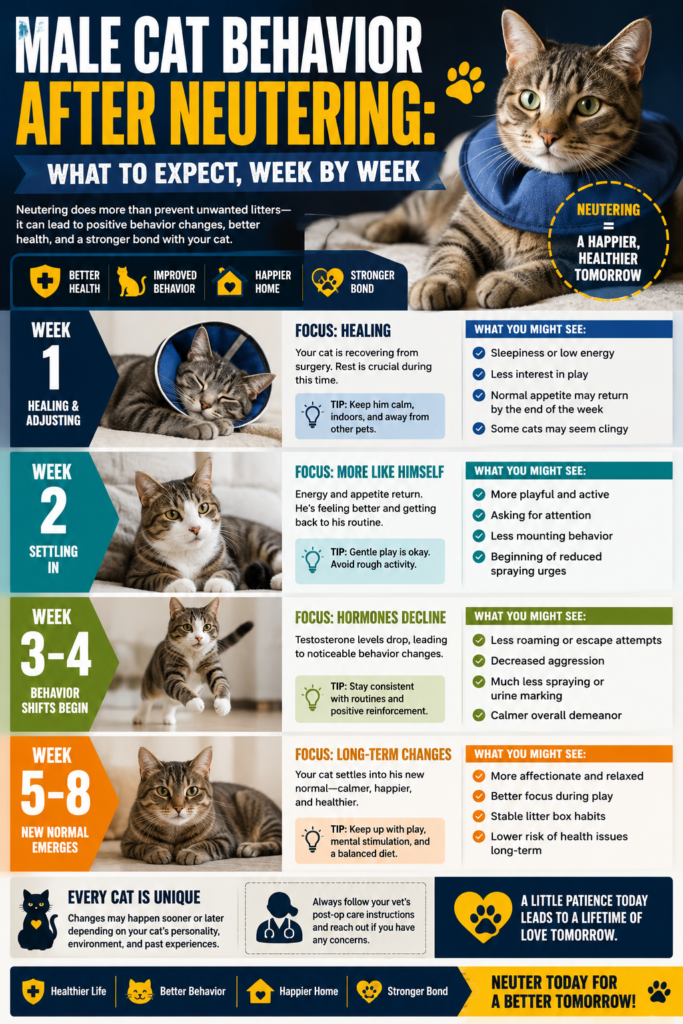
The Behavior Change Timeline: Week by Week
This is the most important section for new owners. Many people expect an immediate personality shift and feel frustrated when it doesn’t happen. Here’s what the research actually shows:
Days 1–3: Recovery, Not Behavior Change
During the first 72 hours, any behavior differences are caused by anesthesia and surgical discomfort, not hormonal shifts. Expect:
- Grogginess, disorientation, or wobbly coordination
- More sleep than usual
- Reduced appetite or mild nausea
- Sensitivity to handling or jumping
- Occasional vocalization from discomfort
Testosterone levels have not meaningfully dropped yet. Do not expect spraying, roaming, or aggression to stop at this stage. Focus entirely on rest and recovery.
What to do: Provide a quiet, warm space. Follow your vet’s post-op instructions. Monitor the incision site daily for swelling, redness, or discharge. If your cat hasn’t urinated within 72 hours of surgery, contact your veterinarian.
Weeks 1–4: Hormones Begin to Drop
Testosterone levels start declining during this window. You may notice:
- Slightly less restlessness or anxious pacing
- Reduced interest in going outside or patrolling territory
- Calmer resting behavior
However, established behaviors—especially spraying or inter-male aggression—are unlikely to disappear yet. Be patient. The “washout period” for testosterone takes time.
Months 1–3: The Most Noticeable Changes
This is when most U.S. cat owners report seeing clear behavioral improvements. By the 4–12 week mark, testosterone has dropped significantly enough that hormone-driven behaviors begin to stabilize or fade.
Research published by Hart and Barrett (1973) and cited consistently by the Cornell Feline Health Center found the following reduction rates in neutered male cats:
| Behavior | % of Cats Showing Reduction |
|---|---|
| Urine spraying | 85–87% |
| Roaming | 90–94% |
| Fighting with other males | 88–90% |
What changes during months 1–3:
- Spraying significantly decreases or stops in the majority of cats
- Roaming drive fades — most cats become more content staying home
- Aggression toward other male cats drops noticeably
- Loud overnight yowling (“caterwauling”) reduces or disappears
- Cats often become calmer and more bonded to their owners
According to the AVMA, these changes in hormone-driven behaviors are well-documented and consistent across breeds and environments.
3–6 Months: Full Stabilization
By 3–6 months post-surgery, your cat’s behavior should be fully stabilized. Any hormone-related behaviors that haven’t resolved by this point are likely rooted in habit, stress, or environmental factors—not testosterone.
If spraying continues past the 6-month mark, consult your veterinarian or a board-certified veterinary behaviorist. The cause is typically stress, multi-cat household dynamics, or anxiety—all of which are addressable.
6 Key Behavior Changes You Can Expect
1. Urine Spraying Decreases Dramatically
This is the change most U.S. cat owners are hoping for. Research from the ASPCA and VCA Hospitals consistently shows that neutering reduces or eliminates urine spraying in approximately 85% of male cats.
Even in cats that continue to spray, the urine odor is significantly less intense after neutering—because the pheromones that give tomcat urine its distinctive smell are testosterone-driven.
What if he keeps spraying? About 10–15% of neutered males continue to spray. According to veterinary behaviorist Dr. Judi Neilson’s research, persistent spraying after neutering is almost always driven by stress, territorial anxiety, or multi-cat conflict—not residual hormones. Feliway pheromone diffusers, litter box optimization (one box per cat plus one extra), and environmental enrichment can help significantly.
2. Roaming and Escape Attempts Decrease
Intact male cats are driven to roam—sometimes traveling several miles—to find mates and patrol territory. This drive is responsible for a large share of traffic-related injuries and disease transmission (FIV and FeLV spread through bite wounds from fighting).
After neutering, the urge to roam drops in roughly 90–94% of male cats. Your cat becomes more content staying home. He’s less likely to bolt through an open door or pace the windows at night.
This is also a significant safety benefit. According to PetMD, neutered male cats live approximately 62% longer than unneutered males, largely because they avoid roaming-related dangers.
3. Aggression Toward Other Cats Decreases
Inter-male aggression is strongly testosterone-driven. About 88–90% of neutered males show a measurable reduction in fighting behavior.
However, aggression is more complex than spraying or roaming. Not all cat aggression is hormonal. Fear-based aggression, play aggression, and redirected aggression are not meaningfully affected by neutering. If your cat remains aggressive toward people or other pets 3–6 months post-surgery, behavioral intervention—not additional surgery—is the next step.
A study published in BMC Veterinary Research found that affiliative behaviors (grooming, sitting near other cats) appeared in neutered adult male cats that had never displayed them before—suggesting neutering can meaningfully shift social dynamics in multi-cat households.
4. Loud Vocalizing (“Caterwauling”) Stops or Reduces
Unneutered male cats yowl—loudly, insistently, and often at 3 a.m.—to attract females and warn off competing males. This behavior is directly testosterone-driven and typically fades within the first 4–8 weeks after neutering.
If your cat continues vocalizing at night after 8 weeks, rule out pain, thyroid issues, or cognitive dysfunction (in older cats). Nighttime vocalization in neutered cats is almost always medical or environmental, not hormonal.
5. He Becomes More Affectionate (Usually)
Many U.S. cat owners report that their male cats become noticeably more cuddly and people-focused after neutering. Catster notes that this is a well-documented pattern: with the constant hormonal pressure of mating drives removed, cats can focus on bonding.
That said, personality is shaped by genetics and early socialization—not hormones. A naturally independent or aloof cat won’t transform into a lap cat. What changes is the intensity of certain drives, not who he fundamentally is.
6. He May Sleep More and Gain Weight
This is the most frequently missed post-neutering change. Without testosterone maintaining lean muscle mass and without the calories burned by roaming and territorial patrolling, neutered males are significantly more prone to weight gain.
Research published in PLOS ONE found that post-neutering weight gain in male cats is driven by increased food intake (due to hormonal changes in ghrelin and appetite regulation), not a dramatic drop in energy expenditure. Resting energy requirements drop by roughly 20–30%.
What to do: Switch to a portion-controlled “neutered cat” or “indoor cat” formula after surgery. Measure meals rather than free-feeding. Add interactive feeders or food puzzles to keep activity levels up. Your vet can recommend the right caloric target for your cat’s age and size.
What Neutering Does NOT Change
Understanding the limits of neutering is just as important as understanding the benefits.
Neutering will NOT change:
- Your cat’s core personality (playful, shy, independent, vocal—these are genetic)
- Aggression toward humans (this is typically fear- or pain-based, not hormonal)
- Anxiety or hyperactivity (unless directly caused by mating drive)
- Learned behaviors that have been practiced for years (older cats take longer to change, and some habits persist)
Neutering is LESS effective when done later:
Cats neutered as kittens (before 5–6 months) show the highest rates of spraying and roaming prevention—because the behaviors were never established as habits. Cats neutered as adults can still benefit significantly, but some behaviors may persist longer or require additional behavioral support.
Age at Neutering: Does It Matter?
Yes. The AVMA recommends neutering before 5 months for most cats. Shelters commonly neuter as early as 8 weeks (pediatric neuter), and research supports the safety of early-age neutering.
| Age at Neutering | Expected Outcome |
|---|---|
| Before 5–6 months | Highest prevention rate for spraying, roaming, aggression |
| 6–12 months | Good outcomes; some behaviors may be briefly established but fade |
| Adult (1+ years) | Significant improvement in most cats; learned behaviors may linger |
| Senior (7+ years) | Still beneficial for health; behavioral changes may be more variable |
If your adult cat has been spraying for years before surgery, expect the behavior to reduce—but possibly not disappear immediately. Give it 3–6 months before adding behavioral interventions.
Recovery Care: What U.S. Vets Recommend
Most veterinary practices in the U.S. charge approximately $200–$300 for a standard cat neuter. Many low-cost clinics, humane societies, and ASPCA programs offer the procedure at reduced or sliding-scale costs.
Post-op care checklist:
- Keep him indoors for at least 5–7 days post-surgery
- Limit jumping and running for 10–14 days
- Check the incision site daily for signs of infection (excessive redness, swelling, discharge)
- Use an e-collar if he tries to lick or bite the incision
- Offer small amounts of food the evening of surgery; return to normal feeding the next day
- Follow your vet’s specific instructions—they may vary by clinic
Call your vet immediately if:
- Your cat hasn’t urinated within 72 hours of surgery
- The incision opens, bleeds, or shows discharge
- He is still very lethargic 48 hours after surgery
- He refuses food for more than 24 hours post-surgery
Common Myths About Neutering Male Cats — Debunked
Myth: “Neutering will make him fat.” Neutering changes metabolism and appetite regulation, but weight gain is preventable with portion control and exercise. Hundreds of thousands of neutered male cats maintain healthy weights with the right feeding routine.
Myth: “He’ll lose his personality.” His personality is determined by genetics and early experience—not testosterone. If he was playful and affectionate before, he’ll be playful and affectionate after. The hormones retire; the cat stays.
Myth: “Neutering will make him depressed.” A calmer cat is not a depressed cat. The absence of constant hormonal stress and mating frustration typically produces a more relaxed, content animal—not a sad one.
Myth: “He’ll still spray because he’s already learned it.” Some learned behaviors do persist—but 85–87% of cats stop spraying within weeks to months of neutering. Even if spraying continues, it’s addressable through environmental modification.
Myth: “Only male cats that go outside need to be neutered.” Indoor male cats still produce testosterone and will still spray, pace, yowl, and show mating-related aggression. Neutering benefits indoor cats significantly.
When to See a Vet Behaviorist
If your neutered male cat shows any of the following 6+ months after surgery, consult a veterinary behaviorist (find a board-certified specialist at the American College of Veterinary Behaviorists, dacvb.org):
- Continued spraying in multiple locations
- Aggression toward people or other pets
- Compulsive behaviors (excessive grooming, pacing)
- Extreme fearfulness or anxiety
- House soiling unrelated to litter box problems
Neutering is one tool, not a complete behavioral solution. Combined with enrichment, routine, and—when needed—professional guidance, neutered male cats can thrive in virtually any U.S. household.
Quick Summary: Male Cat Behavior After Neutering
| What Changes | Timeline | Success Rate |
|---|---|---|
| Urine spraying | 4–12 weeks | 85–87% reduction |
| Roaming & escaping | 4–12 weeks | 90–94% reduction |
| Fighting / inter-male aggression | 4–12 weeks | 88–90% reduction |
| Loud caterwauling | 2–8 weeks | Most cats significantly improved |
| Affection / bonding | Gradual | Many cats become more people-focused |
| Weight gain risk | Immediate | Preventable with diet management |
Key takeaway: Neutering is one of the most reliably beneficial interventions in feline medicine. The behavioral improvements are real, research-backed, and experienced by the majority of cat owners. The changes aren’t instant—but they are consistent. Give your cat 3–6 months, manage his weight, and support his recovery. The results speak for themselves.
Frequently Asked Questions
How long after neutering does a male cat calm down?
Most cat owners notice calmer behavior within 4–8 weeks of surgery. Full behavioral stabilization typically occurs by 3–6 months, once testosterone has fully cleared from the bloodstream.
Will my male cat stop spraying after neutering?
Research shows approximately 85–87% of male cats stop or significantly reduce spraying after neutering. Cats neutered before 6 months have the highest success rates. If spraying continues past 6 months post-surgery, a veterinary behaviorist can help identify stress or environmental triggers.
Do male cats get more affectionate after neutering?
Many do. With the constant hormonal pressure of mating drives removed, cats can focus more energy on bonding with their owners. However, personality is genetic—a naturally aloof cat won’t become a lap cat, but he’ll generally be calmer and more relaxed.
Is it normal for a cat to be aggressive right after neutering?
Mild defensive behavior in the first 24–72 hours is normal and related to discomfort, disorientation, and anesthesia. This should resolve within a few days. If aggression persists or escalates beyond the first week, contact your vet.
Can I neuter an older male cat?
Yes. Adult and senior male cats benefit meaningfully from neutering—both behaviorally and in terms of long-term health. Behavioral changes may take longer or be less complete than in kittens, but health benefits (eliminating testicular cancer risk, reducing prostate issues, longer lifespan) apply at any age.