
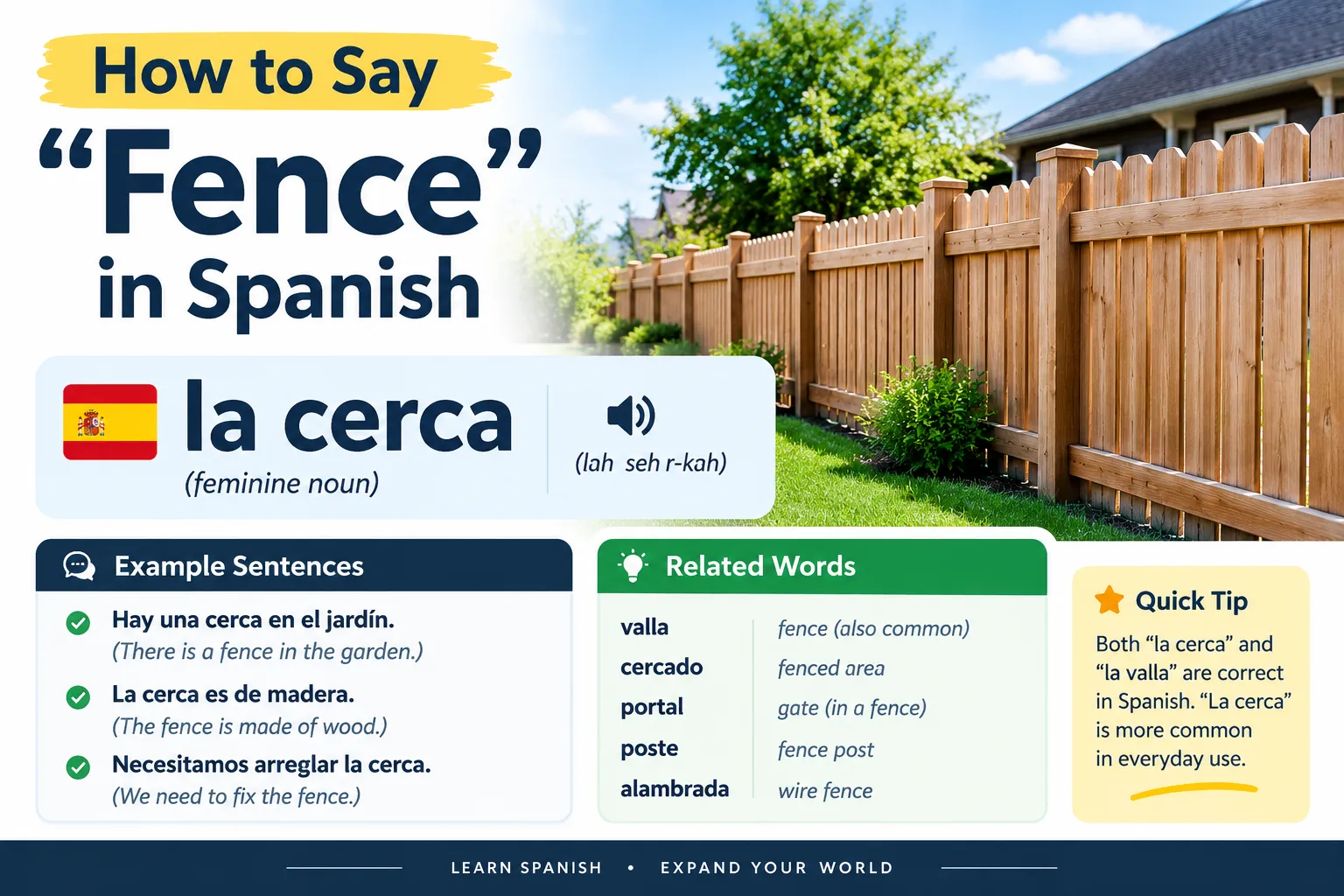
The most common word for “fence” in Spanish is cerca. That’s the safe, general-purpose answer, and it’s right maybe 60% of the time. The other 40% depends on what the fence is made of, what it’s for, and which country the person you’re talking to is from. Spanish has at least seven words that translate to “fence” in English, and using the wrong one doesn’t make you wrong, exactly. It just makes you sound like you learned Spanish from a phrasebook.
The 7 Spanish Words for “Fence” (and When to Use Each)
Here’s the thing dictionaries don’t tell you: a single English word splitting into several Spanish ones usually means the split carries real information, either material or purpose. Fence is a good example.
| Word | Pronunciation | What it means | Where it’s used | Example |
|---|---|---|---|---|
| cerca | SEHR-kah | General fence: wood or wire | Everywhere | Pintamos la cerca del jardín el fin de semana. (We painted the garden fence over the weekend.) |
| valla | VAH-yah | Taller, solid barrier: hoarding or billboard-style panels | Widely used, especially Spain | La valla del jardín es de madera. (The garden fence is made of wood.) |
| reja | RREH-hah | Metal or iron fence, or bars over windows | Common in urban Spain and Latin America | Las rejas protegen la ventana. (The bars/fence protect the window.) |
| barda | BAR-dah | Solid wall-style fence, usually concrete or brick | Mexico | La barda del patio es de concreto. (The patio fence/wall is concrete.) |
| alambrada | ah-lahm-BRAH-dah | Wire or mesh fence | General | La alambrada rodea el terreno. (The wire fence surrounds the lot.) |
| seto | SEH-toh | Hedge (a living fence) | General | El seto separa los jardines. (The hedge separates the gardens.) |
| estacada | ehs-tah-KAH-dah | Picket or stake fence | General, more formal/literary | Less common in everyday speech than in construction specs or older texts |
Notice something in that table? Four of the seven words map to material, not just “fence-ness.” That’s not an accident. Spanish tends to name the thing by what it’s built from a lot more readily than English does.
If you only remember one row, make it cerca. It works as a catch-all even when valla or reja would technically be more precise, the same way “fence” covers a chain-link enclosure and a wrought-iron gate in English without anyone blinking.
Careful: “Cerca” Has Two Meanings
Here’s where a lot of beginners trip, and honestly some intermediate speakers too. Cerca is also the Spanish word for “near” or “close,” used as an adverb, not a noun.
- La cerca es de madera. → The fence is made of wood. (noun)
- Vivo cerca del parque. → I live near the park. (adverb)
Same spelling. Same pronunciation. Completely different job in the sentence. Context sorts it out almost every time. Nobody’s going to hear “vivo cerca” and think you live inside a fence. But if you’re writing rather than speaking, it’s worth a second glance before you hit publish.
Regional Differences: Spain vs. Mexico vs. Latin America
Valla and cerca are understood everywhere, so you’re never really at risk of being misunderstood. But usage tilts by region:
In Spain, valla leans toward construction hoarding and sports/event barriers as much as residential fencing. You’ll hear vallas publicitarias for billboards, which shares the same root. In Mexico, barda is the word you’ll hear most for a solid perimeter wall around a house, where a Spaniard would more likely say muro or just pared. Across the rest of Latin America, cerca and malla (for chain-link specifically) do a lot of the heavy lifting.
None of this is a hard rule. It’s a tendency, and tendencies vary by country and honestly by who’s talking. If regional accuracy matters for your project (a listing, a permit document), it’s worth a quick confirmation with a native speaker from that market rather than trusting a single source, this one included.
“To Fence” as a Verb: Cercar and Vallar
The action of putting up a fence has its own verbs: cercar and vallar.
Vamos a cercar el terreno antes de que lleguen los materiales. (“We’re going to fence the lot before the materials arrive.”)
Vallar works the same way and is slightly more specific to putting up a valla-style barrier rather than a general enclosure. In practice, you’ll hear cercar more often outside of Spain.
The Other Meanings of “Fence” in Spanish
English “fence” carries two meanings that have nothing to do with each other, and Spanish handles them with two completely unrelated words:
Fencing, the sport (épée, foil, the whole En garde! routine) is esgrima. A fencer is an esgrimista, not a cerquista or anything derived from the fence words above. If you search “fencing in Spanish” expecting a construction answer, this is probably why the results looked off. The term splits hard by meaning, and there’s no shared root to bridge the two.
Fence, as in a receiver of stolen goods (the guy who buys the stolen watches, in noir-movie terms) is perista. El ladrón le entregó las joyas robadas a su perista. (“The thief handed the stolen jewels over to his fence.”) Feminine noun, same word for a woman doing the same job: la perista.
And then there’s the idiom. “To sit on the fence,” meaning refusing to take a side, translates to no comprometerse, or more colorfully, mirar los toros desde la barrera. Literally: “to watch the bulls from behind the barrier.” Which, if you think about it, is a more vivid way of saying “staying safely uninvolved” than the English version ever managed.
Talking About a Fence Project in Spanish
This is the part a dictionary page can’t help you with, because it’s not really about translation. It’s about the specific vocabulary you need when the crew or the supplier you’re working with speaks Spanish.
| English | Spanish |
|---|---|
| Wood fence | cerca de madera |
| Vinyl fence | cerca de vinilo |
| Chain-link fence | cerca/alambrada de malla ciclónica |
| Fence post | poste de cerca |
| Fence panel | panel de cerca |
| How tall should the fence be? | ¿Qué tan alta debe ser la cerca? |
| Where’s the property line? | ¿Dónde está el límite de la propiedad? |
| Get a quote for the fence | Pedir un presupuesto para la cerca |
A few of these matter more than they look like they should. Malla ciclónica specifically means chain-link. Say cerca de metal instead and you might get quoted for wrought iron, which is a very different price. “Property line” questions come up constantly on shared-fence projects {{LINK: link to fencing/property-line content if available}}, so it’s worth having the phrase ready before the conversation, not mid-conversation.
Frequently Asked Questions
How do you say fence in Spanish?
The general word is cerca. Depending on the material and purpose, Spanish speakers also use valla (taller barrier), reja (metal/iron), barda (solid wall, mainly Mexico), alambrada (wire), and seto (hedge).
What is fence in Spanish?
“Fence” translates to cerca as a physical barrier. It has two other, unrelated meanings: esgrima for the sport of fencing, and perista for a person who buys and sells stolen goods.
How do you say fencing in Spanish?
If you mean the sport, it’s esgrima. If you mean the material used to build a fence, Spanish doesn’t have a single collective noun the way English does. You’d say cercado or vallado, or just name the fence type directly (cerca de madera, alambrada, etc.).
Is “cerca” the same as the Spanish word for “near”?
Yes, and it’s the same spelling and pronunciation for both. Cerca as a noun means fence; cerca as an adverb means near or close. Context, usually whether it’s paired with “de” (cerca de), tells you which one you’re dealing with.