Adstotally.com: What It Is, What It Isn’t, and How to Judge It

Adstotally.com review explaining its website, advertising network claims, traffic, rankings, and guest posts.

Adstotally.com has an unusual problem: its name promises one thing, and independent reviewers say the site delivers another. Many people expect an advertising platform with campaign tools and publisher accounts. What reviewers describe is a general-interest blog covering business, technology, health, and more. This guide explains what adstotally.com actually is, why so many people search for it, what its traffic figures can and cannot prove, and how its guest-post listings fit in. You will also get a simple checklist for vetting any website whose name sounds more official than its content.

What Is Adstotally.com?

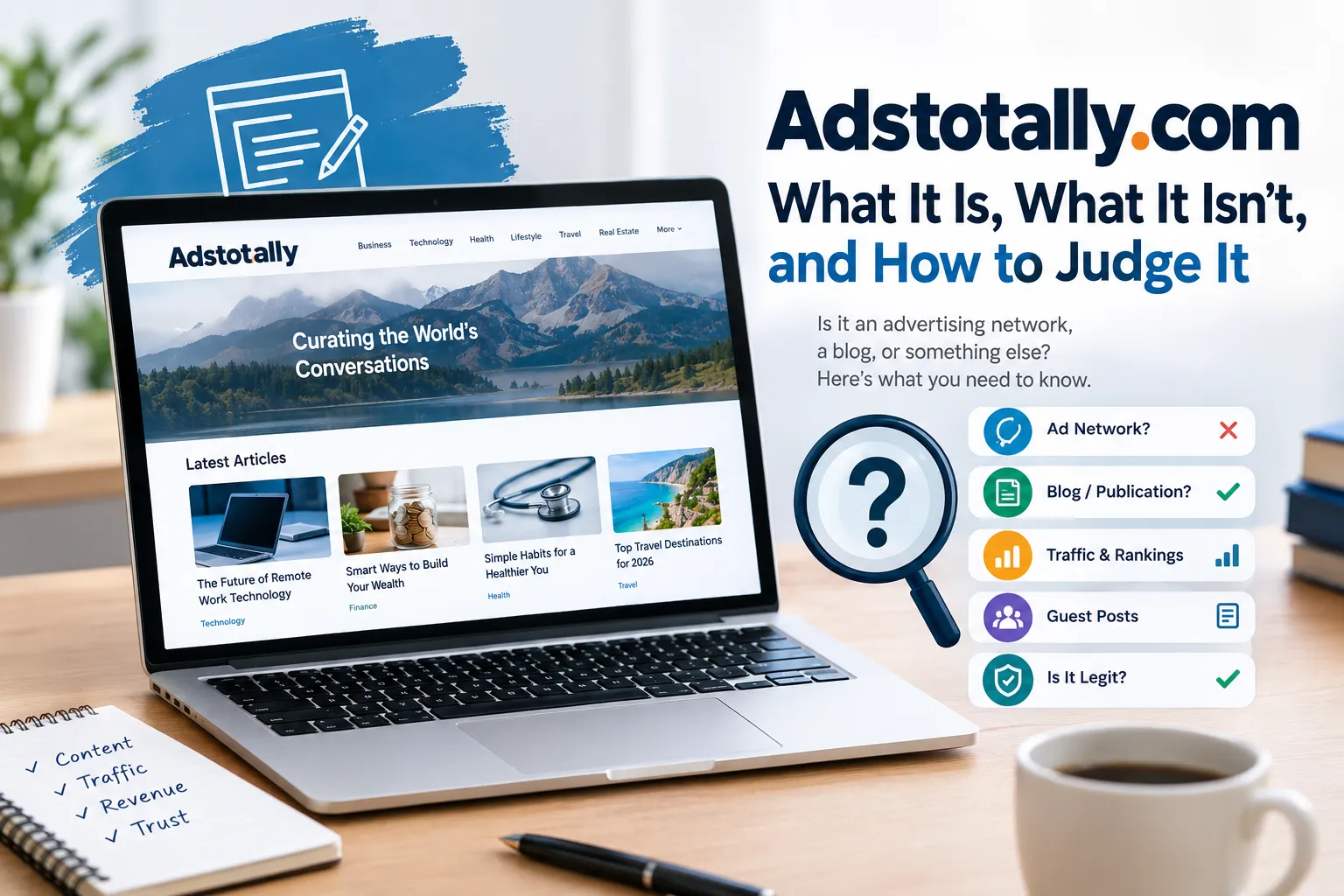
Adstotally.com is a general-interest online publication. According to an October 2026 review from the SEO software company Ranktracker, its navigation spans technology, finance, business, health, education, lifestyle, fashion, travel, real estate, home improvement, and law. The site’s tagline is “Curating the World’s Conversations,” and the reviewer describes it as a WordPress-style blog rather than a software product.

Public domain records, as summarized in that review, show the domain was registered in October 2018 and is paid through October 2030. A long registration history says nothing about article quality, but it does separate adstotally.com from a brand-new throwaway domain. The site also carries the usual policy pages, including a privacy policy, terms, a disclaimer, and a DMCA notice.

Is Adstotally.com an Advertising Network?

The name suggests so, but the evidence points the other way. Ranktracker looked for the features that define an ad platform and found no verified sign of a campaign dashboard, advertiser registration, publisher monetization portal, ad-code generator, impression reporting, or payout system. Besider Magazine, in a separate September 2026 analysis, reached a similar conclusion and said the site should not be treated as a normal ad network.

For context, a genuine ad network connects advertisers who want to buy placements with publishers who sell them. Advertisers build campaigns, set budgets, and choose audiences, while publishers install ad code and track earnings. Google AdSense is a familiar example from the publisher side. Nothing like that infrastructure has been documented at adstotally.com.

Why do some pages claim otherwise? Several unrelated sites describe adstotally.com as an advertising ecosystem, but Ranktracker noted that they offer no verifiable evidence for the features they list. A page on a separate domain, adstotally.org, calls the brand a digital marketing information platform, yet it qualifies almost every statement with the word “may.” Writing that describes what a site might do, rather than what it does, usually means nobody checked.

If you hoped to open an advertiser or publisher account, be careful. Reviewers found no such system on the real domain, so any page asking for payment details or login credentials in the name of an adstotally dashboard deserves suspicion.

What Does Adstotally.com Publish?

The range is wide. Ranktracker’s review lists indexed topics such as wealth building, cosmetic dentistry, statutes of limitation, remote-work cybersecurity, logistics, fashion, fantasy cricket, and online casinos. That breadth defines the site and limits it: a domain that moves from dentistry to gambling to cybersecurity has no clear specialty for readers or search engines to rely on.

Publishing activity is real but uneven. The review found posts dated June 2026, yet some category pages had gone years without updates, with the lifestyle section’s latest visible item dating to April 2021. The reviewer read that pattern as occasional contributed or commercial content rather than a staffed daily newsroom.

Who Writes the Articles?

Most indexed articles are credited to a generic account named adstotally, and the reviews did not find author bios, credentials, or editorial staff pages. A generic byline does not make an article wrong, but it removes accountability. That matters most for finance, health, law, and cybersecurity, where mistakes carry real consequences.

How Much Should You Rely on It?

Treat adstotally.com as a starting point, not a final authority. For anything involving your money, health, legal rights, or security, check claims against government agencies, regulators, medical organizations, or official product documentation. The same advice applies to any general-interest blog.

Why Do So Many People Search for Adstotally.com?

Different people arrive with different questions. Some expect an advertising platform and search for a login. Others saw the domain in a guest-post marketplace and want to know if it is worth paying for. Some are checking legitimacy, and SEO professionals are curious about its traffic. One name pulls four intents into the same search results.

Ranktracker’s data shows the scale of that curiosity, with a caveat. It estimates roughly 74,000 monthly US searches for the exact phrase adstotally.com, with the site ranking third. The reviewer called that figure unusually high for a site with such a modest content profile and advised against treating it as verified demand. Possible explanations include people typing the address into Google instead of the browser bar, interest generated by the many review pages about the site, and quirks in how keyword volumes are modeled. The evidence does not say which explanation dominates.

What Adstotally.com’s Traffic Estimates Can and Cannot Tell You

Ranktracker’s direct check of the domain, using data from August 2026, produced the following estimates.

MetricEstimate
Monthly organic visitsAbout 3,900
Share of traffic from the United States100%
Top keywordadstotally.com
Position for that keyword3
Share of traffic reaching the homepage100%
Estimated traffic value$0

These are modeled figures, not first-party analytics. Ranktracker combines ranking keywords with the clicks typically earned at each position and says plainly that the results are estimates. The pattern matters more than the total: nearly all measurable traffic comes from one country, one keyword, and one page, and it is branded, meaning people already looking for the site by name. That says little about whether individual articles attract readers.

The $0 traffic value is easy to misread. It does not mean the site earns nothing or that the domain is worthless. It means the one keyword driving traffic has no meaningful cost-per-click value.

Marketplace listings paint a very different picture. DR and DA are third-party authority scores from SEO tools, not Google metrics.

SourceReported monthly trafficAuthority metricListed price
Direct Ranktracker check, August 2026About 3,900Not shownNot applicable
Adoovy listing one92,498DR 57$90
Adoovy listing two80,293DR 53, DA 58$120
Accessily listing, last updated June 202518DA 49$77

These numbers cannot all describe the same site at the same moment. They may reflect different dates, tools, or settings, outdated data, or imported errors, and prices change often, so check current listings. The reliable way to settle it is first-party data, such as a recent Google Search Console screenshot or read-only analytics access.

Guest Posts and Paid Links on Adstotally.com

Adstotally.com is publicly listed for guest posts on at least two marketplaces, Adoovy and Accessily, at prices between roughly $77 and $120 depending on the seller. The Accessily listing advertises followed links, and its own text is inconsistent about whether a purchase includes one link or up to three. Resolve inconsistencies like that in writing before any money changes hands.

Paid links are where Google’s rules matter. Google’s documentation asks site owners to mark advertisements and paid placements with the sponsored value of the rel attribute, and it also accepts nofollow. Paid links that pass ranking credit can be treated as potential link spam. A followed, paid link with an exact-match commercial anchor and no disclosure is therefore the riskiest combination. “Do-follow” is a marketplace term, not a Google one, and no seller can promise that Google will count a given link.

Ranktracker’s verdict is worth weighing. It called a placement near the $120 price hard to justify as a traffic purchase, because article-level traffic is unproven and nearly all measurable visits go to the homepage. It saw more reasonable uses in a small SEO experiment, a brand mention, or a clearly labeled sponsored article where little referral traffic is expected.

Domain-level numbers do not transfer to a single post either. A site can draw thousands of homepage visits while a new article gets almost none, so judge a placement by comparable posts rather than the headline figure.

Is Adstotally.com Legit and Safe?

In the narrow sense, yes. It is a real, active site with a history dating to 2018, HTTPS, indexed content, and recent posts. That is different from being a recognized news organization, an ad platform, or a specialist authority, and reviewers did not clearly find a named owner, company, or editorial team in the indexed pages.

On safety, none of the reviews found evidence that ordinary visits install malware or demand sensitive information. Sensible habits still apply, since any general-interest site can link to outside businesses. Be extra careful with links promoting casinos, investment products, health products, and software downloads. The site has published gambling-related content, which is regulated and age-restricted in many places. Keep your browser updated, and never enter payment or login details on pages reached through unfamiliar links.

How to Check Any Website With a Misleading Name

The adstotally.com story is a useful reminder not to trust a domain by its name. This short routine works for any unfamiliar site.

  1. Read the homepage and main menu. Ask whether the site presents itself as a product, a publication, or something else, and whether the menu matches that claim.
  2. Look for the product itself. A real platform shows pricing, sign-up or login pages, and documentation. A site with only articles is a publication, whatever its name suggests.
  3. Find the About, Contact, and policy pages, and look for a named owner or company.
  4. Check article authors and dates, especially on finance, health, and legal topics.
  5. Confirm the exact domain. Lookalike addresses, such as the same name on a different extension, are common, and pages on those domains can describe the original site in ways the original never does.
  6. Compare several independent sources, and discount pages that hedge every claim or repeat each other.
  7. Before paying for any placement, request first-party analytics, confirm the link attribute in writing, and check whether a few recent posts are indexed.

Who Adstotally.com Suits and Who Should Look Elsewhere

Casual readers can treat adstotally.com as a general-interest blog and verify anything important elsewhere. Marketers who want a low-stakes mention or a controlled link test may find it usable, provided they ask for traffic proof and a sponsored or nofollow label. People hunting for advertising tools, ad accounts, or monetization services should look at established platforms directly, since this site does not appear to offer them.

Conclusion: What to Take Away About Adstotally.com

Adstotally.com is a real, active, general-interest publication whose name makes it sound like something else. The best available evidence shows no advertising tools, a broad mix of topics, mostly generic authorship, and traffic concentrated on branded homepage searches. Its guest-post listings carry conflicting metrics, and any paid link on it should be labeled sponsored or nofollow if you want to stay within Google’s guidelines.

Your next step depends on why you came. If you wanted to read, verify important claims elsewhere. If you wanted an ad platform, look at established networks directly. If you were weighing a paid placement, ask for first-party analytics before you spend anything.

This article draws on third-party reviews and public sources available as of October 31, 2026. Traffic, pricing, and ownership details are reported figures or estimates that can change, and nothing here is legal, financial, or investment advice. Verify details with first-party sources before making a purchasing or business decision.

Frequently Asked Questions

Is adstotally.com an advertising network?

No verified evidence says so. Independent reviews found no advertiser dashboard, publisher portal, or payout system on the site and describe it as a general-interest publication instead. Pages claiming otherwise generally do not show proof of those features.

Is adstotally.com legit?

It is a real, active website that has existed since 2018 and published new content in 2026. Legitimate does not mean authoritative, though: most articles carry a generic author name, and the site does not clearly identify an owner. Check important claims against primary sources.

Is adstotally.com safe to visit?

The reviews examined here found no evidence that browsing the site installs malware or requires personal information. As with any site, be cautious about outbound links to casinos, financial products, and downloads, and do not enter payment details on any page claiming to be an adstotally account area.

Does adstotally.com accept guest posts, and what do they cost?

It appears in public guest-post marketplaces, including Adoovy and Accessily, at prices between about $77 and $120 depending on the seller. Those prices and the traffic claims attached to them vary by listing and can change, so confirm them with the seller. Ask that paid links carry a sponsored or nofollow label.

Why does adstotally.com show different traffic numbers on different sites?

SEO tools estimate traffic with models, and marketplace listings may use older data, different settings, or imported errors. A direct Ranktracker check in August 2026 estimated about 3,900 monthly organic visits, while some listings claimed 80,000 or more. Only first-party analytics such as Google Search Console can settle the question.
SEO by HighSoftware99.com: What the Service Offers and How to Evaluate It

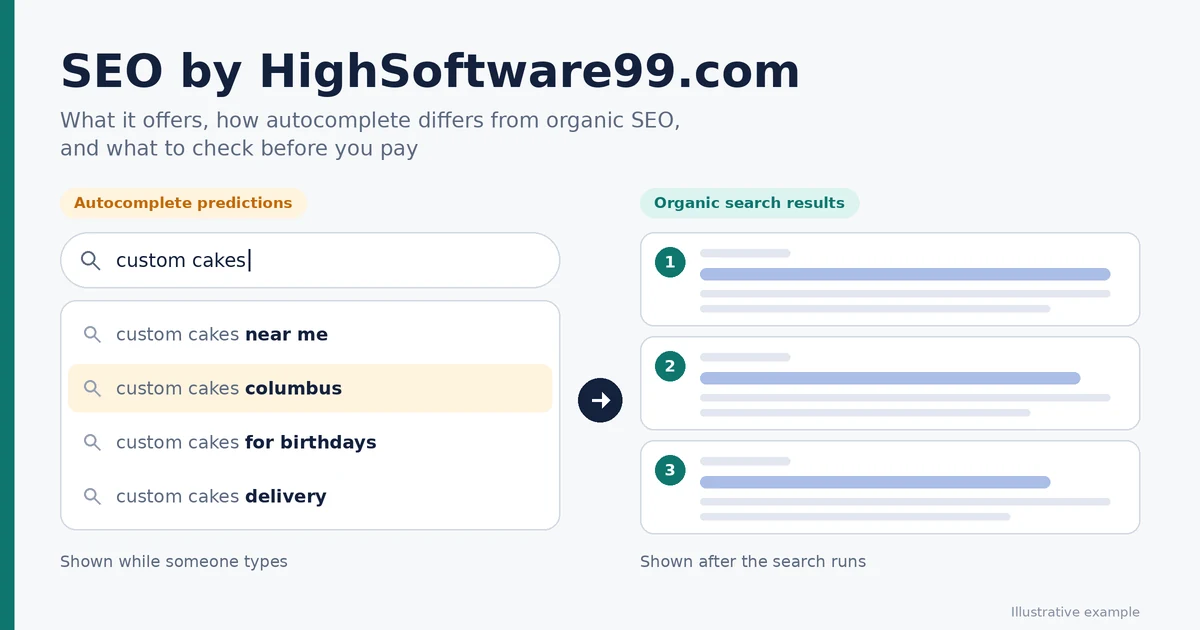
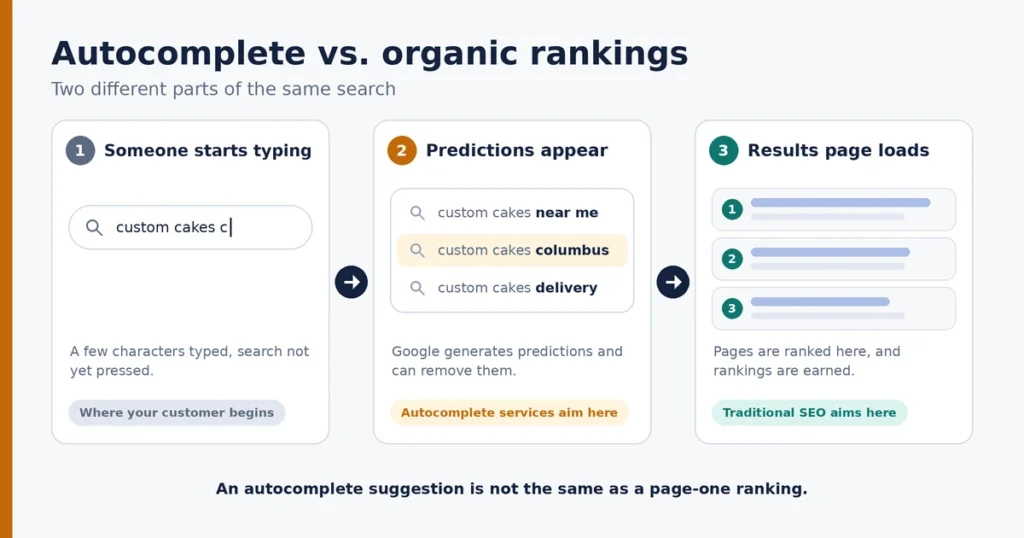
Guide to SEO by HighSoftware99.com showing a search box with autocomplete predictions beside search results

If you searched for SEO by HighSoftware99.com, you probably want a straight answer: what does the service actually do, and is it worth paying for? The picture online is muddy. HighSoftware99.com publicly promotes a Google Autocomplete service, while many articles describe it as a general SEO provider. This guide separates what the brand claims from what Google says, explains how autocomplete differs from traditional optimization, covers pricing questions, and gives you a practical checklist for judging any SEO provider before you commit money.

What Is SEO by HighSoftware99.com?

SEO by HighSoftware99.com is a phrase used to describe search-related services associated with the HighSoftware99.com website. It appears as a brand name, a search query, and an article title on many sites, which is part of why it is hard to pin down.

Search engine optimization, or SEO, is the work of making a website easier for search engines to crawl and understand, and more useful to the people who find it. That usually means technical fixes, helpful content, sensible site structure, and trustworthy links from other sites.

What sets this brand apart in public descriptions is a focus on Google Autocomplete, sometimes shortened to ATC. Autocomplete is the list of predicted searches that appears while someone types into the Google search box. It is a different thing from where a web page ranks in the results, and it is not an official Google service or certification.

Variations of the name add to the confusion. You may see “SEO Service HighSoftware99.com” and “SEO Instant Appear HighSoftware99.com” used for what appear to be the same or overlapping offerings. Knowing which version you are reading about matters before you spend money.

What the Public Website and Third-Party Pages Say

Third-party reviews that describe the HighSoftware99.com homepage say it presents an SEO service built around Google Autocomplete. The site reportedly claims that selected keywords can appear in autocomplete within about 3 to 12 hours, and it gives examples of searches in different geographic markets. Reviewers also note that the site lists broader services, including SEO and SEM, content creation, web design, brand strategy, and social media management.

An advertised timeframe is a claim, not a promise that every customer will see the same result. Reviews that mention the 3 to 12 hour figure generally treat it that way, and so should you.

Other websites using similar HighSoftware99 branding describe a more traditional offering: site audits, keyword research, on-page fixes, technical SEO, and regular reports. Some of these pages name different founders and different company histories, which cannot all be accurate for a single business. That does not prove wrongdoing, but it does mean you should confirm exactly which domain and company you are dealing with.

A large number of articles about this keyword are also generic. Many repeat standard SEO advice without offering evidence about the provider itself. Treat every third-party page, including this one, as a starting point, and ask the provider for written details before you pay.

Google Autocomplete and Traditional SEO: How They Differ

Because the brand is tied to autocomplete, the most useful step you can take is to understand how autocomplete differs from ordinary search rankings.

How Google Says Autocomplete Predictions Work

Google explains that automated systems generate predictions to help people finish a search they were already intending to perform. The predictions reflect common and trending queries related to what someone begins to type, and they can vary with the person’s language, location, and past searches.

Google also publishes autocomplete policies and says it removes predictions that violate them. It may remove predictions it determines to be spam, and when it acts on a reported prediction, it also reviews closely related ones. In plain terms, no business owns an autocomplete slot, and Google decides what stays.

Side-by-Side Comparison

Diagram comparing Google autocomplete predictions with organic search result rankings
FactorGoogle Autocomplete serviceTraditional SEO
What it targetsPredicted searches shown as someone typesWhere your web pages rank in search results
Advertised speedHours to days (HighSoftware99.com advertises 3 to 12 hours)Typically months
What you getA brand or keyword phrase appearing in a predictionOrganic traffic to your pages
DurabilityReportedly campaign-based, with ongoing paymentCan compound as pages and links accumulate
Main riskPredictions can change or be removed by GoogleSlow progress; results depend on competition and quality
Typical measuresWhether the phrase appears, and in which locationsImpressions, clicks, rankings, and conversions

What That Means for Durability and Risk

An autocomplete suggestion can influence what a person types, but it does not by itself bring visitors to your site. A prediction showing your brand name still depends on your website, reviews, and reputation once the person reaches the results page. Because predictions vary by location and can change or disappear, the results of any autocomplete campaign may not hold steady.

Traditional SEO is slower, but it tends to build assets, such as useful pages and earned links, that keep working after a given month of effort ends.

What a Complete SEO Program Covers

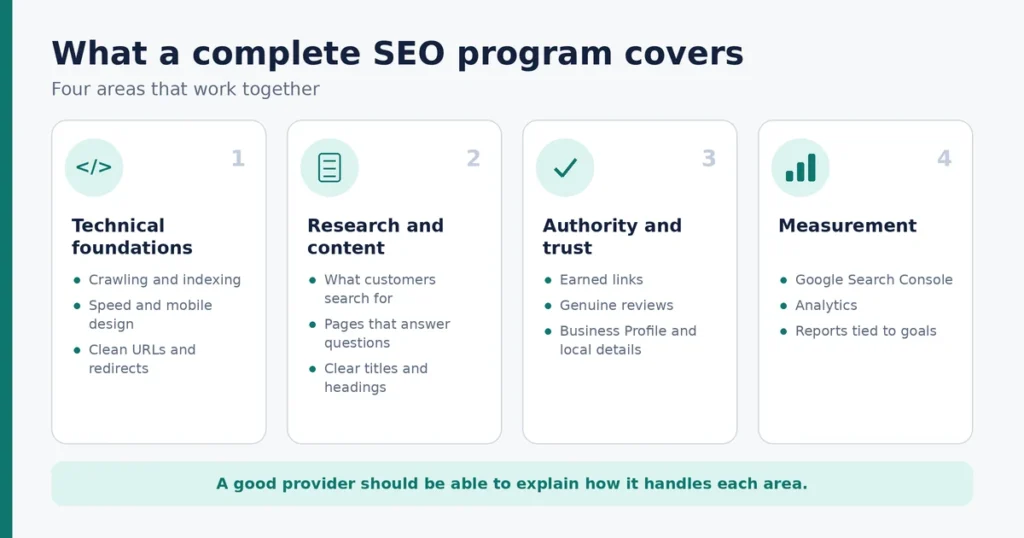
Four areas of a complete SEO program: technical foundations, content, authority and trust, and measurement

Whichever provider you choose, a full SEO program usually combines several areas of work. Seeing them laid out makes it easier to tell whether a service covers the basics or only one slice.

Technical foundations come first. Search engines need to crawl and index your pages, which means working internal links, a sensible URL structure, fast loading, mobile-friendly design, and clean handling of errors and redirects. A site that search engines cannot read properly will struggle no matter how good the writing is.

Keyword research and content come next. This is where you learn what your customers actually type and then create pages that answer those questions better than what already ranks. On-page work, such as clear titles, headings, and image descriptions, helps both people and search engines understand each page.

Authority and trust follow. Earning links from reputable sites, collecting genuine reviews, and showing real expertise all support rankings over time. Local businesses also need an accurate Google Business Profile and consistent name, address, and phone details across the web.

Finally, measurement ties everything together. Google Search Console and an analytics tool show which queries bring impressions and clicks, which pages convert, and where problems remain.

Imagine a bakery that wants more custom-cake orders. An autocomplete campaign might aim to show the bakery’s name when someone types “custom cakes” plus a city. A full SEO program would instead make sure the cake pages are indexable, load quickly on phones, answer common questions about pricing and lead times, and appear in local results with reviews behind them. The first approach may raise name recognition at the moment of searching. The second is what turns a search into an order, and many businesses need it even if they also test the first.

How Long Real SEO Results Take

Honest timelines are one of the clearest differences between real SEO and speed-focused services. A widely cited statement from Google’s Maile Ohye, in Google’s guidance on hiring an SEO, says it typically takes four months to a year for improvements to be implemented and to show results. Industry estimates are similar: many agencies cite three to six months for a typical site and six to twelve months for competitive markets or newer domains.

Several factors move that range. These include how competitive your keywords are, the age and authority of your domain, the technical health of your site, the quality of your content, and how consistently you publish and improve it. A local service with little competition may see movement sooner than a national online store.

One more point is worth stating plainly. Google has said it does not accept payment to rank sites higher, and no one outside Google can guarantee a number-one ranking. A promise of first-page organic rankings in hours or days should raise questions. The 3 to 12 hour claim associated with HighSoftware99.com applies, according to the descriptions available, to autocomplete visibility rather than organic rankings, and the two should not be confused.

Pricing and Cost Considerations

According to third-party reviews, HighSoftware99.com does not clearly display standard autocomplete prices on its main public website. Those reviews point to a seller marketplace listing that reportedly gives starting prices based on keyword competition, along with details on daily pricing, temporary campaign duration, geographic targeting, a one-day trial, and refund terms. Marketplace listings change, so treat any figure you find online as a lead to confirm rather than a quote.

One review warns that daily costs for competitive terms can reach hundreds or even thousands of dollars, which could add up quickly for a small business. That figure comes from a single third-party source and has not been independently verified, so ask for current numbers directly.

Before agreeing to anything, request written answers to these questions:

  • What is the price per keyword, per day, and per country?
  • What is the minimum campaign length?
  • What happens to the suggestion if you stop paying?
  • How is success defined and verified?
  • What are the refund and cancellation terms?

Traditional SEO pricing varies as well. Providers may charge monthly retainers, one-time audit fees, or hourly consulting rates. Compare offers by what is delivered, such as audits, content, fixes, and reporting, rather than by the monthly price alone. Prices and terms for any service can change, so confirm them before you buy.

Who Might Consider It, and Who Might Not

The right choice depends on the outcome you want. The table below matches common goals with sensible starting points.

Your goalLikely better starting point
Have your brand name appear when people begin typing a related searchAn autocomplete service may be relevant, once you have verified the provider and terms
Rank blog posts or service pages for non-brand keywordsTraditional SEO: content, technical health, and earned links
Attract nearby customersGoogle Business Profile, reviews, and location-specific pages
Get a brand-new site indexedGoogle Search Console, a sitemap, and basic technical fixes
Build steady traffic without ongoing campaign feesContent and authority building that compounds over time

The main caution is that autocomplete visibility is not the same as traffic or sales. A brand that appears in suggestions but has a slow site, thin pages, or few reviews may not convert those searches into customers. If you are unsure, fixing the fundamentals first is usually the safer investment, and an autocomplete test can come later with a small budget and clear written terms.

How to Evaluate Any SEO Provider Before Paying

The same checks apply whether you are looking at HighSoftware99.com or any other provider.

  1. Confirm identity. Find the legal business name, a physical or verifiable contact method, and the exact domain you are dealing with, especially when several sites share similar branding.
  2. Ask for a plain-language method. A reputable provider can explain what it does without hiding behind secrecy. If an explanation sounds like a black box, press for detail.
  3. Compare promises with Google’s guidance. Guaranteed rankings, instant results, and claims of a special relationship with Google are all warning signs.
  4. Request sample reports. Ask what metrics you will see, how often, and how they connect to business goals such as leads or sales.
  5. Read the terms. Look at contract length, refund policy, and who owns the work, accounts, and data.
  6. Check references. Ask for clients you can contact, and verify case studies rather than relying on testimonials alone.
  7. Start small. If a trial or short engagement is available, use it before committing to a long contract.

Whatever you decide, keep ownership of your own Google Search Console, analytics, and Business Profile accounts. That protects you if you ever change providers.

Disclaimer: This article is for general information. It draws on publicly available pages reviewed in 2026, and the claims, features, and prices of any service can change. It is not an endorsement of any provider and does not constitute financial or legal advice. Verify details directly with the provider before you buy.

Frequently Asked Questions

What is SEO by HighSoftware99.com?

It refers to SEO and digital marketing services associated with HighSoftware99.com. Public descriptions emphasize a Google Autocomplete (ATC) service, alongside broader offerings such as content creation and web design.

Is SEO by HighSoftware99.com an official Google service?

No. It is presented as a private company’s offering, not a Google product or certification. Google’s autocomplete predictions come from its own automated systems and are governed by its own policies.

Is appearing in Google Autocomplete the same as ranking on page one?

No. Autocomplete shows predicted searches while someone types, while rankings decide where web pages appear in the results. A suggestion may influence what people search for, but it does not guarantee that your website appears or earns clicks.

How much does SEO by HighSoftware99.com cost?

Third-party reviews say standard autocomplete prices are not clearly displayed on the main site, and a marketplace listing reportedly prices by keyword competition and country. Confirm current prices, campaign length, and refund terms in writing, since all of them can change.

How long does SEO take to show results?

Google’s guidance suggests four months to a year, and many agencies cite three to twelve months depending on competition and site condition. Faster movement is possible in low-competition niches, but it is never guaranteed.

Conclusion

SEO by HighSoftware99.com is best understood as a brand attached to a Google Autocomplete service, with broader marketing offerings described differently across the web. The advertised speed is appealing, but autocomplete visibility is not the same as organic rankings, and Google controls what its predictions show. For most businesses, lasting search visibility still comes from technical health, useful content, local signals, and patient measurement.

Your next step is simple. Write down the one outcome you want, whether that is brand visibility in suggestions or organic traffic to your pages. Then request written terms from any provider, test small if a trial is offered, and set up Google Search Console so you can track results on your own.

UploadWords.com Tech: Features, How It Works, Benefits, and What You Should Know

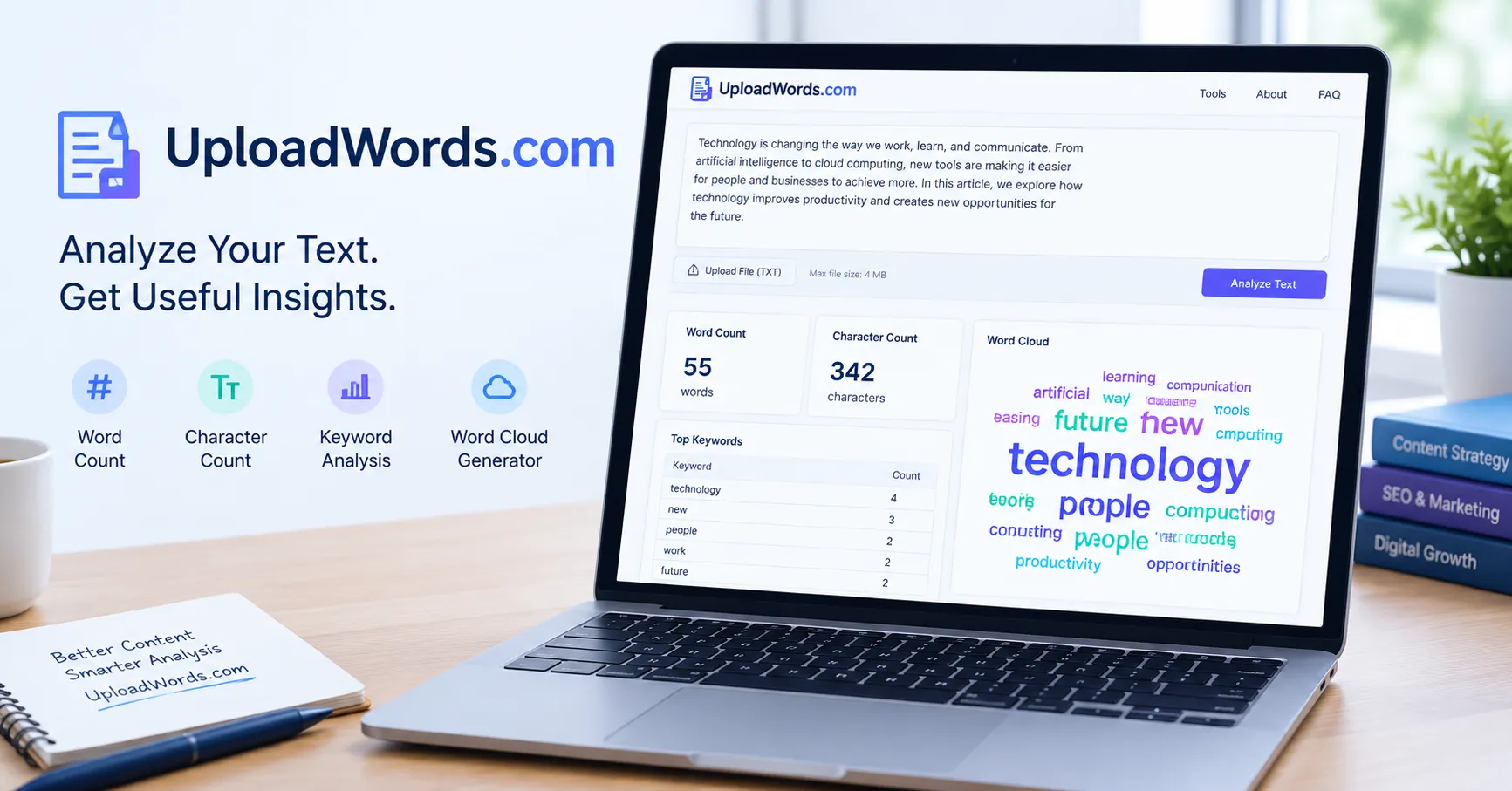
UploadWords.com text analysis tool with word count and keyword analysis

When people search for uploadwords com tech, they often want to understand what UploadWords.com offers, how its technology works, and whether it can help with everyday writing and content-related tasks. UploadWords.com is an online text-analysis tool designed to make it easier to check word counts, examine frequently used keywords, and visualize written content. It brings several basic text-analysis functions together in one browser-based platform. In this guide, we explore its features, practical applications, advantages, limitations, privacy considerations, and how different users can make the most of it.

What Is UploadWords.com Tech?

UploadWords.com is a web-based text-analysis platform that helps users examine written content without needing to install traditional desktop software. Its main purpose is to make common writing and text-review tasks simpler by bringing several useful functions into one place.

The term uploadwords com tech is generally used as a search phrase for information about the platform and its technology-related capabilities. It does not establish that there is a separate software company, mobile application, or US-specific version operating under that name.

The official website presents UploadWords as a free tool for students, writers, bloggers, and digital marketers. Users can work with text, check its length, identify frequently repeated words, and generate a visual word cloud.

Its main functions include:

  • Word counting to measure the length of written content.
  • Character counting to check the total number of characters.
  • Keyword frequency analysis to identify frequently appearing words.
  • Word cloud generation to visualize repeated terms.
  • Copy and export options to make results easier to reuse.

These functions are particularly useful when someone needs a quick overview of a document rather than a complete writing or editing application.

UploadWords is best understood as a lightweight text-analysis utility, not a replacement for advanced grammar software, professional SEO platforms, or cloud document-management systems.

How Does UploadWords Technology Work?

UploadWords follows a relatively simple process: users provide text, the platform analyzes it, and the results appear in an organized format.

This approach makes the tool accessible to people who may not have technical knowledge or experience with professional content-analysis software.

1. Enter or Paste Your Text

The first step is to visit the official UploadWords website and open its text-analysis tool.

Users can paste written content into the available input area. The tool also displays a file-upload option and currently lists TXT files as a supported format, with a maximum file size of 4 MB on its tool and FAQ pages.

It is important to check the current upload instructions before using this feature because the homepage has also displayed a message indicating that file uploads are coming soon. This inconsistency means users should verify the functionality directly rather than assume every upload method is available.

2. Analyze the Content

After entering the text, users can select the analysis option to generate results.

The platform provides information about the number of words and characters. It also identifies frequently appearing words, helping users understand which terms are repeated throughout the document.

These measurements can help with editing, content organization, and basic keyword analysis.

3. Review the Results

The results are presented in separate sections, making them easier to understand.

For example, a student can check whether an assignment meets a required word count, while a blogger can examine which terms appear most frequently in an article.

The platform also provides a word cloud, which turns frequently used words into a visual representation.

4. Copy or Download the Output

After reviewing the results, users can use the available copy options or download the generated word cloud as a PNG image.

This can be useful when preparing writing reports, documenting content research, or sharing a visual summary with colleagues.

Main Features of UploadWords.com

The usefulness of UploadWords comes from combining several basic text-analysis features instead of requiring users to visit multiple websites for simple writing tasks.

Word Count and Character Count

Word counting is one of the most common requirements in writing.

Students may have assignment limits, bloggers may work with editorial guidelines, and professional writers may need to deliver content within a specified length.

UploadWords helps users check these measurements without manually counting words.

Character counting is equally useful for tasks such as preparing short descriptions, social media content, and text with character restrictions.

However, different applications can calculate words and characters differently, particularly when dealing with punctuation, special symbols, numbers, and unusual formatting. For important submissions, users should compare the result with the requirements of the destination platform.

Top Keyword Analysis

The top keyword feature identifies words that appear frequently in a particular piece of writing.

This can help writers recognize repeated terminology and understand which subjects dominate their content.

For example, someone writing an article about home renovation might discover that words such as renovation, materials, contractor, and costs appear frequently.

The information can support content editing by highlighting repetitive language or showing whether important subject-related terms are present.

UploadWords also describes options for removing common stopwords and adjusting the minimum word length. These settings can make keyword lists easier to interpret.

It is important to understand that keyword frequency is not the same as search volume, keyword difficulty, or search intent. The tool examines the text provided by the user; it does not replace professional keyword research.

Word Cloud Generation

A word cloud presents frequently used terms in a visual format.

Words that appear more often generally receive greater visual prominence, making it easier to identify recurring themes without reading the entire frequency list.

For example, a marketing team reviewing customer feedback might use a word cloud to identify recurring topics. A student could also use one to present the main themes of a research document.

UploadWords provides a word cloud preview and a PNG download option, according to its official tool information.

Copy and Export Options

Copying results can save time when users need to transfer information into another document or report.

The platform also offers a download option for its word cloud, which can be useful for presentations and visual documentation.

These features are practical additions for users who want to reuse their analysis rather than simply view it on the website.

Who Can Benefit From UploadWords.com?

UploadWords is designed for people who regularly work with written information. Its basic functionality makes it relevant to several different audiences.

Students and Researchers

Students often need to follow specific word-count requirements when preparing essays, assignments, reports, and research documents.

A word-count tool can help them check the length of their writing before submitting their work.

Keyword frequency can also help students identify recurring concepts in their research. A word cloud may provide a simple visual representation of the themes discussed in a document.

However, these features do not evaluate academic quality, verify research sources, or determine whether an assignment meets its marking criteria.

Bloggers and Content Writers

Bloggers and professional writers frequently review their drafts before publishing.

UploadWords can help them identify repeated words, check article length, and gain a basic understanding of the terms used throughout their content.

For example, a writer preparing a 1,500-word article can use the tool to check the approximate length and identify words that appear unusually often.

This is particularly useful during the editing stage, when the writer wants to improve readability without manually examining every sentence.

SEO Professionals and Digital Marketers

Search engine optimization involves understanding both the subject of a page and the needs of its intended audience.

UploadWords can support basic content reviews by showing which words occur most frequently in an article.

An SEO professional might use this information to identify excessive repetition, review terminology, or compare different content drafts.

However, it should not be confused with tools that analyze search demand, backlink profiles, competitor rankings, or keyword difficulty.

For effective SEO, keyword frequency should be considered alongside search intent, topical relevance, content quality, and the usefulness of the information being published.

Businesses and Marketing Teams

Businesses produce different types of written material, including product descriptions, reports, newsletters, website content, and marketing documents.

A simple text-analysis utility can help teams review these materials before publication.

For example, a marketing manager could check the length of a product description or examine frequently repeated terms across a draft campaign.

The tool may also help small teams that need basic text measurements without purchasing a larger software subscription.

How to Use UploadWords.com Effectively

Getting useful results from a text-analysis platform depends on how the tool is used. The following approach can help users get more value from its features.

Step 1: Prepare Your Document

Before analyzing your text, make sure you have a reasonably complete draft.

Remove unnecessary formatting or unrelated material if your goal is to examine only the main article or document.

For example, when reviewing a blog post, you may want to analyze the article body separately from navigation labels, advertisements, and unrelated website content.

Step 2: Open the Official Website

Visit UploadWords.com and navigate to its Upload Words tool.

Using the correct domain is important because similarly named websites or unrelated services may appear in search results.

Step 3: Add Your Content

Paste your text into the input area or use the supported TXT upload option when available.

Check the current file requirements before attempting to upload a document in another format. The official FAQ lists TXT support and a 4 MB maximum file size, while DOCX support is described as a possible future addition.

Step 4: Review Word and Character Counts

Check the displayed measurements against your writing requirements.

If you are preparing an assignment, compare the result with your instructor’s word-count rules. If you are preparing website content, consider the editorial requirements of your publication.

Step 5: Examine Frequently Used Words

Review the keyword frequency results to identify repeated terms.

If a particular word appears too frequently, consider whether some instances can be replaced with more natural expressions.

Do not remove important terminology simply to make the frequency list look balanced. Clarity and meaning should remain more important than achieving an arbitrary keyword distribution.

Step 6: Generate and Save the Word Cloud

If you need a visual summary, review the word cloud and use the available PNG download feature.

You can then include the image in a presentation, research document, or internal report where appropriate.

Benefits and Limitations of UploadWords.com

Like other online utilities, UploadWords has advantages as well as limitations. Understanding both can help users decide whether it is appropriate for their particular requirements.

Main Benefits

One of its main advantages is simplicity. Users do not need extensive technical knowledge to check basic text measurements.

The platform also advertises free access without requiring users to create an account for its core functionality.

Another benefit is convenience. Word counting, keyword frequency, and word cloud generation are available within the same tool, reducing the need to switch between several separate utilities.

Its browser-based approach also makes it accessible across devices with a compatible web browser and internet connection.

Important Limitations

UploadWords is not designed to perform every type of content-related analysis.

Its keyword frequency feature does not establish whether a particular keyword has strong search demand or whether a page can rank for it.

It also does not replace comprehensive grammar checking, plagiarism detection, fact-checking, or professional content optimization.

File-format support should be checked before use, particularly because the website’s homepage and FAQ currently present different information about file uploads.

Users should also understand that an automatically generated word count may differ from the measurement used by another application.

For professional work, important results should be checked against the requirements of the software or organization receiving the document.

Is UploadWords.com Safe and Private to Use?

Privacy is an important consideration whenever someone enters written content into an online tool.

UploadWords describes itself as a privacy-focused platform. Its About page states that text is processed in the browser for analysis, while its FAQ says that submitted text is not saved as a public document or shared with third parties.

These are statements made by the website itself, rather than independent security audit findings.

Users should therefore distinguish between the platform’s published privacy claims and independently verified security guarantees.

For ordinary writing tasks, users may find the stated approach convenient. However, it is sensible to avoid entering confidential business information, passwords, financial records, private client documents, or sensitive personal information into any online utility unless its data-handling practices have been independently assessed.

Before using a free online service regularly, consider reviewing its privacy policy, terms of use, and contact information.

You should also access the service through its official domain rather than downloading software from unfamiliar websites claiming to offer an alternative version.

UploadWords.com vs. Other Online Text-Analysis Tools

UploadWords is one option in a wider category of online writing utilities. Different tools serve different purposes, so the best choice depends on the type of analysis required.

Tool categoryMain purposeBest suited for
Word countersMeasure words and charactersStudents and writers
Keyword frequency toolsIdentify repeated wordsContent editors and marketers
Word cloud generatorsVisualize recurring termsResearchers and presenters
Grammar checkersIdentify writing and grammar issuesProfessional writers
SEO research platformsAnalyze search demand and competitorsSEO professionals

UploadWords combines several basic functions, including word counting, keyword frequency, and word cloud generation.

A dedicated grammar checker is more appropriate when the main objective is improving sentence structure, spelling, or punctuation.

Similarly, professional SEO platforms are more suitable for researching search volume, ranking difficulty, competitor performance, and backlink opportunities.

The important distinction is that these tools solve different problems. A basic text-analysis utility can complement a professional workflow, but it should not be expected to replace every specialized application.

Frequently Asked Questions About UploadWords.com Tech

1. What is uploadwords com tech?

Uploadwords com tech is a search phrase associated with UploadWords.com and its technology-related text-analysis features. The platform provides tools for checking word counts, character counts, keyword frequency, and word clouds.

2. Is UploadWords.com free to use?

Yes. UploadWords describes its core text-analysis service as free, with no account or subscription required. Check the official website for the latest information about available features.

3. Does UploadWords.com require software installation?

No desktop installation is advertised as necessary for its basic browser-based tool. Users can access the service through its official website using a compatible web browser.

4. Can UploadWords.com help with SEO content?

Yes, it can support basic SEO content reviews by identifying frequently repeated words and checking article length. However, it does not replace keyword research, competitor analysis, search-volume data, or a complete SEO strategy.

5. Can I upload Word or PDF documents to UploadWords?

The official FAQ currently lists TXT files as supported and identifies DOCX support as a possible future feature. PDF uploads are not confirmed in the current tool information, so users should check the latest supported formats before attempting to upload these documents.

Conclusion

UploadWords.com offers a straightforward way to examine written content through word counting, character counting, keyword frequency analysis, and word cloud generation. Its browser-based approach and advertised free access make it a practical option for students, bloggers, writers, and marketers who need basic text insights.

However, it is important to understand what the platform can and cannot do. It is not a complete SEO research system, advanced writing assistant, or cloud-storage service. Its best use is as a supporting utility within a broader writing and content-review process.

If you want to understand the features before using the service, visit the official UploadWords website, review its current tool instructions, and choose the functions that match your requirements.

BacktoFrontShow Pricing: Plans, Costs, Features, and What to Know in 2026

backtofrontshow pricing

If you’re searching for backtofrontshow pricing, you probably want to know how much the service costs, what each plan includes, and whether the features justify the expense. The name can also cause confusion because the website contains references to an older technology podcast as well as pages presenting a podcast analytics platform. Understanding that distinction is important before making a purchasing decision. This guide examines the publicly displayed prices, advertised features, potential annual costs, pricing uncertainties, and practical checks you should complete before paying for a subscription.

1. What Is BacktoFrontShow?

BacktoFrontShow currently presents itself as a podcast analytics platform. According to its website, the service is intended to help podcasters and media teams understand listener demographics, episode performance, engagement, listening patterns, and audience behavior.

The advertised concept is straightforward: instead of relying only on download counts, a creator could use analytics dashboards to explore how audiences interact with episodes and where listeners are located.

However, there is an important distinction between advertised features and independently verified product capabilities. The website describes these functions, but the available public information does not establish that every feature is operational or available to paying customers.

What does the platform claim to offer?

The website lists several analytics categories:

  • Listener demographics and geographical insights.
  • Episode performance tracking.
  • Listening trends and audience behavior.
  • Engagement and feedback analysis.
  • Customizable reports and dashboards.
  • Additional analytics and integrations for higher-tier plans.

These capabilities would be useful in a functioning podcast analytics product. For example, a media team might compare episode performance, investigate changes in engagement, or prepare reports for advertising partners.

The important question is whether BacktoFrontShow can actually deliver those capabilities, how its data is collected, and whether its service justifies the advertised cost.

2. BacktoFrontShow Pricing at a Glance

The current BacktoFrontShow website displays three pricing tiers: Basic, Pro, and Enterprise. The first two have published monthly prices, while Enterprise requires a pricing inquiry.

The following table reflects the amounts displayed on the website, not independently confirmed commercial offers.

PlanDisplayed monthly priceAdvertised focus
Basic$1,200Core audience and episode analytics
Pro$3,600Additional audience growth and engagement analytics
EnterpriseCustom quotePredictive analytics and business integrations

The listed prices are unusually high for individual podcasters, so it is particularly important to verify the product before considering a subscription.

There is also a significant limitation: a price appearing on a website does not, by itself, prove that a service is established, available, or capable of delivering the advertised features.

Before treating these figures as a confirmed quote, contact information, business identity, product access, billing terms, and the actual purchasing process should all be independently verified.

What should you understand about these prices?

The Basic and Pro figures are presented as monthly rates. The website does not clearly establish a discounted annual subscription or provide enough publicly verifiable commercial details to calculate the complete cost of ownership.

Enterprise pricing is not publicly fixed. Its final cost, if the service and offer can be verified, would need to be established through a written quotation.

3. BacktoFrontShow Basic Plan: Features and Cost

The Basic Plan is the lowest-priced tier shown on the website, at $1,200 per month.

Its advertised features include listener demographics analysis, episode performance tracking, listening trends, customizable reporting, feedback analysis, and accessibility and compliance features.

These functions suggest a product intended to provide more detailed audience information than a basic episode counter.

What could the Basic Plan help you understand?

In a working analytics platform, demographic reporting might help a podcast team understand the broad characteristics of its audience. Episode tracking could help identify which subjects attract more attention, while listening trends might reveal changes in audience behavior over time.

Custom reports could also make it easier to present performance information to a marketing department or advertising partner.

Consider a hypothetical business podcast that publishes four episodes each month. Its team might want to compare episode performance, identify topics that attract listeners, and prepare a monthly report. A suitable analytics tool could simplify that process.

However, this example illustrates a possible use case, not a verified BacktoFrontShow customer experience.

Is Basic suitable for beginners?

The Basic tier is described as an entry-level option, but its advertised $1,200 monthly price makes it difficult to recommend to an individual creator without substantial verification.

A new podcaster should first determine whether the proposed insights are unavailable through the existing podcast hosting service or other established analytics options.

For an established media business, a premium analytics subscription might be worth evaluating if it provides demonstrably useful information. Yet that decision requires real product access, a transparent agreement, and evidence that the reporting is accurate.

4. BacktoFrontShow Pro Plan: What Does It Add?

The Pro Plan is listed at $3,600 per month, three times the advertised Basic price.

According to the website, it includes the Basic features along with additional capabilities related to audience growth and churn, segmentation, targeting, and engagement metrics.

These additions suggest that Pro is intended for organizations seeking more detailed audience analysis rather than simple episode reporting.

Audience growth and churn analysis

Audience growth analysis helps a publisher examine how its audience changes over time. Churn generally refers to users or subscribers who stop engaging with a service or discontinue a subscription.

For podcasts, the exact meaning of churn depends on the data available. A podcast listener who stops downloading episodes is not necessarily the same as a paid subscriber who cancels a membership.

Before buying a tool that advertises churn analysis, ask how it defines the metric, which platforms supply the underlying data, and whether its measurements are based on observed behavior or estimates.

Audience segmentation and engagement

Segmentation means dividing an audience into meaningful groups. Depending on the available data, a media business might compare listener groups by geography, listening habits, or engagement patterns.

Such insights can support decisions about episode topics, distribution, and promotional campaigns.

However, the website’s feature descriptions do not fully explain its segmentation methods, data sources, measurement accuracy, or technical requirements. Those details need confirmation before a buyer can assess the practical value of Pro.

Is the upgrade worth three times the price?

The price difference between the advertised tiers is $2,400 per month.

That is a substantial increase. A buyer should therefore ask for a live demonstration showing exactly what Pro adds, which reports are exclusive to the tier, and how those features improve on the Basic experience.

A longer feature list alone is not sufficient justification for paying three times as much.

5. BacktoFrontShow Enterprise Pricing and Features

The Enterprise Plan has no publicly displayed fixed price. The website directs interested users to contact the company for pricing.

Its advertised features include predictive analytics, marketing and CRM integrations, customizable reports, user behavior tracking, and accessibility and compliance functions.

These capabilities would generally be relevant to organizations with more complex reporting needs, multiple stakeholders, or existing marketing systems.

Why is Enterprise pricing custom?

Business software providers sometimes negotiate enterprise contracts according to the number of users, data volume, integrations, support requirements, and level of customization.

Those are common factors across enterprise software, but the available BacktoFrontShow information does not establish which factors determine its own quotation.

A prospective customer should request a written breakdown covering:

  • The total subscription fee and billing frequency.
  • Any implementation or onboarding charges.
  • The number of users, shows, or data sources included.
  • Integration requirements and additional fees.
  • Support availability and response commitments.
  • Contract length, renewal terms, and cancellation conditions.

These details help an organization understand the actual financial commitment rather than focusing solely on the headline price.

Should a business request an Enterprise quote?

Only after establishing that the vendor is legitimate and the product is available.

For a high-cost software purchase, request a live demonstration, a trial using a clearly defined agreement, and written documentation of the service being purchased. Confirm the business’s legal identity and the identity of the party receiving payment.

Do not treat an Enterprise sales form or an advertised list of advanced features as proof of a functioning business.

6. How Much Does BacktoFrontShow Cost Per Year?

Annual budgeting provides a clearer picture of the commitment implied by the displayed monthly prices.

The following figures are simple calculations using the published monthly amounts. They are not confirmed annual subscription offers.

PlanMonthly amount displayedCalculation12-month equivalent
Basic$1,200$1,200 × 12$14,400
Pro$3,600$3,600 × 12$43,200
EnterpriseCustomNot calculableUnknown

The Basic calculation equals $14,400 over 12 months, while Pro equals $43,200. These amounts assume the monthly rates remain unchanged throughout the year.

They do not account for taxes, possible implementation charges, currency conversion, or other fees. The website’s publicly displayed information does not establish whether any of those charges apply.

How should you assess the financial commitment?

Start by comparing the subscription cost with the value the tool could reasonably provide.

Suppose an organization is considering a $1,200 monthly subscription. It should identify the specific decisions the analytics will improve, the work the software might save, and the measurable business outcomes it expects to influence.

The tool would need to produce sufficient value to justify the expense. That value should be assessed through a trial or verified demonstration rather than assumed from marketing claims.

Also, distinguish between a monthly price and the minimum contract commitment. A service advertised at a monthly rate might still require a longer contract, so confirm the cancellation and renewal terms before agreeing to anything.

7. Is There a Free Trial or Free BacktoFrontShow Plan?

The website includes links labeled “Start free Trial” and calls to action such as “Request Access.” However, the public information reviewed does not clearly establish the trial duration, eligibility requirements, billing conditions, or the features included during trial access.

It would therefore be inaccurate to promise that every user can access a free trial or that the service offers a permanent free plan.

What should you confirm before requesting access?

Ask the vendor to explain the following details in writing:

  1. Whether a free trial is currently available.
  2. How long the trial lasts and which features it includes.
  3. Whether payment information is required to start.
  4. Whether the trial automatically converts to a paid subscription.
  5. How to cancel and whether cancellation carries any charges.

If a representative offers trial access, verify that the offer comes from the legitimate business operating the product. Do not provide payment information or sensitive business data simply because a website displays a trial button.

A clearly defined trial should let you understand what you are testing, when access ends, and whether any payment obligation applies.

8. Why Is BacktoFrontShow Pricing Information Confusing?

Search results contain conflicting explanations of BacktoFrontShow. Some pages repeat the $1,200 Basic and $3,600 Pro figures, while others describe the name as a reference to an older technology podcast that did not charge listeners a subscription fee.

The key is to distinguish what can be observed from what has actually been verified.

The older Back to Front Show podcast

The Back to Front Show was associated with web development, design, and technology discussions. Historical material identifies Keir Whitaker and Kieran Masterton as its hosts.

That historical podcast should not automatically be treated as the same product as the analytics platform described on the current website.

The existence of archived podcast episodes does not establish that a separate commercial analytics service is operated by the same people or organization.

The current analytics website

The current website presents BacktoFrontShow as a podcast analytics platform and displays subscription prices. However, a displayed pricing page is not independent confirmation that the service is operational or that customers can purchase and use the advertised software.

The public information reviewed does not sufficiently establish the relationship between the older podcast and the current commercial offering.

This uncertainty matters because buyers need to know exactly which business they are dealing with, what product they will receive, and who is responsible for delivering it.

How can you verify the information?

Use a careful verification process before trusting any pricing guide.

  • Check whether the official website provides a working, verifiable product demonstration.
  • Look for a clearly identified legal business and responsible representatives.
  • Search for independent customer reviews that can be authenticated.
  • Request technical documentation explaining data sources and integrations.
  • Confirm the billing entity, refund policy, contract terms, and customer support arrangements.

Do not assume that multiple websites repeating the same price independently confirm it. Several articles can repeat a claim without establishing its original source.

For this reason, the $1,200 and $3,600 amounts should be treated as website-displayed prices rather than independently verified offers.

9. Is BacktoFrontShow Worth the Price?

Whether a podcast analytics platform is worth its price depends on its reliability, the usefulness of its reports, and the business decisions it helps improve.

For BacktoFrontShow specifically, the advertised pricing is clear enough to compare mathematically, but the available public evidence is not sufficient to establish that the service delivers the stated features or represents good value.

When might premium podcast analytics make sense?

A premium analytics service may be worth evaluating when an established media organization needs reporting that its current tools cannot provide.

For example, a network managing several shows might need consistent performance reports, detailed audience segmentation, or information that supports advertising decisions.

In that situation, the potential value depends on measurable improvements. A business should identify the reports it needs, verify that the tool can generate them accurately, and compare its total cost with practical alternatives.

When should you look elsewhere?

A beginner or independent podcaster may not need an expensive analytics platform.

If your main goal is to monitor episode performance, understand basic audience trends, or measure growth, start by reviewing the reporting features available through your existing podcast host and other established tools.

Before committing to BacktoFrontShow, verify the service’s availability and business identity. If those checks cannot be completed, do not pay based on the published price alone.

The sensible approach is to compare demonstrated functionality and trustworthy support, not just plan names or feature lists.

10. How to Choose a Podcast Analytics Tool Before Paying

If your real goal is to understand podcast performance, use a consistent evaluation process. This makes it easier to compare products fairly and avoid spending money on features you will never use.

Step 1: Define your reporting needs

Write down the information you actually need. It might include episode downloads, audience geography, listening behavior, engagement, advertising attribution, or reports for business partners.

Prioritize essential metrics instead of choosing a tool because it advertises the largest number of features.

Step 2: Check the data sources

Ask where the analytics come from and whether the tool connects to your podcast hosting provider or distribution platforms.

Different services can measure different events, so apparently similar metrics may not be directly comparable. Confirm how each metric is calculated and what limitations apply.

Step 3: Test the product

Where a legitimate trial is available, test it using your own podcast data if possible.

Check whether the dashboards work as expected, the reports are understandable, and the information helps answer real business questions. Verify any claims about automation, integrations, or predictive analytics.

Step 4: Compare total costs

Review the full commercial agreement, including recurring fees, onboarding, extra users, integrations, taxes, and cancellation terms where applicable.

For BacktoFrontShow, do not assume that the displayed monthly prices are confirmed purchase offers until the vendor and product have been independently verified.

Step 5: Make the decision using evidence

Choose a service only when you can verify its capabilities, support arrangements, data practices, and pricing.

A useful analytics tool should make your work more informed or efficient. It should not require you to accept unclear terms or rely entirely on unverified claims.

Conclusion

BacktoFrontShow pricing is presented on its website as $1,200 per month for Basic, $3,600 per month for Pro, and custom pricing for Enterprise. However, these are displayed prices, not independently verified commercial offers. The available public information does not conclusively establish the service’s operational status, customer base, or relationship with the older Back to Front Show podcast.

Before purchasing, verify the business identity, request a genuine product demonstration, and obtain written confirmation of the price, contract terms, and features. If your goal is simply to improve podcast performance, compare established analytics options before making an expensive commitment. A careful evaluation will help you make a better-informed decision and avoid paying for a service you cannot adequately verify.

Frequently Asked Questions

1. How much does BacktoFrontShow cost per month?

The website displays Basic at $1,200 per month, Pro at $3,600 per month, and Enterprise at a custom price. These amounts should be independently confirmed before purchase because the availability of the advertised service has not been conclusively verified.

2. Does BacktoFrontShow offer a free trial?

The website displays a “Start free Trial” link, but the available public information does not clearly establish the trial duration, eligibility, or billing conditions. Confirm the complete terms before submitting payment details.

3. What is the difference between BacktoFrontShow Basic and Pro?

Basic advertises core audience demographics, episode tracking, listening trends, and reporting. Pro adds advertised capabilities such as audience growth and churn analysis, segmentation, and additional engagement metrics, although the actual functionality requires verification.

4. Is BacktoFrontShow a legitimate podcast analytics platform?

The website presents itself as a podcast analytics platform, but that description alone does not establish its legitimacy or operational status. Verify the business identity, working product, independent customer evidence, and contractual terms before sharing information or making a payment.

5. Is BacktoFrontShow the same as the original Back to Front Show podcast?

Not necessarily. Historical pages associate The Back to Front Show with web development and technology discussions hosted by Keir Whitaker and Kieran Masterton. The current website advertises an analytics platform, and the relationship between the two has not been conclusively established.

Research Dossier for Target Company: How to Build One Step by Step

Illustration of a company research dossier folder with a checklist and magnifying glass.

A research dossier for a target company pulls everything you know about an organization into one document: what it sells, how it earns money, who runs it, what could go wrong, and what you should do next. If you are preparing a sales pitch, weighing an acquisition, studying a competitor, or heading into a final-round interview, scattered notes and a dozen open browser tabs rarely lead to confident decisions. This guide explains what belongs in a company dossier, where to find reliable U.S. sources, how to build the document step by step, and how to keep your research accurate and ethical.

What a Research Dossier for a Target Company Is (and Isn’t)

A research dossier is a structured file that collects verified information about one organization and interprets it for a specific purpose. It differs from a basic company profile, which lists facts such as headquarters, headcount, and products. A dossier ties those facts to a decision you need to make.

The word “target” matters. You are not researching the company out of curiosity; you want something from it or about it, whether that is a contract, an investment, a partnership, a competitive edge, or a job offer. That purpose decides what you include, how deep you go, and what you leave out.

A dossier also differs from formal due diligence. Due diligence in a transaction is usually handled by lawyers, accountants, and advisers, and it often relies on confidential documents the target shares during negotiations. A dossier is built from the outside in, mostly from public information, and it usually comes first. It tells you whether a deeper review is justified.

When a Company Dossier Is Worth Building

Almost any high-stakes conversation with or about a company benefits from one, but the right depth depends on what is at risk.

Use caseCore questionTypical depth
B2B sales and account planningWhy would this company buy, and why now?Medium
Investment screeningIs the business sound and reasonably valued?Deep
Acquisition or partnership screeningIs this a safe and strategic fit?Deep
Competitive intelligenceWhere is this rival heading?Medium to deep
Job interview preparationIs this employer stable, and where is it going?Light

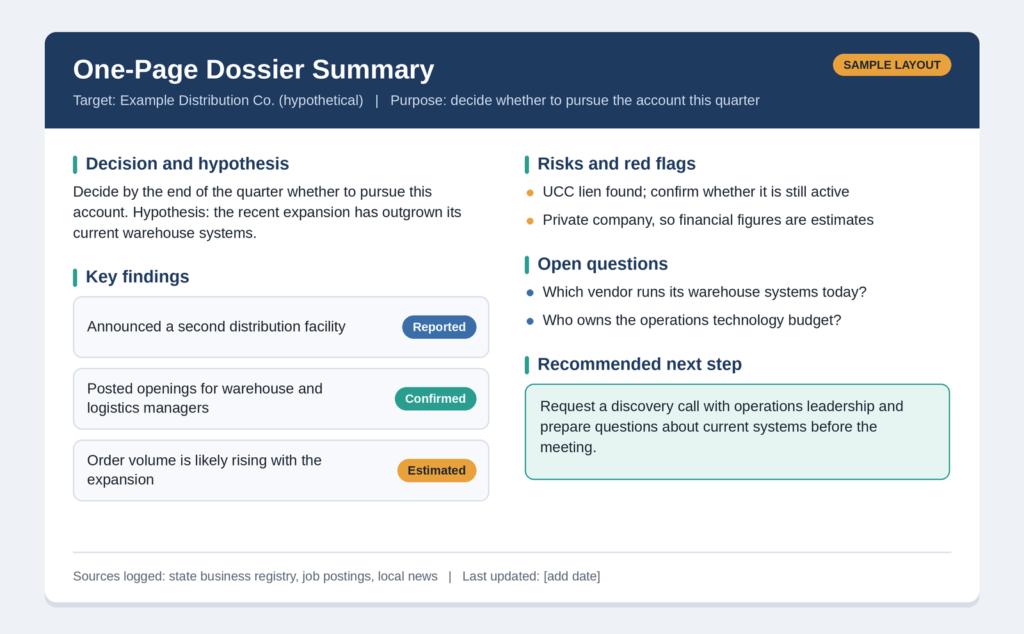
A light dossier may need only a few pages, while an acquisition screen can run far longer. Either way, open with a one-page summary so a busy reader gets the conclusion first.

What to Include in a Company Dossier

Most strong dossiers share the same building blocks. The table lists each one, the question it answers, and where the answer usually comes from.

SectionWhat it answersTypical sources
Purpose and hypothesisWhat decision does this support, and what do I expect to find?Your own notes, written before research starts
Company snapshotLegal name, ownership, headquarters, size, subsidiariesState registry, company website, SEC filings
Business modelWhat does it sell, to whom, and how does it earn money?Annual report, product pages, investor presentations
Financial healthIs it growing, profitable, and sensibly financed?10-K and 10-Q filings; funding news and credit reports for private firms
Leadership and governanceWho decides, and how are they overseen and paid?Proxy statements, company website, reputable news
Market and competitionWho are the rivals, and where does it win or lose?Industry reports, competitor filings, customer reviews
Recent eventsFunding, acquisitions, launches, layoffs, leadership changesForm 8-K reports, press releases, news
Legal and reputational riskLawsuits, liens, enforcement actions, complaintsCourt records, UCC filings, regulator websites
Intellectual propertyWhat does it own, and where is its research heading?USPTO databases, job postings
Implications and next stepsWhat does this mean for my decision?Your own analysis

The first and last rows are the ones people skip, and they matter most. Writing down a hypothesis before you start, such as “this company is expanding faster than its operations can handle,” gives you something to test. Without one, research tends to collect confirming evidence and ignore the rest. The final row turns a pile of facts into a recommendation.

Where to Find Information on Public Companies

In the United States, public companies must file regular disclosures with the Securities and Exchange Commission, and the SEC’s EDGAR database gives the public free access to them. EDGAR’s full-text search covers filings since 2001 and lets you filter by filing category, date range, state of incorporation, and the location of principal executive offices.

A few forms carry most of the value. The 10-K is the annual report, and its business description, risk factors, management discussion, and audited financial statements anchor most dossiers. The 10-Q covers each quarter. The 8-K reports material events such as acquisitions, executive departures, and auditor changes. The DEF 14A proxy statement describes the board, executive pay, and shareholder votes, and Form 4 discloses insider transactions.

A sensible reading order is the 10-K’s business and risk sections, then the latest 10-Q, recent 8-Ks, and the proxy statement. Full-text search also works indirectly: search the target’s name across all filings to see where other companies mention it as a customer, supplier, partner, or litigant.

Beyond the SEC, check the company’s investor relations page for earnings presentations and call transcripts, USAspending.gov (the U.S. Treasury’s official record of federal spending) for contracts and grants, and the USPTO’s Patent Public Search and Trademark Search tools for intellectual property. The USPTO retired its older TESS trademark system on November 30, 2023, so guides that still point to TESS are out of date.

How to Research a Private Company

Private companies do not file with the SEC, so you assemble the picture from fragments. Fortunately, those fragments add up.

Start with the Secretary of State business search in the state where the company is incorporated, then repeat it in the states where it operates. These registries typically show entity type, status, formation date, registered agent, and sometimes officers through annual reports. A status such as inactive or revoked deserves an immediate note.

Next, check Uniform Commercial Code filings, which the Secretary of State usually holds. A UCC-1 is a notice of a security interest in personal property, so these records show which lenders have claims on a company’s assets. Amendments and terminations (UCC-3 filings) show whether those claims are still active.

For litigation, PACER covers federal appellate, district, and bankruptcy courts. Access costs $0.10 per page, any single document is capped at $3.00, and fees are waived in a quarter when your charges total $30 or less. State and local courts run separate systems, so also search the counties and states where the company operates.

Two shortcuts are easy to miss. If a public company acquired the private one, the acquirer’s SEC filings may describe the deal. If the company once traded publicly and later went private, its older filings can still be useful. For everything else, such as funding announcements, customer reviews, and press coverage, label what you find as reported or estimated rather than confirmed, because private companies seldom publish audited financials.

Fees and features change, so confirm details on each site before relying on them.

SourceWhat it coversCost
SEC EDGARFilings by public companies and other registrantsFree
State Secretary of StateEntity status, registered agent, annual reports, UCC filingsBasic searches are typically free; fees for certified copies vary by state
PACERFederal appellate, district, and bankruptcy cases$0.10 per page, $3.00 per-document cap, waived at $30 or less per quarter
USPTOPatents and trademarksFree
USAspending.govFederal contracts and grantsFree

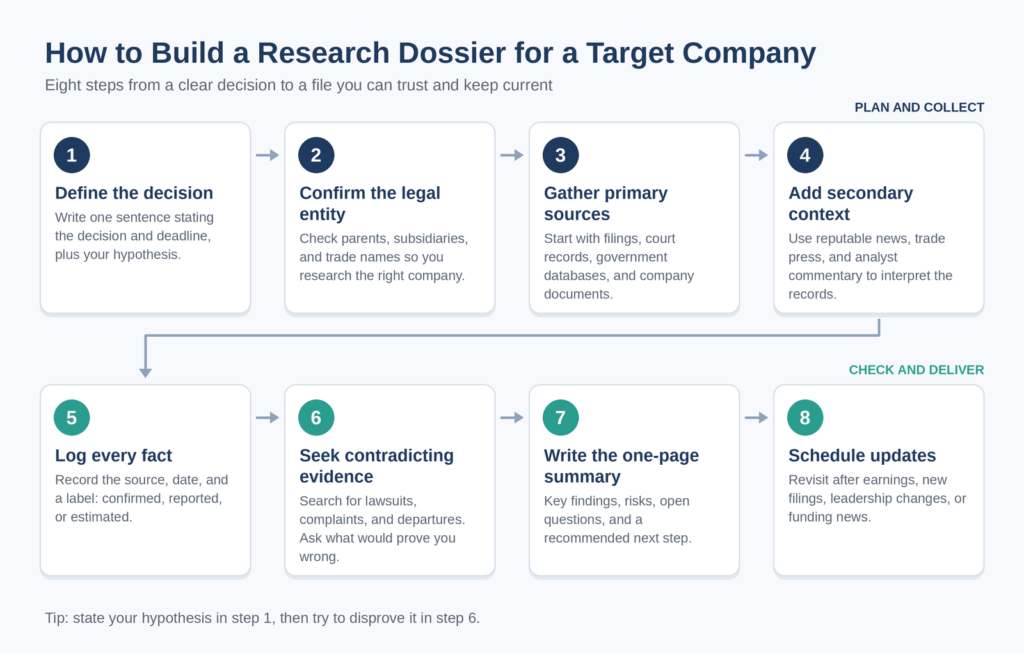
A Step-by-Step Process for Building the Dossier

A repeatable process keeps the work focused and the result trustworthy.

Eight-step process diagram for building a research dossier for a target company
  1. Define the decision and deadline. Write one sentence, such as “I need to decide whether to pursue this account by the end of the quarter,” and add your hypothesis.
  2. Confirm the exact legal entity. Large companies have parents, subsidiaries, and trade names, and researching the wrong one produces the wrong financials and lawsuits. The subsidiary list usually appears as an exhibit to a public company’s 10-K, and for private companies the state registry confirms the registered name.
  3. Gather primary sources first. Filings, court records, government databases, and the company’s own documents come before commentary.
  4. Add secondary sources for context. Reputable news outlets, trade publications, and analyst commentary explain what the records mean. Job postings and customer reviews reveal priorities and pain points, but they are anecdotal, so treat them as signals rather than proof.
  5. Log every fact with its source, date, and confidence level. A simple label such as confirmed, reported, or estimated stops guesses from hardening into facts.
  6. Look for contradicting evidence. Search for lawsuits, complaints, executive departures, and layoffs, and ask what would prove your hypothesis wrong.
  7. Write the one-page summary. Cover key findings, major risks, open questions, and the recommended next step, then arrange the supporting sections behind it.
  8. Schedule updates. Decide now when you will revisit the file, because company information goes stale quickly.

Consider a hypothetical case. You sell warehouse software to a regional distributor and suspect its recent expansion has outgrown its systems. You would look for new facility announcements, warehouse and logistics job postings, and any operational problems mentioned in filings or news coverage. You would also look for the opposite, such as a recent multiyear contract with a competing vendor, which would weaken your case.

Judging Source Quality and Spotting Red Flags

Not every source deserves equal weight. Primary sources, such as SEC filings, court dockets, and government databases, record what the company or an official body actually reported. Secondary sources, such as established news outlets and trade publications, interpret those records and sometimes add original reporting. Tertiary sources, such as aggregators, forums, and social media posts, are useful for leads but should never be the only support for an important claim. When sources disagree, favor the primary record and note the discrepancy.

Certain patterns deserve a closer look. In public companies, they include language expressing substantial doubt about the company’s ability to continue as a going concern, disclosed material weaknesses in internal controls, late-filing notices (Form NT 10-K), changes in the certifying accountant (8-K Item 4.01), and abrupt departures of directors or officers (8-K Item 5.02). In private companies, watch for an inactive or revoked entity status, large or numerous UCC liens, names and addresses that do not match across records, and repeated lawsuits from vendors or employees. A red flag is a prompt for questions, not a verdict, so look for context before drawing conclusions.

Using AI Tools Responsibly and Staying Ethical

AI assistants can summarize long filings, draft outlines, and speed up a first pass. They can also misstate figures, confuse similar company names, or cite sources that do not say what is claimed. Treat any AI-generated fact as a lead, and confirm every number against the original filing or record before it enters your dossier. Check your organization’s policy before pasting confidential material into any tool.

The method matters as much as the content. The Strategic Consortium of Intelligence Professionals (SCIP) maintains a code of ethics that is widely referenced in competitive intelligence. It expects practitioners to disclose their identity and organization before interviews, and SCIP states that obtaining a competitor’s password without authorization is illegal. In practice, rely on public sources, be honest about who you are when you ask questions, and never use deception to obtain confidential information. Keep the focus on the business, too. Executives’ professional roles and public statements belong in a company dossier; their families and home addresses do not.

Conclusion: Start Small and Keep Your Dossier Current

A research dossier for a target company works best when it starts with a clear decision, relies on primary sources, separates facts from estimates, and ends with a recommendation rather than a pile of notes. For public companies, EDGAR gives you free access to the filings that matter most. For private ones, state registries, UCC records, court dockets, and patent and trademark databases fill in much of the picture.

Three tiers of company research sources: primary, secondary, and tertiary

Your next step is simple. Pick one company you need to understand this month, write the one-sentence decision it supports, and build a one-page version using the sources above. Expand it only where the stakes justify more depth, and revisit it after major events such as earnings reports, leadership changes, or new filings.

Disclaimer: This article is general information, not legal, financial, or investment advice. Rules about public records, privacy, and competitive intelligence vary by situation and jurisdiction, so consult a qualified attorney or professional advisor before relying on a dossier for a transaction, investment, or legal decision.

Frequently Asked Questions

What is a research dossier for a target company?

It is a structured document that gathers verified information about one organization and interprets it for a specific decision, such as a sales pitch, an investment, an acquisition, or an interview. Unlike a simple profile, it includes analysis, risks, and a recommended next step.

How long should a company dossier be?

Length should follow the stakes. A few pages is usually enough for sales or interview preparation, while an investment or acquisition screen may need much more. In either case, start with a one-page summary of findings, risks, and next steps.

Where can I find free information about a private company?

Start with the Secretary of State business search in the company’s state of incorporation, then check UCC filings, the USPTO’s trademark and patent databases, and USAspending.gov for federal awards. PACER is inexpensive for light use because fees are waived when quarterly charges are $30 or less. The company’s own website and press coverage fill in the rest.

Is it legal to research a company this way?

Using public records and openly published information is generally lawful. Misrepresenting who you are, accessing accounts without permission, or obtaining confidential information improperly can create legal and ethical problems, so follow your organization’s policies and ask an attorney if you are unsure.

How often should I update a dossier?

Update it before any major meeting or decision, and after significant events such as earnings reports, new 8-K filings, leadership changes, or funding rounds. For active accounts or rivals, a regular quarterly review keeps the file from going stale.

dreammeaning.com USA: What Your Dream Meanings Really Tell You

dreammeaningcom usa

You woke up with a strange image still in your head: a staircase collapsing, an exam you never studied for, a face you haven’t seen in years. You probably typed something like dreammeaning.com USA into a search bar, hoping for a quick answer. This guide explains what dream meaning websites actually offer, where dream interpretation came from, and what sleep science says about dreaming. It also shows how to use a dream dictionary without taking it too literally. By the end, you will have a simple method for reading your own dreams.

What People Want From a dreammeaning.com USA Search

A search like this usually comes from someone with a specific, practical question. They are not looking for a lecture on neuroscience. They want to know what a particular dream symbol, such as a snake, a flood, or a late-night phone call, might signify, and they want it explained in plain English.

Dream meaning websites meet that need in three main ways. Some are A-to-Z dictionaries where you look up a single symbol. Some are articles that explore a theme in depth, like flying or falling. A growing number use artificial intelligence to respond to a dream you describe in your own words.

This is an informational search. The reader is curious and often a little unsettled, but not ready to buy anything. A useful article, or a useful site, should therefore explain the symbol, give context for the interpretation, and be honest about what is known and what is only tradition or opinion.

The History of Dream Dictionaries and Dream Interpretation

People have tried to decode dreams for thousands of years. One of the earliest systematic efforts was the Oneirocritica by Artemidorus of Daldis, a Greek author writing in the second century AD. He classified dreams and their supposed meanings, and many modern dream dictionaries still follow the same basic format.

Dream interpretation took a new direction in 1899, when Sigmund Freud published The Interpretation of Dreams. Freud argued that dreams disguise unconscious wishes, and that a dream’s visible story hides a deeper meaning. Carl Jung later disagreed with parts of Freud’s approach. He saw dreams as a way for the psyche to restore balance, and he linked many recurring images to shared symbols he called archetypes.

On the popular side, American readers have long relied on printed dream books. One widely known example is Gustavus Hindman Miller’s 10,000 Dreams Interpreted, first published in 1901, which still influences how many online dictionaries phrase their entries. Knowing this lineage helps you read modern dream sites more critically. Many of their “meanings” are inherited traditions, not research findings.

What Science Says About Why We Dream

Researchers have not settled why we dream, and anyone claiming a single answer is overselling. Several theories compete, and each explains part of the picture.

The activation-synthesis hypothesis, proposed by J. Allan Hobson and Robert McCarley in 1977, suggested that dreams come from random brain activity during sleep, which the brain then weaves into a story. Later models give the brain a more active role. The continuity hypothesis, associated with psychologist G. William Domhoff, holds that dreams largely reflect our waking concerns, relationships, and preoccupations. Antti Revonsuo’s threat simulation theory proposes that dreaming evolved partly to rehearse responses to danger, which could help explain why chase and fear dreams are so common.

Dreams occur most vividly during rapid eye movement (REM) sleep, but they also happen in other sleep stages, usually with less vivid imagery. Adults cycle through sleep stages roughly every 90 minutes, so a full night includes several dream periods, even if you remember only one.

What does this mean for dream dictionaries? The research supports the idea that dreams often draw on your own life, emotions, and memories. It does not support the idea that a snake or a tooth has one fixed meaning for everyone.

How Dream Meaning Websites and Dream Dictionaries Work

Most dream meaning sites fall into one of three formats. Understanding each helps you judge what you are getting.

Symbol Dictionaries

A symbol dictionary lists dream elements alphabetically and gives a short interpretation for each. This format is fast and easy to use, which explains its popularity. Its weakness is that it treats every dreamer the same. A dream about water means something different to a competitive swimmer than to someone who nearly drowned as a child.

Long-Form Dream Theme Articles

Articles on themes such as being chased, losing teeth, or dreaming about a former partner can explore more than one possible reading. Good ones separate traditional interpretations from psychological ones and tell you which is which. They work best when you want to understand a recurring pattern rather than a single symbol.

AI Dream Interpretation Tools

Newer tools let you type out a dream and receive a tailored interpretation, sometimes with a built-in journal. They can be useful for generating questions and prompts. Their output should be treated as one possible reading, not a diagnosis, because a model has no access to your actual life, only the words you give it.

Common Dream Meanings and What They Often Symbolize

Certain dream themes show up again and again in dream research and on dream websites. The table below summarizes how dictionaries commonly describe them, along with a question that can help you connect the dream to your own situation. These are interpretive traditions, not proven facts.

Dream themeCommon dictionary readingQuestion to ask yourself
FallingLoss of control or insecurityWhere in my life do I feel unsupported?
Being chasedAvoiding a problem or emotionWhat am I trying not to face right now?
Teeth falling outAnxiety about appearance, aging, or communicationAm I worried about how others see me?
FlyingFreedom, ambition, or escapeDo I feel limited or newly empowered?
Being unprepared for a testFear of being judged or evaluatedWhat performance am I anxious about?
WaterEmotions, with calm or turbulent water reflecting moodHow did the water feel in the dream?
Showing up late or missing a flightWorry about missed opportunitiesWhat deadline or choice feels pressing?

Notice that the right-hand column does more work than the middle one. A dictionary entry gives you a starting hypothesis. Your own experience decides whether it fits.

How to Interpret Your Dreams Step by Step (Including Dream Journaling)

You do not need special training to reflect on a dream in a useful way. The following method borrows from common practice in dream journaling and psychology-informed reflection. A journal is the foundation, because it turns scattered impressions into patterns you can actually see.

Write Down the Dream Immediately

Details fade within minutes of waking, so keep a notebook or phone note within reach. Record the date, the setting, the people, what happened, and anything that seemed odd. Fragments are fine. A single image written down is worth more than a full story you forgot.

Small habits help with recall. Keeping a regular sleep schedule, limiting heavy alcohol use before bed, and lying still for a moment after waking can make dreams easier to remember. Alcohol and some medications can affect REM sleep, so if your dreams change suddenly after you start a new medication, mention it to your doctor or pharmacist.

Note the Emotions

Write down how you felt, both inside the dream and on waking. Many dream researchers consider emotion more informative than imagery. A dream about a dog that left you frightened tells a different story than one that left you comforted.

Connect It to Your Waking Life

Dreams often recycle recent events, conversations, or worries, sometimes in distorted form. Ask what in your past week the dream might be echoing. After a few weeks of entries, reread them and look for repeats, such as the same setting, a recurring person, or a common feeling like being rushed or watched. Those repeated elements usually say more than any single dream.

Check Symbols Against a Dream Dictionary

Now look up a symbol or two, but treat the result as one option among several. If a meaning makes you think “yes, that fits,” it is worth exploring. If it feels wrong, that is useful information too. Most dreams call for no action at all. Occasionally, a dream puts words to a worry you had been avoiding, and that can prompt a conversation or a decision.

Dream Dictionary vs. Journal vs. AI vs. Therapist: Which Works Best?

A dictionary is only one tool. Each approach has strengths and limits, and combining them usually works better than relying on any single one.

ApproachBest forMain limitation
Dream dictionary lookupQuick ideas about a specific symbolIgnores your personal context
Personal reflection and journalingSpotting patterns and emotions over timeRequires consistency and honesty
AI-assisted interpretationGenerating questions and alternative readingsCannot know your life; may sound more certain than it is
Working with a therapistDistressing, recurring, or trauma-related dreamsCosts time and money

For most people, a sensible combination is a journal plus an occasional dictionary lookup. A licensed professional becomes more important when dreams are tied to distress, trauma, or poor sleep.

Limits of Online Dream Interpretation and How to Spot Unreliable Claims

Dream websites can be enjoyable and thought-provoking, but a few cautions are worth keeping in mind.

Be wary of absolute claims. If a site says a dream “always means” something, or predicts illness, death, money, or relationship outcomes, treat that as entertainment. No scientific evidence shows that dream symbols reliably predict future events.

Watch for unclear sourcing. A trustworthy article tells you whether an interpretation comes from Freud, Jung, folklore, modern psychology, or the author’s own view. If it never says, you cannot judge how much weight to give it.

Be careful with your privacy. If you use a site or app that asks you to submit dreams, read its privacy policy first. Dreams can contain personal details about relationships, health, and fears, so consider what you are comfortable sharing and storing online.

Finally, do not let an interpretation increase your anxiety. If a reading leaves you more worried, step back. A dream is not a verdict on your life.

Getting the Most From dreammeaning.com USA and Dream Meanings

Searching for dreammeaning.com USA is, at its heart, a search for a way to make sense of something strange and personal. Dream dictionaries and interpretation sites can give you vocabulary and a place to start. The research on dreaming suggests, though, that the most reliable guide to a dream’s meaning is your own life: your emotions, memories, and current concerns.

A good next step is to start a simple dream journal this week. Write down your next three dreams, note how each one felt, and then look up a symbol or two. Compare what the dictionary says with what you already know about yourself. That comparison is where real insight tends to happen.

 Disclaimer


This article is for general information and entertainment. It is not medical or psychological advice. If your dreams or nightmares are frequent, deeply distressing, or interfering with your sleep or daily life, consider speaking with a doctor, sleep specialist, or licensed mental health professional. In the US, the 988 Suicide and Crisis Lifeline is available by call or text at 988 if you are in crisis.

Frequently Asked Questions About dreammeaning.com USA and Dream Meanings

Do dreams really have hidden meanings?

Sometimes dreams reflect real emotions and concerns, which is why reflecting on them can be useful. Science has not shown that specific symbols carry universal, fixed meanings, so interpretations are best treated as ideas to consider rather than facts.

Are dream dictionaries accurate?

Dream dictionaries reflect traditions and interpretive schools, not laboratory findings. They can offer helpful starting points, but their accuracy depends on how well an entry fits your own experience.

Why do I forget most of my dreams?

The brain is less able to store new memories during sleep, and dream recall fades quickly after waking. Writing down your dream immediately, even in fragments, noticeably improves how much you remember.

Can AI interpret my dreams?

AI tools can suggest themes and questions to think about, and some also double as dream journals. They cannot know your personal history, so treat their output as a conversation starter instead of a definitive answer.

When should I worry about my dreams?

Occasional strange or unpleasant dreams are normal. If you have frequent nightmares, dreams tied to a traumatic event, or sleep problems that affect your daytime functioning, talk to a healthcare professional. Treatments such as imagery rehearsal therapy are used for nightmare disorder.

How to Say “Fence” in Spanish: Cerca, Valla, Reja & More Explained

Wooden fence beside a house with Spanish translation "la cerca" and pronunciation guide for the English word "fence".

The most common word for “fence” in Spanish is cerca. That’s the safe, general-purpose answer, and it’s right maybe 60% of the time. The other 40% depends on what the fence is made of, what it’s for, and which country the person you’re talking to is from. Spanish has at least seven words that translate to “fence” in English, and using the wrong one doesn’t make you wrong, exactly. It just makes you sound like you learned Spanish from a phrasebook.

The 7 Spanish Words for “Fence” (and When to Use Each)

Here’s the thing dictionaries don’t tell you: a single English word splitting into several Spanish ones usually means the split carries real information, either material or purpose. Fence is a good example.

WordPronunciationWhat it meansWhere it’s usedExample
cercaSEHR-kahGeneral fence: wood or wireEverywherePintamos la cerca del jardín el fin de semana. (We painted the garden fence over the weekend.)
vallaVAH-yahTaller, solid barrier: hoarding or billboard-style panelsWidely used, especially SpainLa valla del jardín es de madera. (The garden fence is made of wood.)
rejaRREH-hahMetal or iron fence, or bars over windowsCommon in urban Spain and Latin AmericaLas rejas protegen la ventana. (The bars/fence protect the window.)
barda BAR-dahSolid wall-style fence, usually concrete or brickMexicoLa barda del patio es de concreto. (The patio fence/wall is concrete.)
alambradaah-lahm-BRAH-dahWire or mesh fenceGeneralLa alambrada rodea el terreno. (The wire fence surrounds the lot.)
setoSEH-tohHedge (a living fence)GeneralEl seto separa los jardines. (The hedge separates the gardens.)
estacadaehs-tah-KAH-dahPicket or stake fenceGeneral, more formal/literaryLess common in everyday speech than in construction specs or older texts

Notice something in that table? Four of the seven words map to material, not just “fence-ness.” That’s not an accident. Spanish tends to name the thing by what it’s built from a lot more readily than English does.

If you only remember one row, make it cerca. It works as a catch-all even when valla or reja would technically be more precise, the same way “fence” covers a chain-link enclosure and a wrought-iron gate in English without anyone blinking.

Careful: “Cerca” Has Two Meanings

Here’s where a lot of beginners trip, and honestly some intermediate speakers too. Cerca is also the Spanish word for “near” or “close,” used as an adverb, not a noun.

  • La cerca es de madera. → The fence is made of wood. (noun)
  • Vivo cerca del parque. → I live near the park. (adverb)

Same spelling. Same pronunciation. Completely different job in the sentence. Context sorts it out almost every time. Nobody’s going to hear “vivo cerca” and think you live inside a fence. But if you’re writing rather than speaking, it’s worth a second glance before you hit publish.

Regional Differences: Spain vs. Mexico vs. Latin America

Valla and cerca are understood everywhere, so you’re never really at risk of being misunderstood. But usage tilts by region:

In Spain, valla leans toward construction hoarding and sports/event barriers as much as residential fencing. You’ll hear vallas publicitarias for billboards, which shares the same root. In Mexico, barda is the word you’ll hear most for a solid perimeter wall around a house, where a Spaniard would more likely say muro or just pared. Across the rest of Latin America, cerca and malla (for chain-link specifically) do a lot of the heavy lifting.

None of this is a hard rule. It’s a tendency, and tendencies vary by country and honestly by who’s talking. If regional accuracy matters for your project (a listing, a permit document), it’s worth a quick confirmation with a native speaker from that market rather than trusting a single source, this one included.

“To Fence” as a Verb: Cercar and Vallar

The action of putting up a fence has its own verbs: cercar and vallar.

Vamos a cercar el terreno antes de que lleguen los materiales. (“We’re going to fence the lot before the materials arrive.”)

Vallar works the same way and is slightly more specific to putting up a valla-style barrier rather than a general enclosure. In practice, you’ll hear cercar more often outside of Spain.

The Other Meanings of “Fence” in Spanish

English “fence” carries two meanings that have nothing to do with each other, and Spanish handles them with two completely unrelated words:

Fencing, the sport (épée, foil, the whole En garde! routine) is esgrima. A fencer is an esgrimista, not a cerquista or anything derived from the fence words above. If you search “fencing in Spanish” expecting a construction answer, this is probably why the results looked off. The term splits hard by meaning, and there’s no shared root to bridge the two.

Fence, as in a receiver of stolen goods (the guy who buys the stolen watches, in noir-movie terms) is perista. El ladrón le entregó las joyas robadas a su perista. (“The thief handed the stolen jewels over to his fence.”) Feminine noun, same word for a woman doing the same job: la perista.

And then there’s the idiom. “To sit on the fence,” meaning refusing to take a side, translates to no comprometerse, or more colorfully, mirar los toros desde la barrera. Literally: “to watch the bulls from behind the barrier.” Which, if you think about it, is a more vivid way of saying “staying safely uninvolved” than the English version ever managed.

Talking About a Fence Project in Spanish

This is the part a dictionary page can’t help you with, because it’s not really about translation. It’s about the specific vocabulary you need when the crew or the supplier you’re working with speaks Spanish.

EnglishSpanish
Wood fencecerca de madera
Vinyl fencecerca de vinilo
Chain-link fencecerca/alambrada de malla ciclónica
Fence postposte de cerca
Fence panelpanel de cerca
How tall should the fence be?¿Qué tan alta debe ser la cerca?
Where’s the property line?¿Dónde está el límite de la propiedad?
Get a quote for the fencePedir un presupuesto para la cerca

A few of these matter more than they look like they should. Malla ciclónica specifically means chain-link. Say cerca de metal instead and you might get quoted for wrought iron, which is a very different price. “Property line” questions come up constantly on shared-fence projects {{LINK: link to fencing/property-line content if available}}, so it’s worth having the phrase ready before the conversation, not mid-conversation.

Frequently Asked Questions

How do you say fence in Spanish?

The general word is cerca. Depending on the material and purpose, Spanish speakers also use valla (taller barrier), reja (metal/iron), barda (solid wall, mainly Mexico), alambrada (wire), and seto (hedge).

What is fence in Spanish?

“Fence” translates to cerca as a physical barrier. It has two other, unrelated meanings: esgrima for the sport of fencing, and perista for a person who buys and sells stolen goods.

How do you say fencing in Spanish?

If you mean the sport, it’s esgrima. If you mean the material used to build a fence, Spanish doesn’t have a single collective noun the way English does. You’d say cercado or vallado, or just name the fence type directly (cerca de madera, alambrada, etc.).

Is “cerca” the same as the Spanish word for “near”?

Yes, and it’s the same spelling and pronunciation for both. Cerca as a noun means fence; cerca as an adverb means near or close. Context, usually whether it’s paired with “de” (cerca de), tells you which one you’re dealing with.

How much does it cost to add a bathroom?

how much does it cost to add a bathroom

Adding a bathroom costs somewhere between $3,000 and $90,000, and the size of that range comes down to one question: are you converting a space that already exists, or building new? Converting a closet or unused room into a half bath sits at the low end. A primary bathroom built as part of a home addition, with new framing and plumbing run from scratch, sits at the high end. Most homeowners land between $20,000 and $40,000.

That’s a wide answer, so it helps to break the cost down by the type of bathroom you’re adding, where it’s going, and what’s driving the price up or down. If you’d rather skip straight to a number for your own project, our bathroom remodel cost calculator will get you there faster than any range on this page.

Cost by bathroom type

Bathroom typeWhat’s includedTypical cost
Half bath / powder roomToilet, sink, no shower or tub$3,000 – $15,000
Full bath, converted spaceToilet, sink, shower or tub, in a closet, basement corner, or unused room$9,000 – $40,000
Full bath, new additionSame fixtures, but built onto the house with new framing and foundation work$20,000 – $55,000
Primary/ensuite bathToilet, double vanity, shower, sometimes a soaking tub, attached to a bedroom$22,000 – $90,000+
Basement bathFull bath below grade, often needs an ejector pump if it’s under the main drain line$10,000 – $25,000

A half bath skips the shower and tub, which cuts both the plumbing work and the fixture cost, so it’s almost always the cheapest way to add a bathroom. A primary bath addition costs the most because it usually comes with a bigger footprint, better finishes, and a longer plumbing run.

Converting a space vs. building new

The single biggest cost driver isn’t the fixtures. It’s whether you’re working inside your home’s existing footprint or adding onto it.

Converting an existing space, like a closet, a corner of a basement, or part of a laundry room, into a bathroom runs about $200 to $250 per square foot and typically totals $5,000 to $25,000. You’re not pouring a foundation or building exterior walls, so a big chunk of the cost disappears.

Building a new addition to house the bathroom runs $20,000 to $75,000, and sometimes more in expensive markets. You’re paying for a foundation, framing, roofing, siding, and a full plumbing and electrical run to a part of the house that didn’t have any before. Per square foot, that typically lands between $150 and $350 depending on finishes.

If your budget is tight, the fastest way to bring the number down is to find unused space that already exists inside your home rather than building outward.

What actually drives the price

Distance from existing plumbing. A bathroom placed on the other side of a wall from an existing bathroom or kitchen can tap into the same supply and drain lines. One placed far from any plumbing needs new lines run under the floor or through the walls, which adds labor and sometimes requires opening up finished spaces.

Where in the house. A basement bathroom below the home’s main drain line usually needs a sewage ejector pump to push waste up to the sewer line, which adds $1,500 to $3,000 or more. An attic or upper-floor bathroom can mean reinforcing floor joists to handle the weight of a tub.

Fixture and finish quality. A basic toilet runs under $200; a comfort-height model with a soft-close lid can run $500 or more. The same spread applies to vanities, tile, and shower systems. Finish choices alone can double a project’s cost without changing the layout at all.

Permits and inspections. Most jurisdictions require permits for new plumbing and electrical work, and fees run anywhere from $500 to $5,000 depending on the city. Skipping a permit isn’t a real way to save money — it becomes a problem when you go to sell the house.

Where you live. Labor rates in the San Francisco Bay Area or New York City metro can run double what they cost in much of the Midwest or South.

Cost breakdown by category

For a typical mid-range full bathroom (converted space, standard finishes):

CategoryTypical cost
Plumbing rough-in (supply, waste, vent)$1,500 – $8,000
Framing and drywall$1,000 – $5,000
Electrical and ventilation (outlets, exhaust fan, lighting)$1,000 – $4,000
Fixtures (toilet, sink, tub or shower, vanity)$1,500 – $8,000
Flooring and wall finishes$500 – $3,000
Permits and inspections$500 – $5,000
LaborUsually 40% – 60% of the total

Plumbing and labor together make up the bulk of the bill on almost every project. Finishes are the part you control most directly, since a $150 toilet and a $900 toilet do the same job.

Two example budgets

Ranges are useful, but seeing the math laid out helps more. Here’s how the numbers actually stack up for two common projects.

Example: converting a closet into a half bath

Line itemCost
Plumbing rough-in$1,200
Framing and drywall$600
Electrical and ventilation$500
Fixtures (toilet, sink, faucet)$700
Flooring and wall finishes$600
Permits$500
Labor$3,200
Total$7,300

This is a short plumbing run off an existing stack, standard fixtures, and no structural work. It lands near the low end of the half-bath range.

Example: full bath in an unfinished basement corner

Line itemCost
Plumbing rough-in (includes an ejector pump)$4,500
Framing and drywall$2,500
Electrical and ventilation$2,000
Fixtures (toilet, sink, shower, vanity)$3,500
Flooring and wall finishes$1,800
Permits$1,200
Labor$9,500
Total$25,000

The ejector pump pushes this toward the top of the basement-bath range, since the room sits below the main drain line and waste has to be pumped up to reach the sewer line.

These are sample budgets built from the cost ranges above, not quotes from a specific job — your own numbers will move with your location, contractor, and finish choices.

Does adding a bathroom pay for itself?

Not fully, but it does more than most renovations. The 2025 Cost vs. Value Report puts the national average recoup rate for a mid-range bathroom addition at around 53% of what you spend. So a $35,000 bathroom addition might add roughly $18,500 to your home’s resale value on paper.

That figure undersells the real benefit, though. A second bathroom changes whether a one-bathroom house is a serious contender for buyers with families, not just how much it appraises for. Real estate data from sites like Opendoor and Zillow has put the resale value bump for a full bathroom addition somewhere in the 5% to 10% range for the whole house, with half baths adding less. The exact number moves with your local market, so treat it as a rough guide rather than a guarantee.

If you’re adding a bathroom mainly to sell the house, run the numbers with a local agent first. If you’re adding it because you’re tired of sharing one bathroom with three other people, the resale math matters less than it seems to.

Ways to bring the cost down

  • Convert a space you already have — a closet, a corner of a basement, unused space under a staircase — instead of building an addition.
  • Put the new bathroom on the other side of a wall from existing plumbing so the runs stay short.
  • Choose a shower instead of a tub-and-shower combo if space or budget is tight; showers are cheaper to install and use less water long-term.
  • Stick with standard-size, in-stock fixtures rather than custom orders, which carry both a price premium and longer lead times.
  • Get quotes from at least three licensed contractors. Bathroom additions have enough variables (plumbing distance, framing needs, local permit costs) that estimates for the same project can differ by thousands of dollars.

Frequently asked questions

Is it cheaper to convert an existing room into a bathroom, or build a new addition?

Converting existing space is almost always cheaper, often by close to half. You skip the foundation, exterior walls, and roofing that a new addition requires.

How much does adding a bathroom increase home value?

Expect to recoup roughly half of what you spend at resale, based on recent Cost vs. Value data, plus a broader boost to how marketable the home is if it only had one bathroom before.

Do I need a permit to add a bathroom?

In almost every U.S. jurisdiction, yes. New plumbing and electrical work requires a permit and inspection. Costs range from about $500 to $5,000 depending on the city.

How long does adding a bathroom take?

A conversion of existing space typically takes two to four weeks. A full addition with new construction can take two to four months, depending on permitting and how backed up local contractors are.

What’s the cheapest type of bathroom to add?

A half bath converted from existing space, like a closet or an underused corner of a room. Skipping the shower or tub removes the most expensive plumbing and fixture costs.

Costs above reflect national averages for 2026 and will vary by region, contractor, and material choices. For a number based on your own square footage and location, run your project through our bathroom remodel cost calculator.

Tiny Bugs in Bathroom: What They Are and How to Get Rid of Them

Small fuzzy drain flies on a bathroom sink edge, with a magnified close-up of one insect

Last updated: September 2026

You flip on the bathroom light and something small skitters across the tile. Or hovers near the shower drain. Or clings to the grout like a speck of dirt that just… moved. Tiny bugs in the bathroom are almost never random. They show up because your bathroom is, structurally, the most humid room in your house, and humidity is exactly what six common indoor pests are looking for. None of them bite. Most won’t damage a thing. But figuring out which one you’ve got tells you whether you’re dealing with a slow drain, an overwatered houseplant, or a leak you don’t know about yet.

Quick answer: Tiny bathroom bugs are almost always drain flies, fungus gnats, springtails, booklice, carpet beetle larvae, or mold mites, and every one of them is a moisture signal, not a dirt problem. Sort by movement first (jumps vs. flies vs. crawls), then narrow by color and wings. Fix the humidity and the specific source (drain biofilm, a damp bath mat, a slow leak) and most infestations clear up in one to two weeks without pesticide. A spreading mold patch, an unexplained leak, or fabric damage from larvae is when to call a professional instead of continuing to DIY.

What Are These Tiny Bugs in My Bathroom?

The tiny bugs turning up in your bathroom are almost always one of six species, and each one points to a specific moisture problem:

  • Drain flies (moth flies): fuzzy, mothlike, living in the slime coating your drain pipes
  • Fungus gnats: thin, dark, mosquito-shaped, usually arriving with a houseplant’s soil
  • Springtails: wingless, jump when disturbed, thrive anywhere damp
  • Booklice: pale, wingless, grazing on microscopic mold on walls and wallpaper paste
  • Carpet beetle larvae: fuzzy brown “woolly bears,” feeding on hair, lint, and dead skin
  • Mold mites: nearly invisible, appearing as moving dust on mildewed grout

Quick ID: Sort by Movement, Color, or Wings

By Movement

Movement narrows the field fastest. Only two of these six actually fly: drain flies and fungus gnats. Springtails don’t fly. They spring, using a forked tail-like structure called a furcula that flicks them several inches through the air the second you get close. Booklice and mold mites just crawl, slowly enough that most people mistake them for a stain that’s somehow relocating. Carpet beetle larvae crawl too, but with a visible, bristly texture that reads more like a tiny caterpillar than an insect.

By Color

Color is how a lot of people actually search for this: combined, there are more monthly searches for “black,” “brown,” “grey,” and “white” bathroom bugs than for any single species name. Here’s how the colors sort:

  • Black or dark gray: drain flies, fungus gnats, and springtails, by far the largest color group
  • Brown: carpet beetle larvae, older springtails, some booklice
  • Pale, cream, or nearly clear: booklice, mold mites, young carpet beetle larvae
  • White: mold mite clusters, which read as a patch of moving white dust rather than individual bugs
  • Reddish-brown: certain carpet beetle species, occasionally confused with spider mites

By Wings

Wings split the group cleanly in half. Drain flies and fungus gnats fly, and they’re the ones you’ll find at a window or light fixture after dark. Springtails, booklice, carpet beetle larvae, and mold mites have no wings at all. If what you’re looking at doesn’t take off when you get close, you’ve already ruled out two of the six.

BugMovementColorWingsSizeWhere you’ll find itBite / damage riskDIY or call a pro
Drain fliesFlies, short hopsGray to black, fuzzyYes, mothlike1/16″–1/4″ (poppy seed to rice grain)On walls near drains, active at nightNo bite; nuisance onlyDIY
Fungus gnatsFlies, weak flierDark gray to blackYes, clear and delicate1/16″–1/8″ (fruit-fly size)Near houseplants, not drainsNo bite; nuisance onlyDIY
SpringtailsJumps via furculaDark gray, brown, some whiteNo1/16″–1/8″ (a printed period)Grout lines, caulk, damp baseboardsNo bite, no damageDIY
BookliceCrawls in fits and startsPale tan to nearly clearNo (indoor species)1/25″–1/13″ (a grain of salt)Damp walls, wallpaper, new drywallNo bite; can spot stored paper/foodDIY
Carpet beetle larvaeCrawls onlyBrown, banded, bristlyNo (larval stage)1/8″–1/4″ (a short rice grain)Bath mats, baseboards, lintNo bite; bristles irritate skin, damage fabricDIY, unless spreading
Mold mitesCrawls, barely visibleWhite to tanNo~0.3mm (finer than ground pepper)Directly on mold or mildewNo bite; can worsen allergiesDIY unless mold is extensive

Bug-by-Bug Identification & Fixes

Drain Flies

Drain flies, also called moth flies, run 1/16 to 1/4 inch long with dense, hairy wings that give them a dusty, mothlike look. Ohio State University Extension entomologists note the adults hold those wings roof-style over the body at rest. They don’t breed in standing water you can see. They breed in the gelatinous biofilm that coats the inside of a drain pipe, which is why pouring bleach or a standard liquid cleaner down the drain rarely does anything: both run straight past that film without touching it.

The fix has two parts. First, confirm which drain is the source with a 24-hour tape test, a method Washington State University Extension recommends: press a strip of clear tape, sticky side down, over the drain opening overnight, then check it in the morning for trapped flies. Second, treat the source directly: scrub the upper 6–12 inches of pipe with a stiff brush, then apply an enzymatic gel cleaner (Green Gobbler is a common drugstore option) for several nights running. The bacteria in these gels digest the organic film itself, rather than just flushing water over it.

Fungus Gnats

Here’s the mix-up almost everyone makes: fungus gnats look like they belong in the drain-fly category, but an Ask Extension entomologist puts it plainly: fungus gnats do not come from drains. They breed in damp potting soil, and a bathroom infestation almost always traces back to a houseplant nearby, indoors or recently brought in from outside for the season. Adults measure 1/16 to 1/8 inch, resemble tiny mosquitoes with long legs, and University of Georgia Extension identifies a distinct Y-shaped vein pattern on the wings as a reliable ID feature. They’re weak fliers, drawn to windows and light fixtures.

If you’re seeing them and there’s no plant in sight, check for one just outside the bathroom door, or a bag of potting soil sitting in a closet. The fix is moisture management at the soil level, not the drain: let the top inch or two dry out between waterings, and use a yellow sticky trap to catch adults while the population winds down.

Springtails

Springtails are wingless, 1/16 to 1/8 inch, and get their name from a forked structure at the tip of the abdomen that launches them into short jumps. University of Kentucky Extension entomologists note they’re harmless (no bite, no property damage), but they can show up in genuinely startling numbers. Under ideal moist conditions, populations can reach tens of thousands per cubic foot of organic material, according to extension research on the species. They feed on mold, algae, and fungal film, which means a grout line or a damp baseboard is plenty of habitat.

Their presence is really a moisture alarm. University of Maryland Extension points to plumbing leaks and elevated humidity as the two conditions that reliably bring them indoors. Track down the actual leak (a slow drip at a supply line, condensation pooling on a toilet tank, a worn wax ring under the toilet) and the springtails go with it.

Booklice

Booklice (technically psocids) are pale, wingless, and tiny. Utah State University Extension lists them at 1/25 to 1/13 inch, roughly a grain of salt, visible mainly as small moving specks against a wall. They feed on microscopic mold, which is why they turn up on damp drywall, behind wallpaper, or in new construction where joint compound is still curing and releasing moisture. Penn State Extension is specific about the threshold: keeping relative humidity under 50% stops both the mold and the booklice that depend on it.

They move in a distinctive stop-start pattern rather than a smooth crawl, which is often the tell that separates them from a young carpet beetle larva at a glance. The fix is the same as springtails: find the damp spot, dry it out, and keep humidity below that 50% line with a fan or a small dehumidifier.

Carpet Beetles (Larvae)

Carpet beetles show up in bathrooms as larvae, not adults, and University of Maryland Extension describes them as fuzzy, banded, “woolly bear” shapes between 1/8 and 1/4 inch. They feed on hair, lint, dead skin, and any natural-fiber bath mat or towel left damp on the floor: not fabric in general, just the animal-based fibers and organic debris that accumulate faster in a bathroom than almost anywhere else in the house.

One detail worth knowing: they travel further than people expect. In one case logged with a university extension service, a homeowner kept finding a single larva on a bathroom mat despite there being no other fabric within 20 feet, a reminder that larvae can arrive via wall voids or a forgotten insect nest inside the structure, not just the nearest rug. Their bristly hairs can irritate skin on contact, so handle them with a tissue rather than bare fingers. Wash bath mats and towels on hot weekly, vacuum along baseboards, and if the problem persists despite a clean bathroom, check nearby vents or wall cavities for a dead insect or nest feeding the population.

Mold Mites

Mold mites (commonly Tyrophagus species) are close to invisible on their own, at roughly 0.3mm. Iowa State University Extension groups them with the broader “mold mite” family that includes cheese and grain mites, all sharing one requirement: they only appear where mold or mildew is already established. You won’t spot one mite. What you’ll spot is a faint, moving patch of white or tan dust clustered on a mildewed grout line or a shower corner that never quite dries.

Because they eat mold exclusively, a mold mite cluster is a more reliable mold indicator than the visible staining itself: you can have an active colony well before it’s obvious to the eye. Cleaning the mold thoroughly removes their food source and usually ends the problem in one pass. If the mites keep coming back in the same spot, the moisture behind that mold hasn’t actually been fixed yet.

Tiny Bugs in the Bathroom Sink or Drain, Specifically

Not every tiny bathroom bug comes from the drain, even though it feels that way when you spot one near the sink. Drain flies genuinely do breed inside the pipe. Fungus gnats, despite looking similar at a glance, almost never do. Their source is soil, not plumbing. The tape test above is the fastest way to settle which one you’re dealing with before you spend a week treating the wrong thing.

There’s a second drain-adjacent question worth answering directly: can bugs come up through the toilet? Rarely through the bowl itself, but yes, through a dry P-trap. Every drain relies on a small reservoir of water in its trap to block both sewer gas and small pests from coming back up. In a bathroom that doesn’t get used often (a guest bath, a basement half-bath), that water evaporates over weeks, opening a path that was otherwise sealed. Running water in every drain in the house at least once a week, even ones you don’t use, keeps that seal intact.

Often Mistaken For…

  • Ants: carpet beetle larvae moving along a baseboard get called ants more than any other bug on this list. The giveaway is body shape: ants have a pinched waist, larvae don’t.
  • Fleas: springtails jump, and that single behavior is the top reason people assume fleas. The real difference is bite marks. Fleas need a blood meal and leave itchy welts; springtails don’t bite at all.
  • Roaches: a cluster of drain flies near a floor drain, or a larger carpet beetle larva, sometimes gets reported as “baby roaches.” Roach nymphs have long antennae and move fast; nothing on this list does either.
  • Specks of dirt: this one belongs to booklice and mold mites specifically. Until the “dirt” moves, or you catch it under a phone camera zoomed in, there’s genuinely no visual difference.

Why Your Bathroom Keeps Attracting Them

None of these six bugs showed up because your bathroom is dirty in the usual sense. They showed up because a few specific conditions stack on top of each other in a way that a normal cleaning routine doesn’t reliably reach. Steam from every shower raises humidity well above the rest of the house. Soap scum, skin cells, and hair build an organic film inside drain pipes that no amount of surface wiping touches. An exhaust fan that shuts off the moment the water does, instead of running another 20 minutes, leaves that humidity hanging in the air. And any stray organic material sitting in an already-humid room, a bunched-up damp mat, a stack of magazines, a plant just outside the door, gives one of these species exactly the food source it needs.

How to Get Rid of Tiny Bathroom Bugs for Good

  1. Confirm the source. Run the 24-hour tape test on any suspect drain before treating anything.
  2. Treat drains directly. Scrub the pipe with a brush, then run an enzymatic gel cleaner nightly for about a week if drain flies are confirmed.
  3. Extend your exhaust fan’s run time. A cheap timer switch that keeps it running 20–30 minutes post-shower does more for humidity than almost any other single fix.
  4. Add a small dehumidifier if the bathroom has no window or the fan alone isn’t cutting it. The EPA’s mold guidance targets relative humidity below 60%, ideally between 30% and 50%, the same range that stops springtails, booklice, and mold mites from sustaining a population.
  5. Wash bath mats and towels on hot, weekly, and don’t leave them bunched up damp on the floor.
  6. Address houseplants if fungus gnats are the culprit: let soil dry between waterings, or move the plant out of the bathroom entirely.
  7. Recheck in one to two weeks. Once the moisture source is actually gone, most of these six clear up in that window without any pesticide.

If the moisture problem turns out to be bigger than a fan and a dehumidifier can fix (failing grout, a subfloor that’s staying damp no matter what), that’s a renovation question rather than a pest one. ToolCalc Pro’s bathroom remodel cost calculator is a reasonable place to get a ballpark before calling a contractor.

When to Call a Professional

DIY works for the large majority of tiny bathroom bug problems, but a few signs mean it’s time to bring in someone else:

  • You’re still seeing 10 or more new bugs a day after two full weeks of fixing the moisture and treating the source
  • A mold patch has grown past roughly the size of a sheet of paper
  • Carpet beetle larvae have damaged more than one fabric item, suggesting an established population rather than a stray
  • You’ve run the tape test, checked the obvious spots, and still can’t pin down where they’re coming from

At that point you’re looking at a mold remediation call or a pest control visit, not a bigger bottle of drain cleaner.

FAQ

What are the tiny mites in my bathroom? Almost certainly mold mites, roughly 0.3mm, visible only as a moving patch of dust on an already-mildewed surface. Clean the mold thoroughly and they typically go with it.

What are the tiny, flea-like bugs in my bathroom? Springtails. They jump the way fleas do, but they don’t bite, and they don’t need a blood host to survive. A damp grout line is all they need.

What are the tiny bugs that look like specks of dirt? Booklice or mold mites. Both are pale and nearly motionless until disturbed. If the “dirt” moves when you get close, it’s one of these two.

How do I get rid of little bugs in my bathroom? Identify which of the six it is (movement plus color gets you most of the way), then fix the specific moisture source behind it: drain biofilm, an undersized exhaust fan, or a damp bath mat, rather than reaching for spray first.

Why do I still see bugs after I’ve cleaned? Surface cleaning doesn’t reach inside drain pipes or the interior of a grout line, which is where the actual food source lives. Wiping the counter doesn’t touch it; an enzymatic drain treatment or a dehumidifier does.

Are bathroom bugs dangerous to my health? None of the six bite. Carpet beetle larvae hairs can irritate skin on contact, and mold mites can aggravate allergies since they’re tied to active mold growth, but none of these transmit disease.

Can bugs come up through the toilet? Rarely through the bowl itself, but yes, through a dry P-trap in a drain that doesn’t get used often. Running water in every drain weekly keeps that seal from drying out.

Should I use bug spray on them? Not as a first move. Spray kills the adults you can see but does nothing about drain biofilm or the humidity problem underneath, so the population comes right back within days.

When should I call a professional? When the population hasn’t dropped after two weeks of fixing moisture and treating the source directly, or when there’s a mold patch or a leak you can’t locate on your own.

How to Clean a Bathroom Exhaust Fan (Step-by-Step)

How to Clean a Bathroom Exhaust Fan

Clean a bathroom exhaust fan in under 30 minutes: cut power at the breaker, pull down the vent cover, wash it in warm soapy water, vacuum the fan blades and housing with a brush attachment, then reassemble. Do this every 6–12 months. A dust-clogged fan loses airflow and struggles to clear steam, which is usually the first sign something’s wrong.

Most people ignore this fan until it starts rattling or the bathroom stays foggy long after a shower. By then there’s a felt-like layer of dust on every blade. It’s not a hard job. It’s just one nobody remembers to do.

What You’ll Need

You probably already own most of this.

ToolWhy
Screwdriver (magnetic tip helps)Some covers are screwed in, not clipped
Vacuum with crevice + brush attachmentPulls dust off blades without scratching them
Dish soapCuts through the greasy film that builds up on the cover
Microfiber clothFor wiping parts you can’t submerge
Compressed air canOptional, useful for tight motor housing
Step stoolBathroom fans are almost always out of easy reach

Why Do Bathroom Fans Get So Dirty So Fast?

Steam is the reason. Dust that would just blow off a dry surface elsewhere in the house sticks to a bathroom fan because the air passing through it is damp every single day. That moisture turns loose dust into a paste that clings to the blades and cakes onto the motor housing.

It’s a slow build. You won’t notice it week to week. Then one day the fan sounds different, or the mirror stays fogged for ten minutes after your shower instead of two, and you realize it’s been over a year.

How Often Should You Clean a Bathroom Exhaust Fan?

At least once a year, according to the Home Ventilating Institute. Treat that as a floor, not a target. If the bathroom sees heavy daily use, twice a year is closer to right.

Here’s a faster check than counting months on a calendar. Turn the fan on and hold a single square of toilet paper against the grille. If it stays stuck, airflow is fine. If it drops, the fan is either clogged or the motor’s weakening, and only cleaning it tells you which.

How Do You Clean a Bathroom Exhaust Fan?

  1. Cut the power. Flip the wall switch, then turn off the breaker too. Vent fans wire into the same circuit as bathroom lights more often than people expect, and a stray flip mid-clean isn’t a risk worth taking.
  2. Remove the vent cover. Most pull straight down: squeeze the metal mounting clips on either side and it drops free. Some newer covers use screws or spring-loaded tabs instead, so check the edges before you pull.
  3. Wash the cover, but only if it doesn’t have a light or sensor built in. Soak it in warm water with a few drops of dish soap, scrub with an old toothbrush, rinse, and set it on a towel to dry completely before it goes back on.
  4. Vacuum the fan blades and motor housing. Use the brush attachment. Dust on these blades isn’t loose. It’s often baked on from months of steam, so expect to spend real time here. For grime that won’t lift with the vacuum alone, an old toothbrush or the serrated edge of a plastic knife breaks it loose without scratching the blades. Skip metal scrapers or wire brushes; they’ll gouge the plastic.
  5. Wipe everything down with a damp microfiber cloth. This catches what the vacuum missed.
  6. Reassemble and restore power. Clip or screw the cover back in, flip the breaker, then the switch. Run it for a minute and listen. Quieter is the goal.

Total time, start to finish: about 30 minutes for a fan that hasn’t been touched in a year or two. Budget closer to 45 if the blades are heavily caked, since scrubbing each one by hand can eat 10–15 minutes on its own.

How Do You Clean a Bathroom Exhaust Fan Without Removing It?

You can, but only partway. Run a vacuum with a crevice tool through the grille to pull out loose dust, then wipe whatever surface you can reach with a damp cloth. Run the fan for a few minutes afterward to clear anything you loosened but didn’t fully remove.

This works fine as a quick maintenance pass between real cleanings, say a five-minute touch-up at the three-month mark. What it can’t do is reach the fan blades or the motor housing, where the actual buildup lives. Skip the full teardown every time and you’re managing surface dust while the fan keeps losing airflow underneath it.

Is It Safe to Clean a Bathroom Fan That Has a Light?

Not by submerging it. If your fan cover includes a light, a sensor, or (increasingly) a built-in speaker, water and electronics don’t mix. Disconnect the wiring at the connector before removing the cover, then clean it dry: vacuum first, wipe with a barely damp microfiber cloth second, and let it air dry fully before reconnecting anything.

Plain covers with no light are the only ones safe to soak in the sink.

How Do You Know If Your Fan Needs Replacing Instead of Cleaning?

How Do You Know If Your Fan Needs Replacing Instead of Cleaning?

Cleaning fixes airflow. It doesn’t fix a dying motor.

Replace the fan if it’s still loud after a full clean, if you can see damage to the motor housing or blades, or if it’s 10 to 15 years old and still failing to clear steam. A fan that age has usually earned its retirement: a new one is quieter and moves noticeably more air for the same footprint.

A fan that can’t keep up with steam is often the first sign of bigger moisture problems: peeling paint, even mold behind the tile. If you’re already looking at a bigger fix, the Bathroom Remodel Cost Calculator breaks down what that actually runs before you call a contractor.

FAQ

How often should I clean a bathroom exhaust fan?

At least once a year. Twice a year if the bathroom sees heavy daily use.

How do I know if my bathroom fan needs cleaning?

Hold a piece of toilet paper against the running grille. If it doesn’t stay stuck, dust buildup is cutting your airflow.

Can I clean a bathroom exhaust fan without removing it? Partly. Vacuuming through the grille and wiping accessible surfaces works as a maintenance step, but it won’t reach the blades or motor. You still need a full removal every 6–12 months.

Is it safe to clean a bathroom fan that has a light?

Not by soaking it. Disconnect the wiring, then clean the cover dry with a vacuum and a damp cloth.

Can I wash the fan cover in water? Yes, if it’s a plain cover with no light, sensor, or speaker built in. Warm water and a little dish soap is enough.

Why is my bathroom fan still loud after cleaning?

Usually a motor issue, not a dust issue. Loose mounting screws can also cause rattling, so check those before assuming the motor’s failing.

How long does cleaning a bathroom exhaust fan take?

About 30 minutes for a fan that’s gone a year or more without attention. Closer to 45 if the blades are heavily caked.

When should I replace instead of clean my bathroom fan?

If it’s 10 to 15+ years old, still loud after cleaning, or visibly damaged, replacing it makes more sense than continuing to clean it.

ToolCalcPro Footer Preview