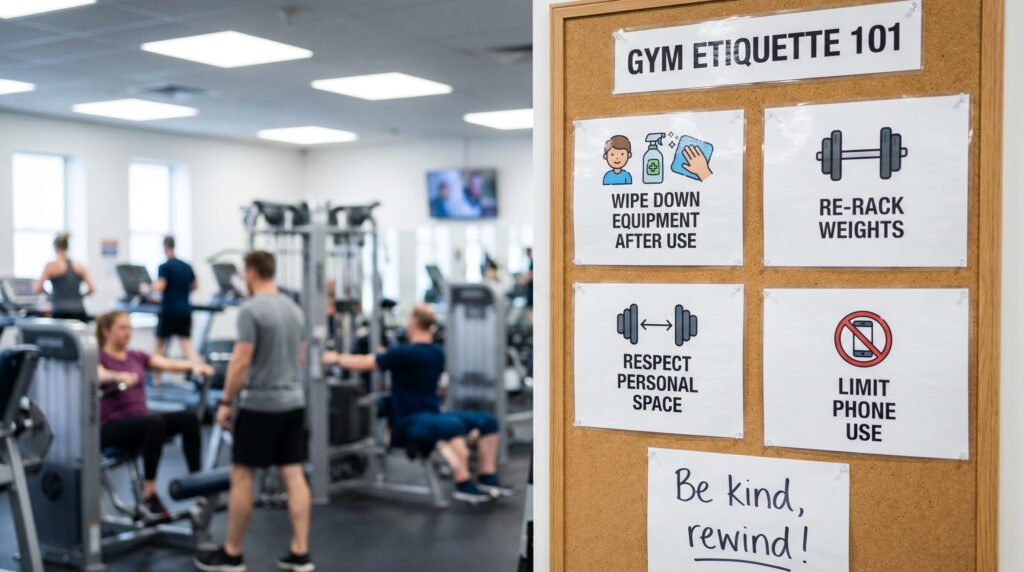
Walk into any gym on a Monday morning, and the unspoken tension is real. Someone’s left a pair of dumbbells in the middle of the floor. A guy three treadmills away is blasting a phone call loud enough to hear over your headphones. The only bench press is “reserved” by a gym bag that hasn’t moved in 20 minutes.
Nobody handed you a rulebook when you swiped your membership card. But gym etiquette — the shared code of conduct that makes a fitness center work for everyone — matters more than most people realize.
A 2024 survey of 2,000 gym-goers found that equipment hogging scored the highest annoyance rating of any gym behavior, clocking a 6.94 out of 10. And a separate study by Nuffield Health found that 74% of gym members believe fellow gym-goers are guilty of bad etiquette — while 33% quietly admitted they work out without deodorant.
Whether you just joined or you’ve been going for years, this guide covers every rule — the posted ones and the ones nobody tells you — so you can train hard, stay welcome, and actually enjoy the gym.
What Is Gym Etiquette and Why Does It Matter?
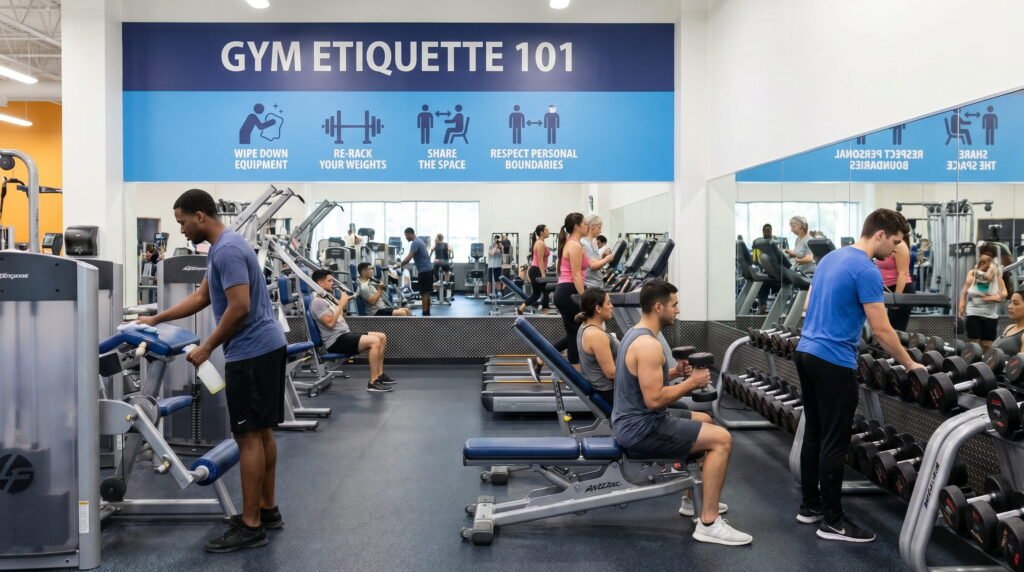
Gym etiquette is the collection of behaviors that keeps a shared fitness space safe, clean, and respectful for everyone using it. Some rules are posted on the wall. Most aren’t.
The unwritten rules exist because gyms are unusually intimate environments. You’re sweating, grunting, and pushing your body to its limit — surrounded by strangers doing the same. That proximity creates friction when people aren’t considerate, and it creates community when they are.
Poor etiquette has real consequences. According to longtime commercial gym employee Katie Cooper, speaking to Garage Gym Reviews, a lack of gym etiquette can drive members away entirely: “With the gym market so competitive now, people will change gyms easily, and annoying habits are enough reason to switch.”
On the flip side, following gym etiquette 101 makes your workouts better too. You waste less time waiting, you build goodwill with regulars, and you avoid the silent judgment that derails focus.
The Core Rules of the Gym (The Ones Posted on the Wall)
Every fitness center has written rules — most cover the basics. These aren’t suggestions.
Re-rack Your Weights
This is the oldest rule in the book, and the most broken. After you finish a set, put the dumbbells, barbells, and plates back where you found them. A weight left on the floor is a tripping hazard. A loaded barbell abandoned on a bench means nobody else can use that station.
The phrase you’ll hear from experienced lifters: “If you can lift it, you can re-rack it.”
When unloading a barbell, remove plates from each side alternately — not all from one side first. A heavily loaded bar tilted to one side can flip and injure someone nearby.
Wipe Down Equipment Before and After Use
No one wants to start their set on a sweaty surface, and most gyms make cleaning supplies easy to find for a reason. Use the spray bottles and paper towels provided — wipe the bench, handles, and any surface you touched. Do it before you use a machine too, since you can’t know whether the last person did it.
This isn’t just courtesy. Gym equipment carries bacteria. In a shared space, skipping the wipe-down is a hygiene issue as much as a manners issue.
Follow Time Limits on Cardio Equipment
Most gyms post time limits on cardio machines. When the facility is busy, monitor the minutes and plan your workout so it wraps on time, every time. During off-peak hours with empty machines, this is less critical. During the after-work rush? Those limits exist for a reason.
If you’re in the middle of a long cardio session and someone’s clearly waiting, the considerate move is to let them know how many minutes you have left or offer to let them hop on another nearby machine.
Dress Appropriately
Find out if your gym has a dress code and dress properly for your workout, the locker room, sauna, or pool. Check for facility requirements, such as wearing the proper shoes for your activity — lifting, cycling, yoga, and running all have different shoe requirements.
Beyond dress codes, avoid 100% cotton for training. Cotton soaks up sweat and stays wet, which can irritate skin over a long session. Moisture-wicking fabrics — polyester, spandex — keep you drier and cut down on odor.
Gym Etiquette 101: The Unwritten Rules Nobody Tells You
These don’t appear on any sign. You’re expected to know them anyway.
Don’t Hover or Ghost Equipment
If you need a machine, wait at a respectful distance and ask about the wait. You can ask to work in politely. Lurking or pacing makes people uncomfortable and slows the flow.
“Working in” means you and another person alternate sets on the same machine. It’s a normal, accepted practice at most gyms — and it keeps things moving during busy hours. Just ask: “How many sets do you have left? Mind if I work in?” Most people say yes.
On the flip side, don’t ghost a piece of equipment. If you need the restroom or a water refill, drape your towel over the machine and come back quickly — not after 10 minutes. Sitting on a bench you’re not using to scroll your phone while someone waits is one of the fastest ways to become unpopular at a gym.
Respect Personal Space
Try not to get on a bike or treadmill right next to someone if other machines are open. This is the gym equivalent of the middle urinal rule. If there are five open treadmills and one person on the end, don’t take the one directly beside them.
In the weight area, give people room while they’re actively lifting. Getting too close to someone mid-set isn’t just annoying — a mis-step during a heavy lift can injure both of you.
Never Give Unsolicited Advice
It’s important to only give workout advice if someone asks. Avoid telling people their form is wrong or they should be running faster — comments like these only make people feel judged and unwelcome.
This applies even when the advice is correct and well-intentioned. The gym is not a classroom. If someone is doing something that’s an immediate safety risk to themselves or others, a quiet word is fair. For everything else — let it go.
Don’t Monopolize Multiple Pieces of Equipment
The number one gym annoyance in the Garage Gym Reviews survey of 2,000 members was hogging equipment. This includes spreading a gym bag across a bench, setting up a superset across three stations at peak hours, or leaving weights on a bar “claimed” while you take an extended rest.
Supersets are fine during slow periods. During peak hours, stick to one station at a time and offer to let people in.
Keep Noise at a Reasonable Level
Some grunting during a heavy lift is natural — a physical response to maximal effort. Theatrical grunting that fills the room is a different thing. Fitness enthusiast and etiquette expert Jo Hayes points out that “loud conversation, singing, and generally impacting others with one’s behavior” are consistently cited as poor gym etiquette, demonstrating a lack of consideration for people who came to focus.
On weights: dropping them. Some Olympic lifts on a platform require it. At a standard commercial gym without proper platforms, put the weights down. It damages equipment and disrupts everyone nearby.
Phone Rules in the Gym
This deserves its own section, because the phone situation at most gyms has gotten worse.
Use Headphones — Always
Your playlist might be personal, but not everyone wants to hear it. Keep music, videos, and phone calls in your headphones and be mindful of your overall noise level. Leave the portable speaker at home. This isn’t negotiable at most gyms.
Step Away for Phone Calls
Taking a call on the gym floor pulls you out of your workout and pulls others into your conversation. If you need to take an important call, step outside or move to a designated area. Keep it brief. Return promptly if you have equipment waiting.
Be Careful with Filming
The gym isn’t a personal TikTok filming studio. If you want to video yourself to check your form or share your workout with a friend, find a quiet corner or a studio room that’s not in use — and set up your camera so that it’s facing you and only you.
Filming other people at the gym without their consent, even accidentally, is a serious breach of privacy. Most gyms prohibit it explicitly.
Don’t Let Your Phone Kill Your Workout
According to a survey by Harpers Fitness, a typical gym-goer wastes up to 35 percent of each sweat session on non-fitness activities including texting, checking email, and scrolling apps. Beyond the etiquette angle, phone overuse just costs you results.
Hygiene Rules at the Fitness Center
This is where a lot of gym-goers fall short — often without realizing it.
Wash Your Gym Clothes After Every Session
Proper gym etiquette doesn’t stop when you leave the gym. Wash and dry your workout clothes each time you wear them — that includes shirts, sports bras, shorts, leggings, and socks.
In a Nuffield Health survey of 2,000 people, 16 percent admitted they don’t wash their clothes between workouts. That’s one in six people wearing yesterday’s gym kit. Your fellow members can tell.
Use Deodorant
Etiquette expert Jo Hayes is direct about this: “Use antiperspirant deodorant. This should go without saying, but it must be said.” Strong body spray isn’t a substitute — overpowering cologne in a closed gym is its own issue. The goal is clean and neutral, not fragrant.
Bring a Towel
A sweat towel serves two purposes: wiping yourself down mid-workout (so your sweat doesn’t go on the equipment), and having something to lay between your skin and shared surfaces. Some gyms require it. All gyms appreciate it.
Stay Home If You’re Sick
If you’re feeling sick, don’t come into the gym and potentially spread the illness to others. Come back when you feel fully recovered. This isn’t just manners — it’s basic public health. The gym is a high-touch, high-sweat environment where illness moves fast.
Rules of the Gym You Should Know Before Your First Visit
If you’re new, the gym can feel intimidating. A 2025 survey found that over 40% of people avoid working out due to gym anxiety — including uncertainty about gym etiquette, where to find things, and how to navigate the space.
That anxiety shrinks fast once you know what’s expected. A few things to do before your first session:
Take the orientation. Most gyms offer one. BayCare Fitness Center General Manager Manthan Thaker recommends going even if you’re an experienced gym-goer, noting that even seasoned fitness enthusiasts can learn something useful from their specific facility’s setup.
Read the posted rules. Every gym has them near the entrance or on equipment. Some facilities allow chalk; some don’t. Some permit weight dropping; others — especially those in office buildings — prohibit it because of noise complaints from other floors.
Ask staff, not random members. Questions about how to use equipment, where things are stored, or what the gym’s specific policies are — staff are the right people for these. Fellow gym-goers mean well but may not know the rules of that specific facility.
Start during off-peak hours. Early mornings (5–7 AM) and mid-mornings on weekdays tend to be quieter. This gives you space to learn the layout and try equipment without the pressure of peak-hour crowds.
Locker Room and Common Area Etiquette
Gymnasium rules extend past the gym floor.
Keep your phone in your pocket in the locker room. Many clubs treat locker rooms as strict no-phone zones — no photos, video, texting, or calls. Protect everyone’s privacy by putting your phone away before you enter.
Don’t spread out. Use the locker you paid for, not the benches and floor around it. Others need space to change.
Keep common areas tidy. Empty cups, used towels, and protein bar wrappers go in the bin — not left on benches or windowsills.
In the sauna: keep conversation quiet, keep clothing on where required by your facility, and limit your time when others are waiting.
What to Do When Someone Breaks the Rules
It happens. Someone’s been hogging the squat rack for 45 minutes, or left 45-pound plates loaded on every barbell.
The cleanest options, in order:
- Ask politely. “Hey, do you have many sets left?” or “Mind if I grab one of those plates?” Most people aren’t intentionally being inconsiderate — they just aren’t aware.
- Let it go if it’s minor. Not every irritation needs a conversation. Save your energy for your workout.
- Talk to staff. If it’s a repeated issue or involves hygiene or safety, gym staff are trained for this. It’s their job to address it — not yours to manage alone.
As etiquette expert Jo Hayes puts it: “Most people are not intentionally being rude. They may simply be unaware, and communicating clearly is the charitable thing to do — both for them, yourself, and others.”
Gym Etiquette Quick-Reference: The Full Rules List
Equipment
- Re-rack all weights after each set
- Wipe equipment before and after use
- Don’t hog multiple machines at once
- Work in with others during busy periods
- Respect cardio time limits during peak hours
Behavior
- Give people space while lifting
- Keep noise — grunting, dropping weights, conversations — at a reasonable level
- No unsolicited advice
- Don’t hover while waiting; ask politely
Phone
- Headphones only for music and video
- Step outside for calls
- No filming others without consent
Hygiene
- Wash gym clothes after every session
- Bring and use a towel
- Wear deodorant
- Stay home when sick
Locker Room
- Phone-free zone in changing areas
- Clean up after yourself
- Don’t spread your things across shared spaces
Conclusion
Gym etiquette isn’t about being perfect. It’s about being aware that the space belongs to everyone — not just you on the days you show up.
Most of the rules above take five seconds to follow: wipe the bench, put the dumbbell back, pull out an earbud before talking to someone. The payoff is a gym where people actually want to train, where the equipment is where it should be, and where even a packed Monday night doesn’t feel hostile.
Start with the basics — clean up, re-rack, respect space — and the rest follows naturally. The gym community rewards the members who make it better.