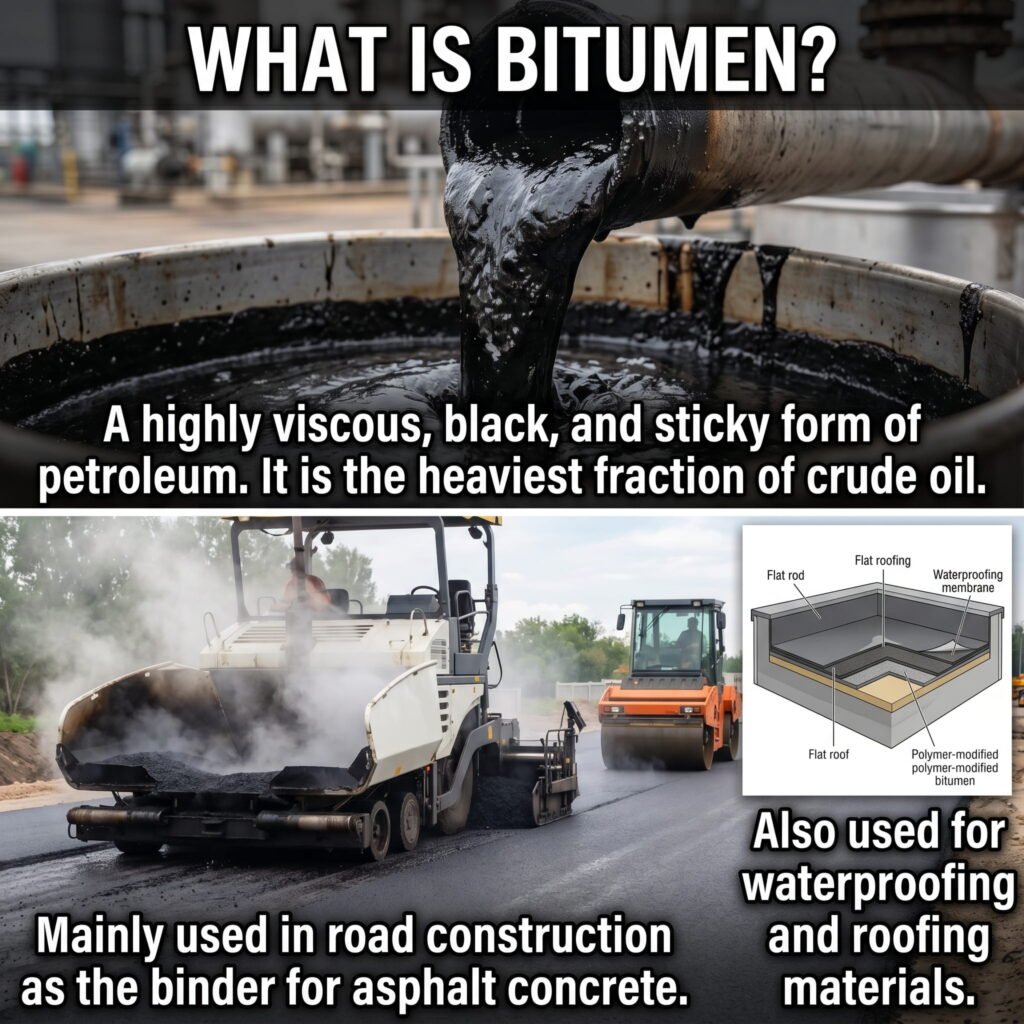
You walk on it. You drive on it. The roof over your head probably has it. Bitumen is one of the most-used construction materials on the planet — and yet most people couldn’t define it if you asked.
Part of the confusion is the terminology. Some call it asphalt. Some call it tar. Some assume it’s a synthetic chemical. None of those are quite right.
Here’s the short version: bitumen is a thick, black, sticky substance that comes from crude oil. It’s the binder that holds asphalt roads together, the glue that waterproofs flat roofs, and a material the world produces over 100 million tonnes of every single year.
In this guide you’ll learn exactly what bitumen is, where it comes from, what it’s made of, how it’s produced, the main types you’ll encounter, and what it gets used for. By the end, you’ll never confuse it with tar again.
What Is Bitumen? The Simple Definition
Bitumen is a semi-solid, viscous form of petroleum — a leftover from crude oil refining that’s too heavy to become petrol or diesel. It’s black, sticky, and behaves like a thick liquid when hot and a brittle solid when cold.
In North America, you’ll often hear it called asphalt cement or asphalt binder. Outside North America, the word “asphalt” usually refers to the finished road surface (bitumen mixed with stone), while “bitumen” refers specifically to the binder. That’s why a British engineer and an American engineer can have the same conversation and mean two different things.
The technical definition from ASTM International calls bitumen a “viscous mixture of hydrocarbons obtained naturally or as a residue from petroleum distillation.” That’s a mouthful. In plain English: it’s the heaviest, stickiest stuff that’s left over after a refinery has pulled out everything lighter.
The takeaway: bitumen is the binder. Asphalt is bitumen plus rocks. Two different things, often used as if they were the same.
Where Does Bitumen Come From? Natural vs Refined Sources
Bitumen has two origins. Most of what’s used today comes from oil refineries, but the natural version has been around for thousands of years.
Natural Bitumen Deposits
Long before refineries existed, bitumen seeped out of the ground in places where oil deposits sat close to the surface. The ancient Babylonians used it as mortar to build the walls of Babylon. The Egyptians used it to embalm mummies — that’s actually where the word “mummy” comes from (the Persian word mūm means bitumen). The Bible mentions “slime pits” near Sodom, which historians believe were natural bitumen pools.
Today, the largest natural bitumen reserves are the oil sands of Alberta, Canada, and the Pitch Lake of Trinidad. The U.S. Geological Survey estimates Canadian oil sands hold over 165 billion barrels of recoverable bitumen — making them one of the largest hydrocarbon reserves on Earth.
Refined Bitumen From Crude Oil
The other 95% of global bitumen supply comes from oil refineries. When crude oil is distilled, the lightest fractions (gases, petrol, kerosene) boil off first. What’s left at the bottom of the tower — the heaviest, stickiest residue — is bitumen.
According to the U.S. Energy Information Administration, each barrel of crude produces only a small percentage of bitumen, but global refinery output is so massive that the world still produces over 100 million tonnes per year.
What Is Bitumen Made Of? The Chemistry Explained
Bitumen isn’t a single chemical. It’s a complex mixture of hundreds of different hydrocarbon molecules — some small, some massive, all sticky.
The Four SARA Fractions
Chemists break bitumen down into four broad groups, often called the SARA fractions:
- Saturates (5–20%) — small, oily molecules that act as a softener
- Aromatics (40–65%) — medium-weight molecules that give bitumen its flow
- Resins (15–25%) — heavier molecules that hold everything together
- Asphaltenes (5–25%) — the largest molecules, responsible for stiffness and black colour
The exact ratios depend on where the crude oil came from. Bitumen from a Venezuelan refinery has a different SARA profile than bitumen from a Russian one — which is why specifications matter when you’re buying bulk for a road project.
Why Bitumen Behaves Like a Liquid and a Solid
Bitumen is what scientists call a viscoelastic material. At high temperatures (above 60°C), it flows like thick honey. At low temperatures, it cracks like glass. In between, it stretches and deforms slowly under load.
That weird dual behaviour is why bitumen works so well for roads. It can be pumped and spread when hot, then it stiffens as it cools to support traffic loads.
How Is Bitumen Produced? The Production Process Step by Step
Modern bitumen comes from a precise refining process. Here’s how a barrel of crude turns into the binder under your driveway.
Step 1: Atmospheric Distillation
Crude oil is heated to around 350°C and pumped into a tall distillation tower. Lighter fractions like LPG, petrol, kerosene, and diesel boil off at different heights and get collected. What sinks to the bottom is called atmospheric residue — a thick, dark fluid.
Step 2: Vacuum Distillation
The atmospheric residue still contains some valuable molecules. To separate them without breaking them down with heat, refineries pump it into a vacuum distillation tower. Lower pressure means lower boiling points, so they can separate more fractions at safer temperatures.
The heaviest residue from this step is called vacuum residue — and that’s bitumen in its rawest form.
Step 3: Air Blowing (Optional)
For roofing-grade bitumen, the vacuum residue gets oxidised by blowing hot air through it. This makes it harder, more heat-resistant, and better suited to flat-roof applications. The result is called oxidised bitumen or blown bitumen.
Step 4: Modification (Optional)
For high-performance applications, bitumen gets blended with polymers like SBS (styrene-butadiene-styrene) or APP (atactic polypropylene). These additives improve cold-weather flexibility and hot-weather rutting resistance — which is why you’ll see them on highways and airport runways.
Step 5: Quality Testing
Before bitumen leaves the refinery, it’s tested for properties like penetration depth, softening point, viscosity, ductility, and flash point. The numbers determine its grade — and the grade determines what it can be used for.
Common Types of Bitumen You’ll Encounter
Not all bitumen is the same. Here are the main types you’ll see specified on construction documents.
Penetration Grade Bitumen — the classic grades like 60/70 and 80/100, named for how deep a standard needle penetrates the surface in a lab test. Common in road construction.
Viscosity Grade Bitumen (VG-10, VG-30, VG-40) — graded by viscosity at 60°C. India, parts of Asia, and increasingly the US use this system.
Polymer Modified Bitumen (PMB) — bitumen mixed with polymers for high-performance pavements. Costs 30–50% more but lasts much longer.
SBS Modified Bitumen — used almost exclusively for flat-roof membranes. Flexible at low temperatures, durable at high ones.
Cutback Bitumen — bitumen thinned with solvents like kerosene or diesel. Used for prime coats and tack coats. Less common today because of environmental rules around solvent use.
Bitumen Emulsion — bitumen droplets suspended in water. Used for cold-mix repair, sealing, and surface dressing. Easier to handle and more eco-friendly than cutback.
What Is Bitumen Used For?
Now that you know what bitumen is, here’s where it actually shows up in everyday life.
Roads. Around 85% of all bitumen produced globally goes into road paving. A typical asphalt road surface is about 5% bitumen and 95% aggregate. If you want to estimate exactly how much bitumen your project needs, the bitumen calculator handles the math in seconds — just plug in your area, thickness, and density.
Roofing. Modified bitumen membranes cover millions of square metres of commercial flat roofs. They’re tough, waterproof, and can last 20–30 years with proper maintenance.
Waterproofing. Bitumen paint and bitumen-based sealants are used to waterproof basements, foundations, and underground tanks.
Pipe Coatings. Steel pipelines used for oil and gas transport are often coated with bitumen to prevent corrosion.
Driveways. Residential driveways made from hot-mix asphalt are common in North America, the UK, and Australia. For a typical two-car driveway, you’re looking at 7–10 tonnes of asphalt material — and the concrete price calculator is worth comparing if you’re undecided between asphalt and concrete.
Industrial uses. Battery cases, sound dampening for cars, and even some inks and paints contain bitumen-derived compounds.
Frequently Asked Questions
Is Bitumen the Same as Asphalt?
Not quite. Bitumen is the sticky black binder. Asphalt is the finished mix — bitumen plus aggregate (crushed stone and sand), sometimes with additives. In North America the words are often used interchangeably, but technically they describe different things. When you “pave a road with asphalt,” what you’re actually laying is asphalt concrete, in which bitumen makes up about 5%.
Is Bitumen the Same as Tar?
No. Tar comes from coal distillation and has a different chemical structure. It contains polycyclic aromatic hydrocarbons that are classified as carcinogenic, which is why tar has been phased out of road construction in most countries. When someone calls something a “tar road” today, they almost always mean a bitumen road. The terms got mixed up because old roads were genuinely made with coal tar, and the habit stuck.
Is Bitumen Toxic?
In its solid, cooled state, bitumen is generally considered low-risk. Hot bitumen fumes during application can irritate the lungs and eyes, which is why workers wear respirators on paving sites. The International Agency for Research on Cancer classifies occupational exposure to oxidised bitumen fumes as “probably carcinogenic” — a precaution, not a guarantee of harm. For a homeowner walking on a finished asphalt driveway, the risk is essentially zero.
How Long Does Bitumen Last?
It depends on the application. A well-built asphalt road typically lasts 15–20 years before it needs major resurfacing. A residential bitumen driveway can last 20–25 years with seal coating every few years. A modified bitumen roof membrane is rated for 20–30 years. Climate, traffic load, and maintenance all affect lifespan — a road in Phoenix bakes harder than one in Manchester.
Where Does Bitumen Come From in the Bible?
The Hebrew word chemar (translated as “slime” or “pitch” in older Bibles) refers to natural bitumen. The Bible mentions it in the story of Noah’s Ark (Genesis 6:14), the Tower of Babel (Genesis 11:3), and the slime pits near Sodom and Gomorrah (Genesis 14:10). Archaeologists have confirmed natural bitumen seeps existed in Mesopotamia for thousands of years — so these references are historically grounded, not metaphorical.
Wrapping Up: What You Now Know About Bitumen
You started this guide possibly thinking bitumen, asphalt, and tar were all the same thing. Now you know better.
Bitumen is the heavy, sticky residue from crude oil refining. It binds together every asphalt road, every flat roof membrane, and most waterproofing systems on the planet. It’s been used by humans for over 4,000 years, comes in dozens of grades and variations, and the world produces over 100 million tonnes of it annually.
If you’re planning a paving or roofing project, the next step is figuring out exactly how much you need. Skip the guesswork and run the numbers through the bitumen calculator on ToolCalcPro — enter your area, thickness, and density, and you’ll have an accurate tonnage estimate in under a minute.
Got a bitumen question we didn’t cover here? Drop it in the comments and we’ll add it to the guide.