Last reviewed: May 2026 | By a licensed solar hot water specialist
If you’ve landed here, you’re probably one of three people: someone researching whether an Edwards system is worth buying, someone whose Edwards unit just stopped working, or someone who’s heard the brand name and wants to know if it’s still a thing.
The short answer to that last one: Edwards the brand is gone. Rheem bought it in 2013. But there are still hundreds of thousands of Edwards solar hot water systems running on rooftops across Australia — and if you own one, there’s plenty you need to know.
This guide covers everything: how the systems work, which model you’re likely dealing with, what goes wrong and when, the repair-or-replace question, and what government rebates apply if you’re looking at a new system.
What happened to Edwards Solar?
Edwards Solar was a Perth-founded company that started making hot water heaters in 1963. For decades it was one of Australia’s most recognised solar hot water brands — genuinely Australian made, with a reputation built on stainless steel tanks and thermosiphon design when most competitors were still using glass-lined mild steel.
In 2013, Rheem Australia acquired Edwards and absorbed it into the Rheem group. The Edwards brand was discontinued. New systems are no longer sold under the Edwards name, and manufacturing has shifted to Rheem’s production lines. What that means practically: if you walk into a plumber supply today asking for “an Edwards system,” you’ll get a Rheem equivalent instead.
What it does not mean is that your existing Edwards system is orphaned. Rheem continues to service the full Edwards range, spare parts remain available for most models, and Rheem’s dealer network (the Rheem Solar Specialist Network) covers the country.
How Edwards solar hot water systems work
Edwards built two fundamentally different types of systems, and knowing which you have changes what repairs cost, who can fix it, and whether replacement makes sense.
Thermosiphon (Hiline — roof-mounted)
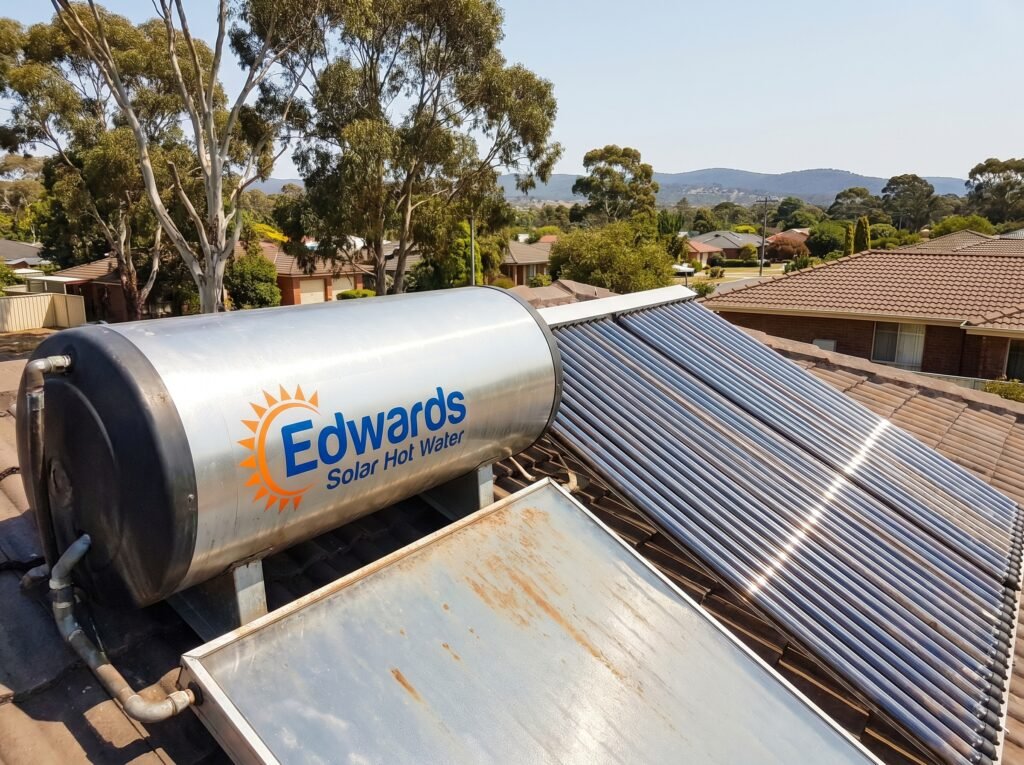
The Hiline is what most people picture when they think of an Edwards system: a horizontal stainless steel tank sitting on the roof, fed by flat-panel solar collectors mounted directly below it.
The physics is elegant. As water inside the collectors heats up from sunlight, it becomes less dense and rises naturally into the tank above. Cooler water at the bottom of the tank drops down to replace it. No pump, no moving parts, no electricity required for the solar heating function itself. The whole thing works on thermosiphon convection.
This design is why old Edwards Hiline systems are still running after 20+ years in some cases. There is genuinely very little to break.
The booster element — electric or gas — is a separate matter. That does have moving parts (or at least an element and thermostat), and those do fail. More on that below.
Split system (Loline — ground-mounted)
Loline systems separate the collector panels (on the roof) from the storage tank (on the ground). A pump circulates water between them, which means you need electricity to run the solar heating function — not just the booster.
The advantage: aesthetics (no tank on the roof) and flexibility for larger households. The disadvantage: a pump that can fail, and a more complex system to diagnose when things go wrong.
Later-model Loline cylinders — introduced after the Rheem integration — shifted from stainless steel to vitreous enamel lining, which requires a sacrificial anode and periodic replacement. This is a meaningful distinction from the original Hiline stainless design.
Electric vs gas boosting
Both system types can be configured with electric or gas boosting for cloudy days. Gas boost is more efficient in most Australian climates, but installation cost is higher and you need an existing gas connection. Electric boost is simpler but can add meaningfully to your bill during winter.
The boost element is inside the tank on Hiline systems, and in a separate ground unit on some Loline configurations.
Edwards model guide — which system do you have?
Most homes with an older Edwards system have one of these:
L Series 2 (Hiline, stainless, roof-mounted)
- L180: 180L tank + 1 × 2.0m² solar collector, electric boost
- L305: 305L tank + 2 × 2.0m² solar collectors, electric boost
- L440: 440L tank + 3 × 2.0m² solar collectors, electric boost
These are the most common residential Edwards systems. Stainless steel tanks with no sacrificial anode required.
LX Series 2 (Hiline, frost-protected)
- Same tank sizes as L Series, but with a glycol heat exchanger built into the cylinder
- Water inside the panels doesn’t directly enter the tank — a glycol/water mix circulates through the collector and transfers heat via the exchanger
- Designed for frost-prone areas (inland NSW, Victoria, ACT, parts of SA)
- LX180, LX305, LX440
If you’re in an area that gets below-zero nights and your system leaks after a cold snap, you may have an L Series that should have been an LX — a common installation error from the early 2000s.
Titan 2 and Australis 2 (later Loline split systems)
- Ground-mounted tanks, vitreous enamel lined
- Re-badged Rheem storage units with Edwards collectors
- Require anode replacement every 5 years
Edwards solar hot water: cost and rebates in Australia
New system cost (Rheem equivalent, 2026): $3,500–$7,500 fully installed, depending on tank size, boost type, and your location. Rural installs skew higher due to travel costs.
Government rebates: The main mechanism is Small-scale Technology Certificates (STCs) under the federal government’s Renewable Energy Target. Solar hot water systems generate STCs based on their energy output and your location’s solar radiation zone. In practice, the installer typically handles STC assignment and discounts the system price upfront.
Approximate STC value at current market rates by capital city:
| City | STC zone | Approx. rebate (L305 equivalent) |
|---|---|---|
| Darwin | 1 (highest) | $900–$1,100 |
| Brisbane | 2 | $750–$950 |
| Perth | 2 | $750–$950 |
| Sydney | 3 | $600–$800 |
| Adelaide | 3 | $600–$800 |
| Melbourne | 4 | $500–$700 |
| Hobart | 4 | $450–$650 |
| Canberra | 4 | $450–$650 |
STC values fluctuate with the market. Always confirm the current rate with your installer or at the Clean Energy Regulator’s registry.
Some states also offer additional rebates. Victoria’s Solar Homes program has included solar hot water at various points since 2018. Check energy.vic.gov.au and equivalent state sites before you buy — these change regularly.
Common Edwards system problems — and what to do
Thermostat failure is the most reported issue. On Hiline systems, the element and thermostat sit inside one end of the horizontal tank. They’re a known weak point over time, especially after 10+ years. If your water is lukewarm but the solar collectors look fine, start here. A replacement thermostat is around $80–$150 plus labour, and any licensed plumber or Rheem service tech can swap it.
Relief valve leaking is extremely common in older systems and is often harmless — or a sign of a problem. Every solar hot water system has a temperature-pressure relief (TPR) valve that releases if pressure builds too high. If yours is dripping occasionally, it may just be doing its job. If it’s running constantly, you likely have an issue with your cold water inlet valve or the system pressure exceeds the valve rating. Don’t ignore this — a blocked relief valve on an over-pressured system can rupture the tank.
Corrosion on “stainless steel” tanks is more common than Edwards’s marketing suggested. Real-world reviews on ProductReview.com.au document L305 tanks corroding through after 8 years. Stainless steel is not immune — marine grade 316 performs better in coastal areas than 304, but water quality, local conditions, and manufacturing variances all matter. If your tank is leaking and it’s under 15 years old, it’s worth getting a quote from Rheem directly about warranty coverage given the Rheem/Edwards integration.
Frost damage hits non-frost-protected L Series systems in cold climates. If your system developed burst pipes after a hard winter night, you have one of three situations: you have an LX Series and the glycol protection failed (the glycol/water mix needs topping up or has degraded), you have an L Series installed in a frost zone (installation error), or your location got an unusually severe frost that exceeded the system’s design spec. In all cases, a Rheem service technician should assess before you run the system again.
Lukewarm water in summer often means a blocked or degraded collector rather than a tank fault. Dirty flat-plate collectors reduce output significantly. A clean with mild detergent and low-pressure water is usually all it takes.
Repair or replace? A decision guide for Edwards owners
This is the question most homeowners actually need answered, and nobody answers it plainly. Here’s a practical framework.
If your system is under 12 years old
Repair, almost always. The economics strongly favour repair at this age — a replacement system installed today will likely outlive the loan you’d use to pay for it. The exception is if the tank itself has corroded through, which is a terminal failure that can’t be fixed.
If your system is 12–20 years old
Depends on what’s broken. A thermostat or element replacement at this age is still sensible — you might get another 10 years out of a fundamentally sound system. But if you’re replacing a collector, looking at tank corrosion, or dealing with a pump failure on a Loline system, get a quote for replacement alongside the repair quote and do the maths. Factor in energy savings from a newer, more efficient system.
A Rheem equivalent of your current system will typically pay back in 5–8 years through energy savings if you’re currently running electric hot water as your primary source.
If your system is over 20 years old
Replace. The original Edwards L Series with stainless steel tanks was genuinely well-built, and some do last 20–25 years. But by this point you’re spending money on a system that’s past its design life. A new Rheem system comes with a 10-year warranty, qualifies for current STC rebates, and will be more efficient than what you’re running.
Edwards vs Rheem solar hot water today
Rheem is functionally the continuation of Edwards — same technology lineage, same Perth manufacturing heritage, same thermosiphon design principles. If you need a direct replacement for an L305, the Rheem 305L close-coupled system is the product you want. Panels are physically compatible in many cases, which can reduce installation cost if only the tank needs replacing.
Parts for the original Edwards L and LX series are still available through Rheem’s parts network. A licensed plumber can order them through any Rheem trade account. The thermostat (Rheem part 052072) is the most commonly replaced component — it’s cross-compatible with Hiline and a range of other roof-mounted systems.
FAQ
Is Edwards solar hot water still made?
. Rheem acquired Edwards in 2013 and discontinued the brand. Equivalent systems are now sold under the Rheem name. Existing Edwards systems can still be serviced and parts remain available through Rheem’s dealer network.
Who services Edwards solar hot water systems in Australia?
Rheem’s authorised service network covers most of Australia. Same Day Hot Water Service, Jim’s Plumbing, and Australian Hot Water are national operators that service the full Edwards range. Your state’s plumbing licensing body can confirm licensed technicians in your area.
How long do Edwards solar hot water systems last?
The stainless steel Hiline range (L and LX Series) has a design life of 20+ years when properly maintained. Real-world results vary — some systems run trouble-free for 25 years, others develop issues after 8–10. Tank corrosion and thermostat failure are the main causes of early retirement.
Can I get government rebates for replacing an Edwards system?
Yes. A replacement Rheem or equivalent solar hot water system qualifies for STCs under the federal Renewable Energy Target, plus any applicable state rebates. The STC value varies by location — see the table above for approximate figures by city.
What replaced the Edwards L305?
The direct Rheem equivalent is the Rheem 305L close-coupled solar hot water system. It uses the same thermosiphon principle, stainless steel tank, and flat-plate collector configuration. Rheem also offers evacuated tube collectors as an upgrade option for lower-sunlight climates.