Last updated: May 2026 | By; Hussnain Mustafa | Source-checked against ATO and Study Assist
More than 3 million Australians carry a HECS-HELP debt. Most of them have no idea what their current balance is, and a surprising number have been operating under myths about salary sacrifice that cost them real money. This guide covers everything that actually matters in 2026: checking your balance, the 20% reduction, how the new repayment system works, and what HECS really does to your ability to buy a home.
What Is HECS-HELP Debt?
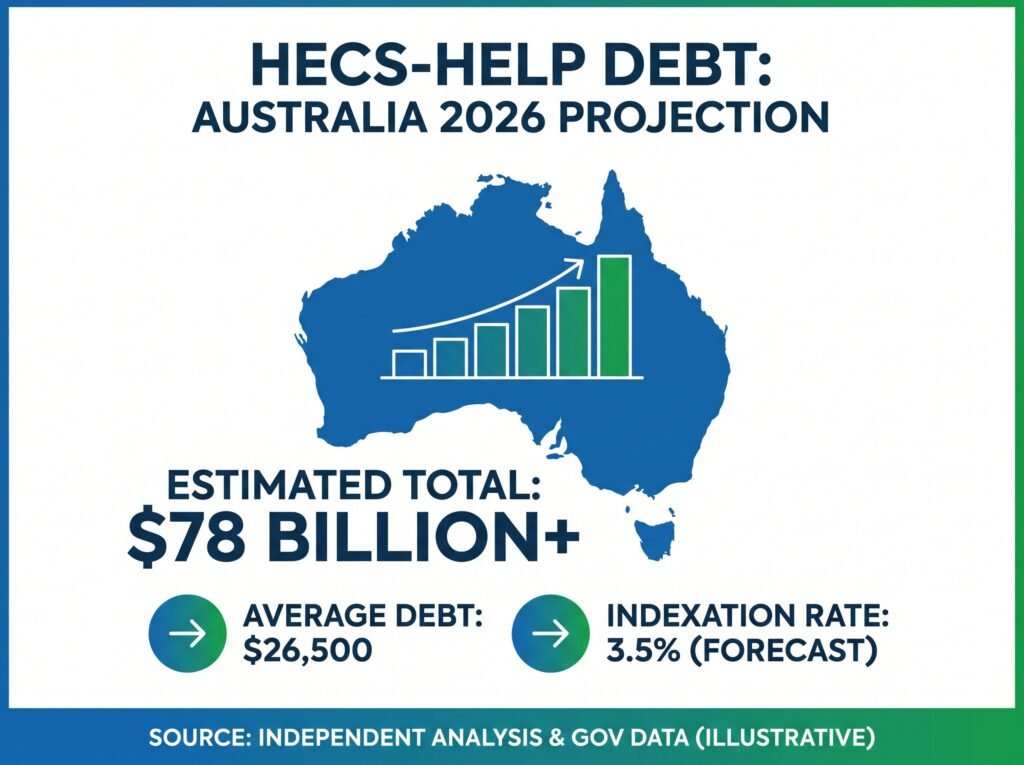
HECS-HELP is the Australian Government’s income-contingent student loan program. When you study at a Commonwealth-supported place at university, the government covers your tuition — and records the amount as a debt you repay through the tax system once your income crosses a set threshold. There is no traditional interest. Instead, your balance is adjusted once a year on 1 June through indexation, capped at the lower of the Consumer Price Index (CPI) or the Wage Price Index (WPI). That cap has applied since 1 June 2023, which means your debt can no longer grow faster than wages — a significant change from the 7.1% indexation shock of 2023. The ATO manages all HECS-HELP balances and collects repayments through your tax return each year.
How to Check Your HECS Debt in 2026
Your HECS balance is held by the ATO, and there are two ways to view it.
Method 1: myGov (recommended)
Log in to your myGov account at my.gov.au and select “ATO Online Services.” Once inside the ATO portal, navigate to “Loan Accounts.” Your current HECS-HELP balance, including a breakdown of loans received, indexation applied, and all repayments made, will be listed there. This is a real-time figure updated by the ATO and is the most reliable number you have.
If your myGov account is not yet linked to the ATO, follow the ATO linking steps under the “Services” menu. The process takes about five minutes and requires your Tax File Number (TFN).
Method 2: Call the ATO
Phone the ATO on 13 28 61. Have your TFN ready — they will verify your identity before sharing any account details. If you need help with the myGov link itself, the ATO myGov helpdesk is on 13 23 07 (select option 1).
What you will not see there: The myHELPbalance portal at studyassist.gov.au shows your available HELP credit limit, not your current debt. It also excludes debts incurred before 2005. Go to the ATO for what you actually owe.
Has the 20% HECS Reduction Been Applied to Your Account?
Yes, if your debt existed before 1 June 2025. The Australian Government legislated a one-off 20% reduction on all HECS-HELP and related student debts through the Universities Accord (Cutting Student Debt by 20 Per Cent) Bill 2025, which became law on 2 August 2025. The ATO applied the reduction automatically to balances as at 1 June 2025, before annual indexation was added for that year.
You did not need to apply. For the average debt of around $27,600, the cut wiped roughly $5,520 from the balance. A $50,000 debt became $40,000 before indexation. Most refunds and credits were processed by the end of January 2026, with more complex accounts finalised by February or March 2026.
The reduction also covered VET Student Loans, Australian Apprenticeship Support Loans, Student Start-up Loans, and the Student Financial Supplement Scheme. Combined, approximately $16 billion in debt was wiped across all affected borrowers.
If you have not logged into myGov since mid-2025, check now. The ATO sent notifications via SMS, email, or myGov Inbox when individual accounts were updated.
One important boundary: the cut does not apply to debt incurred after 1 June 2025. Units you enrol in from July 2025 onwards accumulate at full value.
How Does HECS Repayment Work in 2025-26?
From 1 July 2025, the repayment system changed from a flat-percentage model to a marginal one. Under the old rules, once you crossed the minimum threshold, a percentage applied to your entire income. Under the new system, you only pay on income above the threshold.
New minimum threshold: $67,000 (up from $54,435 in 2024-25).
If you earn $67,000 or less, you make no compulsory repayment regardless of how large your debt is.
A worked example: Grace earns $80,000. Under the old system, her repayment was 3.5% of $80,000 — $2,800 a year. Under the new marginal system, she pays 15% of the $13,000 above the $67,000 threshold — $1,950 a year. That is $850 less annually, or around $32 extra in her fortnightly take-home pay.
The ATO collects repayments through your tax return. Your employer withholds an estimated amount from your pay during the year based on your salary. That withholding is reconciled at tax time — it does not update your visible HECS balance in real time, which is why your payslip can show HECS deductions while your myGov balance stays unchanged until the return is processed.
What Is “Repayment Income”?
The ATO does not use your taxable income to calculate HECS repayments. It uses a broader figure called repayment income, which adds back:
- Reportable fringe benefits
- Reportable employer super contributions (including salary sacrifice)
- Net investment losses (negative gearing)
- Exempt foreign employment income
For most salaried workers with no investments or salary packaging, repayment income equals taxable income. For everyone else, the distinction matters significantly.
Does Salary Sacrifice Reduce Your HECS Repayments?
No. This is the most persistent myth in Australian personal finance, and it causes real financial miscalculations for people trying to manage their student debt and super simultaneously.
Salary sacrificing into super reduces your taxable income, which lowers your income tax. But because the ATO adds reportable super contributions back into your repayment income, the amount you sacrifice is still included in the HECS repayment calculation. The net result: your income tax bill drops, but your HECS repayment stays exactly the same. Novated leases create reportable fringe benefits that are also added back. Salary sacrifice is, in the words of several accountants who work specifically in this space, “basically HECS-neutral.”
This does not mean salary sacrificing is a bad idea — it remains a strong tax strategy. It just will not help you pay off your student loan faster.
The three levers that actually reduce your repayment income:
- Maximise legitimate deductible work expenses — these reduce repayment income directly.
- If you are close to a repayment bracket boundary (around $125,000 or $179,286 for top earners), understand where you sit before the end of the financial year.
- Make voluntary repayments before 1 June each year to reduce the balance that indexation is applied to.
Before you make any changes to your salary packaging arrangement based on HECS strategy, speak with a registered tax agent who can run the numbers for your specific income and benefit structure.
HECS Debt and Home Loans: What Lenders Actually Do
Your HECS debt does not appear on your credit file, and it does not affect your credit score. What it does affect is your borrowing capacity, and the impact is larger than most people expect.
When a bank assesses your home loan application, it treats your compulsory HECS repayment as a fixed monthly expense — just like rent or a car loan repayment. That expense reduces your net disposable income, which directly cuts how much the bank will lend you.
A rough guide: a $50,000 HECS debt for someone earning $80,000 means approximately $1,950 per year in compulsory repayments, or around $163 per month. Assessed at the standard APRA buffer rate, that monthly commitment can reduce borrowing capacity by $30,000 to $50,000 depending on the lender’s model. A $100,000 debt on the same income could reduce it by $60,000 to $80,000. As a general rule of thumb, every $100 per month of compulsory HECS repayment reduces borrowing power by roughly $15,000 to $18,000 at current interest and buffer rates.
The good news from 2025: APRA finalised changes allowing lenders more flexibility in how they assess HECS obligations, recognising that income-contingent repayments differ from fixed commercial debt. From 1 July 2025, banks can also give more favourable treatment if your HECS balance is close to zero.
The new marginal repayment system also means annual HECS repayments are lower for most income brackets than under the old system. Lower annual repayments mean slightly less drag on monthly serviceability. The 20% debt reduction further lowered balances for existing borrowers — compounding these positive effects.
If you are planning a home purchase, the clearest strategy is to know your HECS balance before you sit down with a lender or broker. Mortgage brokers who work regularly with first-home buyers report that many applicants have no idea their HECS debt is affecting their borrowing capacity until they see a loan assessment. Knowing the number upfront lets you plan around it.
The HECS Debt vs Property Dilemma: Should You Pay Off HECS Before Buying?
This question has no universal answer, but the maths is less complicated than most people assume.
HECS has no compound interest. It is indexed once a year (not monthly), and that indexation rate is now capped at the lower of CPI or WPI. For 2025-26, indexation is tracking at roughly 2.5% to 3.4%. A basic ASX or global ETF returning 7% pre-tax works out to around 4.8% after tax in the 32.5% bracket. Over 10 years, investing $20,000 instead of making voluntary HECS repayments can leave you $4,000 to $7,000 ahead.
However, this changes if HECS is the specific obstacle blocking your home loan approval. In that case, reducing the balance to improve serviceability has a direct and immediate financial value. For many first-home buyers, paying down HECS to lift borrowing capacity and enter the property market can be worth more than the investment return on keeping the cash.
The decision comes down to: is your HECS debt actually preventing you from buying at your target price point, or is it just one of many factors? Calculate both scenarios with real numbers before deciding.
Is It Worth Paying Off HECS Early?
Sometimes. The case for voluntary repayments is strongest in two scenarios.
First, if you want to make a payment before 1 June to reduce the balance on which indexation is calculated, timing matters. A $10,000 voluntary repayment on a $50,000 debt before the June 1 indexation date at a 3.4% rate saves $340 in indexation that year. That is not a transformative saving, but it compounds over time.
Second, if your HECS balance is close enough to zero that paying it off changes your borrowing capacity meaningfully, the case is clear. Many lenders treat a fully-cleared HECS debt very differently from a small remaining balance.
The case against early repayment: HECS is one of the cheapest forms of debt available to Australian households. There is no compound interest, no penalty for slow repayment, and the debt is cancelled on death. For younger borrowers with a long repayment horizon, putting extra cash into super (especially with concessional contributions to maximise tax benefits) or investments often produces better long-term outcomes than racing to clear the HECS balance.
What Happens If You Never Pay Your HECS Debt?
If your income never reaches the repayment threshold — currently $67,000 in 2025-26 — no compulsory repayments are ever required. The debt sits on your ATO account, indexed annually, but the ATO does not pursue collection through courts, debt agencies, or credit reporting for people who simply earn below the threshold.
If your income does exceed the threshold but you fail to declare your debt to an employer or lodge tax returns, the ATO can and does pursue outstanding amounts. Since 2017, Australians living overseas are also subject to the same rules: if your worldwide income exceeds the repayment threshold, you must lodge a worldwide income declaration each year and make compulsory repayments. Failing to lodge attracts penalties on top of the debt.
The ATO also has the power to collect outstanding HECS repayments directly from employers or to apply amounts from tax refunds. The debt does not expire.
What Happens to Your HECS Debt When You Die?
Your HECS-HELP debt is cancelled when you die. It does not pass to your family, partner, or estate as an ongoing obligation.
The process works like this: the executor of your estate lodges your final tax return (a “date of death tax return”). If a compulsory repayment would normally have applied to the income you earned up to the date of death, that amount is paid from your estate before assets are distributed to beneficiaries. After that final settlement, the remaining HECS-HELP balance is written off by the government.
Your family is not personally liable for the debt. Beneficiaries inherit whatever is left in the estate after the final tax obligations are settled — the HECS balance itself is not part of that calculation. This is one of the genuinely distinctive features of HECS-HELP compared to most forms of debt, and it is worth making sure your executor knows your loan exists so the final tax return is prepared correctly.
Can Permanent Residents Access HECS-HELP?
Access to a Commonwealth Supported Place (CSP) and HECS-HELP eligibility is tied to citizenship and visa status, not permanent residency alone.
Eligible students include:
- Australian citizens
- New Zealand Special Category Visa holders who meet long-term residency requirements and study their entire course in Australia
- Permanent humanitarian visa holders (or eligible former holders) who will be resident in Australia for the duration of their units
- Pacific Engagement Visa (PEV) holders who will be resident in Australia throughout their studies
Standard permanent residents — for example, holders of a skilled migration permanent visa — are generally not eligible for a CSP or HECS-HELP. They pay full international or domestic fees depending on the institution’s policy, but without government loan support.
If you are unsure about your eligibility, contact your university’s student administration or the Department of Education’s Study Assist team before enrolling.
Is STSL the Same as HECS?
STSL stands for Study and Training Support Loans. It is the umbrella category the ATO uses on tax forms and assessments to cover all income-contingent government study loans, including HECS-HELP. When your employer asks whether you have a HELP debt on your Tax File Number Declaration form, they are asking whether you have any STSL. When your payslip shows an “STSL” or “HELP” deduction, that is your HECS withholding.
The short answer: yes, STSL on your tax paperwork refers to the same debt you know as HECS.
Does HECS Debt Affect Your Credit Score?
No. HECS-HELP debt does not appear on your credit file with Equifax, Experian, or illion. It is a government loan managed entirely through the ATO and the tax system, not through commercial credit reporting. Missing a compulsory HECS repayment — because you underestimated your income, for example — does not generate a credit default listing.
What HECS does affect is the serviceability assessment lenders run when you apply for credit. That is a separate calculation from credit scoring. A lender can see from your payslip or tax returns that you have HECS repayments, and they factor those into how much they will lend you — but your credit score itself is unaffected.
Can You Get HECS-HELP for TAFE?
Mostly no, but there are exceptions. HECS-HELP is specifically for Commonwealth-supported places at approved higher education providers — which means universities and some other higher education institutions. TAFE courses generally do not qualify for HECS-HELP.
However, VET Student Loans (VSL) are available for some higher-level vocational courses at approved VET providers, including certain diploma and advanced diploma qualifications. These are a separate scheme from HECS-HELP but work on a similar income-contingent basis. The 20% debt reduction in 2025 also applied to VET Student Loans.
Check your course and provider eligibility directly with Study Assist before assuming HECS-HELP is available.
Frequently Asked Questions
How do I check my HECS debt balance?
Log in to myGov, link your account to ATO Online Services, and select “Loan Accounts.” Your current HECS-HELP balance, a breakdown of indexation applied, and your repayment history are all listed there. Alternatively, call the ATO on 13 28 61 with your TFN ready.
Has the 20% HECS reduction been applied to my account? If your debt existed before 1 June 2025, yes — the ATO applied it automatically. Log into your ATO account via myGov to confirm. If the reduction is not showing, contact the ATO directly.
Does salary sacrifice reduce my HECS repayments? No. Salary sacrificed super contributions are classified as reportable super contributions and are added back into your repayment income by the ATO. Your HECS repayment is calculated on that broader figure, not just your taxable income. Salary sacrifice reduces your income tax bill, not your student loan repayment.
Does HECS debt affect my home loan borrowing capacity? Yes, significantly. Lenders treat your compulsory HECS repayment as a monthly expense in their serviceability calculation. A $40,000 HECS debt on an $80,000 income can reduce borrowing capacity by $30,000 to $50,000 depending on the lender and their assessment model.
What is the HECS repayment threshold in 2025-26? $67,000. If your repayment income is at or below this amount, no compulsory repayment applies. Above $67,000, the new marginal system means you pay only on income above the threshold, at tiered rates starting at 15%.
What happens to HECS debt when you die? It is cancelled. Your estate may pay the compulsory repayment due for income earned up to the date of death (through the final tax return), but the remaining HECS-HELP balance is written off. Family members and beneficiaries are not responsible for the debt.
What happens if I never pay my HECS debt?
If your income never reaches the $67,000 threshold, no repayment is ever required and the ATO does not pursue collection. The debt is indexed annually. If you do earn above the threshold but fail to report it (particularly from overseas income since 2017), the ATO can and does enforce repayment obligations and apply penalties for non-lodgment.
Does HECS affect my credit score?
No. HECS-HELP is a government loan recorded by the ATO, not a commercial debt. It does not appear on your credit file and does not affect your credit score. It does, however, affect how much a lender will offer you on a home loan.
Can permanent residents get HECS-HELP?
In most cases, no. Standard permanent residents on skilled migration visas are generally ineligible for Commonwealth Supported Places and HECS-HELP. Eligibility requires Australian citizenship, certain New Zealand visa categories, or specific humanitarian visa types. Confirm your eligibility with your university or Study Assist before enrolling.
Is my HECS repayment pre-tax or post-tax?
Compulsory HECS repayments are made after tax. Your employer withholds extra from your gross pay to cover estimated HECS obligations, and the ATO reconciles the exact amount through your tax return. Voluntary repayments are also made from your post-tax income. The repayment is not a tax deduction.