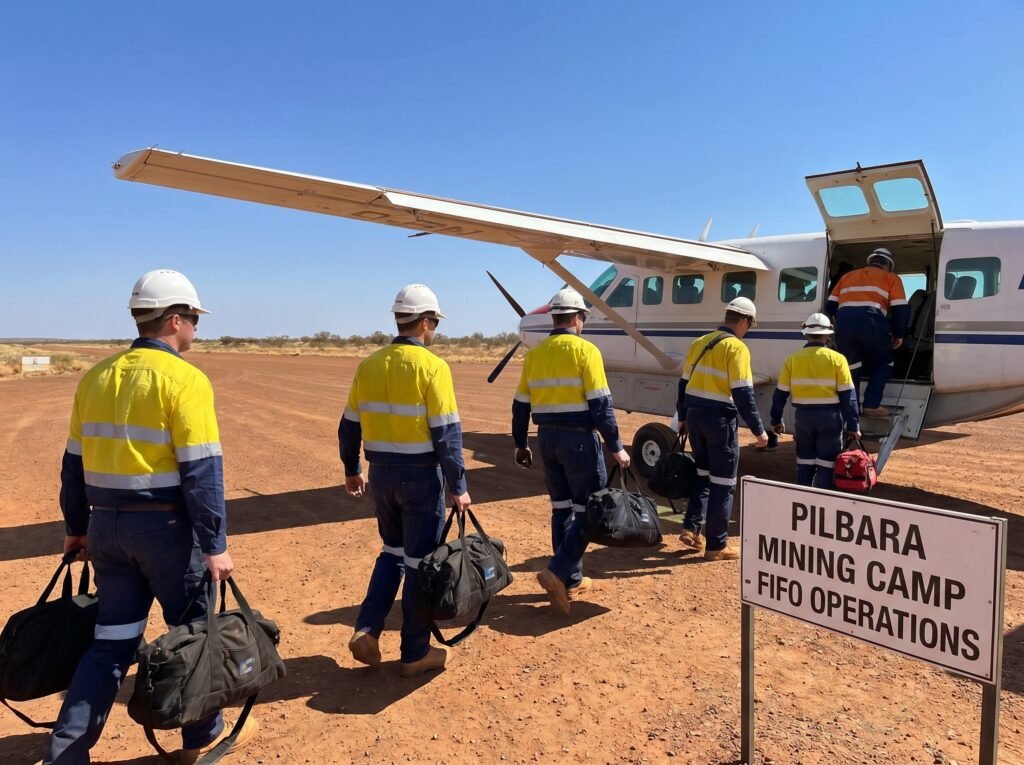
Australia runs on remote work. The iron ore coming out of the Pilbara, the gold pulled from the Goldfields, the gas flowing offshore from the Browse Basin — none of it happens without tens of thousands of workers flying in and flying out every week. Fly in fly out jobs in Australia span trades, healthcare, hospitality, engineering, and more. This guide covers how FIFO works, what it pays, and how to get started — including if you have no prior mining or resources experience.
What does fly in fly out (FIFO) mean?
FIFO stands for fly-in fly-out. It’s a work arrangement where employees are flown from a capital city or regional hub to a remote work site, complete their rostered shift period on site, then fly home for their days off.
Workers live in a camp village during their swing — all meals, accommodation, and transport are provided by the employer. You’re not expected to drive hours to a remote mine. You fly in, work, and fly out.
FIFO is common in mining, oil and gas, construction, and camp services. It exists because the richest resource deposits in Australia are in locations where it’s not practical to build permanent communities — the Pilbara in WA, the Bowen Basin in Queensland, offshore rigs in the Timor Sea, and remote Northern Territory sites.
How is FIFO different from regular remote work?
FIFO is not working from home remotely. It’s physically relocating to a site for weeks at a time. During your swing, you live and breathe the job — long days, no commute, but also no personal space, no grocery runs, and no choice about your surroundings. Off swing, you’re completely free at home. That rhythm is the defining feature of the lifestyle.
How FIFO rosters work
Your roster defines the rhythm of FIFO life. Most roles run a set pattern of days on site followed by days at home.
Common roster patterns in Australia
- 2 weeks on / 1 week off (2:1) — the most common pattern in WA mining
- 8 days on / 6 days off (8:6) — used frequently in Queensland coal
- 4 weeks on / 2 weeks off — common in offshore oil and gas
- 7 days on / 7 days off (7:7) — popular in camp services, cleaning, and hospitality roles
- 14 days on / 7 days off (14:7) — common for trades and technical roles
Longer swings typically mean higher site allowances. Shorter, more balanced rosters are more common in support roles.
What’s included on site
Most mine site employers cover the full cost of your time on site:
- Flights — return from your nominated departure city (Perth, Brisbane, Darwin, Townsville, Cairns, Sydney, Melbourne, and Adelaide are common)
- Accommodation — single room in a camp village (most modern sites have private ensuites)
- Meals — full catering, usually three meals a day plus crib (packed lunch)
- Recreational facilities — gyms, pools, recreation rooms, and TV lounges are standard on major sites
- Wi-Fi — variable by site, improving significantly on newer projects
Your on-site living costs are zero, which is a major driver of savings for FIFO workers.
Types of fly in fly out jobs in Australia
FIFO is not just mining operators. Sites need a full workforce to function — trades, services, health, and admin staff all fly in. Here’s a breakdown of the main role categories.
Mining and resources FIFO jobs
The core of the FIFO workforce. Common roles include:
- Underground miners — drill and blast, continuous miners, bogger operators
- Surface mining operators — haul truck drivers, excavator operators, dozer operators
- Drillers and drill offsiders — surface and underground exploration drilling
- Process plant operators — run crushing, screening, and processing equipment
- Supervisors and leading hands — site-level team management
These roles tend to have the highest salaries but also require site experience, machinery tickets (VOCs), and in many cases trade qualifications or an operator’s background.
Trades and construction FIFO jobs
Electricians, boilermakers, fitters, plumbers, carpenters, and welders are in constant demand on FIFO sites — both during construction phases and for ongoing maintenance shutdowns.
Trade-qualified workers typically need:
- Australian Certificate III or equivalent
- Relevant licences (electrical, plumbing, high risk work licence for rigging/scaffolding)
- A white card (construction induction)
FIFO tradespeople often earn well above equivalent city-based roles. A fly in fly out electrician in WA mining can earn $120,000–$160,000 per year including allowances.
Hospitality, cleaning and camp services
Every mine site camp needs to run like a small hotel. Roles include:
- Camp attendants and housekeepers — cleaning rooms and common areas
- Kitchen hands and cooks — food prep, service, kitchen cleaning
- Chefs — running the kitchen for hundreds of workers
- Utility all-rounders — a mix of housekeeping, kitchen support, and grounds maintenance
- Retail and bar attendants — where wet canteens exist
These are the most accessible entry points for workers with no mining background. A fly in fly out cleaning job or camp catering role requires no qualifications beyond basic hospitality awareness and a willingness to work shifts.
Nursing and healthcare FIFO jobs
Mine sites with large workforces are required to have on-site medical capability. Fly in fly out nursing jobs are a growing segment — mine site nurses, paramedics, occupational health nurses, and site doctors all work on FIFO rosters.
FIFO nurses typically need AHPRA registration and at least two years of clinical experience. Remote or emergency nursing experience is valued. Salaries for fly in fly out nursing jobs in Australia start around $110,000 and often exceed $150,000 with site allowances.
Engineering and technical FIFO roles
Geologists, metallurgists, mine engineers, electrical engineers, and project engineers work FIFO on both operating mines and development projects. These roles typically require a university degree and relevant site or industry experience.
How much do FIFO workers get paid?
Pay ranges vary by role, experience, and roster. Below are realistic salary ranges for common FIFO roles in Australia (annual, including allowances):
| Role | Experience Level | Salary Range (AUD) |
|---|---|---|
| Camp attendant / utility | Entry level | $65,000 – $85,000 |
| Kitchen hand | Entry level | $65,000 – $80,000 |
| Chef | Qualified | $90,000 – $130,000 |
| Haul truck driver | Experienced | $100,000 – $140,000 |
| Boilermaker | Trade-qualified | $110,000 – $160,000 |
| Electrician | Trade-qualified | $120,000 – $160,000 |
| Mechanical fitter | Trade-qualified | $115,000 – $155,000 |
| Mine site nurse | Registered nurse | $110,000 – $150,000 |
| Geologist | 3–5 years experience | $100,000 – $140,000 |
| Mine engineer | 5+ years experience | $130,000 – $200,000 |
| Supervisor / leading hand | 8+ years experience | $150,000 – $220,000 |
These figures reflect total package including site allowances and fly-in allowances. Because accommodation and meals are covered on site, take-home savings potential is high — particularly for workers avoiding rent during their swing.
Can you get a FIFO job with no experience?
Yes, but the pathway depends on what you mean by “no experience.”
Camp services, cleaning, and kitchen hand roles have the lowest barriers — many advertise explicitly for workers with no mining background. Employers in this space hire for attitude, reliability, and the ability to work long shifts in a structured environment. If you’ve worked in hospitality, retail, or any service job, you have relevant experience.
Mining operator and trades roles are harder to access without relevant tickets, licences, or industry background. That said, a number of large companies run new-to-industry programs — BHP, Rio Tinto, and Fortescue all have structured pathways for entry-level operators.
Best entry-level FIFO jobs for beginners
If you’re starting from scratch, these roles are most accessible:
- Camp attendant / housekeeper — cleaning rooms and common areas; no qualifications needed
- Kitchen hand — food prep and dish washing; basic food handling certificate a plus
- Labourer / trades assistant — general site labouring; white card required, usually fast to get
- Security officer — some sites offer on-the-job training; RSA or security licence may be required
- Utility all-rounder — mix of cleaning, kitchen, and grounds maintenance
Getting your white card (construction induction card) and a standard first aid certificate before applying will make your application more competitive. Some sites also require a Standard 11 general induction, which is specific to the mining industry and usually completed online before your first swing.
Where are most FIFO jobs located in Australia?
The majority of fly in fly out jobs in Australia are based in Western Australia — particularly the Pilbara region (iron ore), the Goldfields (gold), and offshore from the Kimberley coast (oil and gas). Perth is the most common departure city, and WA consistently has the highest concentration of FIFO roles nationally.
Other active FIFO job markets:
- Queensland — Bowen Basin coal, Mackay, Townsville, and Cairns as departure cities; a large share of QLD FIFO roles are in coal mining
- Northern Territory — Darwin-based FIFO to remote mine sites and construction projects
- South Australia — Olympic Dam (copper, uranium), Port Augusta, Whyalla
- New South Wales — Hunter Valley coal, some remote construction projects
- Offshore (national) — oil and gas platforms off WA, NT, and Victoria; typically 4-week-on rosters
Fly in fly out jobs from Melbourne, Sydney, and Adelaide exist but are less common than Perth or Brisbane departures. Workers in eastern states often find the WA and QLD markets accessible — employers fly workers from wherever they live.
How to apply for FIFO jobs in Australia
FIFO roles are advertised on Seek, Indeed, LinkedIn, and direct company career portals. Major employers to check directly include BHP, Rio Tinto, Fortescue, Newmont, Sodexo, Compass Group, and Downer Group.
When applying:
- Read the job ad carefully for required tickets and licences — apply only if you genuinely hold them
- Include your white card, VOCs, Standard 11, and any machinery hours prominently
- Specify your nominated departure city — most ads ask for this
- Be clear about roster flexibility — some employers ask if you can do a specific pattern
What to put on a FIFO resume
Generic resumes don’t work well in mining recruitment. Applicant tracking systems filter heavily by keywords. Your resume should include:
- Safety record — any awards, zero-harm achievements, or specific safety training
- Specific tickets and licences — list every one, with renewal dates
- Machinery and equipment experience — be specific about models and hours where possible
- Site names and employers — recruiters and hiring managers recognise site names
- Roster experience — mention the patterns you’ve worked (e.g. “14:7 roster, 18 months continuous”)
If you’re coming from a different industry, translate your existing experience to site terms: logistics experience = supply chain; hospitality = camp services; security = site access control.
Is FIFO work right for you?
FIFO suits some people extremely well and grinds others down. Be honest with yourself before applying.
It tends to work well for:
- People who are single or have a partner comfortable with extended absences
- Workers who want to pay off debt, save a deposit, or build capital quickly
- Those who enjoy structured environments and don’t need a lot of social variety
- People willing to trade urban lifestyle for financial acceleration
It’s harder if:
- You have young children and your partner can’t manage solo parenting during swings
- You struggle with isolation or need a lot of social interaction to stay mentally well
- You find it difficult to disconnect from family obligations
- You expect to maintain an active social life on a continuous basis
The mental health dimension of FIFO is real and documented. Many workers thrive; others find the lifestyle unsustainable within 12–24 months. The financial rewards are genuine, but so is the personal cost for people who aren’t well-suited to the rhythm.
FAQ
What qualifications do I need for FIFO work?
It depends on the role. Entry-level camp services and kitchen roles need little more than a willingness to work shifts and a basic food handling certificate. Trade roles require a Certificate III in the relevant trade and applicable licences. Operator roles require VOCs for the specific machinery. Most site roles require a white card and a Standard 11 mining induction. A current driver’s licence is expected for almost all roles.
Are there FIFO jobs for women?
Yes — FIFO is not a male-only workforce. Women work across all categories: nursing, administration, camp services, trades, geology, and engineering. Most large operators have active diversity programs specifically recruiting women into non-traditional roles. Fly in fly out jobs for females are advertised directly on mining company career portals, and some companies have women-in-mining apprenticeship programs.
Can I do FIFO work if I’m based in Sydney or Melbourne?
Yes. Many roles are open to workers flying from any capital city. Employers nominate departure cities per role — Perth and Brisbane are most common, but Sydney and Melbourne departures exist, particularly for QLD coal and offshore roles. When applying, state your preferred departure city and confirm the employer can accommodate it.
What is the difference between FIFO and DIDO?
DIDO stands for drive-in drive-out. It works the same way as FIFO — you travel to a remote site for your roster period and return home for your days off — but instead of flying, workers drive. DIDO roles are common for sites within 3–5 hours of a regional town. Accommodation and meals are still typically provided on site.
How do I find FIFO apprenticeships?
Major mining companies run structured apprenticeship programs that operate on FIFO rosters. BHP, Fortescue, and Anglo American have all offered electrical, mechanical, and instrumentation apprenticeships with FIFO arrangements. Search directly on company career portals for “apprenticeship” alongside relevant state filters. TAFE programs in WA and QLD also have mining-specific pathways.