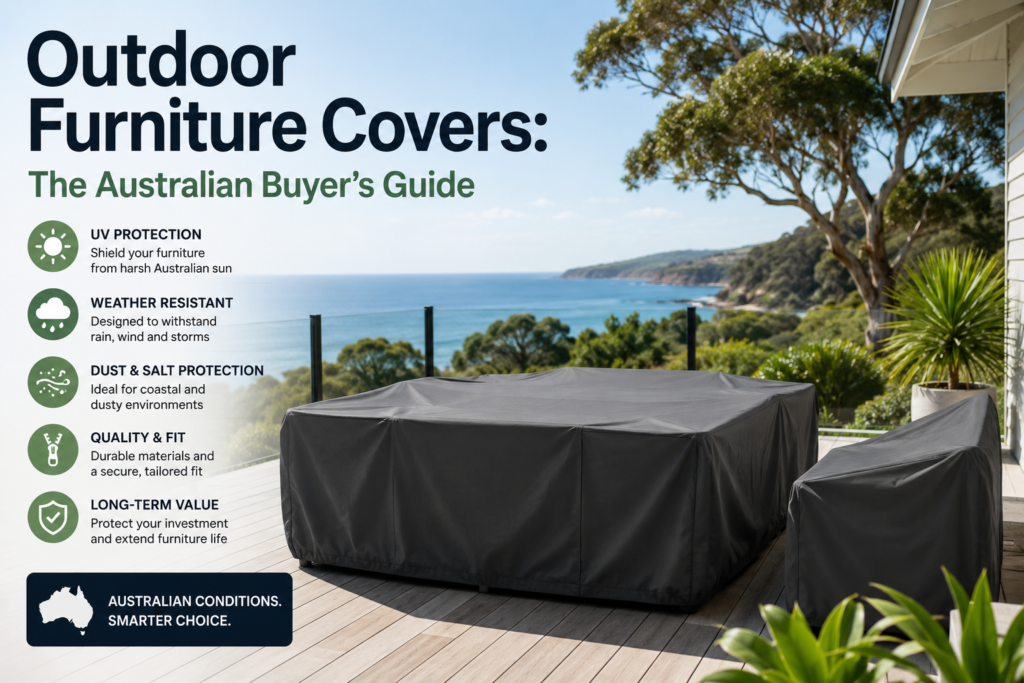
Australia is not a forgiving environment for outdoor furniture. The UV index here regularly hits 11+ in summer — well above the global average — and that’s before you factor in salt-laden coastal winds, humidity that climbs into the 80s in Queensland, and the unpredictable cold-snap-meets-hailstorm combination that hits Melbourne in what passes for spring. If you’ve ever walked outside to find cushions that have faded to pink, timber that has cracked, or metal frames with rust creeping in from the edges, you know exactly what the stakes are.
Outdoor furniture covers are one of the simplest, most cost-effective ways to protect a significant investment. But not all covers are created equal, and the wrong choice — buying thin, non-breathable covers or getting sizing wrong — can actually cause more damage than leaving furniture uncovered. This guide breaks down everything you need to know to choose the right outdoor furniture covers for Australian conditions.
Why Outdoor Furniture Covers Are Non-Negotiable in Australia
Most countries have one or two seasonal weather threats to worry about. Australia has several happening simultaneously, often in the same week.
UV degradation is the biggest culprit. Australia’s ozone layer is thinner than in the northern hemisphere, meaning UV radiation is more intense even on overcast days. Quality outdoor furniture can show visible fading and surface breakdown within a single summer if left completely unprotected. Solution-dyed acrylic fabrics and powder-coated metals fare better than most, but no material is fully UV-immune without some protection.
Moisture and humidity create a different problem — mould. In coastal cities like Sydney and in tropical regions like Far North Queensland, the combination of warm temperatures and high humidity turns any trapped moisture into a mould farm within days. This is especially damaging to cushion foam and timber frames.
Salt air in coastal areas is corrosive to metal components, stitching thread, and painted surfaces. Even powder-coated aluminium — often marketed as maintenance-free — benefits from a cover in areas within 2–3 km of the ocean.
Wind and storm debris are particularly relevant in Perth (Fremantle Doctor) and cyclone-prone northern regions. Leaves, grit, and airborne salt all accelerate surface wear.
A quality cover addresses all of these. It is not a luxury item — in Australia, it is standard protective maintenance.
Types of Outdoor Furniture Covers (And What Each Protects)
The cover you need depends entirely on what you’re protecting. Using a generic cover on an oddly shaped piece usually means gaps, pooling water, and wind lift.
Garden table covers are the most commonly purchased category, and for good reason — table surfaces take the most direct sun and rain exposure. Look for covers with elastic hems or drawstring closures at the base, not just a loose drape, to prevent wind lift. Sizes range from small bistro tables (around 60cm diameter) to large rectangular dining settings (up to 360cm in length).
Outdoor chair covers come in single-chair and stacked-chair formats. If you stack chairs over winter, a single stacking cover designed for four to six chairs is far more practical than individual covers. Director-style and foldable chairs have their own slim-profile cover designs.
Sun lounge covers need to accommodate the reclined shape of the frame, which means they tend to be longer and lower-profile than chair covers. A poor fit here leads to water pooling in the middle of the cover — the opposite of protection.
Outdoor sofa and lounge set covers are the largest and usually sold as full-set covers designed to go over an entire seating configuration at once. These are more expensive but far more convenient than trying to coordinate multiple individual covers.
Daybed covers are a specialist category — outdoor daybeds are large, often have a canopy frame, and need a cover that accounts for the canopy structure. Measure carefully before purchasing.
BBQ and accessory covers are often bought separately but should be part of the same seasonal protection routine. Grills are expensive and highly vulnerable to moisture corrosion.
Cover Materials Explained: What the Fabric Numbers Actually Mean
This is where most buyers get lost. “600D polyester” and “1000D PVC-coated” sound technical, but the numbers are simply telling you about thread density — similar to thread count in bed sheets.
Denier (D) measures the weight and thickness of the fibres. A higher denier means a thicker, heavier, more durable fabric:
- 300D–420D polyester — lightweight, suitable for mild climates or furniture under a pergola or covered patio. Not ideal for exposed outdoor settings in Australian summer.
- 600D polyester with PU coating — the most common standard for quality outdoor covers in Australia. The polyester provides structure; the PU (polyurethane) coating on the underside provides waterproofing. Coverworld, which has supplied covers in Australia since 2007, uses 600D fabric as their benchmark.
- 1000D PVC-coated polyester — heavy-duty, designed for exposed settings, coastal properties, or areas with frequent heavy rain. Heavier to handle but significantly more durable.
- Oxford fabric (420D) — a specific weave pattern that adds structural rigidity to lighter fabrics. Commonly used in mid-range covers with UV coating applied to the outer surface.
- Solution-dyed acrylic — the premium option. Unlike fabrics dyed after weaving, solution-dyed acrylics have colour baked into the fibre during manufacturing, making them far more UV-stable. Sunbrella is the most well-known brand. More expensive, but particularly well-suited to Australia’s UV intensity.
One important note: surface UV coatings wear off over time, especially in intense Australian sun. Solution-dyed fabrics resist UV at a structural level and will consistently outperform coated alternatives after two or three seasons.
Waterproof vs Water-Resistant: The Difference Matters
“Waterproof” and “water-resistant” are not interchangeable terms, and the distinction matters in Australia’s climate.
Water-resistant covers repel light rain and dew. The fabric is treated so water beads and runs off rather than soaking in. In most mild climates, this is sufficient.
Waterproof covers use a PU coating or PVC lining that blocks water penetration under sustained pressure. The technical measure is a water column rating — a test where a column of water is applied to the fabric until penetration occurs. A cover rated at 1500mm+ water column is considered reliably waterproof for Australian rain events.
The counterintuitive part: fully waterproof covers can cause damage if used incorrectly. A sealed, non-ventilated cover traps any residual moisture on the furniture surface. In humid regions like coastal Queensland, this creates exactly the mould environment you’re trying to prevent. The solution is to look for covers with air vents — small mesh ventilation points that allow moisture to escape without compromising rain protection. Alternatively, ensure furniture is completely dry before covering.
Breathable covers — which are different again — allow some air circulation while still repelling light moisture. These are appropriate for covered patios or areas with low rainfall.
How to Measure Your Outdoor Furniture for a Cover
An ill-fitting cover is worse than no cover in wind. Water pools in loose fabric, wind catches edges and stresses seams, and gaps let in exactly the elements you’re trying to block.
The three measurements you need:
- Length — measure the longest dimension of the piece
- Width — measure at the widest point, including armrests
- Height — measure from the floor or lowest point to the highest point (back of chair, cushion, etc.)
Leave a margin: Choose a cover 5–10cm larger than each dimension. Covers should have some ease to fit properly without stretching, but not so much slack that they billow.
Odd shapes: L-shaped and U-shaped sofa configurations need sectional covers designed specifically for those configurations. A standard rectangular cover on an L-shape will either leave sections exposed or sit so awkwardly that it provides almost no protection.
Adjustable fixings: Look for elastic hems, drawstring cords with cord locks, or side-release buckle straps. These keep covers in place during wind without requiring you to tie knots each time.
Matching Your Cover to Your Climate Zone
Not all Australian climates place the same demands on a cover, and this is something the industry rarely discusses clearly.
Tropical Australia (QLD, NT, Northern WA): The priority is breathability and mould resistance, not heavy waterproofing. Constant humidity means moisture gets trapped easily. Opt for 600D covers with air vents; avoid thick PVC-coated covers that seal completely. Consider bringing cushions indoors during the wet season.
Coastal Australia (Sydney, Adelaide, Perth, Melbourne coast): Salt air corrosion is the biggest threat alongside UV. A 600D or higher cover with UV resistance is the baseline. In areas within a kilometre or two of the ocean, 1000D heavy-duty covers are worth the extra investment for metal furniture especially.
Southern temperate (inland VIC, ACT, SA, TAS): Frost and temperature swings become relevant. Look for covers that won’t crack in cold temperatures — thick PVC can become brittle. 600D oxford or 1000D PU-coated polyester handles temperature range well. Snow-capable covers with reinforced seams are available if needed.
Dry inland (Central Australia, inland WA/QLD): UV is the primary threat; rain is infrequent. Solution-dyed acrylic or 600D oxford with quality UV coating is ideal. Heavy-duty waterproofing is less important than UV stability.
5 Mistakes Australians Make When Buying Outdoor Furniture Covers
1. Buying on price alone Thin, cheap covers (typically 300D or below) degrade within a single Australian summer. The PU coating on the underside peels; the fabric becomes brittle and tears in wind. What feels like a saving becomes a replacement purchase within 12 months.
2. Assuming waterproof means better A fully sealed cover on a humid day traps moisture against your furniture. Without air vents, this promotes mould and mildew — especially on timber and cushion fabrics. In coastal QLD, a well-vented water-resistant cover often outperforms a sealed waterproof one.
3. Getting sizing wrong Oversized covers pool water, catch wind, and don’t secure properly. Always measure length, width, and height before purchasing, and choose a cover with adjustable fixings rather than relying on size alone to hold it in place.
4. Leaving covers on all summer without checking Covers need periodic removal in dry weather to allow furniture to air out and any trapped moisture to evaporate. This is especially relevant after rain events in humid climates. A cover left on continuously without ventilation can cause as much moisture damage as leaving furniture uncovered.
5. Forgetting cushions and accessories Table and chair covers don’t protect cushions stored underneath them. Cushion storage bags or separate waterproof cushion covers are needed. Umbrella covers, BBQ covers, and side-table covers are frequently overlooked and often end up being the weakest link in outdoor protection.
How to Clean and Store Outdoor Furniture Covers
Covers need maintenance too — a neglected cover becomes a source of dirt, mould, and degraded protection.
Regular cleaning (every 4–6 weeks during use season):
- Shake off loose debris
- Rinse with a garden hose
- For grime, use a soft brush with mild soap solution — avoid bleach unless the care label specifically permits it
- Allow to dry completely in the sun before re-applying or storing
Seasonal storage (when covers are not in use):
- Ensure covers are fully dry before folding — damp storage is the fastest route to mould
- Roll rather than fold where possible to avoid permanent creases
- Store in a breathable bag rather than a sealed plastic bin — sealed containers trap residual moisture
- Keep off the ground and away from direct sunlight in a cool, dry location (garage or garden shed)
- Inspect stored covers once during the off-season to catch any developing issues early
UV coating maintenance: PU and UV coatings on the outer surface gradually degrade. A UV-protectant spray can extend the effective life of coated covers. Solution-dyed fabrics don’t require this treatment.
FAQ
Are outdoor furniture covers worth it in Australia?
Yes — Australia’s UV index, coastal salt air, and seasonal moisture make protective covers one of the most cost-effective ways to extend the life of outdoor furniture. Quality covers, properly maintained, can extend furniture lifespan from 3–5 years to 8–10 years.
What material is best for outdoor furniture covers in Australia?
For most Australians, 600D polyester with PU coating provides the best balance of durability and price. For coastal properties or high-UV areas, look for 1000D heavy-duty covers or solution-dyed acrylic fabric, which resists UV at a structural level rather than relying on a surface coating.
Should I cover my outdoor furniture in summer?
Yes, but with caveats. Don’t leave covers on continuously without removing them on dry days to allow ventilation. Covers protect against UV degradation and summer storms, but a sealed cover left on in heat and humidity can trap moisture and accelerate mould growth.
How do I measure outdoor furniture for a cover?
Measure length, width, and height at the widest/tallest points. Choose a cover 5–10cm larger than each dimension. For odd-shaped configurations like L-shaped sofas, buy covers designed specifically for that shape rather than using a standard rectangular cover.
What is the difference between waterproof and water-resistant outdoor covers?
Water-resistant covers repel light rain but can be penetrated by sustained heavy rain. Waterproof covers (with PU or PVC lining) block water penetration under pressure — measured by a water column test (look for 1500mm+ rating). Waterproof covers are better for exposed settings; water-resistant breathable covers can be preferable in high-humidity tropical climates where moisture trapping is a concern.
Where can I buy outdoor furniture covers in Australia?
Dedicated Australian suppliers include Coverworld (covering since 2007, with one of the widest size ranges in Australia), Covers & All AU (custom and standard sizes), My Wicker, and Odie Home. Bunnings stocks a range for common furniture sizes. For custom-made covers for non-standard shapes, specialist suppliers are worth the premium.