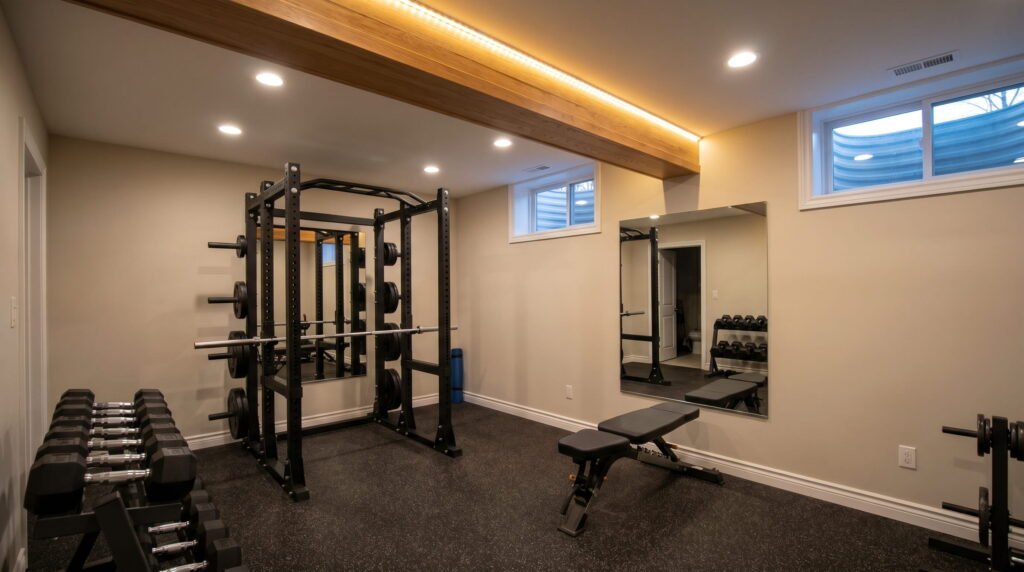
You finally built your home gym. The equipment is in place, the mirror is mounted, and you’re ready to train. But something feels off every time you step in. Your motivation tanks after ten minutes, your energy is low, and the space just feels… uninspiring.
Here’s the thing: it might not be your workout. It might be your lighting.
Most home gym guides spend thousands of words on squat racks and rubber flooring, then dedicate one sentence to lighting: “Make sure the room is well lit.” That’s not a plan — that’s a shrug. The right home gym lighting does more than help you see. It directly influences your energy, your focus, your safety, and how hard you’re willing to push.
In this guide, you’ll get everything you need to set up home gym lighting that actually works — exact lumen targets, the best fixture types for your space, how to choose the right color temperature for your workout style, and a simple placement strategy that eliminates dark corners and harsh glare.
Why Your Home Gym Lighting Affects Your Workout (More Than You Think)
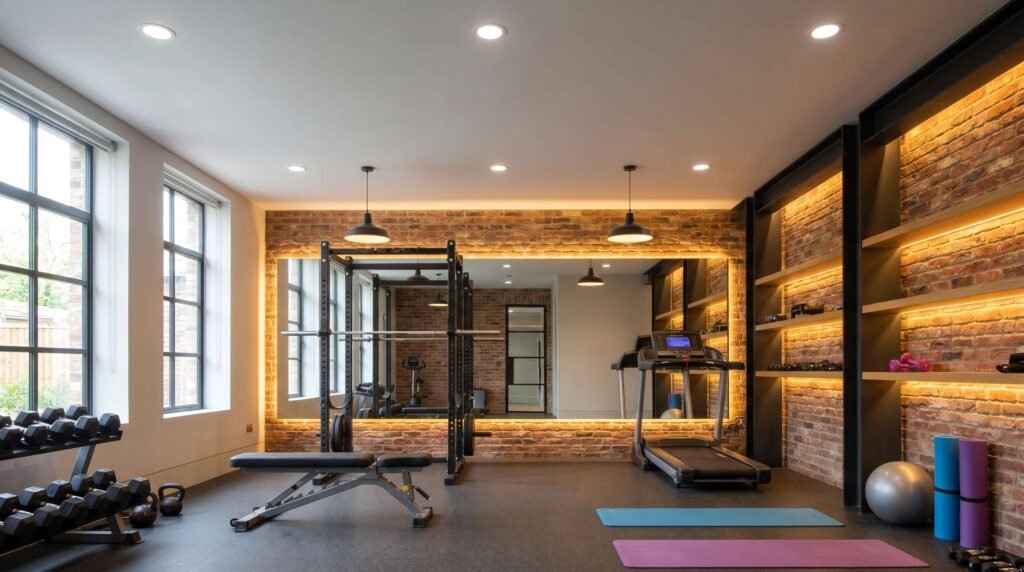
Most people think of lighting as an aesthetic choice. It’s not. It’s a performance variable.
What the Science Says About Light and Physical Performance
A study published in PLOS ONE exposed 43 participants to bright light versus dim light before a 40-minute cycling test. Researchers measured heart rate, lactate levels, oxygen uptake, and perceived motivation. The bright light group consistently showed higher physical output across all metrics.
More recently, Arizona State University researchers working with the Illuminating Engineering Society tested how lighting intensity and color affected grip strength and heart rate during treadmill exercise. The results were clear: bright cool white light produced stronger grip strength and higher cardiovascular activation compared to dim or warm-toned conditions.
In plain terms: train under better light, perform better.
Bright Light, Better Lifts — The Mood and Motivation Connection
The connection goes beyond raw performance. Research highlighted by Technogym shows that bright light triggers serotonin production — the neurotransmitter tied to mood elevation and sustained energy. That’s why you feel more awake under natural daylight and drowsy in a dim room.
Your home gym lighting works the same way. A poorly lit space signals your body to wind down, not ramp up. A brightly lit space primes you for effort. It’s not motivation you’re missing — it’s photons.
How Many Lumens Do You Need for a Home Gym?
Lumens measure total light output. More lumens means more brightness, but the right amount depends on your space size and how you use it.
Lumen Targets by Workout Zone
Not all workout types need the same brightness. Here’s how to match lumens to activity:
- Cardio zones (treadmill, rowing machine, elliptical): Aim for 150–200 lumens per square foot. You need enough brightness to read equipment displays and stay alert.
- Free weight areas (barbell, dumbbells, power rack): Target 200–300 lumens per square foot. Better visibility means better form checks and safer spotting.
- Yoga and stretching zones: 50–80 lumens per square foot is plenty. Softer light supports the relaxed, focused state you want for flexibility work.
- Multipurpose home gyms: A practical middle-ground target is 50 lumens per square foot as a floor, scaling upward based on natural light available.
For a typical 200–300 sq ft garage gym with no windows, experts at Hyperlite recommend aiming for 80 lumens per square foot — which puts total output around 16,000–24,000 lumens spread across multiple fixtures.
How to Calculate Lumens for Your Space
You don’t need to do this by hand. The formula is straightforward:
Total lumens needed = Room area (sq ft) × Target lumens per sq ft
So a 250 sq ft garage gym targeting 80 lumens/sq ft needs 20,000 total lumens — distributed across several fixtures, not one blinding unit.
The easiest way to run this calculation is with the General Lighting Calculator on ToolCalcPro. Enter your room dimensions and get an instant recommendation for total lumens and fixture count — no guesswork required.
The Best Home Gym Lighting Fixtures
Once you know your lumen target, you need to pick the right type of fixture for your space.
Recessed Lighting — Clean, Evenly Distributed, and DIY-Friendly
Recessed lights (also called can lights or downlights) sit flush with the ceiling and project light straight down. Industry experts consistently recommend them as the top choice for dedicated workout rooms because they eliminate hanging fixtures that could get in the way of overhead movements.
They work especially well in finished rooms — converted bedrooms, basement gyms with drywall ceilings, or dedicated home gym additions. The key is spacing them correctly so you get even coverage with no dark corners.
A first-time renovator used the Recessed Lighting Calculator on ToolCalcPro to plan a 14×16 workout room layout. Instead of hiring a lighting designer, they generated a full fixture plan in under two minutes and ordered exactly the right number of cans — no returns, no over-ordering.
LED Shop Lights and Panel Lights — The Garage Gym Workhorse
If your home gym is in a garage or unfinished basement, LED shop lights are the most practical pick. They’re affordable, install quickly, and many models can be daisy-chained together so one switch powers your entire setup.
Bright white LED shop lights at 5,000K are a proven choice for garage gyms — they deliver the cool, energizing light that performance needs and they’re available in six-packs that cover most single-car garage dimensions easily.
LED panel lights are another strong option for lower ceilings. They produce wide, even illumination with minimal glare — useful if you have mirrors and don’t want harsh reflections when checking form.
Track Lighting — Flexible and Zone-Targeted
Track lighting lets you point individual light heads exactly where you want them. This makes it ideal if your gym has distinct zones — a treadmill on one side, a squat rack on the other, and a stretching corner. You can angle one head toward the barbell, another at the mirror, and a third across the cardio area.
The trade-off is that track lighting requires more planning upfront. For a multipurpose gym with multiple workout stations, though, the flexibility is worth it.
Choosing the Right Color Temperature for Your Home Gym
Color temperature, measured in Kelvin (K), determines whether your light looks warm and yellow or cool and blue-white. It’s one of the most overlooked variables in home gym lighting — and one of the most important.
Cool White (5,000–6,500K) for High-Intensity Training
Cool white light mimics natural daylight. It activates the blue light spectrum, which research shows is mentally stimulating and promotes alertness and focus. For heavy lifting, HIIT, cardio sessions, or any high-intensity training, you want to be in this Kelvin range.
A practical starting point: 5,000K is natural daylight — energizing without feeling clinical. Go up to 6,000–6,500K if your gym is a windowless basement and you want the brightest, most alerting environment possible.
Warm White (2,700–4,000K) for Yoga, Stretching, and Recovery
Warm white light is relaxing. Lower Kelvin values produce a yellowish, cozy glow that signals your nervous system to slow down. That’s exactly what you want for yoga flows, mobility work, and post-workout stretching.
If your home gym doubles as a yoga space, dimmable LEDs with adjustable color temperature are the smartest investment you can make. Set them to 5,500K for your HIIT session, dial back to 3,000K and dim by 40% for your cool-down. One lighting setup, two completely different environments.
Home Gym Lighting Layout — Where to Place Your Lights
Knowing your fixture type and lumen count isn’t enough if your placement is off. Poor layout creates shadows, glare, and uneven brightness that undermines everything else.
Spacing Rules Based on Ceiling Height
A reliable rule of thumb for recessed lights: space fixtures at a distance equal to half the ceiling height. For a standard 8-foot ceiling, place cans approximately 4 feet apart. For a 10-foot ceiling, space them 5 feet apart.
For garage gyms with higher ceilings (12 feet or more), LED high bay lights become the better option. These fixtures project light further downward and maintain even coverage across larger areas without requiring dozens of individual cans.
Use the Can Light Calculator on ToolCalcPro to determine the exact number and spacing of your lights based on room dimensions and ceiling height — it removes all the guesswork from the layout step.
Mirror Placement and Avoiding Glare
Mirrors amplify brightness, which is useful for form-checking but can create eye-straining glare if your lights point directly at reflective surfaces. To avoid this:
- Place recessed lights in front of mirrors, not directly above them, so light hits your face at a flattering angle rather than bouncing straight back at you.
- Avoid exposed LED chips pointing toward mirror height — opt for frosted or diffused lens fixtures.
- If you use track lighting, angle heads away from mirror surfaces and toward the floor in front of them.
Proper mirror lighting also keeps your workout space feeling larger and more professional — which is a real motivational bonus.
Frequently Asked Questions About Home Gym Lighting
What is the best color temperature for a home gym?
For most workouts, 4,000–6,500K is the sweet spot. This cool-to-daylight range keeps you alert and energized. If you do yoga or meditation in the same space, look for dimmable LEDs that can shift down to 2,700–3,000K for those sessions.
How many lights do I need for a garage gym?
It depends on your garage size and fixture output. For a standard single-car garage (roughly 12×20 feet = 240 sq ft), targeting 80 lumens per square foot means you need about 19,200 total lumens. A six-pack of LED shop lights producing 3,000–4,000 lumens each will cover that comfortably. Use the General Lighting Calculator to verify the number for your exact dimensions.
Should I get dimmable lights for my home gym?
Yes — especially if you use the space for multiple purposes. Dimmable LEDs let you crank brightness during a lifting session and soften it for yoga or post-workout stretching. They’re also useful for screen-based workouts (connected fitness, online classes) where harsh overhead light can wash out the display.
Can I use smart LED lights in my home gym?
Smart LEDs are a legitimate upgrade for home gyms. They let you save lighting presets — a “heavy lift” scene at 6,000K and full brightness, a “cool-down” scene at 3,000K and 50% brightness — and switch between them with your phone or voice command. The initial cost is higher, but the flexibility pays off if your gym doubles as a yoga or meditation room.
The Bottom Line on Home Gym Lighting
Home gym lighting isn’t a finishing touch — it’s a performance tool. Here are the three things to lock in before you buy a single bulb:
- Lumens first. Calculate your room’s total lumen requirement before choosing fixtures. A 250 sq ft gym needs roughly 15,000–20,000 total lumens.
- Kelvin for your training style. High-intensity training → 5,000–6,500K. Yoga and recovery → 2,700–3,500K. Dimmable smart LEDs give you both.
- Placement matters as much as fixtures. Space recessed lights at half your ceiling height, keep them in front of mirrors, and eliminate glare with diffused lenses.
Ready to nail the numbers? The General Lighting Calculator on ToolCalcPro calculates exactly how many lumens and fixtures you need based on your room size — free, instant, and no spreadsheet required.
Got a garage gym, basement gym, or converted room with a tricky layout? Drop your dimensions in the comments and we’ll help you figure out the right setup.