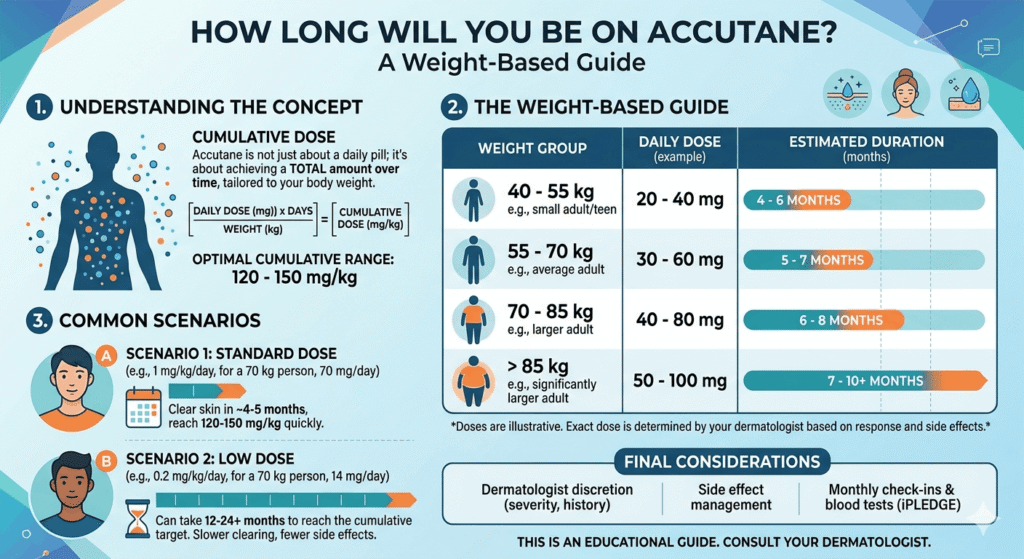
“How long does Accutane take to work?” The answer you’ll get from most sources is “4 to 6 months.” That’s not wrong, but it’s incomplete. Your Accutane course length is a calculation — and it’s personal to your weight, your daily dose, and where your dermatologist targets your cumulative dose.
The range in real clinical practice is wider than most people expect: some patients finish in 4 months, others are prescribed 7 or 8. Low-dose patients can run for 12–18 months. The math behind all of these timelines is the same; the inputs just differ.
This guide explains how the timeline is determined, what affects it, and how to calculate yours. If you want the number quickly, the Accutane cumulative dose calculator handles the math automatically — enter your weight and daily dose and it gives you your timeline.
How Long Does Accutane Take to Work?
There are two questions hiding inside this one, and they have different answers.
When will I see results? Most patients notice reduced oiliness within 4–6 weeks. Visible clearing — fewer active breakouts — usually starts somewhere in month 2 or 3. Full results, meaning stabilized clearance, typically arrive by month 4–6 on standard dosing. Some patients hit that plateau earlier; a few take longer.
When am I actually done? This is the more important question, and it has nothing to do with when your skin clears. You’re done when you’ve reached your prescribed cumulative dose — the total milligrams per kilogram of body weight your dermatologist is targeting. Your skin clearing is a sign the drug is working. Reaching the cumulative dose is what determines whether it keeps working long-term.
A lot of patients feel tempted to stop when their skin clears. That’s the most common mistake in Accutane treatment. Stopping early is a major predictor of relapse.
What Actually Determines Your Accutane Timeline
Three factors drive your treatment length:
1. Your body weight. Heavier patients need more total milligrams to reach the same cumulative dose. A 90 kg patient targeting 150 mg/kg needs 13,500 mg total. A 60 kg patient needs 9,000 mg. Same target, very different amounts of drug.
Medical disclaimer: This guide is for informational purposes only and does not constitute medical advice. Your dermatologist determines your dosing schedule and treatment duration based on your individual clinical situation.
2. Your daily prescribed dose. This is set by your dermatologist based on your weight and acne severity. Standard dosing runs 0.5–1 mg/kg/day. Your daily dose, divided into your total mg needed, determines how many days your course takes.
3. Your cumulative dose target. For years, the clinical benchmark was 120–150 mg/kg. A 2025 study in JAMA Dermatology by Lai and Barbieri found that patients who reached 220 mg/kg had a relapse rate of 26.9%, compared to 47.4% for those who stopped below that threshold. Many dermatologists now target 150–220 mg/kg — and the higher in that range you go, the longer treatment runs.
Accutane Timeline by Weight and Dose
The table below shows estimated treatment duration to reach the 150 mg/kg cumulative dose target at three common daily doses. These assume a consistent daily dose — if your dose is adjusted during treatment (which is common), the actual timeline shifts.
| Weight | Daily Dose 40 mg | Daily Dose 60 mg | Daily Dose 80 mg |
|---|---|---|---|
| 50 kg | 6.3 months | 4.2 months | 3.1 months |
| 60 kg | 7.5 months | 5.0 months | 3.8 months |
| 70 kg | 8.8 months | 5.8 months | 4.4 months |
| 80 kg | 10.0 months | 6.7 months | 5.0 months |
| 90 kg | 11.3 months | 7.5 months | 5.6 months |
| 100 kg | 12.5 months | 8.3 months | 6.3 months |
Target: 150 mg/kg. For 220 mg/kg target, multiply each figure by approximately 1.47.
The “4–6 months” rule of thumb assumes a 60–80 kg patient on 40–60 mg/day. If you’re heavier, or your dermatologist is targeting a higher cumulative dose, the honest answer is closer to 7–12 months.
When Does Accutane Start Working?
Isotretinoin works by dramatically reducing sebaceous gland activity — the oil-producing glands in your skin shrink, producing less sebum, starving the bacteria and comedones that cause acne. This process starts in the first few weeks.
Here’s roughly how the timeline progresses:
Weeks 1–4: Sebum production begins dropping. Skin may start to dry out (lips first, usually). No visible clearing yet — and for some patients, acne briefly worsens. This is the “purge.”
Weeks 4–8: Oil production is noticeably reduced. Active breakouts start slowing down. Existing lesions begin to heal. If you’re going to purge, it typically peaks in this window.
Month 2–3: Most patients see meaningful clearing. New breakouts become less frequent. Skin texture starts improving.
Month 4–6: For patients on standard dosing targeting 150 mg/kg, this is often when skin is largely clear. The drug has done its job on surface acne.
After clearance: You keep taking it. This is the part that catches people off guard. Feeling clear at month 4 doesn’t mean month 5 and 6 are unnecessary — those months are adding cumulative dose that determines whether the clearance lasts.
The Accutane Purge: Real or Myth?
It’s real for a meaningful minority of patients, though not universal. The purge refers to a worsening of acne — more breakouts, sometimes in new areas — during the first 4–8 weeks of treatment.
The mechanism isn’t fully understood, but the leading explanation is that isotretinoin accelerates the lifecycle of existing clogged pores, pushing trapped sebum to the surface faster than normal. Whatever was going to become a pimple next month becomes one this week instead.
Most purges resolve by week 6–8 as the drug reaches full effect. If your acne is dramatically worse at week 10 or beyond, talk to your dermatologist — a true purge doesn’t last that long.
Patients who are more likely to experience a purge tend to have more comedonal acne (blackheads and whiteheads) to start with. Those with primarily inflammatory acne (cysts and nodules) sometimes skip the purge phase.
Low-Dose Accutane: How Long Does It Take?
Low-dose and microdose Accutane protocols have become more common in the last several years. The appeal is fewer side effects — less dryness, less impact on liver enzymes, more tolerable for people who struggled with standard doses.
A low-dose course typically means 10–30 mg/day regardless of body weight, rather than the weight-based standard of 0.5–1 mg/kg/day.
The cumulative dose math doesn’t change. A 70 kg patient targeting 150 mg/kg still needs 10,500 mg total. At 20 mg/day, that’s 525 days — roughly 17.5 months. At 30 mg/day, about 11.7 months.
The 2024 systematic review in JEADV confirmed what several earlier studies had suggested: cumulative dose matters more than daily dose for long-term outcomes. Low-dose courses are effective — as long as patients reach an adequate cumulative total. The failure mode for low-dose Accutane is stopping before you get there.
Use the Accutane cumulative dose calculator to see your specific low-dose timeline.
Does Acne Come Back After Accutane?
Sometimes. The relapse statistics are more nuanced than “Accutane is a permanent cure” or “Accutane only works temporarily” — both of which you’ll encounter online.
The 2025 Lai and Barbieri study in JAMA Dermatology is the most current data. Patients who reached a cumulative dose of 220 mg/kg or more had a 26.9% long-term relapse rate. Those who stopped below 220 mg/kg had a 47.4% relapse rate. Earlier research using the 120 mg/kg benchmark showed even higher relapse rates.
So: yes, some patients relapse, but reaching a higher cumulative dose significantly reduces that risk. The variables that predict relapse include:
- Cumulative dose reached (the most controllable factor — complete your course)
- Age at treatment (teenagers have higher relapse rates than adults, partly due to ongoing hormonal changes)
- Acne type (hormonal acne patterns may recur if the underlying hormonal driver isn’t addressed)
- Sex (females have somewhat higher relapse rates in most studies, often linked to hormonal cycles)
A second course of Accutane is effective for patients who relapse, but it restarts everything — iPledge, monthly blood work, side effects. Finishing the first course adequately is the better path.
Your iPledge Timeline
Accutane treatment in the US requires monthly iPledge compliance for female patients of childbearing potential: a negative pregnancy test and contraceptive confirmation before each 30-day supply. This is non-negotiable and can delay your refills if tests are late.
Male patients and others not of childbearing potential have a less intensive iPledge requirement, but monthly prescriptions are still standard.
The practical implication: each prescription fill is one month’s supply. Your treatment length, in iPledge terms, is the number of monthly fills you need. A 9-month course = 9 fills, 9 monthly blood draws, 9 dermatologist check-ins.
Plan your treatment timeline around this. If you’re traveling or have schedule conflicts, coordinate in advance — delayed fills mean delayed cumulative dose progress.
Frequently Asked Questions
How long does Accutane take to work?
Initial results — reduced oiliness and fewer new breakouts — typically show up by month 2–3. Full clearing usually arrives by month 4–6 on standard dosing. The distinction between “working” (skin clearing) and “done” (cumulative dose reached) matters: skin can clear before treatment is complete.
How long is a course of Accutane?
Standard courses run 4–7 months at 0.5–1 mg/kg/day. Low-dose courses (10–30 mg/day) typically run 12–18 months. Your specific timeline depends on your weight and cumulative dose target — the calculator gives your personalized estimate.
Does acne come back after Accutane?
Relapse is possible. The 2025 JAMA Dermatology study found relapse rates of 26.9% at 220 mg/kg and 47.4% below that threshold. Completing your full course and reaching the cumulative dose target is the single most controllable factor in long-term clearance.
Why does Accutane treatment length vary so much?
Treatment length is cumulative dose math: your target (in mg/kg) multiplied by your weight (in kg) gives total milligrams needed. Divide by your daily dose for the number of days. A 100 kg patient on 40 mg/day takes twice as long as a 50 kg patient at the same dose to reach 150 mg/kg.
When does Accutane start working?
Sebum reduction begins within the first few weeks. Visible clearing typically starts in month 2–3. Some patients experience an initial purge (temporary worsening) in the first 4–8 weeks.