
Ask three septic contractors how big your system should be, and you’ll often get three different answers. A septic tank size calculator settles the question in seconds by running the same formulas your local health department uses.
One contractor says 1,000 gallons because that fits most county permits. Another quotes 1,250. The third hands you a bill with a mound system and an engineering fee before you’ve seen a soil test. What almost no one does up front is walk you through the actual math.
That math isn’t complicated, but it decides whether your system lasts 30 years or fails in 5. It also drives most of your install cost. This guide shows you how to find the right tank size, estimate your drain field footprint, and pin down a realistic 2026 install cost before a contractor ever sets foot on your property. You’ll get the EPA sizing formulas, a bedroom-by-bedroom chart, regional cost ranges, and answers to the questions that cost homeowners the most money when they skip them.
How Septic Tank Size Is Calculated
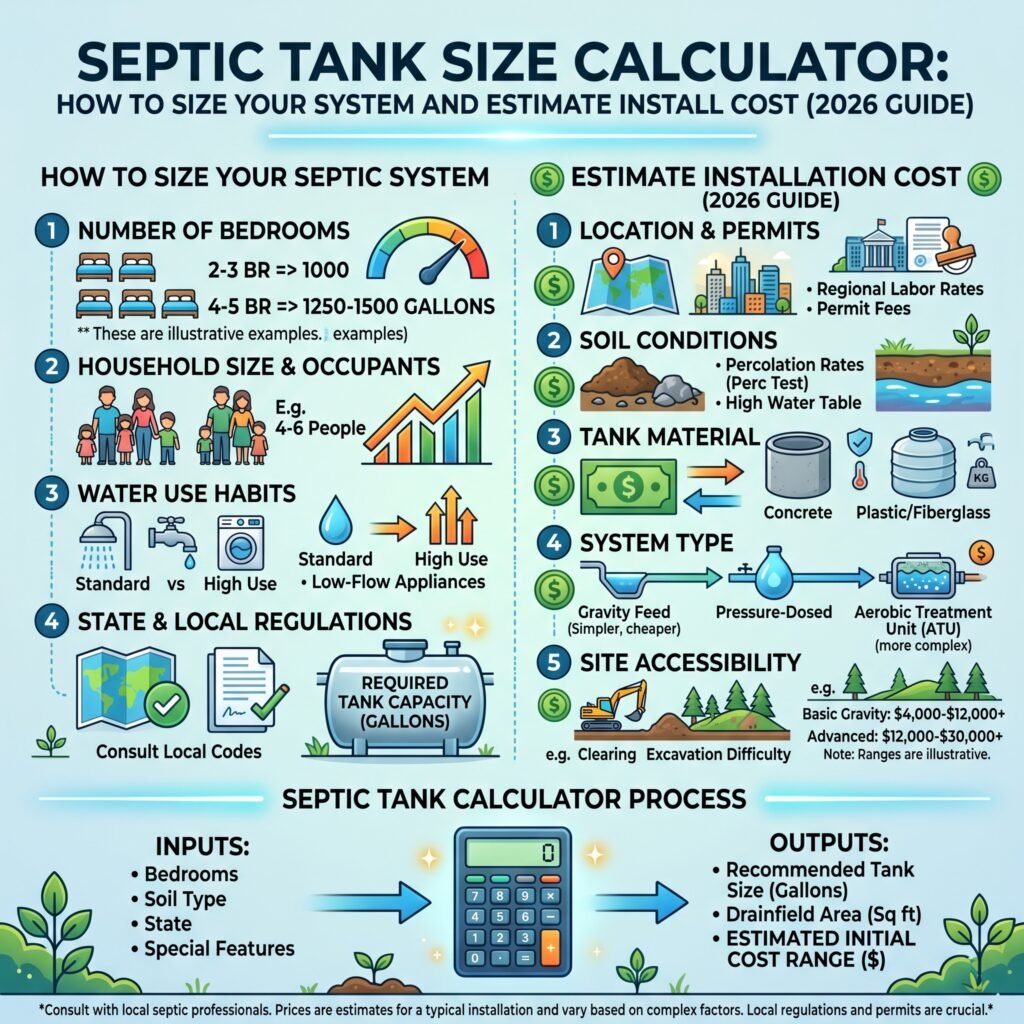
Septic sizing uses two separate numbers: tank capacity and drain field area. Both start from the same input (projected daily wastewater flow), but they follow different formulas. A septic system size calculator runs both at once so you can see how they interact.
The EPA 150-gallon-per-bedroom rule
The baseline for residential wastewater is about 150 gallons per day per bedroom, based on roughly 75 gallons per person and two people per bedroom. According to the EPA’s septic systems guidance, this is the figure most state and county health codes build their sizing tables on. A 3-bedroom house projects to 450 gallons per day. A 4-bedroom house projects to 600.
Some jurisdictions use a slightly lower 120 gpd number, but 150 is the more conservative figure most permit reviewers default to. Use the higher number for your own planning.
The two-day retention standard
Once you know daily flow, the tank has to hold at least two days of it so solids can settle before effluent exits to the drain field. That’s where the minimum capacity comes from. 450 gpd × 2 days = 900 gallons, which rounds up to the nearest standard 1,000-gallon tank.
Retention is what keeps your drain field alive. When wastewater moves through the tank too fast, solids get pushed into the field, the soil clogs, and you’re looking at a drain field replacement. Angi’s 2026 data pegs that repair at around $7,000 on its own.
Why bedroom count beats current occupancy
Codes size on bedrooms, not on how many people live in the house today. A retired couple in a 4-bedroom ranch still gets sized for 8 occupants because the home could sell tomorrow to a family of six. Scorpion Septic’s sizing guide points out that sizing to current occupancy violates most health codes.
That’s why a septic calculator asks for bedrooms first, not people. If your actual occupancy runs higher than bedrooms suggest (say a 2-bedroom Airbnb that sleeps eight), you feed in the higher number so the tool uses peak flow instead of the code minimum.
Septic Tank Size Chart by Bedrooms
The bedroom-to-gallon table is the fastest way to ballpark your tank before you run any numbers. Here’s the version most US jurisdictions follow.
Standard residential tank sizes
| Bedrooms | Minimum Daily Flow (GPD) | Minimum Tank Size |
|---|---|---|
| 1–2 | 300 | 750–1,000 gal |
| 3 | 450 | 1,000 gal |
| 4 | 600 | 1,250 gal |
| 5 | 750 | 1,500 gal |
| 6 | 900 | 1,750–2,000 gal |
Many states set 1,000 gallons as the absolute floor regardless of bedroom count. The Septic Guide’s 2026 review notes that some counties have raised the minimum higher in response to research on effluent quality and drain field longevity, so always verify with your local health department before buying.
When to upsize beyond the code minimum
Going one size above the minimum usually costs a few hundred dollars more at install and can push your pumping interval from 3 years to 5. InspectAPedia’s septic tank sizing tables recommend adding 250 gallons for each bedroom above 3 as a safer rule of thumb than the bare code minimum.
Upsize if you have any of these: frequent long-term guests, plans to add a bedroom, marginal soil that’ll stress the drain field, or a property you’ll convert to a short-term rental. Swapping a 1,000-gallon tank for a 1,500-gallon tank after the fact means excavating your yard a second time, which can run $5,000 to $10,000 you didn’t need to spend.
How disposals, hot tubs, and rentals change the math
A garbage disposal increases solid waste load by up to 50%, which is why many codes require a tank 50% larger than the bedroom count would normally demand. Hot tubs and water softeners can add hundreds of gallons of intermittent flow that overload a standard tank.
If you run a septic tank sizing calculator without accounting for these fixtures, you’ll undersize. Add 250 gallons to the minimum for each major high-use fixture beyond the norm.
How to Size a Septic Drain Field (Perc Rate Method)
The drain field is where most of your money goes and where most failures happen. Sizing it correctly means using a number you don’t get from your tank math: your soil’s percolation rate. A proper septic drain field size calculator pulls this in before producing any area estimate.
Perc rate: the number that drives everything
A perc test measures how long it takes water to drop one inch in a saturated hole. According to the University of Nebraska-Lincoln’s drainfield design guide, under 5 minutes per inch is too fast (sandy soil, poor treatment), and over 60 is too slow (clay, won’t drain). The sweet spot for a conventional system sits between 15 and 60 minutes per inch.
A certified perc test costs $450 to $2,000 depending on lot complexity and is required before any permit. It also decides your system type, which is the single biggest cost variable in the whole project.
Drain field size table by bedrooms and soil
Once you have a perc rate, the septic field size calculator formula is:
Drain field area = Daily flow ÷ Soil loading rate
Here’s what that produces across a typical residential range, adapted from Angi’s leach field sizing data:
| Bedrooms | Fast Perc (5–10 MPI) | Medium Perc (30 MPI) | Slow Perc (51–60 MPI) |
|---|---|---|---|
| 1 | 165 sq ft | 250 sq ft | 350 sq ft |
| 2 | 330 sq ft | 500 sq ft | 700 sq ft |
| 3 | 495 sq ft | 750 sq ft | 1,050 sq ft |
| 4 | 660 sq ft | 1,000 sq ft | 1,400 sq ft |
A 3-bedroom house on average soil typically needs about 750 square feet of drain field. The same house on clay can push past 1,000.
Why reserve area doubles your footprint
Most US codes require a 100% reserve area equal to your active drain field. If your field is 750 square feet, you set aside another 750 square feet of buildable land you can’t drive on, build over, or plant trees on. That reserve kicks in when the original field fails, and it’s when, not if.
For a 3-bedroom house, the total septic footprint (tank, active field, reserve area, plus setbacks from wells, buildings, and property lines) typically runs 4,000 to 6,000 square feet. Lots that look plenty big on paper often don’t fit a full septic system once setbacks are applied.
What Does a Septic System Cost in 2026?
Sizing tells you what you need. A septic system cost calculator tells you what that’ll run. Here are the 2026 numbers homeowners are actually paying.
National average vs. regional ranges
Angi’s 2026 cost report puts the national install average at $8,033, with most homeowners paying between $3,591 and $12,476 for a complete system. HomeGuide’s data lines up at $3,500 to $8,500 for a conventional install.
Region matters a lot. SiteX Ready’s 2026 pricing guide shows Southwest installs averaging $7,000 to $20,000, while Northeast jobs run $15,000 to $35,000 because of stricter regulations and mandatory engineering requirements. Any septic tank installation cost calculator that ignores your state is guessing.
Cost by system type
Soil picks your system type. You don’t. Here’s what each runs in 2026:
- Conventional gravity: $3,000 to $10,000. Cheapest option, works only on decent soil.
- Pressure distribution / pump: $7,000 to $15,000. Needed when the drain field sits uphill of the tank.
- Sand filter: $6,000 to $18,000. Often required near lakes, rivers, and sensitive waters.
- Aerobic treatment unit: $10,000 to $20,000. Uses oxygen and pumps, needed for poor soil.
- Mound system: $10,000 to $30,000+. Required when native soil or a high water table fails conventional design. Government data from Scott County, Minnesota pegs averages at $23,000 to $30,000 for mounds.
A septic cost calculator that asks for your soil type and perc rate first, then your bedroom count, will produce a range that actually applies to your property.
Five hidden costs most homeowners miss
The headline numbers don’t include these items, and they add up fast. From Today’s Homeowner’s 2026 install cost guide and HomeGuide data:
- Perc test and soil evaluation: $450–$2,000
- Permits (building, drainfield, sometimes abandonment): $450–$2,300
- Excavation in clay or rocky soil: $2,000–$8,000 extra
- Distribution box: $80–$150 for the part, more with labor
- Septic risers and alarm: $300–$600 for risers plus $500 for a pump alarm if you have a pressure system
Plan on $2,000 to $5,000 in these line items on top of your tank and drain field quotes. A cheap tool that leaves them out will lowball your real bill by a wide margin.
Septic Sizing and Cost FAQs
What size septic tank do I need for a 3-bedroom house?
Most states require a minimum 1,000-gallon tank for a 3-bedroom home. The math backs it up: 3 bedrooms × 150 gpd = 450 gpd × 2-day retention = 900-gallon minimum, rounded up to the nearest standard 1,000-gallon size.
Upsize to 1,250 or 1,500 gallons if you have a garbage disposal, plan to add a bedroom, or host guests frequently. The upgrade usually costs $200 to $400 more at install and can add two years to your pumping interval.
How much does it cost to install a septic system for a 4-bedroom home?
A 4-bedroom install typically runs $6,000 to $15,000 for a conventional system on decent soil, based on HomeGuide and Angi 2026 data. You’ll need a 1,250-gallon tank minimum, about 1,000 square feet of drain field on average perc, and a 100% reserve area.
If your soil requires a mound or aerobic system, expect $15,000 to $30,000 or more. A septic tank cost estimate that matches your state and soil will come closer than any national average.
How long does a properly sized septic system last?
Concrete septic tanks typically last 20 to 30 years with proper maintenance. Drain fields last 15 to 30 years depending on soil and usage patterns. Plastic (polyethylene) and fiberglass tanks can last 30+ years but cost more upfront. If you’re also pricing concrete for a slab, footings, or other parts of your build, the Concrete Price Calculator gives you material costs by project size.
The fastest way to shorten a septic system’s lifespan is undersizing. An undersized tank pushes solids into the drain field, which clogs the soil and forces a replacement decades earlier than planned.
Can you replace just the tank without the drain field?
Yes, if the drain field is still working. SepticTankHub’s 2026 replacement data shows tank-only swaps running $3,000 to $7,000, versus $10,000 to $25,000 or more for a full system replacement.
Get a licensed inspector to evaluate the drain field before committing to a tank-only job. If the field is close to failure, doing both at once usually beats doing them six months apart.
Right-size Once, Not Twice
Getting your septic system right comes down to three numbers: projected daily flow from bedroom count, tank capacity that holds at least two days of that flow, and drain field square footage driven by your soil’s perc rate. Nail those three up front and you dodge the $10,000 to $30,000 retrofits that come from underbuilding.
On cost, budget $4,000 to $12,000 for a conventional install in 2026, with more if your soil forces a mound or aerobic system. Regional pricing, permit fees, and the perc test itself add real money on top of the headline numbers.
Run the numbers yourself using the Septic Tank Size Calculator on ToolCalcPro. Enter your bedrooms, soil type, and occupancy to get tank size, drain field area, and a cost estimate in seconds. For more home and construction calculator guides, browse the ToolCalcPro blog.
What’s your bedroom count and soil type? Drop it in the comments and I’ll flag anything that looks off for your setup.