If you’re weighing a master’s degree in clinical mental health counseling — or you’re already licensed and wondering whether you’re being paid fairly — salary data is the first thing you need. The problem is that the numbers vary wildly depending on where you look, and most salary articles don’t explain why.
This guide cuts through the noise. You’ll find the national averages, a state-by-state salary table, a breakdown by work setting, and a realistic look at how your degree level, licensure, and specialty affect what lands in your bank account each month. There’s also a section on private practice income that most sites gloss over — including the actual math.
What Is the Average Clinical Mental Health Counseling Salary?
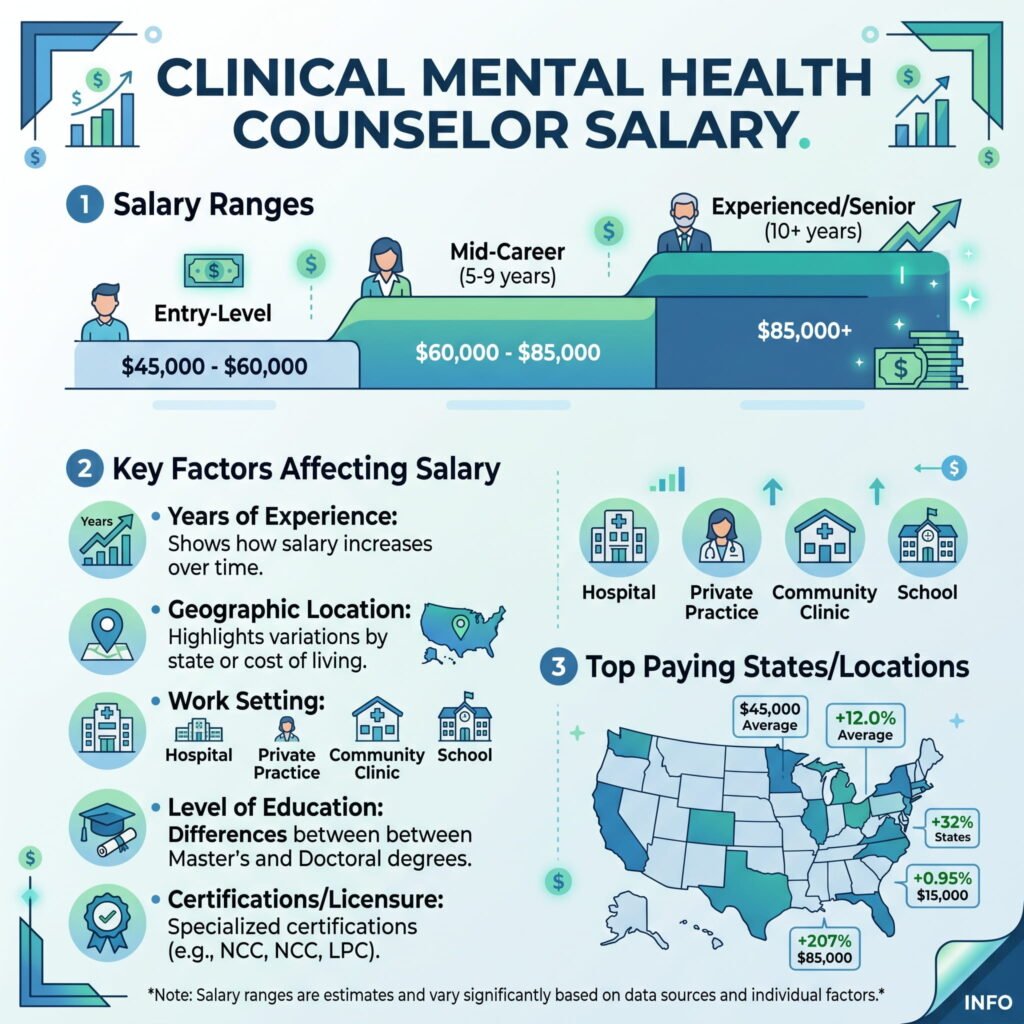
Quick answer: The clinical mental health counseling salary in the United States ranges from $59,190 per year (Bureau of Labor Statistics median) to $72,203–$75,569 based on market data from ZipRecruiter and APOS. Entry-level positions typically start between $38,000 and $45,000. Experienced counselors in private practice regularly exceed $100,000.
The gap between government data and market data is real and worth understanding. The BLS measures a broad occupational category — “substance abuse, behavioral disorder, and mental health counselors” — which pulls down the median by including lower-paid roles. When you isolate clinical mental health counselors specifically, market platforms report higher averages:
| Source | Average Annual Salary | Data Date |
|---|---|---|
| Bureau of Labor Statistics (median) | $59,190 | 2024 |
| ZipRecruiter | $72,203 | Feb 2026 |
| Glassdoor | $73,663 | Feb 2026 |
| APOS | $75,569 | 2026 |
On an hourly basis, that works out to roughly $34.71–$36.33 per hour at the market average.
The full salary range runs from about $36,000 at the bottom 10% to $116,000 at the top 10%. Most full-time clinical mental health counselors fall somewhere between $59,500 and $80,000 (25th to 75th percentile). What puts you at the high end rather than the low end is exactly what the rest of this article covers.
Clinical Mental Health Counseling Salary by State
Geography is one of the strongest predictors of CMHC pay. A counselor in California earns roughly 30% more than a counselor doing identical work in Mississippi. Here are the highest-paying states based on BLS 2025 data:
| State | Median Annual Salary |
|---|---|
| California | $78,200 |
| New Jersey | $74,500 |
| Alaska | $71,400 |
| Oregon | $70,300 |
| Washington | $67,600 |
| Connecticut | $69,400 |
| Massachusetts | $70,664 |
| District of Columbia | $71,891 |
| New York | $69,028 |
| Colorado | $66,249 |
A note on cost of living: A $78,200 salary in California doesn’t stretch as far as a $67,000 salary in a mid-cost state. Before relocating for a higher number, factor in housing, taxes, and overall purchasing power — not just the gross figure.
State Spotlights: Florida, Texas, Georgia, and New Jersey
These four states generate consistent search traffic from counselors doing local salary research, so here’s what the data shows:
Florida sits below the national market average, with licensed mental health counselors typically earning $55,000–$65,000. The state has a strong private practice market in metro areas like Miami, Orlando, and Tampa, where cash-pay and hybrid billing models can push earnings above the salaried average.
Texas tracks similarly to Florida — mid-$50s to mid-$60s for salaried roles, with higher ceilings in Houston, Austin, and Dallas private practice. Texas does not have income tax, which meaningfully improves take-home pay compared to high-tax states.
Georgia averages around $55,000–$62,000 for clinical mental health counselors, with Atlanta commanding a premium. The state’s growing population and ongoing expansion of behavioral health services have created steady demand.
New Jersey is among the top-paying states in the country at a $74,500 BLS median, driven by high cost of living, proximity to New York City, and strong insurance reimbursement rates.
How Work Setting Affects Your CMHC Salary
Where you work matters as much as where you live. Clinical mental health counselors practice across a wide range of settings, and the compensation structures are genuinely different — not just in total pay, but in how that pay is delivered.
| Work Setting | Typical Salary Range | Notes |
|---|---|---|
| Private practice (self-employed) | $60,000–$100,000+ | Variable; depends on client volume and fee structure |
| Hospital / healthcare system | $50,000–$70,000 | Stable salary + benefits; often union-negotiated |
| Community mental health agency | $45,000–$58,000 | Often includes loan forgiveness eligibility |
| Government / VA / SAMHSA | $55,000–$65,000 | Strong benefits; loan repayment incentives |
| School-based counseling | $45,000–$55,000 | Predictable hours; summers may be reduced-pay |
| Nonprofit | $44,000–$58,000 | Mission-driven; PSLF eligible |
| Telehealth platform (employed) | $55,000–$75,000 | Growing segment; often W-2 with productivity bonuses |
The Private Practice Opportunity (With Real Numbers)
Most salary articles say “private practice pays more” and leave it there. Here’s the math that most sites skip.
A full-time private practice counselor carrying 25 clinical hours per week at $130 per session (a conservative rate for most mid-size metro areas) generates $169,000 in gross annual revenue. After expenses — office lease or HIPAA-compliant telehealth platform, billing software, malpractice insurance, continuing education, and self-employment taxes — a well-run solo practice nets $95,000–$120,000 for an experienced clinician.
Even at a more conservative 20 sessions per week at $120:
- Gross: $124,800/year
- Net after ~30% overhead and SE tax: $75,000–$90,000
That’s above what most agency or hospital positions pay, with the added benefit of scheduling control. The catch: building a full caseload takes 12–24 months, and income is variable until then. Most counselors transition to private practice after 3–5 years of salaried experience rather than starting there fresh out of licensure.
Salary by Experience Level: Entry, Mid-Career, and Senior
Your paycheck grows significantly over the first decade of your career. Here’s a realistic progression:
Entry-level (0–2 years, pre-licensed or newly licensed): $38,000–$45,000. Most graduates begin as LPC Associates or LMHCA, working under supervision toward full licensure. This period typically lasts 2–3 years. Some community mental health and VA positions offer loan forgiveness during this stage, which substantially improves total compensation.
Mid-career (3–7 years, fully licensed): $55,000–$75,000. With full licensure (LPC, LMHC, or equivalent) and a specialized focus, counselors in this range have usually moved beyond entry-level agency roles into hospital-based, group practice, or government positions — or have begun building a private practice.
Senior / supervisory (8+ years): $75,000–$100,000+. Senior CMHCs who take on clinical supervision, program coordination, or leadership roles earn at the higher end of institutional pay. Those running established private practices or group practices frequently exceed $100,000.
The single biggest salary jump typically comes from earning full licensure. Licensed counselors earn approximately $9,000 more annually on average than non-licensed colleagues in comparable roles — and licensure opens access to insurance billing, which is what makes private practice financially viable.
How Your Degree Level Impacts Earnings (MS vs. MA vs. PhD)
The master’s degree is the standard entry point into clinical mental health counseling. Whether that’s an MS (Master of Science) or an MA (Master of Arts) doesn’t significantly affect your salary — both qualify you for the same licensure paths and the same clinical roles. The curriculum emphasis differs slightly (MS programs tend to be more research-quantitative; MA programs more humanistic), but employers and licensing boards treat them equivalently.
| Degree | Typical Starting Salary | Salary Ceiling |
|---|---|---|
| Bachelor’s in psychology/counseling | Not eligible for clinical licensure | N/A |
| Master’s (MS or MA in CMHC) | $38,000–$48,000 | $100,000+ (private practice) |
| Post-master’s certificate in specialty | $5,000–$10,000 premium | Depends on specialty |
| PhD or doctoral degree | $55,000–$70,000 starting | $130,000+ (supervisory/academic) |
A PhD in clinical mental health counseling opens doors to academic faculty positions, clinical director roles, research and grant-funded work, and advanced supervisory credentials — all of which pay above the master’s-level ceiling. However, a PhD takes 4–7 additional years and comes with substantial additional cost. For most counselors focused on direct client work, a master’s plus strong licensure plus a specialty certification offers a better ROI than a doctorate.
If you hold an MS or MA in clinical mental health counseling and are researching salary specifically for your degree type — the market rates above apply directly. The “master of science in clinical mental health counseling salary” and “master of arts in clinical mental health counseling salary” are essentially the same number in practice.
Specializations That Pay More
Generalist clinical mental health counselors earn the median. Specialists earn more. The premium is typically 10–15% above base pay, and in some cases higher for certifications that are nationally credentialed and in high demand.
| Specialization | Salary Premium | Notes |
|---|---|---|
| Trauma-informed care / EMDR | 10–15% | High demand; certification through EMDRIA |
| Substance abuse / addiction counseling | 8–12% | Growing with addiction crisis; CAADC/CSAC credentialing |
| Child and adolescent counseling | 8–10% | School + community + private practice demand |
| Couples and marriage counseling | 10–15% | Private practice rates typically higher |
| Eating disorder treatment | 10–12% | Specialized residential facilities pay premium |
| Military / veteran counseling | 10–15% | VA positions + loan repayment benefits |
| Group practice ownership / clinical director | 20–40% above staff | Administrative premium on top of clinical pay |
Beyond the pay premium, specialization improves private practice fill rates. A counselor who works with a specific population (veterans, athletes, adolescents with ADHD) builds referral networks faster than a generalist and can often charge higher session rates in cash-pay markets.
CMHC Salary vs. Related Roles: LCSW, LPC, MFT, and Psychologist
Clinical mental health counselors aren’t the only licensed professionals in therapy rooms. Here’s how CMHC pay compares to adjacent credentials:
| Role | Median Annual Salary | Notes |
|---|---|---|
| Clinical Mental Health Counselor (CMHC/LPC/LMHC) | $59,190–$75,569 | Varies by state credential name |
| Licensed Clinical Social Worker (LCSW) | $60,000–$71,619 | Broader scope in child welfare, hospitals |
| Marriage and Family Therapist (MFT) | $58,500–$72,000 | Often slightly higher in private practice |
| Licensed Professional Counselor (LPC) | $57,900–$75,386 | Same credential as LMHC in many states |
| Psychologist (PhD/PsyD) | $85,000–$130,000 | Requires doctorate; can prescribe in some states |
| Psychiatrist (MD) | $220,000+ | Medical degree required |
The honest assessment: LPCs, LMHCs, LCSWs, and MFTs operate in overlapping salary ranges and often do similar clinical work. The differences are more about which doors are open (LCSWs get more hospital placements; MFTs specialize in relational work) than dramatic pay differences at the median. Psychologists and psychiatrists earn significantly more, but require substantially more education and training time.
Is a Master’s in Clinical Mental Health Counseling Worth It?
This question deserves a real answer, not a marketing pitch.
The typical investment: A master’s in clinical mental health counseling runs 2–3 years full-time and costs $30,000–$80,000 in tuition depending on whether you attend a public or private program. Add living expenses and opportunity cost, and the total financial commitment is substantial.
The payoff trajectory: Starting at $40,000–$45,000, moving to $55,000–$65,000 by year 5 with full licensure, and potentially $80,000–$100,000+ by year 10 in private practice or a senior role. A counselor who stays in the field for 20+ years easily generates lifetime earnings that justify the graduate investment, especially with loan repayment assistance.
Loan forgiveness options that actually matter:
The National Health Service Corps (NHSC) offers loan repayment awards of $30,000–$50,000 (tax-free) for licensed mental health counselors who commit to 2 years of service in a Health Professional Shortage Area (HPSA). Many community mental health settings qualify. This program can eliminate a significant portion of graduate debt faster than any private practice income ramp-up.
Public Service Loan Forgiveness (PSLF) applies to counselors working for qualifying nonprofit or government employers. After 10 years of qualifying payments, remaining federal student loan balances are forgiven — a major factor for counselors who prefer agency or community work over private practice.
Bottom line: For someone genuinely drawn to clinical mental health work, the degree pays for itself — but the timeline is longer than many people expect. The ROI improves substantially if you choose a reasonably priced program, pursue loan forgiveness, and commit to licensure within 3 years of graduation.
Job Outlook and Future Salary Trends
Clinical mental health counseling is one of the faster-growing healthcare professions in the country right now.
The Bureau of Labor Statistics projects 17% job growth for mental health counselors through 2034 — more than three times the average growth rate across all occupations. That translates to approximately 48,900 job openings per year through 2033, driven by increasing demand for mental health services, workforce shortages in underserved areas, and expanded insurance coverage for behavioral health.
Two trends worth watching for salary implications:
Telehealth parity laws are changing the earning geography for private practice counselors. As more states require insurers to reimburse telehealth sessions at the same rate as in-person visits, a counselor in a lower-cost state can now see clients in higher-reimbursement markets — effectively accessing metropolitan rates without metropolitan rents. This is meaningfully expanding income potential for rural and suburban counselors.
Value-based care models are beginning to enter mental health contracting. Insurers increasingly tie some reimbursement to clinical outcomes rather than pure session counts. For clinicians who track and can demonstrate treatment effectiveness, this creates upside. For those who don’t, it adds administrative complexity. Getting comfortable with outcome measurement tools now positions you well.
How to Maximize Your CMHC Salary
These five moves have the clearest documented impact on lifetime earning potential as a clinical mental health counselor.
1. Get licensed as fast as your state allows. The gap between pre-licensed and fully licensed pay is real ($9,000+ per year on average). Track your supervised hours carefully from day one, don’t let requirements lapse, and schedule your licensing exam as soon as you’re eligible. Every month of delay is money left on the table.
2. Choose your first job with loan forgiveness in mind. If you have significant student debt, a community mental health or government position with NHSC or PSLF eligibility may outperform a higher-salary private group practice once forgiveness is factored in. Run the actual numbers before accepting any first offer.
3. Add a specialty credential within your first 3–5 years. Certifications in trauma (EMDR, TF-CBT), addiction (CAADC), or child and adolescent work add $5,000–$10,000 to average salaries and make you a more attractive hire for specialized positions.
4. Negotiate your first offer. Most new graduates don’t negotiate — and employers expect them not to. Even a $3,000–$5,000 increase on your starting salary compounds over your entire career. Research the market rate for your state and setting before accepting, and ask. The worst they say is no.
5. Consider the private practice transition intentionally. Private practice offers the highest earning ceiling in this field, but unplanned transitions fail more often than planned ones. A common successful path: build a part-time private practice caseload (5–8 clients/week) while employed, reach 15+ weekly clients before going full-time, and maintain a 3–6 month expense buffer. Done this way, private practice income typically exceeds a salaried position within 2 years of the full-time transition.
Frequently Asked Questions
How much does a clinical mental health counselor make per year? The BLS reports a median of $59,190 per year for this occupational category. Market sources like ZipRecruiter and Glassdoor show averages of $72,203–$73,663 for clinical mental health counselors specifically. The range runs from $36,000 at the entry level to $116,000+ for top earners.
What is the highest-paying state for clinical mental health counselors?
California consistently ranks first, with a BLS-reported median of $78,200 annually. New Jersey ($74,500), the District of Columbia ($71,891), Alaska ($71,400), and Oregon ($70,300) round out the top five. Washington, Massachusetts, and Connecticut also pay above the national average.
How much do mental health counselors make in private practice? Private practice income varies widely based on caseload, session fee, and overhead. A full-time counselor seeing 20–25 clients per week at $120–$150 per session can gross $125,000–$195,000 annually before expenses. Net income after overhead (roughly 25–35%) typically falls in the $75,000–$120,000 range for an established practice.
Is a master’s in clinical mental health counseling worth the investment? For most people entering this field by genuine interest, yes. The degree is required for licensure, and licensure is required to practice and bill insurance independently. Loan forgiveness programs (NHSC, PSLF) substantially improve the financial picture for counselors in community or government settings. The ROI is stronger with an affordable program, early licensure, and a defined plan for specialty or private practice development.
How does clinical mental health counselor salary compare to LCSW or LPC pay? These roles operate in overlapping salary ranges. LCSWs median around $60,000–$72,000; LPCs and LMHCs median around $57,900–$75,000; MFTs track similarly. The differences in pay are driven more by state, setting, and experience than by credential type within this tier. Psychologists (PhD/PsyD) earn significantly more at $85,000–$130,000, but require a doctorate.
What type of counselor makes the most money? Within the master’s-level counseling space, private practice counselors with specialized expertise (trauma, addiction, couples) in high-cost-of-living metro areas consistently earn the most — often $90,000–$120,000 net. Clinical directors, group practice owners, and supervisors in institutional settings also reach the higher end. Psychologists and psychiatrists earn more, but require additional years of training beyond a master’s degree.
Does it matter whether I get an MS or MA in clinical mental health counseling for salary purposes? No. Both the Master of Science (MS) and Master of Arts (MA) in clinical mental health counseling qualify you for the same state licensure paths and the same clinical positions. Salary outcomes are essentially identical between the two. Choose based on program quality, curriculum fit, and cost — not the degree designation.