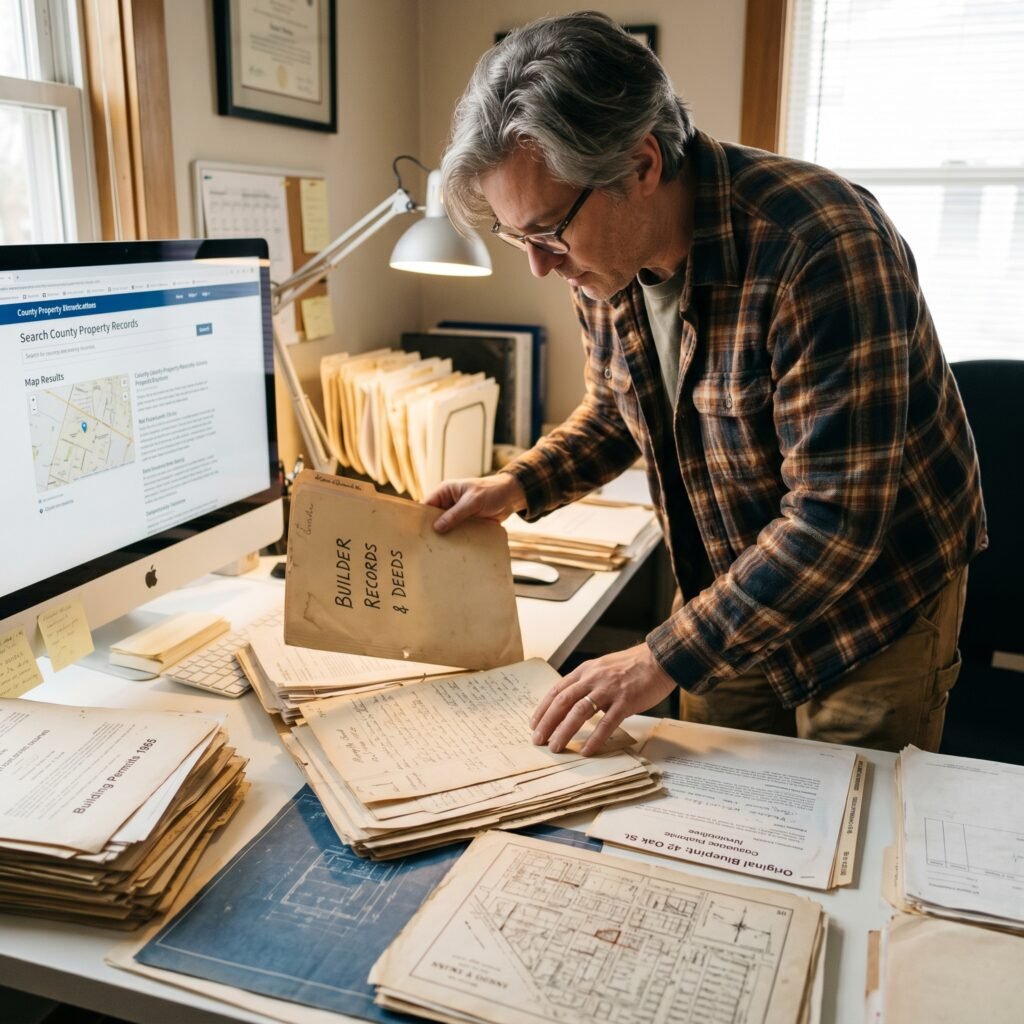
Most homeowners never think about who built their house — until they need to know. A cracked foundation, a fire, a renovation that turns up something unexpected, a warranty question, or just the nagging curiosity of moving into a 1970s split-level and wondering who put it together.
Finding the answer is usually possible. Building permits are public records. County assessors track property history. Deeds leave paper trails. And several free online tools now aggregate this data into searchable databases.
Here’s a quick answer first, then each method in full.
Quick answer: The fastest way to find out who built your house is to search your county’s building department records by address — original construction permits list the contractor’s name. If that doesn’t work, pull your deed from the county recorder’s office and look at the “Grantor” field from the first sale. Free tools like BuildZoom and PropertyChecker let you search permit history by address without visiting an office.
Why You Might Need to Know Who Built Your House
Before the methods — the reasons matter, because they affect which level of detail you actually need.
Insurance claims: After fire or structural damage, insurers sometimes ask about construction methods, materials, and the original contractor to assess scope and liability.
Renovation planning: Knowing the builder — especially for tract homes — can surface the original floor plans, standard material specs, or even the original blueprints from the building department.
Warranty research: Some builders offer structural warranties that transfer to subsequent owners. If you bought a home that’s less than 10 years old, there may be an active warranty you don’t know about.
Structural or defect concerns: If you suspect your home has construction defects, knowing the original contractor is the first step toward any legal or insurance action.
Curiosity and history: Plenty of people just want to know. That’s a fine reason too.
Step 1: Check Your Building Permit Records
This is the most direct route. Every house built with a permit has a paper trail at the local building department — and that permit lists the contractor who pulled it.
Where to look:
Go to your city or county’s building department website and search for a permit lookup portal. Most jurisdictions let you search by street address. You’re looking for the original “New Construction,” “New Dwelling,” or “Original Permit” — not the renovation permits added over the years.
What you’ll find:
The permit record typically includes the permit date, permit number, permit type, the applicant’s name (often the contractor or developer), the inspector’s notes, and sometimes the architect. The contractor who pulled the original building permit is almost always the builder.
If records aren’t online:
Many jurisdictions have digitized permits back to the mid-1990s but have gaps for anything older. If your house predates the digital records, call the building department directly, bring your address, and ask for the permit history. Some offices charge a small fee ($5–$15) for printed copies.
Important: If your house was built before the local permitting system was established — common for rural homes and anything pre-1950 in smaller towns — there may be no permit on file at all. Jump to the old-home section below.
Step 2: Search County Assessor and Property Records Online
Your county assessor’s office tracks every parcel in the county for tax purposes. That database includes ownership history, year built, square footage — and sometimes the original builder or developer.
How to find your county assessor:
Search “[your county name] county assessor property search” and go to the government site (.gov). Enter your address. Look for fields like “Year Built,” “Builder,” “Developer,” or “Subdivision.” Not every county includes the builder name, but many do — especially for subdivision homes built after 1970.
Also check:
- County Recorder / Clerk: Holds the deed history. The earliest deed on file for your property often names the original seller, which in many cases was the developer or builder who sold the home new.
- County GIS portal: Many counties now offer interactive map tools that layer property data including permit history and ownership records. Search “[your county] GIS property viewer.”
These searches are free and take about five minutes.
Step 3: Pull Your Deed and Title Documents
The deed is the legal document that transferred ownership of the property. If your house was sold new by the builder, the builder’s name appears as the “Grantor” — the seller — on that first deed.
Where to get it:
If you still have your closing documents, the title company provided a copy of the deed. If not, the county recorder’s office has every deed on file and most allow online searches. Search “[your county] recorder deed search” to find the portal.
What to look for:
Work backward from the current deed to find the earliest transfer. The original sale from the builder to the first buyer will show the developer or construction company as the Grantor. On subdivision homes, this is often a company name (e.g., “Greenview Homes LLC” or “XYZ Development Group”) rather than a personal name.
Title company: If you’re having trouble navigating deed records yourself, call the title company that handled your closing. They have access to the full chain of title and can often answer this question in a single phone call.
Step 4: Use Free Online Tools That Aggregate Permit Data
Several websites pull building permit data from local jurisdictions and make it searchable without you having to navigate dozens of different county portals.
BuildZoom (buildzoom.com): Tracks licensed contractor activity tied to permits across the U.S. Search your address and you’ll see a permit history including the contractors associated with each permit. The original construction permit, if in the database, typically lists the builder.
PropertyChecker (propertychecker.com): Aggregates permit records from thousands of municipalities. Enter your address and get a permit log showing permit types, dates, and applicants. Useful when your county’s own portal is clunky or incomplete.
ATTOM Data (attomdata.com): More of a data provider than a consumer tool, but worth knowing — it powers many real estate platforms and includes permit histories for residential properties nationwide.
Redfin and Realtor.com: Search your address and scroll to the property details section. These platforms sometimes display builder information pulled from MLS data, especially for newer homes or planned subdivisions. Don’t rely on these as primary sources — the data can be incomplete — but it’s a fast first check.
These tools work best for homes built after 1985. For older homes, the data gets spotty.
Step 5: Ask the HOA, Neighbors, or Your Real Estate Agent
Sometimes the fastest answer isn’t in a database — it’s in a neighbor’s memory or a real estate agent’s listing notes.
HOA records: If your neighborhood has a homeowners association, the HOA was likely established by the original developer. The HOA documents — CC&Rs, bylaws, and meeting minutes — often reference the builder. Call or email the HOA management company and ask who the original builder was.
Long-term neighbors: Someone who has lived on your street since the homes were built may remember the construction company, the name on the trucks, or the subdivision’s marketing materials. Worth a quick conversation.
Real estate agents: The agent who listed your home (or any agent who has sold homes in your subdivision) often has builder information in listing notes or MLS historical data. Even if you didn’t use an agent, you can call any local agent and ask about the builder of homes in your subdivision — they usually know.
Previous owners: If you have contact information for who you bought from, reach out. They may have the original builder’s documentation, warranty paperwork, or floor plans.
Step 6: Look for Physical Builder Markings Inside the Home
Production builders often stamped or stenciled their company name on structural elements — a practice that helps identify the builder even when records are sparse.
Where to look:
- Attic: Check roof trusses and framing members. Builder stamps, nail plate markings, and truss manufacturer tags are common.
- Basement or crawl space: Foundation forms, beam stamps, and mechanical system labels sometimes include the installer or builder.
- Electrical panel: The original panel may have an installation sticker with the electrician’s license number and sometimes the general contractor’s name.
- Breaker box door: Occasionally has a builder or electrician sticker from the original install.
- Original windows and doors: Some builders used branded windows that can be traced to a regional supplier or era of construction.
This method is most useful for confirming a name you’ve already found through records, rather than as a primary search method.
What If Your House Was Built Before 1960?
Pre-1960 homes — especially anything before 1940 — present real challenges. Permits may not exist, county records are fragmentary, and the builder may be long out of business or deceased. Here’s where to look when the standard methods hit a wall.
Sanborn Fire Insurance Maps: These detailed block-by-block maps of American cities were produced from the 1860s through the 1970s for insurance underwriting purposes. They show building footprints and materials for every structure on every block. The University of Texas hosts a large free collection; many public libraries also provide digital access. If your house appears on a 1935 map but not a 1930 map, it was built between those dates — and local newspapers from that window often ran notices about new construction.
Historic newspaper archives: Search your local newspaper’s archive (many are available free through ProQuest or your public library) for your property address. New home construction was commonly announced in local papers, often naming the builder or contractor.
City directories: These annual directories (like today’s phone books, but organized by address) list who was living at each address each year. The first year your address appears as “occupied” gives you a construction window. Libraries and Ancestry.com maintain large collections of city directories.
Local historical society: County and municipal historical societies often hold building records, photographs, and documents that never made it into digital county systems. Call ahead, bring your address and the approximate decade of construction, and ask what they have.
Previous owner chain: Trace the deed history back to the first transfer. The first owner often bought directly from the builder, and sometimes their name (or the development company’s name) is a direct lead.
Production Builder vs. Custom Home: Why It Changes Your Search
This distinction matters and almost no one explains it.
Production (tract) homes are built by a developer who constructs many identical or similar homes in a subdivision at once. Think D.R. Horton, Lennar, PulteGroup, or thousands of smaller regional builders. For these homes:
- The building permit is usually under the developer company’s name, not a specific contractor
- The subdivision plat map (filed with the county) identifies the developer
- HOA documents almost always name the original developer
- Neighbors all have the same builder — asking around works well
Custom homes are built by a general contractor hired by the original owner, usually for a single lot. For these homes:
- The building permit is under the GC’s name or license number
- There’s no subdivision — each lot is its own story
- The original deed may name the GC if they held the lot, or it may just name the original owner
- Building permit records are the most reliable source
If your home is in a subdivision with a name (Maple Creek Estates, Sunset Crossing), it’s almost certainly a production home and the developer’s name is your target. If it sits on a standalone lot with no neighborhood name, it’s likely custom — and the building permit is your best lead.
State-Specific Tips
Texas: Licensed contractors are registered with the Texas Department of Licensing and Regulation (TDLR). Once you find a contractor name from permit records, you can verify their license history at tdlr.texas.gov. For Texas property records, your county appraisal district (CAD) website is the starting point — Texas has 254 counties, each with its own CAD portal.
Florida: Florida’s Department of Business and Professional Regulation (DBPR) maintains a searchable contractor license database at myfloridalicense.com. Search the contractor name or license number found on the building permit to pull their full licensing history and contact details.
Frequently Asked Questions
How do I find out who built my house for free?
Start with your county’s building department website and search the permit history by address — this is free in most jurisdictions. County assessor and recorder websites are also free. BuildZoom and PropertyChecker offer free address searches for permit data. The only costs you’ll encounter are small copy fees (typically $5–$15) if you need certified printed records.
Can I find who built my house by address online?
Yes. Enter your address into BuildZoom (buildzoom.com) or PropertyChecker (propertychecker.com) for aggregated permit data. Your county’s building department portal and assessor website are the primary official sources. Redfin and Realtor.com also display builder information for some properties, though it’s not always complete.
What records show who built a house?
The original building permit is the most reliable record — it lists the contractor who filed it. The deed from the original sale names the builder or developer as the Grantor. County assessor records sometimes include builder or subdivision information. Title documents from your closing may also reference the builder.
What if my county doesn’t have online permit records?
Call the building department directly with your address. Most offices can pull permit history over the phone or in person. For records that predate their current system, ask where older records are stored — some have been transferred to county archives or a historical society.
My house is old and there are no permits on file. Now what?
For pre-1960 homes, try Sanborn fire insurance maps (free through university libraries), historic newspaper archives searchable by address, city directories on Ancestry.com, and your local historical society. Tracing the deed chain all the way back to the first recorded sale is also effective.
Does the builder name appear on Zillow?
Sometimes. Zillow pulls data from MLS listings and public records, and for planned subdivisions, the builder is often listed in the property details section. It’s worth checking, but treat it as a starting point — verify with permit records or county assessor data before relying on it.
How do I find the contractor who built my house vs. the developer?
For subdivision (production) homes, the developer is the company that built and sold the neighborhood — their name is on the subdivision plat and HOA documents. The contractor may be the same entity or a GC hired by the developer. For custom homes, the contractor who pulled the original building permit is the builder. The permit record will list a name or license number that you can look up through your state’s contractor licensing board.
More Real Estate & Legal tools and property calculators at ToolCalcPro.