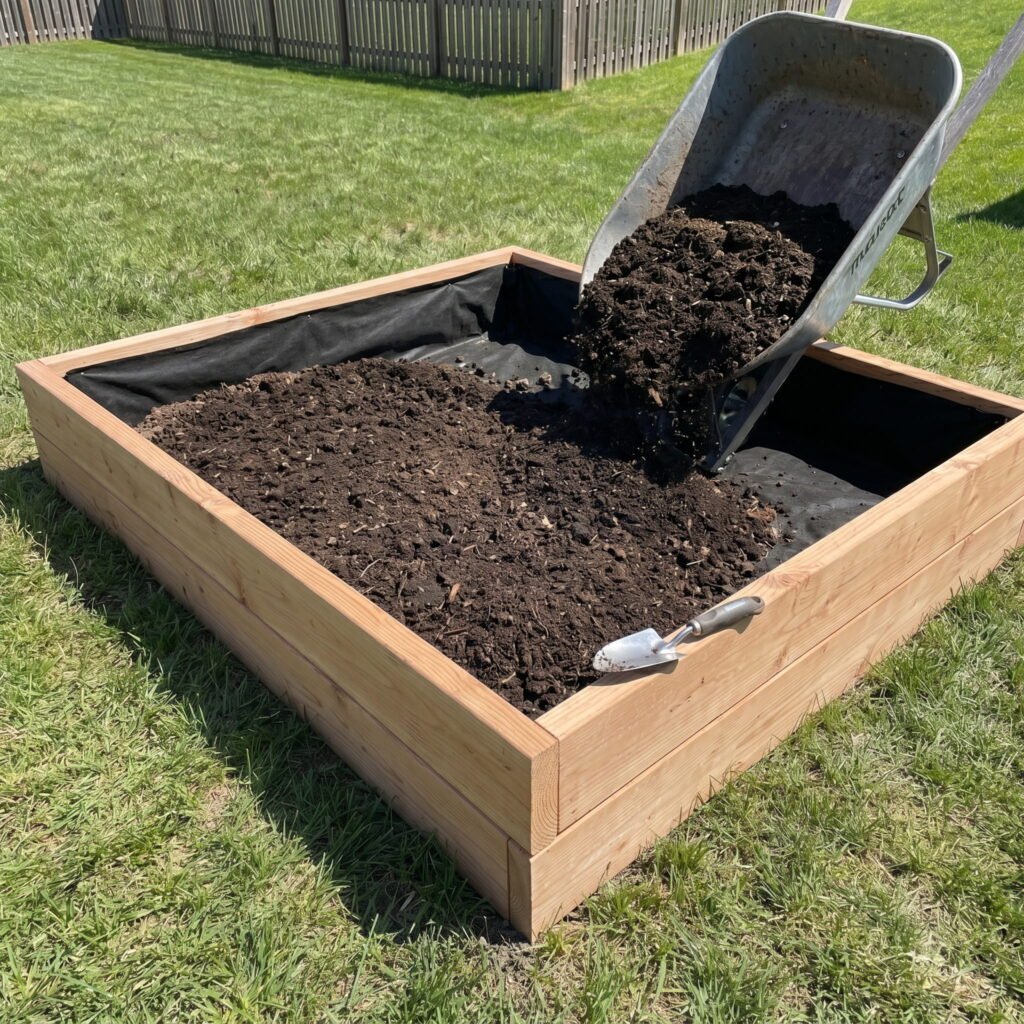
Most people who build a raised bed get the soil wrong. They eyeball the volume, guess at bag counts, and end up driving back to the garden center twice. This guide gives you the numbers before you buy anything — and links to the calculators that do the math for your specific bed.
Why raised beds?
A raised bed gives you control over three things you can’t easily fix in the ground: drainage, soil quality, and depth. Native soil in most American yards is compacted, clay-heavy, or full of rocks. A raised bed starts clean.
The tradeoff is cost. You’re buying lumber and fill soil, which adds up fast if you guess wrong on quantities. That’s what this article is for.
Step 1: Choose your size
Before anything else, settle on dimensions. This decision drives everything downstream — lumber cuts, soil volume, how many plants fit.
Width matters more than length. A bed you can’t reach across is a bed with a dead center. Work from both sides? Go up to 4 feet wide. Work from one side only (against a fence or wall)? Keep it to 2–2.5 feet. Reaching across wet soil to plant or weed will compress it, defeating the point of a raised bed.
Common sizes and what they’re good for:
- 4 × 4 ft — a good starter size; fits comfortably on a deck or patio; soil cost is manageable
- 4 × 8 ft — the standard; enough room for a serious mix of crops without becoming a project
- 4 × 12 ft or longer — for experienced gardeners or anyone growing enough to matter to a CSA; soil cost climbs fast here
Depth depends on what you’re growing:
- Leafy greens and herbs: 6 inches is enough
- Most vegetables: 12 inches
- Deep-rooted crops (tomatoes, carrots, squash): 18–24 inches
A 4 × 8 ft bed at 12 inches deep holds 32 cubic feet of soil. At 18 inches deep, that’s 48 cubic feet. The difference between those two depths — 16 cubic feet — is roughly 8 bags of 2-cubic-foot bagged mix. That adds $50–$100 before you’ve bought a seed.
Run the numbers before you cut any lumber: Raised Garden Bed Soil Calculator →
Step 2: Pick your lumber
The standard choice is 2× lumber (actual thickness 1.5 inches) — either 2×6, 2×8, or 2×10 boards, stacked to get the depth you need.
Wood type:
- Cedar — the gold standard for outdoor raised beds; naturally rot-resistant; smells good; lasts 10–20 years untreated; costs about 2–3× pine
- Douglas fir — a reasonable middle ground; less rot-resistant than cedar but much cheaper; expect 5–8 years before replacement
- Untreated pine — cheapest option; will rot; fine if you plan to replace boards in 3–4 years
- Composite lumber — no rot, no splinters, no off-gassing concerns; expensive upfront, but the last bed you’ll ever build
- Pressure-treated lumber — modern PT lumber (post-2004, using copper-based preservatives) is generally considered safe for vegetable gardens, though many gardeners still avoid it for edibles
Skip railroad ties and old telephone poles. The chemicals used in those — creosote, pentachlorophenol — do leach into soil at levels you don’t want near food crops.
How much lumber for a 4 × 8 ft bed at 12 inches tall:
You need four 8-foot boards for the long sides (two per side) and four 4-foot boards for the short ends. That’s eight boards of 2×6. Cut list:
- 2× (8 ft) boards: 4
- 2× (4 ft) boards: 4 (or rip two 8-footers in half)
Corner options: 4×4 corner posts sunk 12 inches into the ground give the most rigidity. L-brackets work for lightweight beds. For beds over 8 feet long, add a center stake to prevent bowing.
Step 3: Fill it with the right soil
This is where most first-time builders go wrong — and where the money goes.
Don’t fill a raised bed with native soil. Even good garden soil compacts badly in a contained bed, drains poorly, and brings weed seeds with it.
The classic raised-bed mix is sometimes called “Mel’s Mix” (from Mel Bartholomew’s Square Foot Gardening):
- ⅓ compost (blended from multiple sources)
- ⅓ peat moss or coconut coir
- ⅓ coarse vermiculite
It drains well, stays loose, and holds moisture without waterlogging. The downside: vermiculite is expensive, and coarse grades can be hard to find locally.
A practical alternative for a 4 × 8 × 12-inch bed:
- 50% quality topsoil or garden mix
- 30% compost (home or commercial)
- 20% perlite or coarse sand for drainage
How much does it cost?
For a standard 4 × 8 ft bed at 12 inches deep (32 cubic feet):
| Material | Volume needed | Avg. bagged cost |
|---|---|---|
| Topsoil/garden mix | ~16 cu ft | $40–$70 |
| Compost | ~10 cu ft | $30–$50 |
| Perlite | ~6 cu ft | $25–$45 |
| Total | 32 cu ft | $95–$165 |
Buying in bulk (by the yard) cuts cost by 30–50% if you have enough volume to justify a delivery. One cubic yard = 27 cubic feet, so a single 4 × 8 × 12 bed sits just above one yard of material. If you’re building two or more beds, call a local landscape supplier for a bulk quote.
How much compost do you need? The answer depends on your bed dimensions and your target ratio: Compost Calculator →
Step 4: Edge it
Garden edging around a raised bed does three things: keeps lawn grass from creeping in under the boards, gives the bed a finished look, and makes mowing easier.
Your options:
Steel or aluminum edging — the cleanest look; lasts decades; flexible enough to follow curves; costs $1–$2 per linear foot installed. A 4 × 8 bed has 24 feet of perimeter, so plan $24–$48 in material.
Plastic landscape edging — cheaper and easier to install; tends to pop up over time and crack in cold climates; not the right choice if you want it to hold for more than a few seasons.
Brick or stone — a permanent solution; no rot, no shifting in mild climates; labor-intensive to install level; works best with straight runs.
Wood header boards — a board laid flat around the bed perimeter; matches the bed aesthetic; will eventually rot; simplest DIY option.
For a raised bed, the most practical choice is a 4-inch steel or aluminum edging strip buried 2–3 inches deep on the outside of the lumber. It creates a mow-able edge and stops grass runners cold.
Step 5: Protect it from animals
If you have deer, rabbits, or groundhogs, an unprotected raised bed is free lunch. A fence is not optional.
Rabbits and groundhogs: A 2-foot-tall chicken wire fence with the bottom 6 inches bent outward and buried does the job. These animals don’t jump — they dig. The buried flange stops them before they start.
Deer: Need 8 feet of height to deter reliably, or a double-fence system (two shorter fences set 3 feet apart — deer won’t jump wide obstacles). Most gardeners use tall T-posts with deer netting for a cost-effective solution.
Birds and squirrels: Row cover or bird netting stretched over a simple PVC hoop frame. Remove it during pollination if you’re growing anything that needs insect access.
If you’re growing mostly greens and herbs, a simple 18-inch wire hoop covered with row cover handles most critters and doubles as frost protection in spring and fall.
Step 6: Mulch the paths
The area around and between raised beds turns into mud quickly if you don’t address it. Options:
- Wood chips — free from local tree services; breaks down into good organic matter over 2–3 years; weed suppressive if laid 4–6 inches deep
- Pine straw — lighter and easier to move than wood chips; good in warmer climates; pine straw bale coverage depends on the area and desired depth — Pine Straw Calculator →
- Gravel or crushed stone — permanent solution; no decomposition; expensive upfront; good for people who want a tidy look year-round
Don’t use landscape fabric under wood chips in paths you’ll be walking on repeatedly. It breaks down, shreds, and makes a mess within 3–4 years.
What does a raised bed actually cost?
Here’s a realistic budget for a single 4 × 8 × 12-inch cedar raised bed:
| Item | Cost range |
|---|---|
| Cedar lumber (8 boards) | $80–$120 |
| Corner hardware | $10–$20 |
| Soil fill (bagged) | $95–$165 |
| Steel edging (24 ft) | $25–$50 |
| Basic rabbit fence | $20–$40 |
| Path mulch (pine straw or chips) | $0–$30 |
| Total | $230–$425 |
Bulk soil delivery drops the fill cost by $30–$70 if you’re doing two or more beds at once. Building with untreated pine instead of cedar cuts lumber cost nearly in half — but plan to replace boards in 3–5 years.
The math changes significantly with bed size. A 4 × 12 × 18-inch bed holds 72 cubic feet of soil — more than double the 4 × 8 × 12 version. Run your specific dimensions before you order anything.
→ Raised Garden Bed Soil Calculator — cubic feet, bag count, and cost estimate for any bed size. → Compost Calculator — how much compost for your target mix ratio. → Pine Straw Calculator — bale count for path mulching.
What to plant first
If this is your first raised bed, keep it simple. A 4 × 8 bed can support:
- 2 tomato plants (stake or cage them)
- 4 pepper plants
- 1 zucchini (it will try to take over — it always does)
- A row of basil along the south edge
- Lettuce or spinach in any remaining cool corner
Plant tomatoes once soil temps hit 60°F consistently. For most of the US, that’s late April through mid-May. → Tomato Seed Planting Calculator — start-date timing and seed count from saved seeds.
ToolCalcPro calculators are educational tools, not professional horticultural or contractor advice. Bring your specific site conditions to a local nursery or extension office for the final word.