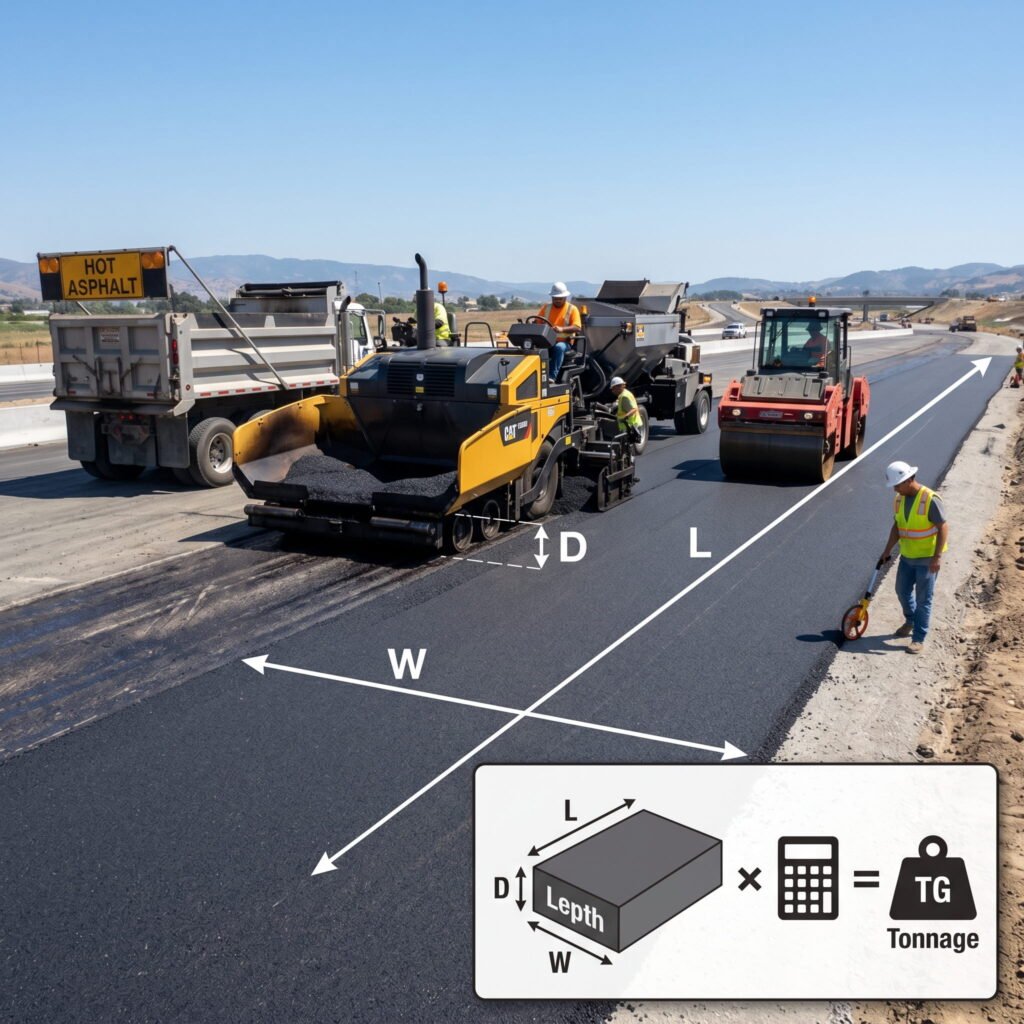
For a 1,000 sq ft driveway at 2.5 inches thick: (1,000 × 2.5 ÷ 12) × 145 ÷ 2,000 = 15.1 tons. The 145 is asphalt’s density in lbs per cubic foot; 2,000 converts pounds to tons. </div>
Whether you’re estimating materials for a driveway, parking lot, or private road, the calculation is the same: measure the area, pick a thickness, and plug the numbers into one formula. This guide walks through exactly how to do it, with checked examples for common project sizes.
Prefer to skip the math? The asphalt tonnage calculator runs the same formula automatically.
The asphalt tonnage formula
<div class=”formula-box”>
Tons = (Length × Width × Thickness ÷ 12) × 145 ÷ 2,000
Where:
- Length and width are in feet
- Thickness is in inches (÷ 12 converts to feet)
- 145 is the density of standard hot mix asphalt in lbs per cubic foot
- 2,000 converts pounds to tons
</div>
You can also write this as a single-step formula using square footage:
Tons = Square feet × Thickness (in) × 145 ÷ 24,000
Both versions give the same result. Use whichever is easier to plug into your calculator.
Step-by-step: how to calculate asphalt tonnage
Step 1: Measure the area
Measure the length and width of your project in feet. For a rectangular driveway or parking lot, that’s straightforward. For an L-shaped or irregular area, split it into rectangles, calculate each one separately, then add the results.
Step 2: Multiply length × width to get square footage
Example: a 50 ft × 20 ft driveway = 1,000 sq ft.
Step 3: Choose your asphalt thickness
Standard thickness by project type:
| Project type | Typical thickness |
|---|---|
| Residential driveway (light vehicles) | 2–3 inches |
| Residential driveway (heavy vehicles or RVs) | 3 inches |
| Parking lot | 3–4 inches |
| Private road or rural lane | 4 inches |
| Highway or arterial road | 4–6 inches |
For most residential driveways, 2.5 inches is the standard working figure. If the driveway sees regular use from trucks or heavy vehicles, use 3 inches.
Step 4: Apply the formula
Plug your measurements in: (Length × Width × Thickness ÷ 12) × 145 ÷ 2,000
Step 5: Add a 5–10% waste factor
Asphalt compacts during rolling, and real-world jobs rarely consume exactly the calculated amount. Add 5% minimum to any estimate. Add 10% for odd-shaped areas or long haul distances where temperature loss during transit can affect how material lays.
Worked examples
Example 1: single-car driveway (40 × 20 ft, 2 inches)
- Area: 40 × 20 = 800 sq ft
- Volume: 800 × (2 ÷ 12) = 133.3 cu ft
- Weight: 133.3 × 145 = 19,333 lbs
- Tons: 19,333 ÷ 2,000 = 9.7 tons
- Order: 9.7 × 1.08 = ~10.5 tons
Example 2: two-car driveway (50 × 20 ft, 2.5 inches)
- Area: 50 × 20 = 1,000 sq ft
- Volume: 1,000 × (2.5 ÷ 12) = 208.3 cu ft
- Weight: 208.3 × 145 = 30,208 lbs
- Tons: 30,208 ÷ 2,000 = 15.1 tons
- Order: 15.1 × 1.08 = ~16.3 tons
Example 3: small parking lot (100 × 50 ft, 3 inches)
- Area: 100 × 50 = 5,000 sq ft
- Volume: 5,000 × (3 ÷ 12) = 1,250 cu ft
- Weight: 1,250 × 145 = 181,250 lbs
- Tons: 181,250 ÷ 2,000 = 90.6 tons
- Order: 90.6 × 1.07 = ~97 tons
Example 4: private road (200 × 12 ft, 4 inches)
- Area: 200 × 12 = 2,400 sq ft
- Volume: 2,400 × (4 ÷ 12) = 800 cu ft
- Weight: 800 × 145 = 116,000 lbs
- Tons: 116,000 ÷ 2,000 = 58.0 tons
- Order: 58.0 × 1.08 = ~62.6 tons
Quick reference: tons of asphalt by area and thickness
Use this table to get fast estimates without running the formula. All figures use standard hot mix density (145 lbs/cu ft) and do not include a waste factor — add 5–10% to each.
| Area | 2 in | 2.5 in | 3 in | 4 in | 6 in |
|---|---|---|---|---|---|
| 500 sq ft | 6.0 t | 7.6 t | 9.1 t | 12.1 t | 18.1 t |
| 750 sq ft | 9.1 t | 11.3 t | 13.6 t | 18.1 t | 27.2 t |
| 1,000 sq ft | 12.1 t | 15.1 t | 18.1 t | 24.2 t | 36.2 t |
| 1,500 sq ft | 18.1 t | 22.7 t | 27.2 t | 36.2 t | 54.4 t |
| 2,000 sq ft | 24.2 t | 30.2 t | 36.2 t | 48.3 t | 72.5 t |
| 3,000 sq ft | 36.2 t | 45.3 t | 54.4 t | 72.5 t | 108.8 t |
| 5,000 sq ft | 60.4 t | 75.5 t | 90.6 t | 120.8 t | 181.2 t |
What density should you use?
The formula above uses 145 lbs per cubic foot, which is the standard density for hot mix asphalt (HMA) — the most common material used in residential and commercial paving. Most contractors and suppliers quote tonnage using this figure by default.
If your project uses a different mix type, adjust accordingly:
| Asphalt type | Density (lbs/cu ft) | Notes |
|---|---|---|
| Standard hot mix asphalt (HMA) | 145 | Use for most driveways and parking lots |
| Dense-graded HMA | 143–150 | Tighter void structure, slightly heavier |
| Open-graded / porous asphalt | 120–135 | Lighter; used for drainage applications |
| Asphalt millings (RAP) | 100–120 | Recycled material; use 110 as a middle estimate |
For millings specifically, use the same length × width × thickness formula but swap the density. A 1,000 sq ft area at 3 inches uses 18.1 tons of hot mix but only 13.8 tons of millings (using 110 lbs/cu ft).
How to calculate asphalt tonnage from square yards
If your measurements are in square yards (common in commercial specs and DOT projects), use this simplified formula:
Tons = Square yards × Thickness (in) × 0.054
The 0.054 factor combines the density (145 lbs/cu ft) and unit conversion in one step. Here’s the derivation: 9 sq ft per sq yard × 145 lbs/cu ft ÷ (12 inches/ft × 2,000 lbs/ton) = 0.054375.
Example: 200 square yards at 3 inches → 200 × 3 × 0.054 = 32.4 tons
Cross-check: 200 sq yards = 1,800 sq ft → (1,800 × 3 ÷ 12) × 145 ÷ 2,000 = 32.6 tons ✓ (rounding difference only)
How to calculate asphalt for irregular shapes
Most real projects aren’t perfect rectangles. Here’s how to handle common shapes:
L-shaped driveways: Split the L into two rectangles. Calculate each separately and add the tonnage.
Curved edges: Estimate the curve as a straight line or use length × average width. For tight radiuses, add an extra 3–5% to the waste factor.
Tapered driveways: Use the average width — measure width at the widest point, width at the narrowest point, add them together, and divide by two. Then multiply by length.
Circles or cul-de-sacs: Area = π × radius². For a 30 ft radius circle: 3.14159 × 30² = 2,827 sq ft, then apply the standard tonnage formula.
Use the calculator to skip the math
The asphalt tonnage calculator handles all of the above automatically: enter your length, width, and thickness, and it returns tons needed, cost estimate, and coverage per ton. For projects with multiple zones at different thicknesses, you can run each section separately and add the results.
For full project cost estimates including labor, see the asphalt driveway cost calculator.
FAQ: how to calculate asphalt tonnage
How do you calculate asphalt tonnage?
Use this formula: Tons = (Length × Width × Thickness in inches ÷ 12) × 145 ÷ 2,000. For a 1,000 sq ft driveway at 2.5 inches thick, that’s (1,000 × 2.5 ÷ 12) × 145 ÷ 2,000 = 15.1 tons. The 145 figure is the density of standard hot mix asphalt in lbs per cubic foot.
How many tons of asphalt do I need for 1,000 square feet?
At 2 inches thick: 12.1 tons. At 2.5 inches: 15.1 tons. At 3 inches: 18.1 tons. These figures use a density of 145 lbs/cu ft for standard hot mix asphalt. Add 5–10% to your calculated figure to account for waste and compaction.
What is the density of asphalt for tonnage calculations?
Standard hot mix asphalt (HMA) weighs 145 lbs per cubic foot. Dense-graded mixes run 143–150 lbs/cu ft. Open-graded and porous mixes are lighter at 120–135 lbs/cu ft. Asphalt millings compact to roughly 100–120 lbs/cu ft — use 110 as a working estimate for millings projects.
How do you calculate asphalt tonnage from square yards?
Multiply: square yards × thickness in inches × 0.054. For example, 200 square yards at 3 inches = 200 × 3 × 0.054 = 32.4 tons. This factor bundles asphalt’s density (145 lbs/cu ft) and the square yard to cubic foot conversion into a single multiplier.
How much does a ton of asphalt cover?
At 2 inches thick, 1 ton covers roughly 82 square feet. At 2.5 inches, about 66 square feet. At 3 inches, about 55 square feet. You can use these coverage rates to cross-check your tonnage calculation: divide your total area by the coverage rate for your chosen thickness.
Should I add extra when ordering asphalt?
Yes — always order 5–10% more than your calculated tonnage. Asphalt compacts during rolling and some material is always lost to edges, joints, and minor overages. Running short mid-pour forces a break in the pour that creates a visible joint in the finished surface.