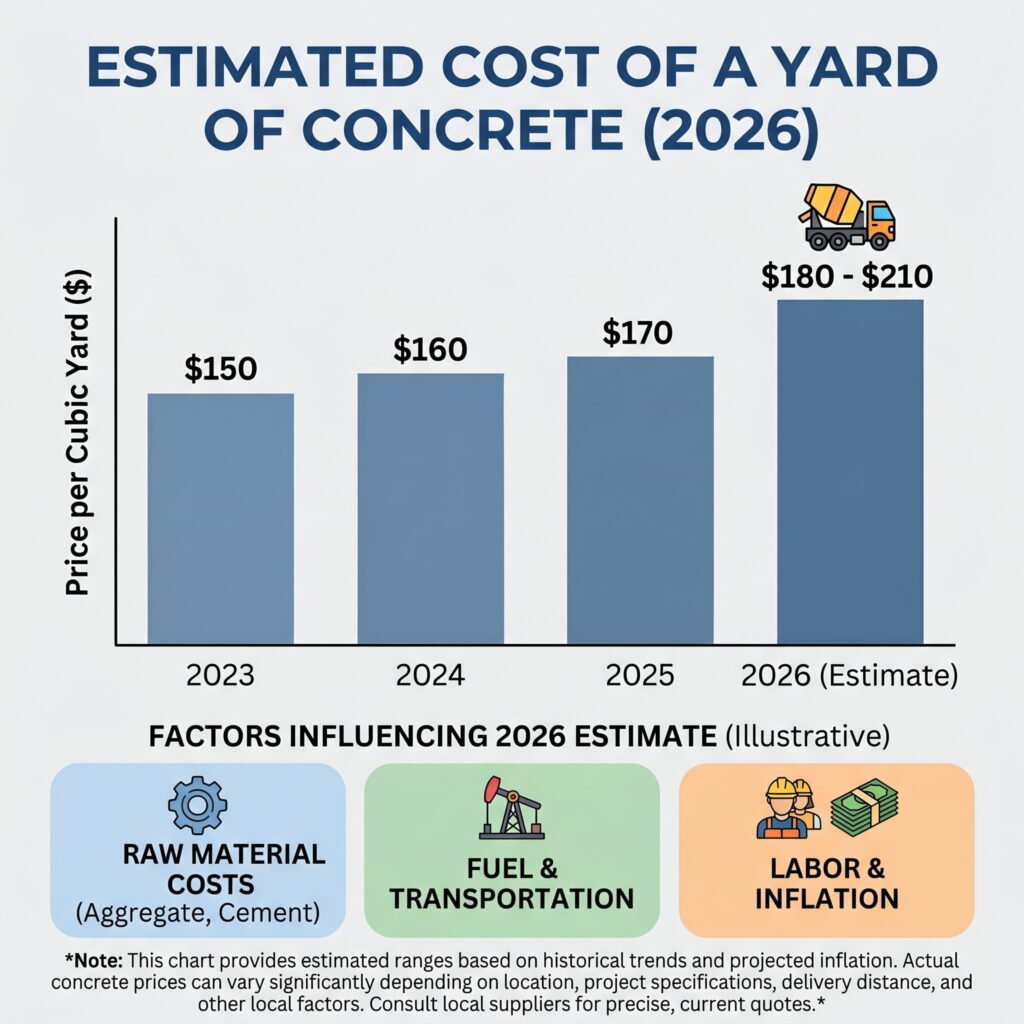
Most pricing guides will tell you concrete costs “$120 to $200 per cubic yard.” That’s technically true and practically useless — an $80 spread on a 10-yard pour is the difference between a $1,200 and a $2,000 bill before labor.
The honest answer to how much a yard of concrete costs in 2026 is closer to $155 nationally for ready-mix delivered, but three things move that number more than anything else: where you live, how much you order, and what’s actually in the mix. Most calculators ignore at least one of those.
This guide gives you the 2026 dollar figures by region, the formula to estimate your own pour, the variables that bend your final quote, and a quick sanity check you can run before you call a single supplier. Whether you’re a homeowner sizing a patio or a contractor pricing a job, you’ll leave with a number you can actually defend.
How much does a yard of concrete cost in 2026?
The national average for ready-mix concrete in 2026 is around $155 per cubic yard delivered, with a typical range of $125 to $195. That’s up roughly 4–6% from 2025, in line with the broader Producer Price Index for ready-mix concrete tracked by the St. Louis Fed.
For a standard residential pour at 3,000 PSI strength, expect to pay $160 to $175 per yard. Bumping up to 4,000 PSI — what most foundations and driveways need — adds $20 to $30. The NRMCA’s annual industry benchmarking put 2024’s national average at $179.89 per cubic yard for context.
Ready-mix vs. bagged — when each makes sense
Ready-mix is delivered by truck and priced per cubic yard. It’s the right call once your project crosses about 1 cubic yard, which is roughly 45 80-pound bags. Below that, bagged concrete from a hardware store at $4 to $15 per bag is cheaper.
Above 5 yards, ready-mix wins on every dimension — cost, time, consistency. A two-car driveway needs around 6 yards. A 400 sq ft patio at 4 inches needs about 5 yards. Once you’re in that range, bagging it yourself costs more in labor than the concrete saves.
What’s behind the 2025 to 2026 price jump
Cement prices haven’t spiked, but transportation has. Fuel surcharges, driver shortages, and Mississippi River water levels all pushed delivered prices up. Gordian’s analysts noted that low water on the Mississippi cut barge traffic by 20%, squeezing aggregate movement and rippling into ready-mix quotes.
Concrete cost per square foot (installed)
Installed cost is what most homeowners actually want to know — material, labor, finish, and prep all bundled into one number per square foot. For 2026, plain residential flatwork runs $5 to $12 per square foot installed.
That number splits roughly 50/50 between materials and labor, though the labor share grows with finish complexity. A broom-finished slab is fast; stamped concrete is slow.
Material vs. installed cost (and why people confuse them)
Material-only is the concrete itself plus reinforcement and forms. For a 4-inch slab, materials run $2 to $4 per square foot. Add labor for pouring, finishing, edging, and cleanup and you’re at $5 to $8 per square foot for a basic pour.
Premium finishes change the math. Stamped concrete adds $4 to $8 in labor alone. A contractor quoting “$12 per square foot” for a stamped patio isn’t gouging — they’re charging for time, templates, and color hardener you don’t see line-itemed.
Cost by project type — slab, patio, driveway, foundation
Different projects need different thicknesses, reinforcement, and prep, which moves the per-square-foot price more than most calculators show. Here’s the 2026 lay of the land for typical residential work:
- Plain slab (shed, garage floor): $5 to $8 per sq ft
- Patio (broom finish): $6 to $10 per sq ft
- Driveway (4–6″ with rebar or mesh): $7 to $12 per sq ft
- Foundation (footings + walls): $10 to $20 per sq ft
- Stamped or decorative finish: add $4 to $8 per sq ft
How to calculate concrete cost yourself
The math behind a concrete estimate isn’t complicated. Length × width × thickness, all in feet, divided by 27. That gives you cubic yards. Multiply by your local ready-mix rate, add labor, and you have a defensible number to compare against any contractor quote.
A reader who ran this math before calling for quotes on a 400 sq ft patio knew the material cost was around $1,200. When the first contractor came in $800 over that on materials alone, they pushed back with the receipts and got a fair price.
The “divide by 81” shortcut for a 4-inch slab
Most residential flatwork is 4 inches thick, and there’s a faster shortcut: total square footage divided by 81 equals cubic yards. A 400 sq ft patio at 4 inches needs 400 ÷ 81 = 4.94 yards, which you’d round up to 5 to cover waste. For 6-inch pours, the divisor is 54. For 12 inches, it’s 27.
Worked example — 10×10 slab, broom finish
A 10×10 slab at 4 inches thick comes out to 1.23 cubic yards. At a national average of $155 per yard, that’s $190 in concrete. Add a basic broom finish at $4 per sq ft installed, and the total lands around $400 to $500 depending on region. You can run your own square footage and ready-mix rate to see the same math against your local prices.
Worked example — 20×20 patio, stamped finish
A 20×20 patio at 4 inches needs about 4.94 yards, or roughly $765 in material at $155 per yard. Stamped labor at $7 per square foot brings the installed total to around $2,800 to $3,200. Add color hardener and sealer and you’re easily at $4,000.
Why you add 5–10% for waste
Spillage, uneven subgrade, and the gap between what you ordered and what actually gets used always pushes the real volume up. Most contractors add 10%; for a small DIY pour, 5% is enough. Skip it and you’ll be calling for a second short load — which costs more than the original.
What changes the price (the variables most calculators skip)
Two contractors quoting the same patio can come in $1,500 apart and both be honest. The gap is in the variables that don’t show up in a per-yard headline.
PSI strength — 3,000 vs. 4,000 vs. 5,000
PSI is the compressive strength of the cured concrete. Higher PSI means more cement, which means a higher price. For 2026:
- 3,000 PSI: $160 to $175/yd — patios, sidewalks, light slabs
- 4,000 PSI: $180 to $200/yd — driveways, foundations, garage floors
- 5,000 PSI: $200 to $230/yd — heavy commercial, freeze-thaw exposure
If your contractor specs 4,000 PSI for a project that doesn’t need it, that’s an upsell. If they spec 3,000 for a foundation, that’s a corner cut.
Reinforcement — rebar, mesh, fiber
Rebar adds $0.65 to $1.75 per square foot installed. Wire mesh is cheaper at $0.25 to $0.35. Fiber-mesh (mixed into the concrete itself) costs $5 to $15 per yard added to the mix and skips the install labor. Most residential driveways use either rebar in a grid or fiber.
Short-load fees and delivery distance
A short load — anything under a full truck of 10 yards — hits hard. Cart-Away’s breakdown of short-load charges puts typical 2026 fees at $40 to $60 per missing yard, or a flat $150 to $350 depending on the supplier.
Distance matters too. Most ready-mix plants include 10–20 miles in the base price; beyond that, Fixr’s delivery cost data shows surcharges of $5 to $10 per mile. For rural pours, this can add hundreds.
Finish — broom, stamped, exposed, polished
The finish is where the labor cost lives. Broom finish is the standard $2 to $4 per square foot. Stamped jumps to $6 to $8. Exposed aggregate sits around $5 to $7. Polished concrete (interior) runs $7 to $15 depending on grit level and stain. Pick the finish that fits the use, not the photo.
Concrete prices by US region (2026)
The same yard of concrete that costs $135 in Memphis can cost $185 in San Francisco. Regional pricing isn’t about the concrete — it’s about labor markets, fuel, environmental rules, and how far the materials had to travel.
Why the Mississippi River level affects your quote
A surprising chunk of US aggregate moves by barge. When the Mississippi runs low, barge traffic drops and trucking picks up the slack at higher cost. The Bureau of Labor Statistics tracks regional concrete PPI and the Mid-Atlantic and Midwest indexes both reflect this drag. The Southern PPI series, also tracked by the St. Louis Fed, tells the same story from a different angle.
Quick regional reference table
| Region | Ready-mix per yard | Installed slab per sq ft |
|---|---|---|
| Northeast | $145–$170 | $7–$12 |
| Midwest | $135–$155 | $5–$9 |
| South | $130–$150 | $5–$8 |
| West Coast | $150–$190+ | $8–$15 |
Use these as a sanity check. If your quote sits 25% above the high end of your region’s range, ask why. If it’s below, ask what’s missing.
Will concrete prices go down in 2026?
Probably not — but the rate of increase is slowing. Industry forecasts from IMARC’s cement pricing report point to a 2–4% increase across 2026, well below the 4–6% jump from 2025. Diesel stabilization and easing supply chains are doing most of the work.
If you have a flexible timeline, schedule pours for late fall or early spring. Demand drops, suppliers compete on rate, and you’ll often save 5–10% versus mid-summer pricing. For larger projects, it’s worth modeling the long-term hit on your savings goals before you commit.
Frequently asked questions
How much does a 10×10 concrete slab cost?
A 10×10 slab at 4 inches thick costs around $400 to $500 installed in 2026. That’s about $190 in material at the national average ready-mix rate plus $200 to $300 in labor for a basic broom finish. Stamped or decorative finishes can push it past $700.
How much is a yard of concrete delivered?
A yard of concrete costs $125 to $195 delivered in 2026, with a national average around $155. That assumes a full truck (10 yards) within 20 miles of the plant. Order less than a full truck and short-load fees of $40 to $60 per missing yard apply.
What’s the cheapest way to buy concrete?
The cheapest way depends on volume. Under 1 cubic yard, bagged concrete at $4 to $15 per bag wins. Between 1 and 5 yards, mobile mix services (you only pay for what you use) often beat ready-mix. Over 5 yards, a full truck of ready-mix is always cheapest per yard.
How accurate is an online concrete price calculator?
A good concrete price calculator gets you within 10–15% of a real contractor quote, assuming you input current local ready-mix rates and the right project type. It can’t predict short-load fees, site access issues, or unusual prep work — those come from a site visit. Use the calculator number as your floor and your negotiation anchor.
The bottom line
Concrete pricing in 2026 isn’t mysterious — it’s just unevenly explained. The national average for ready-mix is around $155 per cubic yard. Installed flatwork runs $5 to $12 per square foot for residential projects. Three variables — region, mix strength, and delivery distance — move your final number more than the headline rate ever will.
Run the math before you call. Use the regional table as your sanity check, the formula as your floor, and a contractor quote as your real-world adjustment. If a quote sits inside your sanity-checked range, you’re being fair-dealt. If it’s 20%+ above, ask which variable is doing the work.
The fastest way to pressure-test any quote is to run your numbers in the Concrete Price Calculator on ToolCalcPro — plug in your dimensions, your local ready-mix rate, and the finish you want, and you’ll have your sanity-check number in under a minute.
What size project are you pricing right now, and what region are you in? Drop the details in the comments and I’ll point you at a realistic 2026 range for your area.