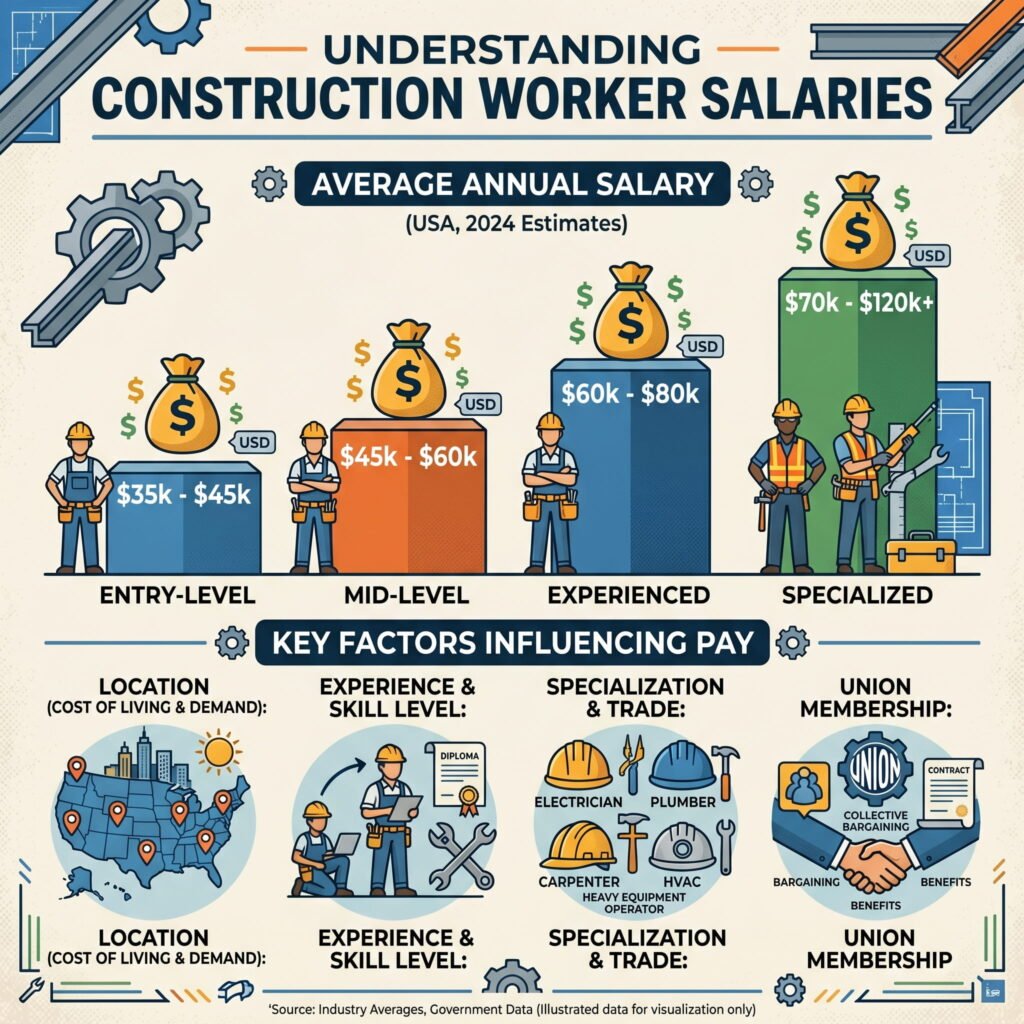
Construction worker pay swings wider than almost any other career in America. One worker on a residential crew in Mississippi might bring home $30,000 a year. Another running a crane in Honolulu can clear six figures. Same job title, very different paychecks.
That spread is exactly why a single “average salary” number isn’t worth much if you’re trying to plan a career or benchmark what you should be earning. The real answer to how much does a construction worker make depends on four things: your trade, your state, your experience level, and whether you work union or non-union.
This guide breaks down all four using the latest 2024–2025 data from the Bureau of Labor Statistics, NAHB, and union reporting. You’ll see real numbers for entry-level laborers and master electricians, the top-paying states, the union pay premium, and the levers you can pull to push your own paycheck higher. By the end, you’ll know exactly where you fit on the scale and where you can move.
How Much Does a Construction Worker Make in the US?
The short answer: it depends on what you mean by “construction worker.”
For general construction laborers and helpers, the BLS reports a median annual wage of $46,050 in May 2024, or about $22.47 an hour. The bottom 10% earn under $34,200 and the top 10% clear $77,530.
If you include the broader construction and extraction group (skilled trades, supervisors, and equipment operators), the median jumps to $58,360. That’s well above the $49,500 median for all US occupations.
Hourly vs annual
Most construction workers are paid by the hour, not on a fixed salary. National average hourly earnings in construction reached about $39.70 in July 2025, according to BLS Current Employment Statistics. That figure includes supervisors and skilled trades, so it runs above what a general laborer typically earns.
At $22.50 an hour with a 40-hour week and no overtime, you’re looking at roughly $46,800 a year before taxes. Add 5–10 weekly overtime hours (paid at 1.5x), and the same worker can clear $58,000 or more.
Why averages mislead you
The mean for the full group sits around $63,920, according to Construction Coverage’s 2024 analysis. That sounds great, but the spread inside the number is enormous. State, trade, experience, and union status each move pay by tens of thousands of dollars. The rest of this guide shows exactly how.
Construction Worker Pay by Experience Level
Experience is the single biggest lever inside any one trade. A first-day apprentice and a 20-year master can sit on the same job site earning wildly different paychecks.
Entry-level laborers
If you walk onto a site with no experience, you’re starting in general labor or as a trades helper. Typical pay sits between $15 and $22 an hour, depending on your state and the project type. ZipRecruiter’s data has the 25th percentile around $36,000 a year nationally, which lines up with about $17.30 an hour.
Apprentices
Apprenticeships are the better entry path if you want to build long-term earning power. Registered apprenticeship programs are paid from day one, usually starting at 40–60% of the journeyman wage in your trade and stepping up every 6–12 months over 3–5 years.
A real example: a first-year carpentry apprentice on a $38.07/hr commercial scale starts at about $19.03/hr. An electrical apprentice often begins around $18/hr and reaches $40+/hr at completion.
Journeymen and beyond
Once you finish your apprenticeship and earn journey-level status, your pay jumps. Journeyman electricians with 4–5 years of experience commonly earn $55,000–$85,000. Carpenters land in the $59,000–$76,000 range, with the top 25% above $76,290.
Master tradesmen, foremen, and supervisors push higher. A foreman or specialty electrician working industrial or solar projects can clear $90,000–$160,000 with overtime.
How Much Do Different Construction Trades Make?
Picking the right trade matters more than almost any other decision you’ll make in this career.
General laborers and helpers
The base of the construction pyramid. Median pay sits at the $46,050 figure mentioned above. These roles handle site prep, material moving, and assisting skilled trades, and they require no formal credential to start.
Carpenters
Carpentry is one of the largest construction occupations in the country, with around a million workers nationally. The median annual wage is $59,310, and the top 25% earn $76,290 or more. Commercial carpenters typically out-earn residential framers, and union carpenters in NYC, Boston, or San Francisco often clear $100,000 with benefits.
Electricians
Electricians are among the highest-paid skilled trades. The BLS reports a median annual wage of $62,350 for electricians in May 2024, with the top 10% clearing $106,030. Industrial electricians and those working renewable energy or EV charging projects regularly hit six figures. Specialists installing recessed lighting on commercial fit-outs can also map fixture counts faster using a recessed lighting calculator before quoting jobs.
Plumbers and pipefitters
Plumbing posts the highest median of any major trade at $62,970, with the top 10% over $102,000. Industrial pipefitters and refinery-certified plumbers can reach $95,000+ thanks to safety and certification requirements.
HVAC technicians
HVAC sits at a $59,810 median with 8% projected employment growth through 2034, the second-fastest of the major trades. Smart-building specialists and commercial techs in high-cost metros push toward $75,000.
The six-figure trades
A few specialty roles rank well above everything else. Elevator installers and repairers post a median of $108,130, the highest of any construction trade. Pile driver operators show the widest pay spread of all, with the top 25% earning at least $105,100.
Which US States Pay Construction Workers the Most?
Geography easily adds or subtracts $20,000+ from your annual pay for the same work.
Top-paying states
Looking at average hourly earnings, Alaska and Massachusetts both topped $50/hr in April 2025, with Hawaii, New Jersey, Washington, and Illinois close behind. On a cost-of-living-adjusted basis, Illinois leads the country at $80,734 per year, followed by Alaska ($78,435), Hawaii ($75,804), North Dakota ($74,685), and Minnesota ($74,286).
Many of these states share a feature: strong union presence and prevailing wage laws on public projects, which lift baseline pay for everyone in the trade.
Top-paying metros
Cities can outpace their state averages by a lot. The New York–Newark–Jersey City area averages around $32.80 an hour ($68,210 a year) for construction workers. Boston, San Francisco, and Seattle aren’t far behind. If you’re willing to relocate, metro choice alone can push you up two pay tiers.
Lowest-paying states
The bottom of the table looks very different. Arkansas, Mississippi, West Virginia, Louisiana, and Texas typically show ranges in the low to mid $30,000s for general labor. Texas in particular averages about $18.74/hr ($38,990/yr) for construction workers despite a booming building market, because the state’s right-to-work labor laws keep union density low.
Do Union Construction Workers Earn More Than Non-Union?
Yes, and the gap is bigger than most people think.
The 46% wage premium
BLS 2024 data shows union construction workers earned a median $1,530 per week, versus $1,051 for non-union workers in the same trades. That’s a 46% gap, and it’s wider than the union premium across all industries combined.
LIUNA reports union construction average hourly wages of $33.86, versus $28.95 for non-union workers, a $5/hr difference that compounds over a full career.
Benefits move the gap further
Wages are only part of the picture. The hourly value of union benefits averages $22.26, compared with $11.32 for non-union workers. That covers health insurance, pension contributions, training funds, and paid leave. Add wages and benefits together and union total compensation runs roughly 36% higher than non-union.
The trade-off
Union work isn’t a free lunch. You pay dues (typically 1–2% of gross wages), you go through a hiring hall instead of negotiating directly, and you follow union rules on the job. For most workers in commercial, industrial, and public-works construction, the math still favors joining.
How to Increase Your Construction Worker Salary
If you’re already in the trade, here’s where you have real control over your pay.
Pick a high-paying specialty
The fastest single move is choosing a trade with strong wage growth. BLS projects 9% employment growth for electricians through 2034 and 8% for HVAC technicians, both far ahead of the 4% national average. More demand means more pricing power on your hourly rate.
Get licensed and certified
Master electrician, journeyman plumber, OSHA 30, NCCER, welding certifications. Each credential moves you up a pay band. Industrial electricians with renewable energy certifications can charge $62,000–$85,000+, well above the general electrician median.
Use overtime strategically
Construction has no FLSA overtime exemptions. Every non-exempt worker gets 1.5x their hourly rate for any hour over 40 in a week, regardless of how much they earn. A $30/hr worker pulling 10 weekly overtime hours adds $23,400 to their annual pay. Stacking overtime on a high base rate is the simplest way to push toward six figures.
Relocate
Moving from Texas to Illinois (same trade, similar experience) can lift your pay by $15,000–$25,000 a year before cost-of-living adjustments. If you’re early-career and mobile, a two-year stint in a high-paying metro can compound your lifetime earnings significantly.
Can you actually make $100,000 in construction?
Yes, and it’s more common than people assume. Master electricians, journeyman plumbers in industrial settings, elevator installers, foremen, crane operators, and specialty welders regularly clear six figures. Self-employed contractors who run their own crews often earn more, though they take on bid risk and use tools like a concrete price calculator to keep their estimates profitable.
What’s the outlook through 2034?
Strong. The BLS projects 649,300 annual openings across construction and extraction occupations from 2024 to 2034, plus 7% employment growth specifically for laborers and helpers. The industry already faces a 530,000+ worker shortage in 2026, which keeps upward pressure on wages and creates room for sign-on bonuses of $2,000–$10,000 for licensed trades.
Final Takeaways
Three things to remember when you’re answering how much does a construction worker make for yourself.
First, your trade decides more than your job title. A general laborer in the same city as a master electrician can earn half as much. Second, state and union status add huge spreads on top of trade choice. Third, total compensation is bigger than the hourly number once you factor in overtime and benefits.
If you’re already pulling a strong construction paycheck, the next question is what to do with it. Run your savings, age, and target retirement age through the Coast FIRE Calculator on ToolCalcPro to see how soon you can stop hustling and let compounding do the rest. For more career and money guides, visit the ToolCalcPro blog.
What’s your hourly rate and state? Drop it in the comments so other readers can benchmark themselves.