
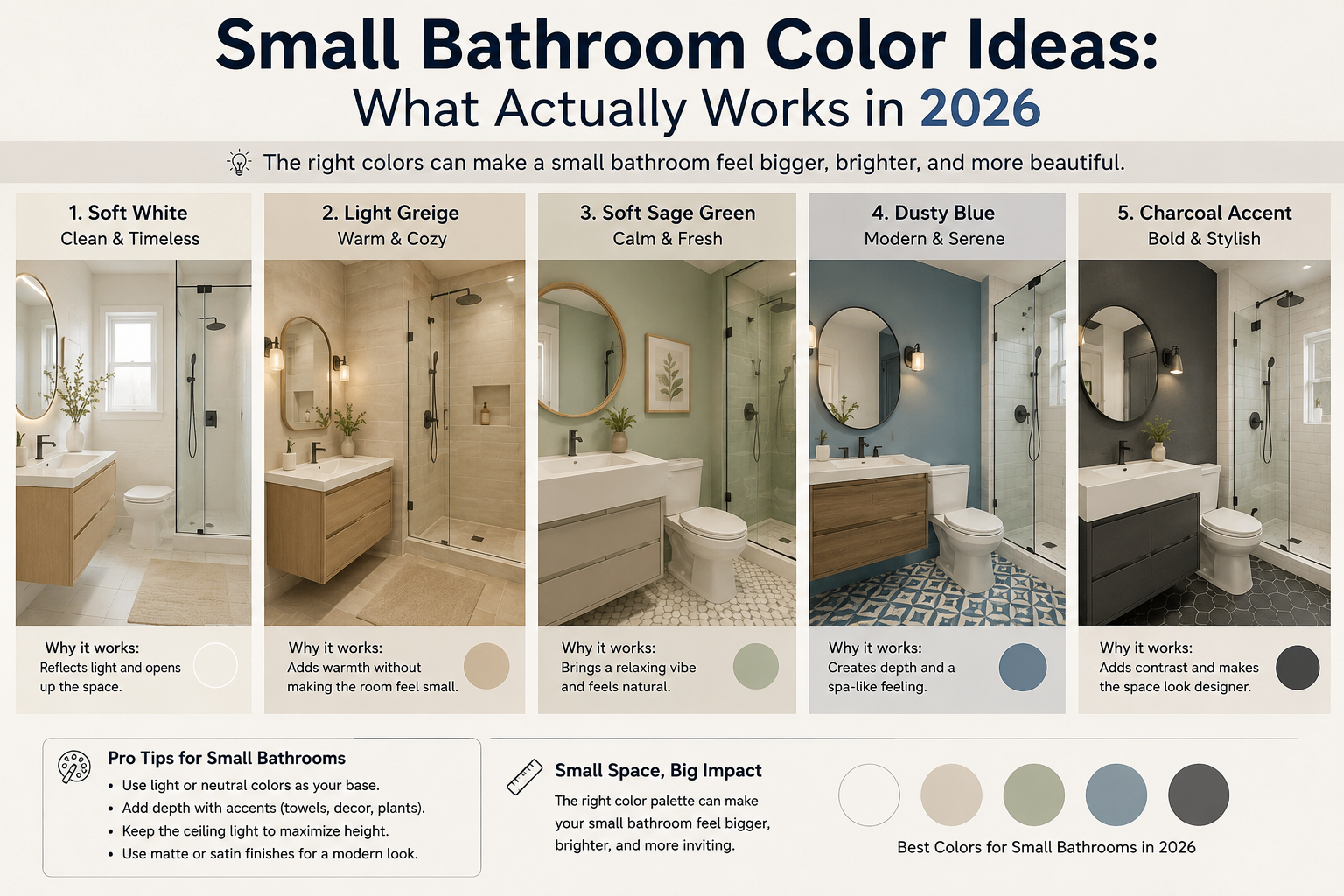
Most small-bathroom color advice stops at “go light, it’ll look bigger.” That’s true about half the time, and it’s the least useful half. The colors that actually change how a cramped bathroom feels aren’t about light versus dark. They’re about contrast, light reflectance value (LRV), and whether the room has a window at all. A windowless powder room painted white often looks worse than the same room in a confident navy, because there’s no daylight to make the white look bright in the first place. Below is a working list of named colors from Sherwin-Williams, Benjamin Moore, Dunn-Edwards, and Farrow & Ball, sorted by the situation you’re actually painting for, plus the finish, ceiling, and budget questions that most guides skip.
Fast-Scan Summary
| If your bathroom is… | Try | LRV | Finish |
|---|---|---|---|
| Small with a window | Sherwin-Williams Alabaster (SW 7008) | 82 | Satin |
| Small and windowless, used daily | Benjamin Moore White Dove (OC-17) | 85 | Satin or semi-gloss |
| A windowless powder room | Benjamin Moore Hale Navy (HC-154) | 6 | Satin, matte if well-ventilated |
| Looking for a soft color, not white | Sherwin-Williams Sea Salt (SW 6204) | 63 | Satin |
Why Some Colors Make a Small Bathroom Feel Bigger (and Some Don’t)
Light bounces off high-LRV colors and gets absorbed by low-LRV ones. That’s really the whole mechanism. A wall painted at LRV 80+ reflects most of the light hitting it, which softens shadows and blurs the corners where walls meet, so the room reads as more open. A wall at LRV 10 does the opposite: it eats the light and the corners stay sharp and visible. Neither effect is “better.” It depends on whether you want the room to disappear or to feel intentional.
Light, Low-Saturation Colors and How They Reflect Light
Warm whites and pale neutrals in the LRV 70-85 range are the safest pick when a bathroom gets real daylight, because that daylight is doing half the work already. The color just needs to get out of the way. This is also where low contrast matters more than color choice: painting the walls, trim, and ceiling within a few LRV points of each other removes the visual “stop signs” that make a small room look boxy. A bright white wall next to bright white trim reads as one continuous surface. A bright white wall next to stark white trim with visible shadow lines reads as a small room with a lot of edges.
The Dark-Color Myth: When Deep, Saturated Colors Actually Work
The “dark paint shrinks a room” rule assumes the room has competing light sources for the dark color to lose contrast against. Take away the window and that assumption falls apart. In a windowless powder room, a saturated navy or charcoal absorbs the artificial light evenly instead of bouncing it unevenly off four close walls, which is what makes small bright rooms look washed out and flat under a single overhead fixture. Design blogs call this “color drenching”: the same color on walls, trim, and ceiling, so there’s no line for the eye to catch on. It’s counterintuitive and it’s also the single most common professional pick for tiny powder rooms right now.
Best Small Bathroom Colors With Natural Light
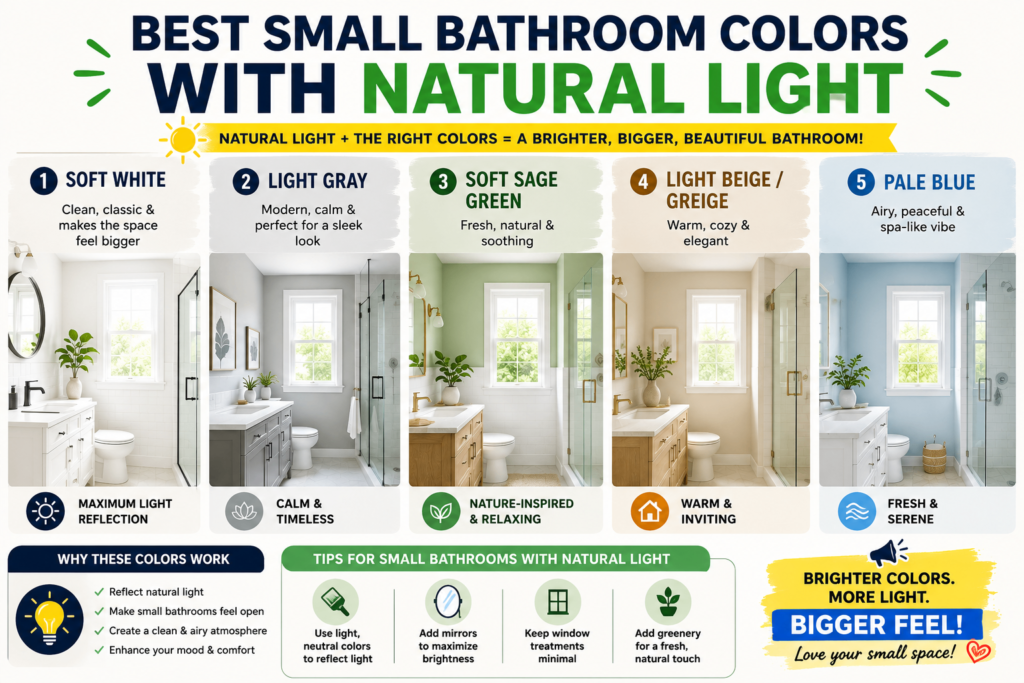
Warm Whites and Light Neutrals
| Color | Brand | Code | Notes |
|---|---|---|---|
| Alabaster | Sherwin-Williams | SW 7008 | 2016 Color of the Year, still the most-cited small-bathroom white among designers |
| Swiss Coffee | Benjamin Moore | OC-45 | A New Jersey stylist’s go-to for small baths; also sold under the same name by Behr (code 12) |
| Cotton Field | Dunn-Edwards | DE 6253 | Warm light gray, one designer’s default greige for small spaces |
| Cloud White | Benjamin Moore | OC-130 | Softer and warmer than Alabaster, less likely to read stark under LED bulbs |
Codes and formulas get updated by manufacturers periodically.
Soft Pastels: Blue, Green, and Gray-Blue
If straight white feels sterile, the next safest step down isn’t a bold color, it’s a desaturated one. Sherwin-Williams Sea Salt (SW 6204) is the most-cited light green for small bathrooms in current design coverage, showing up as the pick from two separate designers in the same year. Benjamin Moore Healing Aloe (1562) is a lighter, slightly warmer alternative. For blue-gray instead of green-gray, Benjamin Moore Boothbay Gray (HC-165) reads as pale blue in daylight and pulls gray under artificial light, which is worth knowing before you commit, since your bathroom probably runs on both at different times of day.
Best Colors for a Small Windowless Bathroom or Powder Room
Can you paint a small windowless bathroom a dark color? Yes, and it frequently looks better than white does in that specific room, because white needs daylight to look “bright” and a windowless room can’t supply that. A deep, confident color reads as a choice. A pale color with no daylight to activate it can read as dim instead of airy.
Why Powder Rooms Can Go Bold
A powder room is used for minutes at a time, not hours. That changes the math on bold color completely: you’re not living in the space long enough for a dark wall to feel heavy, and the drama that would be exhausting in a primary bathroom reads as hospitality-grade design in a half bath guests see for ninety seconds. This is the one room in most houses where a professional would actively encourage you to ignore “resale-safe” advice, within reason (more on that below).
Best Dark and Jewel-Tone Picks
| Color | Brand | Code | LRV |
|---|---|---|---|
| Hale Navy | Benjamin Moore | HC-154 | 6 |
| Naval | Sherwin-Williams | SW 6244 | 4 |
| Iron Ore | Sherwin-Williams | SW 7069 | 6 |
| Caponata | Benjamin Moore | AF-650 | N/A |
| Hague Blue | Farrow & Ball | No. 30 | N/A |
Best Whites for Windowless Baths That Need to Feel Bright, Not Stark
For a full bathroom without a window, one you actually get ready in every morning, you usually want the opposite move: the highest-LRV white you can find, so the bulbs are doing maximum work.
| Color | Brand | Code | LRV |
|---|---|---|---|
| White Dove | Benjamin Moore | OC-17 | 85 |
| Alabaster | Sherwin-Williams | SW 7008 | 82 |
| Shoji White | Sherwin-Williams | SW 7042 | 74 |
One thing that trips people up here: in a windowless room, your light bulb is doing the job daylight normally does. A soft-white bulb (2700K) will pull warm whites toward yellow. A daylight bulb (5000K) keeps them true but can make the same white look slightly blue and clinical. Check your paint sample under the exact bulb that’ll be in the fixture, not under a showroom light or your phone flashlight.
What Paint Finish to Use in a Small Bathroom
This is the gap in most bathroom color guides: they’ll name twelve colors and never mention that the wrong sheen will fail in a bathroom regardless of which color you picked.
| Finish | Moisture resistance | Best for | Watch out for |
|---|---|---|---|
| Flat / matte | Low, unless it’s a bath-specific formula | Ceilings, very low-use powder rooms with a fan | Regular matte will show water spotting and is hard to wipe clean |
| Eggshell | Moderate | Powder rooms with minimal splash exposure | Still not built for a shower wall or sink backsplash |
| Satin | Good | General bathroom walls, the default pick for most jobs | Shows roller marks more than matte if application is uneven |
| Semi-gloss | Best | Trim, doors, and any wall inside splash range of a sink or tub | Highlights wall imperfections; patch and sand first |
If you’re set on a true matte look in a bathroom that actually gets steam, buy a formula built for it rather than fighting a standard flat paint. Benjamin Moore’s Aura Bath & Spa line is a matte specifically engineered for mildew resistance in humid rooms, which is different from asking a regular flat wall paint to do a job it wasn’t built for.
The Ceiling, Trim, and “Fifth Wall”
Should a small bathroom ceiling match the walls? More often than not, yes. A stark white ceiling against a colored wall draws a hard horizontal line right where the room is shortest, which visually caps the height. Painting the ceiling the same color as the walls, or a version a couple of shades lighter in the same family, removes that line and lets the eye travel up without hitting a stop. This is the same color-drenching logic from the windowless-bathroom section, just applied to a bathroom that does have a window. It works in both cases for the same reason: fewer visual breaks read as more space, not less.
How to Test a Small-Bathroom Paint Color Before You Commit
Skipping this step is the single most common reason a color that looked perfect on the chip looks wrong on the wall.
- Buy a real sample, not just a chip. A 2-inch paper swatch under store lighting tells you almost nothing about how a color behaves in a 5×8 room with one bulb.
- Paint two coats on white foam board, not directly on the wall. A movable board lets you check the color in every corner and against every fixture instead of committing to one patch.
- Let it cure for 24 to 48 hours before judging it. Wet paint and freshly dried paint both read differently than fully cured paint, especially with darker colors.
- Check it at the times you’ll actually use the room. Morning grooming light and evening bath light can make the same wall look like two different colors, particularly under mixed bulb temperatures.
- Hold the board against your actual tile, grout, and vanity top. Undertones that look neutral on their own can clash hard once they’re next to fixtures you can’t easily change.
How Much Paint (and Budget) a Small Bathroom Needs
A typical 5×8 small full bathroom has roughly 170 to 190 square feet of paintable wall once you subtract the door and the mirror or vanity backsplash area. Quality interior paint from Sherwin-Williams or Benjamin Moore covers 350 to 400 square feet per gallon, per coat . That means one gallon is usually enough for two coats on the walls, with enough left over for touch-ups or a same-color ceiling.
On price, expect roughly $40 to $90 per gallon for a quality interior paint from either brand as of 2026, with specialty bath-and-spa formulas landing toward the top of that range current price at your local store, pricing varies by region and ongoing sales. For a full 5×8 bathroom, that puts paint alone somewhere around $45 to $100, before primer, tape, or a sprayer rental.
If you’re weighing a full remodel against just repainting, our bathroom remodel cost calculator breaks out where paint sits against tile, vanity, and labor costs, so you can see the whole budget in one place instead of guessing.
Original Analysis: Ranking Every Color in This Guide by Actual LRV
Marketing copy calls a color “light” or “dramatic,” but those words mean different things across brands. To make an honest comparison, we pulled the published Light Reflectance Value for every color named above straight from each manufacturer’s technical data sheet and ranked them on one scale.
| Rank (lightest to darkest) | Color | Brand | LRV |
|---|---|---|---|
| 1 | White Dove (OC-17) | Benjamin Moore | 85 |
| 2 | Alabaster (SW 7008) | Sherwin-Williams | 82 |
| 3 | Shoji White (SW 7042) | Sherwin-Williams | 74 |
| 4 | Bella Blue | Benjamin Moore | 17.5 |
| 5 | Blue Spruce | Benjamin Moore | 16.81 |
| 6 | Stormy Sky | Benjamin Moore | 13.75 |
| 7 | Hale Navy (HC-154) / Iron Ore (SW 7069) | Benjamin Moore / Sherwin-Williams | 6 |
| 8 | Naval (SW 6244) | Sherwin-Williams | 4 |
The gap between rank 3 and rank 4 is the real story here: there’s no “medium” option on this list. Every color that shows up repeatedly in small-bathroom recommendations sits either above LRV 70 or below LRV 20. Nobody is putting a mid-tone gray-beige at LRV 45 on a “best small bathroom colors” list, and once you see the ranked numbers, it’s obvious why: a mid-LRV color gets the worst of both effects, not enough reflectance to open the room and not enough saturation to read as a deliberate choice.
Where This Doesn’t Apply
- You’re selling within the next 12 to 18 months and your local buyer pool skews conservative. A jewel-tone or near-black powder room can photograph beautifully and still cost you showings. Repainting one small room neutral before listing is cheap insurance most competitors won’t tell you to consider.
- Your bathroom has poor or no exhaust fan. Skip flat and matte finishes entirely, and think twice about a dark, low-sheen ceiling. Trapped humidity shows water spotting on dark flat paint faster than it does on a lighter satin.
- You’re renting. A dramatic powder room repaint is a common source of security-deposit disputes in small spaces. Check the lease before you buy the navy.
FAQ
What colors make a small bathroom look bigger?
Light, high-LRV colors (roughly 70 and up) like warm whites and pale neutrals reflect more light and blur the line where walls meet the ceiling, which reads as more space. The bigger factor is actually contrast: keeping walls, trim, and ceiling within a few shades of each other removes the visual breaks that make a small room look boxy.
Can you paint a small bathroom a dark color?
Yes, and in a windowless powder room it often looks better than white does, since there’s no daylight to make white look bright in the first place. A deep, saturated color absorbs artificial light evenly instead of bouncing it unevenly around four close walls, which reads as intentional rather than dim.
What is the best paint color for a small bathroom with no windows?
It depends on how the room is used. For a full bathroom used daily, a high-LRV white like Benjamin Moore White Dove or Sherwin-Williams Alabaster keeps it feeling clean under artificial light. For an occasional-use powder room, a deep tone like Benjamin Moore Hale Navy or Sherwin-Williams Iron Ore turns the missing window into a design choice instead of a limitation.
What paint finish should I use in a bathroom?
Satin or semi-gloss for anything near water. Satin works for general walls, and semi-gloss is worth using on trim and any surface within splash range of a sink or tub. Flat and matte finishes struggle with humidity unless they’re a specialty bath-and-spa formula built for it.
Should a small bathroom ceiling be the same color as the walls?
Usually, yes. Matching the ceiling to the walls, or using a slightly lighter version of the same color, removes the hard line where they meet, which makes a cramped room feel taller instead of boxed in. A stark white ceiling against colored walls does the opposite: it draws attention to exactly how low the ceiling is.
The Bottom Line
If your bathroom gets daylight, start with a high-LRV white like Alabaster and keep the ceiling and trim close to the same shade. If it doesn’t and it’s used daily, go with an even higher-LRV white like White Dove and get the bulb temperature right before you blame the paint. If it’s a powder room nobody spends more than two minutes in, skip the safe choice: Hale Navy or Iron Ore will do more for the room than another coat of white ever could. Test on foam board first, use satin or semi-gloss, and budget one gallon for the walls of a typical small bath.
About the author: Hussnain Mustafa covers home-improvement cost and planning content, including the calculator tools on toolcalcpro.com. LinkedIn