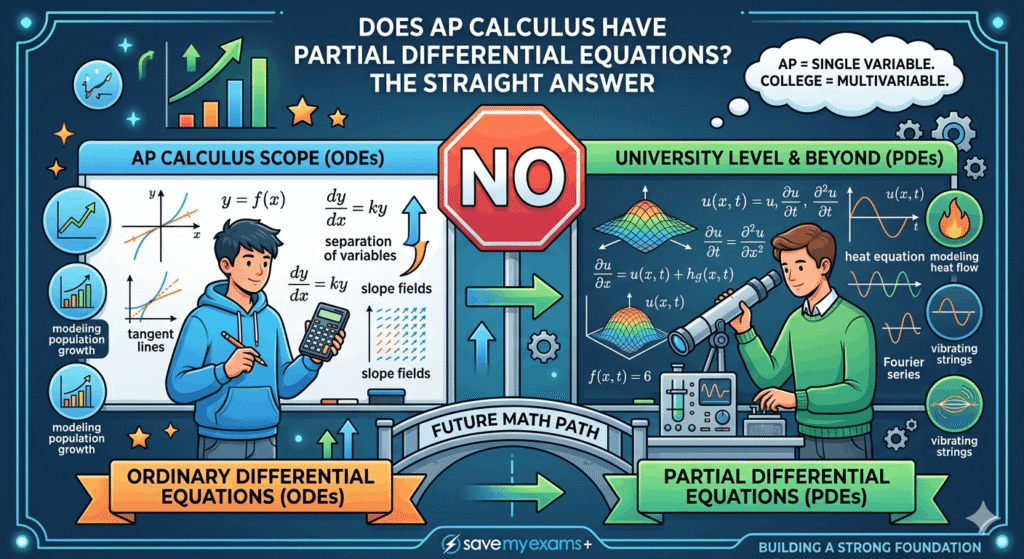
You’re a high school student eyeing AP Calculus, wondering if it’ll dive into partial differential equations (PDEs) like the advanced stuff you’ve heard about in college. This guide cuts through the confusion with a direct no—AP Calculus sticks to ordinary differential equations (ODEs)—and explains what that means for your learning journey. You’ll walk away knowing exactly what AP covers, how PDEs differ, and your next steps if you’re curious about partial differential equations.
What AP Calculus Actually Covers
AP Calculus AB and BC form the backbone of high school calculus, mirroring a first-year college course. Both focus on limits, derivatives, integrals, and their real-world applications, but neither touches partial differential equations. The College Board outlines four main units: limits and continuity, differentiation, integration, and applications like series in BC.
Unit 7 in both courses introduces differential equations, but only ordinary ones—think equations with one independent variable, like modeling population growth with dy/dx = ky. You’ll sketch slope fields, separate variables to solve them, and apply exponential or logistic models. No multivariable functions or partial derivatives here.
This keeps AP accessible for high schoolers while building skills for college. Students often master separation of variables by exam time, verifying solutions against initial conditions.
Ordinary vs Partial Differential Equations
The key split lies between ordinary differential equations (ODEs) and partial differential equations (PDEs). ODEs involve functions of a single variable and total derivatives, like Newton’s cooling law: dT/dt = -k(T – T_a). AP Calculus nails these in Unit 7.
PDEs, or partial differential equations, enter with multiple variables and partial derivatives—think heat flow in a plate, ∂u/∂t = α(∂²u/∂x² + ∂²u/∂y²). These demand techniques like separation of variables across dimensions or Fourier series, far beyond AP scope.
In practice, ODEs solve timelines (e.g., radioactive decay), while PDEs model waves or diffusion in space. AP builds your ODE foundation, making PDEs less intimidating later.
Why No PDEs in AP Calculus
AP prioritizes breadth over depth to fit a school year and exam format. Partial differential equations require multivariable calculus mastery first—vectors, partial derivatives, line integrals—which AP BC only skims in polar coordinates or series.
College courses like Math 442 tackle PDEs after Calc III, covering classification (elliptic, parabolic, hyperbolic) and solvers like Laplace transforms. High schoolers risk overload; AP’s ODE focus yields 60-70% exam pass rates already.
Real-world example: Engineering students use PDEs for fluid dynamics post-AP, but AP grads enter college ahead on ODEs for circuits or mechanics.
Intro to Partial Differential Equations
Partial differential equations govern phenomena varying in space and time, like the wave equation ∂²u/∂t² = c²∂²u/∂x² for vibrating strings. “Partial” refers to derivatives with respect to one variable while holding others constant.
Common types include first-order (transport equations) and second-order like Laplace’s (∇²u = 0 for steady heat). Solving PDEs often starts with assuming separability: u(x,t) = X(x)T(t), leading to ODEs per variable.
For beginners, picture the heat equation: a metal rod’s temperature u(x,t) diffuses evenly. Boundary conditions (fixed ends) and initial heat set the solution via Fourier series.
Solving PDEs: Key Methods
Solving PDEs builds on AP skills but scales up. Separation of variables works for many: assume product solutions, reduce to ODEs, then superpose via integrals or sums.
For second-order partial differential equations, classify first—parabolic (diffusion), hyperbolic (waves), elliptic (steady-state)—then pick tools. Fourier transforms handle infinite domains; finite differences approximate numerically.
Example: Solve the 1D wave equation with fixed ends. Eigenfunctions sin(nπx/L) form the basis; coefficients come from initial displacement via Fourier sine series. AP’s series knowledge in BC helps here.
Second-Order Partial Differential Equations Deep Dive
Second-order PDEs like the biharmonic equation ∇⁴u = 0 arise in plate bending. Canonical forms: heat (parabolic), wave (hyperbolic), Laplace (elliptic).
Real scenario: Acoustics uses the wave equation for sound propagation. Engineers solve numerically with software like MATLAB, but analytically via d’Alembert’s formula for 1D: u(x,t) = [f(x+ct) + f(x-ct)]/2 + integral g.
These demand comfort with boundary value problems—AP’s initial value ODEs are a gentle ramp-up.
Partial vs Ordinary: When to Use Each
ODEs suffice for 1D dynamics; PDEs for fields in space. AP equips you for ODE-heavy fields like biology; PDEs shine in physics/engineering.
FAQ
Does AP Calculus BC cover PDEs?
No, BC adds series and parametrics but sticks to ODEs like logistic models. PDEs wait for university.
What’s the difference between PDE and ODE?
ODEs use total derivatives (one variable); PDEs use partials (multi-variable). AP teaches ODEs only.
How do you solve basic PDEs?
Start with separation of variables, apply boundaries, sum eigen-solutions. Builds on AP ODE skills.
Are second-order PDEs in high school?
Rarely—AP skips them. They’re college-level, focusing on classification and transforms.
Can AP Calculus prep you for PDEs?
Yes, via derivatives, integrals, and series. Strong AB/BC scores ease the transition.
AP Calculus doesn’t include partial differential equations—it’s all ordinary ones—but that’s by design for solid foundations. You’ve got the tools to tackle ODEs now and PDEs later.