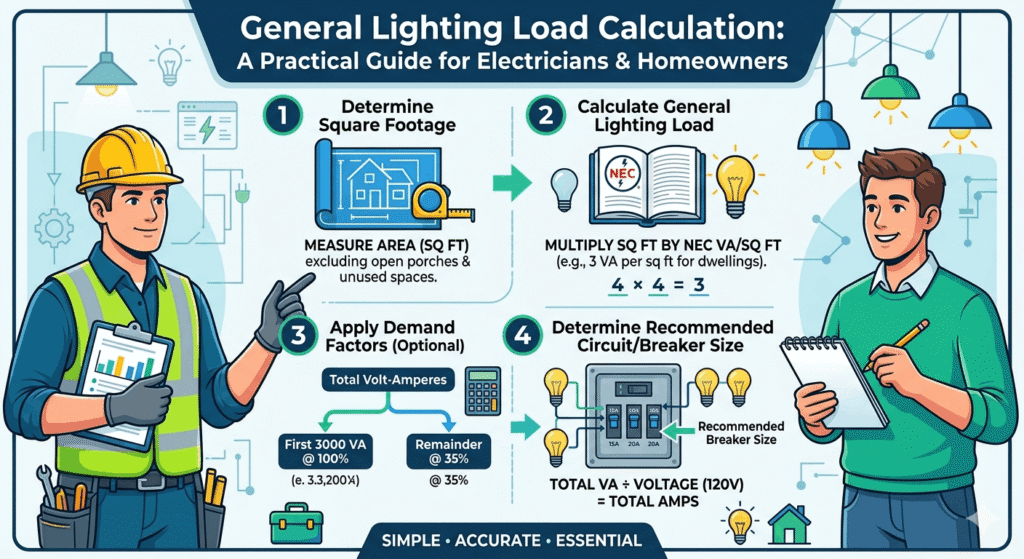
What general lighting load calculation really means
“General lighting load” refers to the total electrical demand created by the basic, everyday lighting in a building: ceiling lights, wall lights, recessed fixtures, and similar fixtures used for overall illumination, as opposed to specialty or task lighting.
A general lighting load calculation answers a simple but critical question:
“How much power (in watts or VA) do all the lights in this room or building actually draw, and can the circuit safely handle it?”
This calculation is essential for:
- Designing safe branch circuits and breaker sizing.
- Planning electrical panels and service capacity.
- Avoiding under‑wired circuits that trip or overheat.
In this guide, you’ll learn how to:
- Step through general lighting load calculations manually.
- Understand how a general lighting load calculator works behind the scenes.
- Answer “how to calculate general lighting load” in both homes and small commercial spaces.
How electrical codes set the baseline
Why codes matter for lighting load
Modern electrical work in the U.S. (and many other countries) follows the National Electrical Code (NEC), which defines minimum rules for load calculations.
For general lighting, the key references are:
- NEC Article 220, Part III (Standard Method for dwelling‑unit and other occupancy loads).
- NEC Table 220.12 (unit loads for general lighting by occupancy: dwelling, restaurant, office, etc.).
These tables tell you how many volt‑amps per square foot (VA/ft²) to assume for each type of space, even before you count every single light fixture.
Typical unit loads (VA per square foot)
Here are common NEC‑style values used for general lighting load calculations:
| Occupancy type | Typical VA/ft² (approx.) |
|---|---|
| Residential dwelling | 3 VA/ft² |
| Office | 3.5 VA/ft² |
| Retail store | 3 VA/ft² |
| Restaurant / dining | 2 VA/ft² |
These values are starting points; you can adjust later if you know the exact fixtures.
Step‑by‑step: How to calculate general lighting load by hand
Here is a repeatable, code‑aligned method you can use for any room or building.
Step 1: Measure usable floor area
For a single room or entire floor, calculate the gross floor area in square feet (or square meters, if using metric codes).
Example (house):
- Floor area = 1,800 ft².
Step 2: Pick the VA/ft² unit load
Use the appropriate VA/ft² from the code table for your occupancy.
Example (residential):
- Residential = 3 VA/ft².
- General lighting load = 1,800 ft² × 3 VA/ft² = 5,400 VA.
Step 3: Convert VA to amps (if needed)
To size circuits, divide by system voltage:
Amps=VoltageVA
For a 120‑volt residential circuit:
Amps=1205400=45 A
This 45 A is the total general lighting load at the panel, not on a single circuit. You’ll subdivide this into multiple branch circuits.
Step 4: Account for continuous loads (if applicable)
If the lights are on for 3 hours or more continuously (common in offices, restaurants, or commercial spaces), the NEC requires you to treat the load as continuous and derate accordingly.
Guideline (U.S. practice):
- Multiply the calculated load by 1.25 to get the circuit design load (because a breaker is typically limited to 80% for continuous loads).
Example (continuous load):
- Base load = 5,400 VA.
- Circuit design load = 5,400 × 1.25 = 6,750 VA (≈ 56 A at 120 V).
When to move from “generic” to “fixture‑by‑fixture” calculations
The “area × VA/ft²” method is fast and code‑compliant, but it is a conservative estimate. In some projects you may want—or be required—to calculate exact fixture loads.
Fixture‑by‑fixture lighting load method
- List all luminaires in the space with their wattages (or VA ratings).
- Sum all watts (or VA) for each circuit.
- Convert to amps using:
Amps=VoltageTotal fixture watts
- Apply continuous‑load factor (1.25) if used for 3+ hours at a time.
Example (office room):
- Ten 36‑W LED fixtures → 10 × 36 W = 360 W.
- At 120 V → 360 ÷ 120 = 3 A.
- If continuous: 3 A × 1.25 = 3.75 A (still far below a 15‑A breaker).
This method is useful when:
- You must minimize breaker counts or wiring costs.
- You’re using high‑efficiency LEDs and want to avoid over‑designing circuits.
How a “general lighting load calculator” works
A general lighting load calculator (online or in software) is simply an automated version of the steps above.
Typical inputs:
- Total floor area (ft² or m²).
- Occupancy type (residential, office, restaurant, etc.).
- System voltage (120 V, 240 V, etc.).
- Optional: average fixture wattage or number of luminaires.
Typical outputs:
- Total general lighting load in VA.
- Equivalent amps at selected voltage.
- Recommended number of branch circuits (based on 15‑A or 20‑A limits).
What to watch out for when using a calculator:
- Check if the calculator already applies the 1.25 continuous‑load factor or if you must add it manually.
- Verify which VA/ft² values it uses (they should match your local code).
Even if you use a calculator, it’s good practice to run a quick manual check (area × VA/ft²) to confirm the result.
Practical examples: homes vs small commercial spaces
Example 1 – Single‑family home (residential)
- Floor area: 2,000 ft².
- Occupancy: Dwelling (3 VA/ft²).
General lighting load=2,000×3=6,000 VA
- At 120 V: 6,000 ÷ 12(porting) = 50 A.
- If not continuous, you can split this into several 15‑A or 20‑A branch circuits (e.g., 4–5 circuits depending on local rules).
This value is often combined with small‑appliance and laundry loads in residential standard‑load calculations.
Example 2 – Small restaurant dining area
General lighting load=1,500×2=3,000 VA
- At 120 V: 3,000 ÷ 120 ≈ 25 A.
- Since dining lighting often runs for hours, treat as continuous:
Design load=25A×1.25=31.25 A
This usually means at least two 20‑A circuits (or one 30‑A circuit, if code‑permitted).
Common mistakes to avoid in general lighting load calculations
Using the right formula is only half the battle; it’s just as important to avoid typical errors.
1. Ignoring continuous‑load rules
Many people calculate VA from fixtures or area but forget to multiply by 1.25 for continuous loads. This can lead to undersized breakers and nuisance tripping.
2. Using the wrong VA/ft² value
Plugging in a residential 3 VA/ft² value for a retail or office space (or vice versa) can give misleading load estimates. Always check the NEC Table 220.12 equivalent for your occupancy.
3. Mixing lighting and receptacle loads incorrectly
In dwellings, the 3 VA/ft² rule often covers both general lighting and general‑use receptacles (unless treated separately).
If you also add dedicated appliance loads (kitchen countertop circuits, laundry, etc.), you must apply demand factors from NEC 220.42–220.52 to avoid over‑estimating the service.
4. Forgetting future expansion
When designing lighting circuits, leave some margin for:
- Additional decorative or accent lighting.
- Upgraded fixtures with slightly higher wattage.
This safety margin reduces the need for re‑wiring later.
FAQ: Common questions about general lighting load
Q1: How do you calculate general lighting load for a house?
For a typical single‑family dwelling, multiply the total square footage by the NEC‑based unit load (usually 3 VA/ft²). Then divide by the system voltage to convert to amps, and apply the 1.25 continuous‑load factor if needed.
Example (2,000 ft² home):
2,000 × 3 = 6,000 VA → 6,000 ÷ 120 = 50 A.
Q2: What is a general lighting load calculator?
A general lighting load calculator is an online or software tool that automates the “area × VA/ft² → VA → amps” calculation. It may also suggest breaker sizes and circuit counts based on your voltage and code‑style assumptions.
Q3: Are receptacles included in general lighting load?
In many residential calculations, the 3 VA/ft² value is used for both general lighting and general‑use receptacles, unless the code separates them or you perform a more detailed load breakdown.
Q4: When should I treat lighting as a continuous load?
Lighting is treated as continuous if it is expected to operate for 3 hours or more at a time. This is common in commercial, retail, and restaurant applications, and it requires you to multiply the load by 1.25 for circuit‑sizing purposes.
Q5: Can I recalculate lighting load after installing LEDs?
Yes. If you replace incandescent or fluorescent fixtures with high‑efficiency LEDs, you can recalculate the load using the actual fixture wattage instead of the original VA/ft² estimate. This may allow you to reduce breaker sizes or consolidate circuits, but only if local code permits.
Taking the next step after your calculation
Once you’ve performed a general lighting load calculation, the next practical steps depend on your role:
- For electricians / designers: Use the calculated VA and amps to size branch circuits, select breaker ratings, and plan panel layouts. Cross‑check with NEC demand‑factor rules for appliances and service‑entry calculations.
- For homeowners / DIYers: Share your calculated load with a licensed electrician and ask them to review the design before installation.
If you’d like, you can also explore related guides such as:
- How to calculate total electrical load for a home (including appliances
- How to choose the right breaker size for lighting circuits.
By mastering general lighting load calculations and understanding how a general lighting load calculator works underneath, you’ll design safer, more compliant electrical systems that meet both code requirements and real‑world needs.