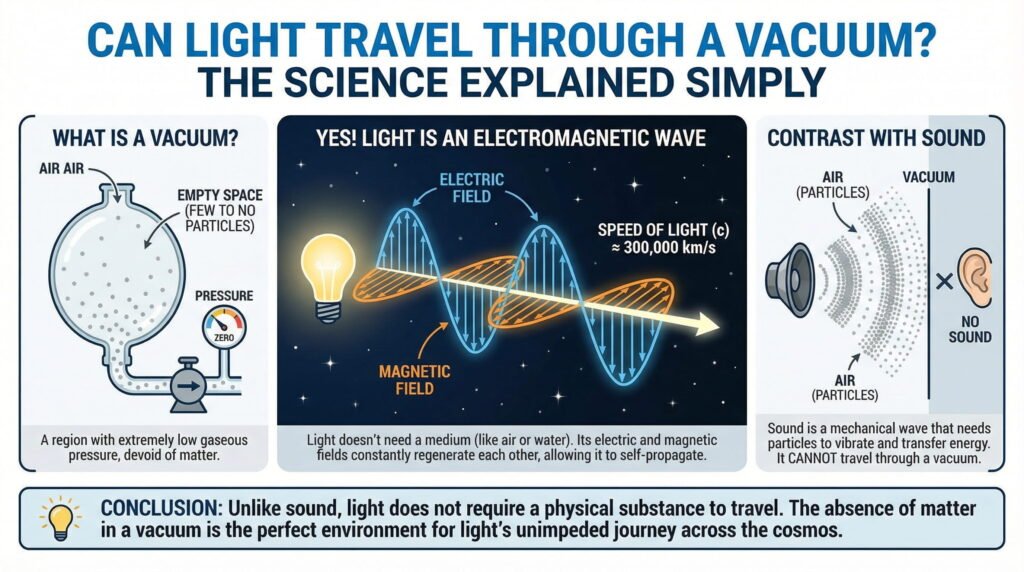
You’ve probably heard that sound needs air to travel — but what about light? Can light travel through a vacuum, or does it need something to carry it? The answer surprises most people, and understanding it changes the way you see the universe.
Whether you’re studying for a physics exam, satisfying a late-night curiosity, or just wondering how sunlight reaches us across 93 million miles of empty space — this article has you covered. We’ll explain exactly how and why light can travel through a vacuum, why sound cannot, and what this all means in the real world.
Quick Answer: Yes — light can absolutely travel through a vacuum. Unlike sound, light doesn’t need a physical medium (air, water, or solid material) to move. In a vacuum, light actually travels at its fastest possible speed: approximately 186,000 miles per second (299,792 km/s).
What Is a Vacuum, and Why Does It Matter?
Before diving into light’s behavior, it’s worth clarifying what a vacuum actually is. In physics, a vacuum refers to a region of space that is entirely empty of matter. That means:
- No air molecules
- No gas or liquids
- No solid particles
True “perfect” vacuums are incredibly rare, but outer space is the closest thing to a vacuum that naturally exists on a large scale. The fact that light can cross this “nothingness” is the only reason we can see anything beyond our own atmosphere.
Why Light Can Travel Through a Vacuum
Light can travel through a vacuum because it is an electromagnetic wave. This is the fundamental reason it differs from mechanical waves like sound.
Light consists of oscillating electric and magnetic fields. These fields don’t need to “vibrate” through atoms; instead, they are self-sustaining. A changing electric field creates a magnetic field, and a changing magnetic field creates an electric field. This self-reinforcing cycle allows the wave to move through empty space indefinitely.
How Light Moves Through Empty Space
Think of it like this:
- Sound is like a “high-five” passed down a line of people; if there are no people (molecules), the message stops.
- Light is like a self-propelled drone; it brings its own “engine” and doesn’t need anyone to pass it along.
Science Fact: Light in a vacuum always travels at exactly 299,792,458 meters per second. This constant is denoted as $c$ in physics equations, most famously in Einstein’s $E = mc^2$.
Light Waves vs. Sound Waves: A Comparison
The difference between light and sound is one of the most common topics in introductory physics.
| Feature | Light Waves | Sound Waves |
| Wave Type | Electromagnetic | Mechanical |
| Medium Needed? | No (Can travel in a vacuum) | Yes (Needs air, water, or solids) |
| Speed in Vacuum | ~186,000 miles per second | Zero (Cannot travel) |
| Speed in Water | Slower than in vacuum | Faster than in air |
Why Sound Cannot Travel Through a Vacuum
Sound is a mechanical wave—it travels by compressing and decompressing molecules. If you remove the air, there is nothing to compress. This is why the famous movie tagline is true: “In space, no one can hear you scream.”
Does Light Speed Change in Different Materials?
Yes. While light is fastest in a vacuum, it slows down when passing through matter like glass, water, or air. This happens because light interacts with the atoms in the material, which creates a delay.
- Vacuum: $100\%$ speed ($c$)
- Air: Slightly less than $c$
- Water: ~ $75\%$ of $c$
- Glass: ~ $67\%$ of $c$
The ratio of light’s speed in a vacuum to its speed in a specific material is known as the refractive index.
Real-World Evidence
- Sunlight and Starlight: The Sun is 93 million miles away. If light couldn’t travel through a vacuum, the Earth would be pitch black and frozen.
- Space-Based Telescopes: The James Webb Space Telescope sees light that has traveled through the vacuum of deep space for over 13 billion years.
- Satellite Communications: Your GPS and satellite TV rely on radio waves (a form of light) traveling through the vacuum of space to reach Earth.
Common Misconceptions
- “Light needs air to travel”: False. Air actually acts as a slight “speed bump” for light. It moves better without it!
- “Space is dark because it’s empty”: Not exactly. Space is actually full of light. It only looks dark because there is no matter for that light to “hit” and reflect into your eyes.
- “Nothing can travel through a vacuum”: While sound and heat (conduction/convection) can’t, radiation (light) and gravity move through it perfectly.
Frequently Asked Questions
Can light waves travel through a vacuum?
Yes. All electromagnetic waves—including visible light, X-rays, and radio waves—travel through a vacuum without needing a medium.
Does light slow down in a vacuum?
No. A vacuum is the only place where light reaches its maximum theoretical speed ($c$). Any other material (like glass or water) will slow it down.
Why can light travel through empty space but sound can’t?
Because light is made of self-sustaining electromagnetic fields, whereas sound requires the physical vibration of atoms.
Conclusion
The science is definitive: light can travel through a vacuum. This ability is what allows us to study the stars, communicate globally via satellite, and enjoy the warmth of the Sun. Understanding the difference between electromagnetic waves (light) and mechanical waves (sound) is the key to understanding how energy moves through our universe.