How to Calculate Concrete Slab Cost: Your Complete Guide to Estimating Any Project
Whether you’re pricing out a new driveway, planning a backyard patio, or pouring a simple 10×10 shed base, knowing how to estimate your concrete costs before you call a contractor can save you hundreds — sometimes thousands — of dollars.
This guide walks you through everything you need to figure concrete for any slab project: how to use a concrete slab cost calculator, what drives price differences across the country, how many bags or yards you actually need, and what hidden costs most homeowners miss until it’s too late.
By the end, you’ll be able to walk into any contractor conversation knowing your numbers cold.
What Does a Concrete Slab Actually Cost?
Before diving into calculations, it helps to understand the price landscape. Nationally, the average cost to pour a concrete slab runs between $4 and $8 per square foot for a standard 4-inch-thick residential pour. That range shifts depending on your region, the thickness required, site conditions, and whether you’re doing any of the work yourself.
Here’s a quick reference to frame your project:
| Project Type | Typical Size | Estimated Cost Range |
|---|---|---|
| Small shed pad | 10×10 ft | $400 – $800 |
| Parking pad / 1-car | 12×20 ft | $960 – $1,920 |
| Standard driveway | 16×30 ft | $1,920 – $3,840 |
| 30×30 garage slab | 30×30 ft | $3,600 – $7,200 |
| Sidewalk (50 linear ft) | 50×4 ft | $800 – $1,600 |
These figures assume a 4-inch pour with basic site prep. Reinforcement, drainage, and finishing upgrades add cost on top.
How to Use a Concrete Slab Cost Calculator
A concrete slab cost calculator does the math for you in seconds, but understanding what’s happening behind the numbers helps you spot mistakes — and ask better questions when getting quotes.
Step 1: Measure Your Slab Dimensions
You need three measurements: length, width, and thickness. Most residential slabs are 4 inches thick. Driveways carrying heavy vehicles often go to 6 inches, and structural floors may require 8 inches or more.
Example: A 20-foot by 30-foot driveway at 4 inches thick.
Step 2: Figure Concrete Yardage
Concrete is sold by the cubic yard. One cubic yard equals 27 cubic feet. To calculate how many yards you need:
Volume (cubic feet) = Length × Width × Thickness (in feet) Then divide by 27 to convert to cubic yards.
For the 20×30 driveway at 4 inches (0.333 feet):
20 × 30 × 0.333 = 200 cubic feet ÷ 27 = 7.4 cubic yards
Always add 10% for waste and overage. That brings the order to about 8.1 yards.
Step 3: Use a Concrete Bag Calculator (for Small Jobs)
For small pads like a mailbox base, fence post, or 10×10 shed, bags of premix concrete are more practical than ordering a ready-mix truck. An 80-pound bag yields approximately 0.6 cubic feet of mixed concrete.
For a 10×10 shed pad at 4 inches thick:
10 × 10 × 0.333 = 33.3 cubic feet ÷ 0.6 = 56 bags of 80-lb mix
At roughly $6–$7 per bag at a home improvement store, that’s around $336–$392 just in material — before any labor.
How Much Is a Yard of Concrete?
This is one of the most common questions homeowners ask — and the answer varies more than you’d expect.
Cost of concrete per yard nationally falls between $120 and $180 for ready-mix delivery as of 2026. Most concrete suppliers have a minimum order (often 1 cubic yard) and charge a short-load fee for orders under 5–7 yards since the truck doesn’t run full. That fee typically adds $75–$150 to smaller jobs.
Regional pricing differences are significant:
- Northeast / West Coast: $150–$200+ per yard
- Midwest / South: $110–$155 per yard
- Rural areas: Often higher due to delivery distance
When budgeting, always get quotes from at least two local ready-mix suppliers. Prices can swing $30–$40 per yard between suppliers in the same ZIP code.
Driveway Concrete Cost Calculator: What to Expect
Your driveway is likely the largest concrete pour on a typical residential property, which makes accurate estimating especially important.
How to Figure Concrete for a Standard Driveway
A two-car driveway is usually 16–20 feet wide and 18–30 feet long. Using our driveway concrete cost calculator logic:
For a 16×24 driveway at 4 inches:
16 × 24 × 0.333 = 127.7 cubic feet ÷ 27 = 4.7 yards × 1.10 (waste) = 5.2 yards
At $150/yard for material: $780 in concrete alone
Labor typically adds $2–$5 per square foot, bringing total installed cost to roughly $1,500–$3,100 for that same driveway.
What Drives Driveway Costs Up
Several factors push your driveway costs beyond the base estimate:
Thickness upgrades — Going from 4 to 6 inches increases your yardage by 50%, which adds meaningfully to both material and labor.
Rebar or wire mesh — Structural reinforcement adds $0.50–$1.00 per square foot but significantly extends the life of the slab, especially in freeze-thaw climates.
Excavation and base prep — If your site needs grading, gravel base installation, or soil removal, expect $500–$2,000 in additional prep costs.
Decorative finishes — Stamped, exposed aggregate, or colored concrete can double or triple the per-square-foot cost.
💡 [Internal link opportunity: Link to your Driveway Cost Calculator page here]
Concrete Pad Cost: Patios, Sheds, and Sidewalks
10×10 Shed Pad
A 10×10 shed pad is one of the most common small concrete projects. Total installed cost typically runs $400–$800, depending on your region and site conditions. If you’re a capable DIYer, handling the pour yourself brings material costs down to $200–$300.
Key considerations for shed pads:
- Most shed pads are poured at 4 inches
- A gravel base (4–6 inches of compacted gravel) is strongly recommended for drainage
- Footings may be required by local code depending on shed size and permanence
Sidewalk Cost Calculator: What You Need to Know
Sidewalks are typically 3–4 feet wide and poured at 4 inches. Pricing runs $7–$14 per linear foot installed, though this varies based on width and finish.
For a standard 4-foot-wide, 50-foot sidewalk:
4 × 50 × 0.333 = 66.6 cubic feet ÷ 27 = 2.5 yards
At $140/yard plus $3/sq ft labor for 200 square feet:
- Material: ~$350
- Labor: ~$600
- Total: $950–$1,200
💡 [Internal link opportunity: Link to your Sidewalk Cost Calculator page here]
How Much Does a 30×30 Concrete Slab Cost at 4 Inches Thick?
A 30×30 slab is a popular size for two-car garages, workshop floors, and large covered patios. Here’s the breakdown:
Yardage calculation:
30 × 30 × 0.333 = 300 cubic feet ÷ 27 = 11.1 yards × 1.10 = 12.2 yards
Cost breakdown (national averages):
| Line Item | Estimated Cost |
|---|---|
| Ready-mix concrete (12.2 yds @ $150) | $1,830 |
| Wire mesh reinforcement | $300–$450 |
| Gravel base (4 inches) | $400–$800 |
| Labor ($4/sq ft × 900 sq ft) | $3,600 |
| Finishing (broom finish) | Included |
| Total Installed Estimate | $6,130–$6,680 |
Adding control joints, a thicker pour, or decorative finishing can push this to $8,000–$10,000+.
How to Calculate Concrete Cost on Any Project
Once you understand the formula, you can figure concrete cost for virtually any shape or size:
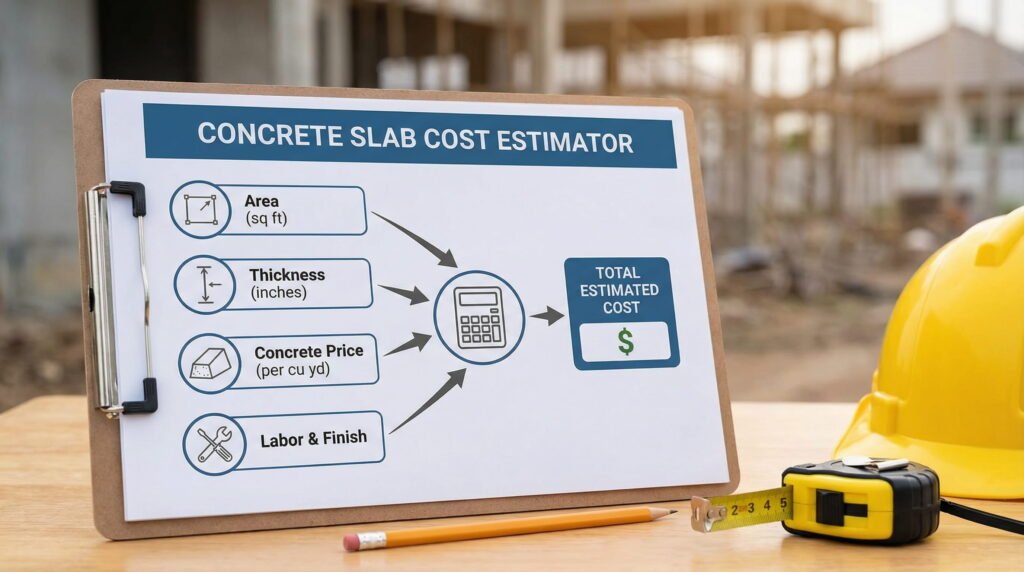
1. Calculate volume in cubic feet: Length (ft) × Width (ft) × Thickness (ft) = Cubic feet
2. Convert to cubic yards: Cubic feet ÷ 27 = Cubic yards
3. Add 10% waste factor: Cubic yards × 1.10 = Order quantity
4. Multiply by local concrete price: Yards × $/yard = Material cost
5. Add labor, base prep, and finishing: These vary widely — get at least 2–3 local contractor quotes.
For irregular shapes (L-shaped driveways, curved patios), break the shape into rectangles, calculate each section separately, and add the totals together.
💡 [Internal link opportunity: Link to your main Concrete Yardage Calculator tool here]
Frequently Asked Questions
How much is a yard of concrete?
Ready-mix concrete costs between $120 and $180 per cubic yard in most U.S. markets. Prices are higher on the coasts and in urban areas. Most suppliers charge a short-load fee for orders under 5–7 yards, which can add $75–$150 to small jobs.
What does a 10×10 concrete slab cost?
A 10×10 concrete pad (100 square feet at 4 inches thick) typically costs $400–$800 installed. DIY material costs run $200–$350 depending on whether you use ready-mix bags or order a partial yard of ready-mix.
How do I use a driveway concrete cost calculator?
Enter your driveway’s length, width, and desired thickness (usually 4 or 6 inches). The calculator estimates cubic yards, adjusts for waste, and multiplies by local concrete pricing to give you a material estimate. For a total project cost, add $2–$5 per square foot for labor and any base prep costs specific to your site.
What is the cost of a 30×30 concrete slab 4 inches thick?
A 30×30 slab at 4 inches requires approximately 12 cubic yards of concrete. Fully installed with a gravel base and wire mesh reinforcement, expect to pay $5,500–$7,500 in most U.S. markets. Costs vary based on your region, site prep needs, and finish choices.
How many bags of concrete do I need for a slab?
For small slabs, divide your total cubic footage by 0.6 (for 80-lb bags) or 0.45 (for 60-lb bags). A 10×10 slab at 4 inches needs about 56 bags of 80-lb premix. For anything over about 1 cubic yard (27 cubic feet), ordering ready-mix is usually more cost-effective than buying bags.
Get an Accurate Estimate Before You Pour
Concrete is one of those materials where small measurement errors add up fast. Ordering short means an emergency call mid-pour. Ordering too much means paying for yards you’ll never use — and figuring out where to put the extra.
Our concrete slab cost calculator handles all the math automatically. Enter your dimensions, choose your slab thickness, and get an instant estimate for yardage, bags, and total material cost — with regional pricing built in.
Whether you’re quoting a job for a contractor, planning a weekend DIY pour, or just trying to budget a major home improvement, having accurate numbers upfront puts you in control of the project before the first truck arrives.
Have a question about your specific project? Drop your dimensions in our calculator and see what comes back — or leave a comment below and we’ll help you figure it out.