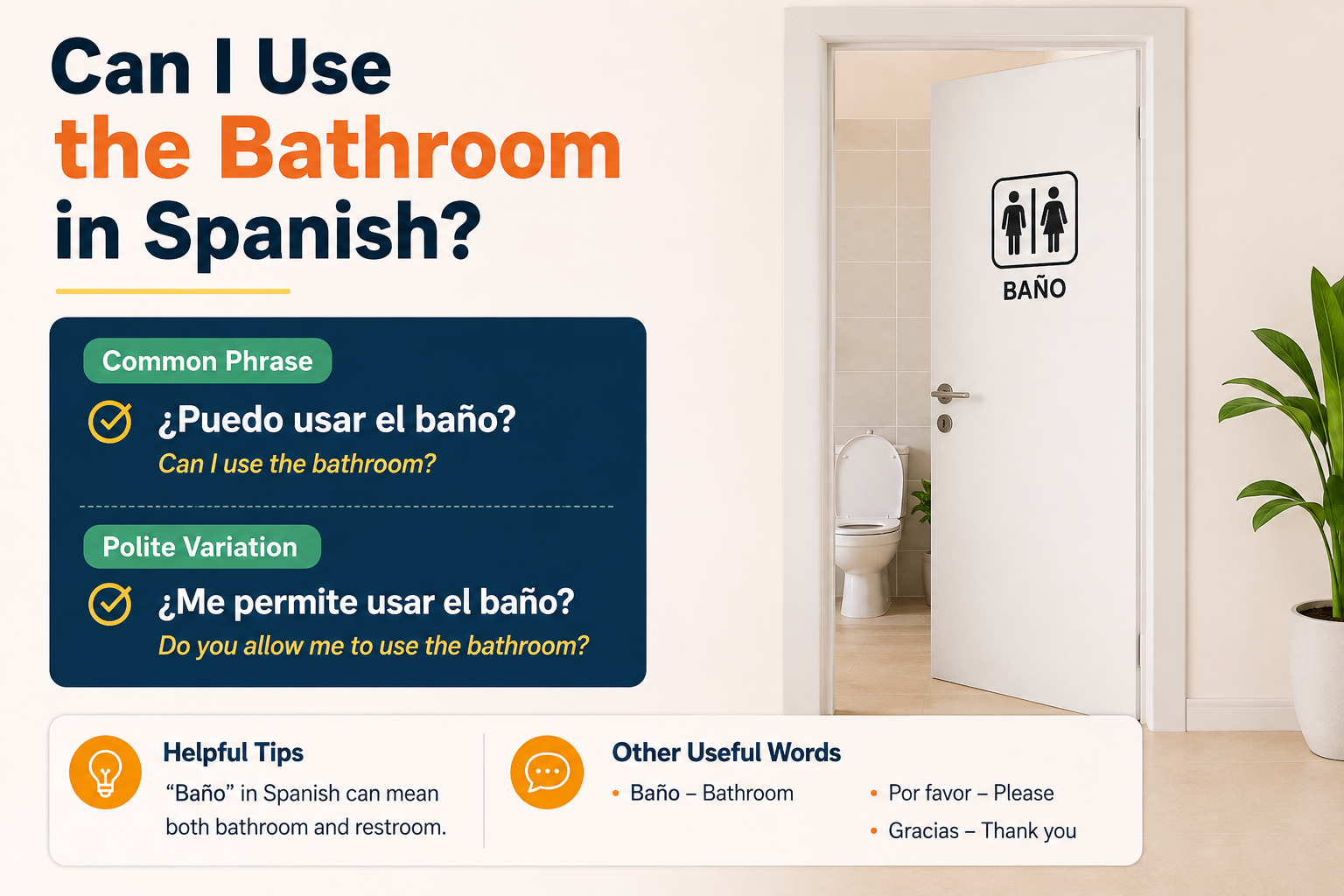
“Can I use the bathroom?” in Spanish is ¿Puedo usar el baño? or ¿Puedo ir al baño? — both mean exactly the same thing and are understood everywhere Spanish is spoken. For a more polite or formal version, say ¿Podría usar el baño?
That covers the basics, but which phrase you reach for depends on who you’re asking — a friend, a teacher, or a stranger at a restaurant all call for slightly different wording. Here’s every version you’re likely to need, plus the vocabulary and real-world examples to go with them.
Every Way to Say “Can I Use the Bathroom” in Spanish
Casual and everyday
If you’re talking to a friend, a family member, or anyone you’d address informally, these are your go-to phrases:
- ¿Puedo ir al baño? — Can I go to the bathroom?
- ¿Puedo usar el baño? — Can I use the bathroom?
Both are interchangeable. Ir al baño leans slightly more common in everyday speech, but a native speaker won’t blink at either one.
Polite and formal
Talking to someone you don’t know well — a teacher, a shop employee, an older relative, or anyone you’d address as usted — swap puedo for podría:
- ¿Podría usar el baño? — Could I use the bathroom?
- Disculpe, ¿podría usar el baño? — Excuse me, could I use the bathroom?
Leading with disculpe (“excuse me”) is a small touch that makes the request noticeably more polite, especially with strangers.
Asking to use someone’s bathroom
Specify whose bathroom you mean by adding a possessive:
- ¿Puedo usar tu baño? — Can I use your bathroom? (informal — tú)
- ¿Puedo usar su baño? — Can I use your bathroom? (formal — usted)
Stating you need to go (not asking permission)
Sometimes you’re not asking — you’re announcing. These work when you need to excuse yourself or explain urgency:
- Necesito ir al baño. — I need to go to the bathroom.
- Tengo que ir al baño. — I have to go to the bathroom.
- Necesito usar el baño urgentemente. — I urgently need to use the bathroom.
Puedo vs. Podría — Which One Should You Actually Use?
Both words come from poder (“to be able to”), but podría is the conditional form, and conditional phrasing softens a request the same way “could I” sounds gentler than “can I” in English.
A simple rule of thumb:
| Talking to… | Use |
|---|---|
| A friend, sibling, or close family member | Puedo |
| Your own kids or people younger than you | Puedo |
| A teacher, a host, a stranger, waitstaff, or anyone older/unfamiliar | Podría |
| Anyone, when you want to sound extra polite | Podría + disculpe |
Neither one is ever “wrong” — puedo isn’t rude — but podría is the safer default any time you’re unsure how formal to be.
“Where Is the Bathroom?” in Spanish
Once you’ve got permission (or just need to find one), here’s how to ask its location:
- ¿Dónde está el baño? — Where is the bathroom? (the standard, all-purpose version)
- ¿Dónde están los baños? — Where are the bathrooms? (for public restrooms, which are often plural)
- Perdón, ¿dónde está el baño? — Excuse me, where is the bathroom?
Adding perdón or disculpe before either question is common courtesy when you’re asking a stranger rather than someone you already know.
What Does “Baño” Actually Mean?
El baño is the universal, safe-everywhere word for bathroom in Spanish — it’s a masculine noun, so it always pairs with el (and un baño pequeño means “a small bathroom,” not “a small bathroom” with a feminine ending). You’ll rarely go wrong defaulting to it, but you’ll also hear regional alternatives depending on where you are:
| Term | Meaning | Where it’s common |
|---|---|---|
| El baño | Bathroom (general, universal) | Everywhere |
| El servicio | Restroom (public) | Spain, especially in restaurants, airports, train stations |
| El aseo | Restroom (public) | Spain |
| El lavabo | Bathroom / sink | Spain, parts of Latin America |
| El váter | Toilet (the fixture) | Spain |
| El inodoro | Toilet (the fixture) | Most Spanish-speaking countries |
| El sanitario | Restroom (public, more formal) | Latin America |
Is el baño masculine or feminine? Masculine. It takes the article el, and any adjective describing it should be masculine too — for example, el baño está limpio (“the bathroom is clean”), not limpia.
Bathroom Vocabulary You’ll Actually Need
Asking to use the bathroom is often just step one — here’s the vocabulary that comes up right after:
| English | Spanish |
|---|---|
| Toilet paper | El papel higiénico / el papel de baño |
| Sink | El lavabo |
| Shower | La ducha |
| Towel | La toalla |
| Soap | El jabón |
| Toothbrush | El cepillo de dientes |
| Toilet (fixture) | El inodoro |
| Mirror | El espejo |
What Will They Say Back?
Knowing how to ask is only half the exchange — here’s what you’ll likely hear in response:
- Sí, claro. — Yes, of course.
- Por supuesto. — Of course.
- Adelante. — Go ahead.
- Está al fondo a la derecha. — It’s at the back, on the right.
- Lo siento, está ocupado. — Sorry, it’s occupied.
Asking in Real Situations
Seeing the phrase in context makes it stick better than a translation table alone. Here are three common scenarios.
In a Spanish class, asking your teacher:
Student: Profesora, ¿puedo ir al baño? Teacher: Sí, pero vuelve rápido — ya casi termina la clase.
(Teacher, can I go to the bathroom? — Yes, but come back quickly, class is almost over.)
As a guest in someone’s home:
You: Perdón, ¿podría usar tu baño? Host: Claro, está al final del pasillo, a la izquierda.
(Excuse me, could I use your bathroom? — Of course, it’s at the end of the hallway, on the left.)
While traveling, at a restaurant:
You: Disculpe, ¿podría usar el baño? Soy cliente. Waiter: Sí, está al fondo, pasando la barra.
(Excuse me, could I use the restroom? I’m a customer. — Yes, it’s in the back, past the bar.)
FAQ
How do you say “may I use the bathroom” in Spanish?
“May I use the bathroom?” translates to ¿Puedo usar el baño? in most everyday situations, or the more formal ¿Podría usar el baño? when speaking with someone you don’t know well, like a teacher or a shop employee.
Is “puedo” or “podría” more polite?
Podría is the more polite of the two. Puedo is perfectly correct grammar, but podría — the conditional form of poder — softens the request, the same way “could I” sounds gentler than “can I” in English.
What’s the difference between “baño” and “servicio”?
Baño is the all-purpose word for bathroom and works almost anywhere in the Spanish-speaking world. Servicio specifically refers to a public restroom — think airports, restaurants, or train stations — and is heard far more often in Spain than in Latin America.
How do you say “toilet,” “restroom,” or “washroom” in Spanish?
All three are usually translated as el baño in casual speech. For the toilet fixture itself, speakers use el inodoro (most countries) or el váter (Spain). In a formal or public setting, “restroom” is often el servicio or los aseos.
Is “el baño” masculine or feminine?
Masculine — it takes the article el, and any adjective describing it should also be masculine, as in un baño pequeño (“a small bathroom”).