Concrete Slab Calculator: How to Estimate Yards, Bags, and Total Project Costs in 2026
Pouring a concrete slab without doing the math first is one of the most expensive mistakes a homeowner can make. Order too little and the truck leaves before the job is done. Order too much and you’re paying for concrete that ends up in a pile on your lawn.
A good concrete slab calculator removes the guesswork entirely. Whether you’re planning a driveway, a garage floor, a backyard patio, or a simple sidewalk, knowing your numbers before you call a supplier puts you in complete control of the project — and the budget.
This guide covers everything you need: how to calculate cubic yards and bags, what concrete costs in 2026, how to estimate total project cost for common slab types, and answers to the questions homeowners ask most. Let’s get into it.
Why Accurate Concrete Calculations Actually Matter
A cubic yard of ready-mix concrete weighs roughly 4,000 pounds. Once it’s mixed and rolling in the drum, you have a narrow window — typically 90 minutes — to place and finish it. There’s no pausing the pour to make a second order.
Getting your quantities right before the truck shows up isn’t just about saving money. It’s about having a smooth, stress-free pour day. Contractors use a concrete yard calculator on every job for this exact reason. Homeowners should too.
Beyond yardage, understanding how pricing works — material per yard, delivery fees, labor rates — helps you evaluate quotes intelligently and avoid overpaying.
How to Use a Concrete Slab Calculator
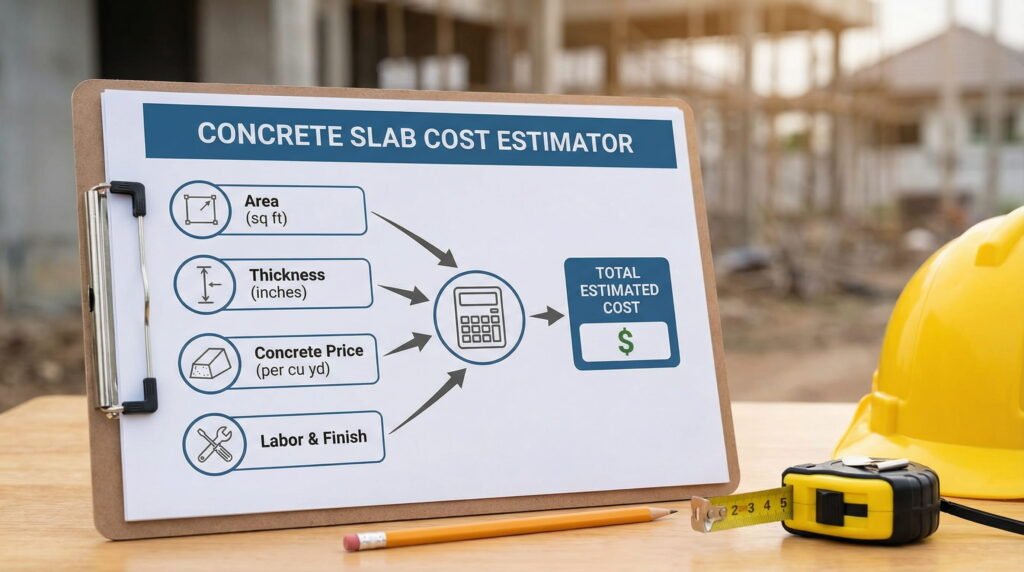
Every concrete calculation starts with the same three inputs: length, width, and thickness. From those three numbers, you can figure out everything else.
The Basic Formula
Convert all measurements to feet first. Thickness is almost always given in inches, so divide by 12.
Volume (cubic feet) = Length × Width × (Thickness ÷ 12)
Then convert to cubic yards (since concrete is sold by the yard):
Cubic yards = Volume ÷ 27
Finally, add a 10% waste and overage buffer — this accounts for uneven subgrade, spillage, and slight miscalculations.
Order quantity = Cubic yards × 1.10
Worked Example: 20×24 Driveway at 4 Inches
20 × 24 × (4 ÷ 12) = 20 × 24 × 0.333 = 160 cubic feet 160 ÷ 27 = 5.93 cubic yards 5.93 × 1.10 = 6.5 yards to order
That’s a number you can call your ready-mix supplier with today.
💡 [Internal link: Link to your Concrete Slab Calculator tool here]
Concrete Yard Calculator: How Many Yards Does Your Project Need?
Here’s a quick reference table for the most common residential slab sizes at 4-inch thickness — the standard for most patios, walkways, and light-duty driveways.
| Project | Dimensions | Cubic Yards (+ 10%) |
|---|---|---|
| Small shed pad | 10×10 ft | 1.4 yds |
| One-car driveway | 12×20 ft | 3.0 yds |
| Two-car driveway | 20×30 ft | 8.1 yds |
| Standard patio | 16×20 ft | 4.4 yds |
| 30×30 garage slab | 30×30 ft | 12.2 yds |
| 4-ft sidewalk (50 ft long) | 4×50 ft | 2.7 yds |
For 6-inch slabs (heavy vehicles, garage floors in cold climates), multiply the 4-inch figure by 1.5. So that 20×30 driveway at 6 inches would need about 12.1 yards instead of 8.1.
Concrete Bag Calculator: When to Buy Bags Instead of Ordering a Truck
For small projects — a fence post base, a mailbox pad, a step repair — bagged premix concrete makes more sense than calling a ready-mix supplier. Most suppliers have a minimum order of 1 cubic yard, and short-load fees make partial truck orders expensive on small jobs.
How Many Bags Do You Need?
Standard bag yields:
- 80-lb bag → approximately 0.60 cubic feet
- 60-lb bag → approximately 0.45 cubic feet
- 40-lb bag → approximately 0.30 cubic feet
Formula:
Total bags = (Cubic feet of slab) ÷ (Yield per bag)
Example: 8×10 shed pad at 4 inches
8 × 10 × 0.333 = 26.7 cubic feet 26.7 ÷ 0.60 = 45 bags of 80-lb mix (add 10% = 50 bags)
At roughly $6–$8 per 80-lb bag in 2026, that’s $300–$400 in material. Compare that to ordering a partial yard of ready-mix (which with short-load fees often runs $250–$350 for just 1 yard), and bags win for jobs under about 1.5 cubic yards.
The crossover point: Once your project exceeds about 1.5–2 cubic yards, ready-mix becomes more economical in both cost and labor. Mixing 80+ bags by hand is genuinely exhausting.
Concrete Price Calculator: What Does Concrete Cost in 2026?
Concrete pricing has three components that most homeowners don’t separate out clearly: material cost per yard, delivery fees, and labor. Understanding each one helps you read quotes accurately.
Cost of Concrete Per Cubic Yard (2026 National Averages)
Ready-mix concrete costs between $130 and $200 per cubic yard in 2026, depending on your region, mix design, and supplier. Most standard residential mixes (3,000–4,000 PSI) fall in the $140–$175 range.
Regional pricing snapshot:
- Northeast / Pacific Coast: $165–$200+/yard
- Southeast / Midwest: $130–$160/yard
- Mountain West / Plains: $140–$170/yard
- Rural areas: Add $20–$40/yard for extended delivery
Delivery and Short-Load Fees
A full concrete truck carries 8–10 cubic yards. For loads under 5–7 yards, most suppliers charge a short-load fee of $75–$200. If you’re right on the edge of that threshold, it sometimes makes sense to add a small amount to your order just to avoid the fee.
Labor Rates for Concrete Installation
This is where the real cost variation lives. Contractor labor for concrete flatwork runs $3–$6 per square foot for a standard broom-finished slab. That includes forming, placing, screeding, and basic finishing. Add-ons that increase labor cost include:
- Wire mesh or rebar: +$0.50–$1.25/sq ft
- Vapor barrier: +$0.20–$0.40/sq ft
- Stamped or exposed aggregate finish: +$4–$10/sq ft
- Colored concrete: +$2–$5/sq ft
Concrete Pad Cost Calculator: Estimates by Project Type
Driveway Concrete Cost Calculator
Driveways are the biggest concrete pour most homeowners take on. Pricing depends heavily on size, thickness, and whether you’re replacing existing concrete (demo adds $1–$2/sq ft).
Standard two-car driveway (20×30 ft, 4-inch pour):
| Line Item | Cost |
|---|---|
| Concrete material (8 yds @ $155) | $1,240 |
| Short-load fee (if applicable) | $0 (full load) |
| Wire mesh reinforcement | $450 |
| Gravel base (4 inches, compacted) | $600 |
| Labor ($4/sq ft × 600 sq ft) | $2,400 |
| Total installed estimate | $4,690 |
For a 6-inch driveway built to handle trucks or heavy equipment, budget $5,800–$7,500 for the same footprint.
💡 [Internal link: Link to your Driveway Concrete Cost Calculator here]
Garage Foundation Cost Calculator
A garage slab is typically poured at 4–6 inches with a thickened perimeter footing (8–12 inches thick at the edges) to support the wall load. This uses more concrete than a simple flat slab and adds some forming complexity.
30×30 garage floor (4-inch field, 10-inch perimeter footing):
Approximate concrete needed: 14–15 yards
| Line Item | Cost |
|---|---|
| Concrete (14.5 yds @ $155) | $2,248 |
| Rebar for thickened edge | $400 |
| Vapor barrier | $180 |
| Gravel base | $800 |
| Labor ($4.50/sq ft × 900 sq ft) | $4,050 |
| Total installed estimate | $7,678 |
Contractor quotes for 30×30 garage slabs in 2026 typically range from $6,500–$10,000 depending on region and finish spec.
Concrete Sidewalk Cost Calculator
Residential sidewalks are usually 4 feet wide at 4-inch thickness. Installed cost runs $8–$15 per linear foot in 2026.
50-linear-foot sidewalk (4 ft wide, 4-inch pour):
Volume: 4 × 50 × 0.333 = 66.6 cu ft ÷ 27 = 2.5 yds (+ 10% = 2.7 yds)
| Line Item | Cost |
|---|---|
| Concrete (2.7 yds @ $155 + short-load fee) | $575 |
| Gravel base | $150 |
| Labor ($3.50/sq ft × 200 sq ft) | $700 |
| Total installed estimate | $1,425 |
Per linear foot: $28.50 — right in the middle of the national range when all costs are combined.
Frequently Asked Questions
How much is a yard of concrete?
In 2026, ready-mix concrete costs between $130 and $200 per cubic yard depending on your region and mix design. Most standard residential mixes land in the $140–$175 range. Add $75–$200 in short-load fees for orders under 5–7 yards, and factor in delivery distance surcharges in rural areas.
How many square feet does 1 yard of concrete cover?
One cubic yard (27 cubic feet) covers different areas depending on slab thickness:
- 4 inches thick: 81 square feet
- 6 inches thick: 54 square feet
- 3 inches thick: 108 square feet
A quick way to remember it: at 4 inches, one yard covers roughly a 9×9-foot area.
How many bags of concrete make a yard?
It takes approximately 45 bags of 80-lb premix concrete to make one cubic yard. That’s 60 bags of 60-lb mix, or 90 bags of 40-lb mix. For reference, hand-mixing 45 bags takes most people 3–5 hours of hard work — another reason to order ready-mix for anything over a yard or two.
What is the cost of a 30×30 concrete slab?
A 30×30 slab (900 square feet) at 4 inches thick costs $5,500–$9,500 installed in most U.S. markets in 2026. The wide range reflects regional labor rates, whether a gravel base and reinforcement are included, and the finish type. Garage slabs with thickened perimeter footings sit at the higher end of that range.
How much is a truckload of concrete?
A full concrete truck holds 8–10 cubic yards. At current pricing, a full load costs $1,100–$1,900 for the material alone, depending on your region and mix. Most contractors order slightly more than they need to avoid short-load fees — so for large projects, designing your slab dimensions to use full truckloads can save you money.
Start With the Numbers, Then Make Your Decision
Every successful concrete project starts the same way: someone does the math. Yardage, bags, delivery fees, labor — none of these are mysteries once you know how to break them down.
Our concrete slab calculator does all of this automatically. Enter your length, width, and thickness, and you’ll instantly see cubic yards, bag counts, material cost estimates, and a total project range — all updated for 2026 pricing.
Whether you’re getting your first contractor quote or planning a full DIY pour, knowing your numbers before any conversation starts puts you in a position of clarity rather than guesswork.
Use the Concrete Slab Calculator →
Have a specific project in mind? Drop the dimensions in the calculator and see exactly what you’re working with — before you pick up the phone.
Estimates in this guide reflect 2026 national averages and typical U.S. contractor rates. Actual costs vary based on your location, site conditions, and project specifications. Always get at least two to three local quotes before committing to a contractor.