
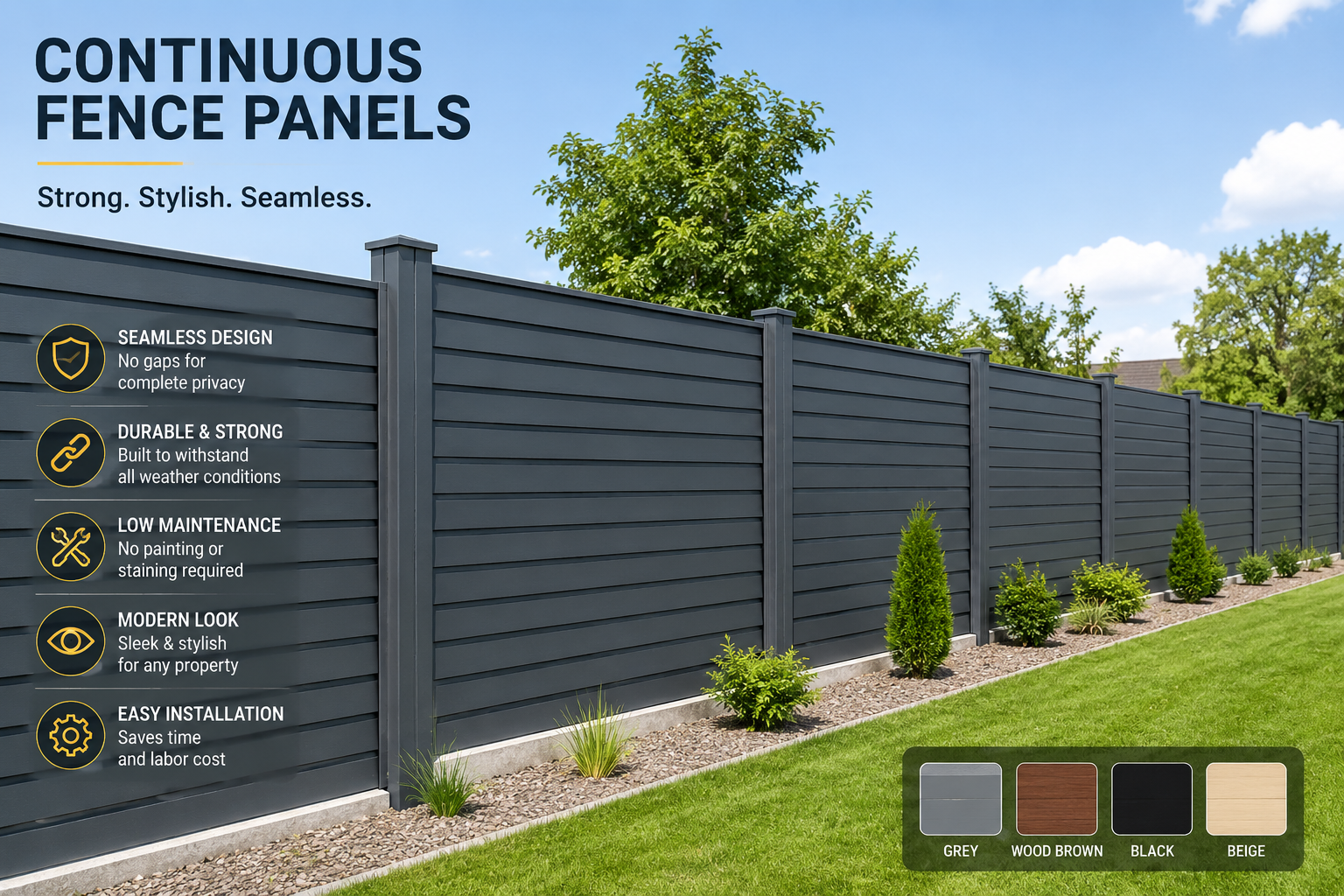
Picking a fence for a pasture, arena, or property line usually comes down to one question: how much time do you want to spend maintaining it later? Continuous fence panels answer that by replacing individual rails and posts with pre-built sections that connect end to end in a straight, uniform line. Here’s what they’re made of, what they cost, and how to put them up yourself.
What Are Continuous Fence Panels?
Continuous fence panels are pre-welded steel fence sections, usually 20 feet long, that connect end to end along posts to form one uniform barrier without individual pickets in between. Each section attaches directly to a post at both ends, so a 200-foot fence line needs about 10 panels instead of dozens of separate rails and pickets.
How They’re Different From Cattle Panels, Cable Fence, and Pipe Fence
Cattle panels are the closest relative, but they’re typically shorter (around 16 feet), built as a welded wire grid rather than horizontal rails, and better suited to hogs, goats, and garden use than large livestock or long fence runs. Cable fence uses tensioned steel strands between posts. It looks clean when it’s new, but the cables stretch over time and need periodic retensioning to stay tight. Pipe fence is the heaviest-duty option: individual pipes welded on site into a custom structure. It’s strong and permanent, but the labor cost is high since nothing arrives pre-built.
Continuous panels sit in between. They’re factory-built like cattle panels, use horizontal rails like pipe fence, and don’t stretch or need retensioning the way cable does.
Types of Continuous Fence Panels
4-Rail vs. 5-Rail vs. 6-Rail (and 3–7 Bar Options)
Rail count doesn’t change the height of the finished fence. Every standard panel ends up around 5 feet tall once installed roughly a foot off the ground. What changes is the spacing between rails.
4-rail panels have the widest gaps and the most open sightline. They’re the lightest option, usually the cheapest, and work well for cattle and horses in open pasture where you don’t need to stop smaller animals from slipping through. 5-rail panels are the middle ground and the most common configuration sold, since the tighter spacing handles mixed livestock without adding much weight or cost over a 4-rail panel. 6-rail panels (and 7-bar panels from some suppliers) close the gaps further. These are the right call for goats, sheep, foals, or any high-pressure spot like an alley or crowding pen where an animal might try to push through or under a wider-spaced rail.
Steel Gauge, Galvanizing & Powder-Coat Finish
Most panels use 14-gauge steel tubing for the horizontal rails, around 1-1/4 inches in diameter, with thinner solid rod verticals spaced along the panel for rigidity. Finish is the other variable worth checking before you buy:
- Galvanized: a zinc coating that resists rust without repainting. This is the standard choice for most climates and the safest default if you’re not sure which finish to pick.
- Powder-coated: a thicker, more scratch-resistant finish, usually found on premium product lines and priced a bit higher.
- Bare or painted steel: the cheapest option up front, but it needs more attention over time since paint chips and bare steel rusts faster than a galvanized coating.
Standard Sizes and Specifications
Panel Length: 20 ft vs. 24 ft
Twenty feet is the length nearly every manufacturer standardizes on, mainly because it’s a length one or two people can lift and position without a tractor or forklift. Twenty-four-foot panels exist and cover more ground per joint, but they’re noticeably heavier per panel and mostly show up on large commercial jobs where fewer connection points matter more than ease of handling.
Panel Height and Rail Spacing
The standard installed height across the market is 5 feet, reached by setting the panel about a foot above grade. Here’s how rail count maps to spacing and use case:
| Rail Count | Rail Spacing | Best For |
|---|---|---|
| 4-Rail | Widest gaps | Cattle, horses, open pasture |
| 5-Rail | Balanced | Mixed livestock, general-purpose fencing |
| 6-Rail | Tighter gaps | Small livestock, high-traffic pens |
| 7-Bar+ | Tightest gaps | Bucking stock, high-pressure containment |
Benefits of Continuous Fence Panels
The biggest advantage shows up over time, not on install day. Wire fencing needs periodic retensioning as it stretches and settles; a welded continuous panel doesn’t stretch, so it won’t sag or need that maintenance cycle. Since each panel is a single rigid piece, the whole fence line holds a straighter, more uniform look than wood or wire ever will, especially once you’re a few years past installation.
Strength is the other factor. A welded steel panel handles the weight of a leaning or pushing animal better than a strand of wire, which is one reason continuous panels are the default choice around cattle. The trade-off is upfront cost: continuous panels typically cost more per linear foot than wire fencing, though the lower long-term maintenance often closes that gap over a few years.
Best Uses for Continuous Fence Panels
Pastures and cross-fencing are the most common application, since the panels hold up to daily animal contact without the year-over-year sagging that wire develops. Riding and roping arenas are another strong fit; the clean, uniform rail line gives spectators and timers an unobstructed sightline that wire or wood rail can’t match. Perimeter and property-line fencing works well too, particularly where you want a finished look along a road frontage.
For containment specifically, cattle and horses are the two animals continuous panels are built around, though the tighter 6-rail and 7-bar configurations extend that to goats and sheep. Some suppliers also sell free-standing versions, meant for portable corrals or temporary pens where you don’t want to set permanent posts at all.
How Much Do Continuous Fence Panels Cost?
Price by Rail Count
Expect to pay somewhere between $125 and $180 for a standard 20-foot panel, with price scaling up alongside rail count and finish quality. As one published example, Seven Peaks Fence and Barn lists 4-rail panels at $129, 5-rail at $153, and 6-rail at $177 per 20-foot section as of 2026. Treat those figures as a ballpark rather than an industry average since pricing shifts with regional steel costs and supplier margins.
| Rail Count | Approx. Price (20-ft Panel) |
|---|---|
| 4-Rail | $125–$135 |
| 5-Rail | $145–$155 |
| 6-Rail | $170–$180 |
That per-panel price is only part of the budget. Posts, concrete for corner and gate posts, gate hardware, and freight all add to the total, and freight tends to be the number people underestimate: steel panels this heavy usually ship by freight carrier on a flatbed rather than standard parcel, which can add a meaningful amount to a large order.
How to Install Continuous Fence Panels
Installing continuous fence panels doesn’t require welding, and one person can do it with the right prep.
Tools You’ll Need
A post hole digger or auger, a level, a tape measure, a string line for keeping the run straight, manufacturer clips or self-drilling screws with a driver, and jack stands or a second set of hands to hold panels upright while you fasten them.
Step-by-Step Installation
- Run a string line along the planned fence path to keep every post aligned.
- Set corner and gate posts first, and sink them deeper (ideally in concrete) since they carry the tension of the whole line.
- Set line posts at 20-foot intervals to match your panel length.
- Stand the first panel against its posts, using jack stands to hold it level while you work.
- Attach the panel to each post with the clips or screws the manufacturer provides.
- Move to the next panel and repeat, checking the string line as you go.
- Cap the posts once the run is complete.
- Walk the full line to check for square and level before backfilling or setting the final post in concrete.
Do You Need to Weld? (Clips vs. Welding)
No. Most continuous panels install with clips or self-drilling screws, which is standard practice and holds up fine under normal pressure. Welding is an option if you want a permanent connection and already have the equipment, but it adds labor most DIY installs don’t need, and it makes swapping out a damaged panel later much harder.
How Many Continuous Fence Panels Do You Need?
The math is simple for a straight run: divide your total linear footage by 20 (the standard panel length) and round up. A 200-foot fence line needs 10 panels. Add extra panels for any corners the line turns through, and plan for a gate frame instead of a panel wherever you need an opening, since gates are sized and sold separately from standard panels.
That hand calculation works fine for a short, straight stretch. It gets tedious fast once you’re factoring in corners, gates, and uneven ground on a longer run, which is exactly the kind of math a dedicated calculator handles faster and with fewer mistakes: enter total footage and rail count, and get back panel count, post count, and a rough cost estimate in one step.
Frequently Asked Questions
What are continuous fence panels? Pre-welded steel fence sections, typically 20 feet long, that connect end to end along posts to form a continuous barrier without traditional in-between pickets. They’re most common in agricultural fencing but also used for perimeter and arena fencing.
How long is a standard continuous fence panel? Twenty feet is the industry standard. Some suppliers offer 24-foot panels for large commercial runs, but they’re heavier and harder for one or two people to handle without equipment.
How many rails does a continuous fence panel need? Most panels come in 4-rail, 5-rail, or 6-rail configurations, and some suppliers go up to 7-bar. More rails means tighter spacing between rails, not a taller fence, since the finished height stays around 5 feet regardless of rail count.
How much do continuous fence panels cost? A standard 20-foot panel typically runs $125 to $180 depending on rail count and finish, not counting posts, gates, or freight. Heavy steel panels usually ship by freight carrier rather than standard parcel, which can add significantly to the total.
Do you need to weld continuous fence panels? No. Most panels install with manufacturer-supplied clips or self-drilling screws, and one person can put them up with a string line and jack stands. Welding is an option for a permanent connection but isn’t required.
How far apart should posts be for continuous fence panels? Since each panel spans 20 feet on its own, posts generally go at each panel end, roughly every 20 feet along a straight run. Corner and gate posts need to be set deeper, ideally in concrete, since they carry the tension of the whole line.
Are continuous fence panels good for cattle? Yes. Continuous panels are one of the most common fencing choices for cattle, since the rigid rail structure holds up to a large animal leaning or pushing on it better than typical wire strand fencing does.
How many panels do I need for my fence? Divide your total linear footage by 20 (the standard panel length) and round up, then add extra for corners and account separately for any gate openings. A fence panel calculator handles this in one step, and factors in posts and rough cost at the same time.
The Bottom Line
Continuous fence panels trade a bit of upfront cost for a fence that goes up faster and stays straight for years without the sagging and retensioning wire fencing needs. Whether it’s a 4-rail run across open pasture or a 6-rail setup around a high-traffic pen, the panel count and post count come down to simple math once you know your total footage. Run the numbers with a continuous fence panel calculator before you order, so the count matches the job on the first try.
The discussion provides useful context for evaluating market opportunities.
ROI Calculator