
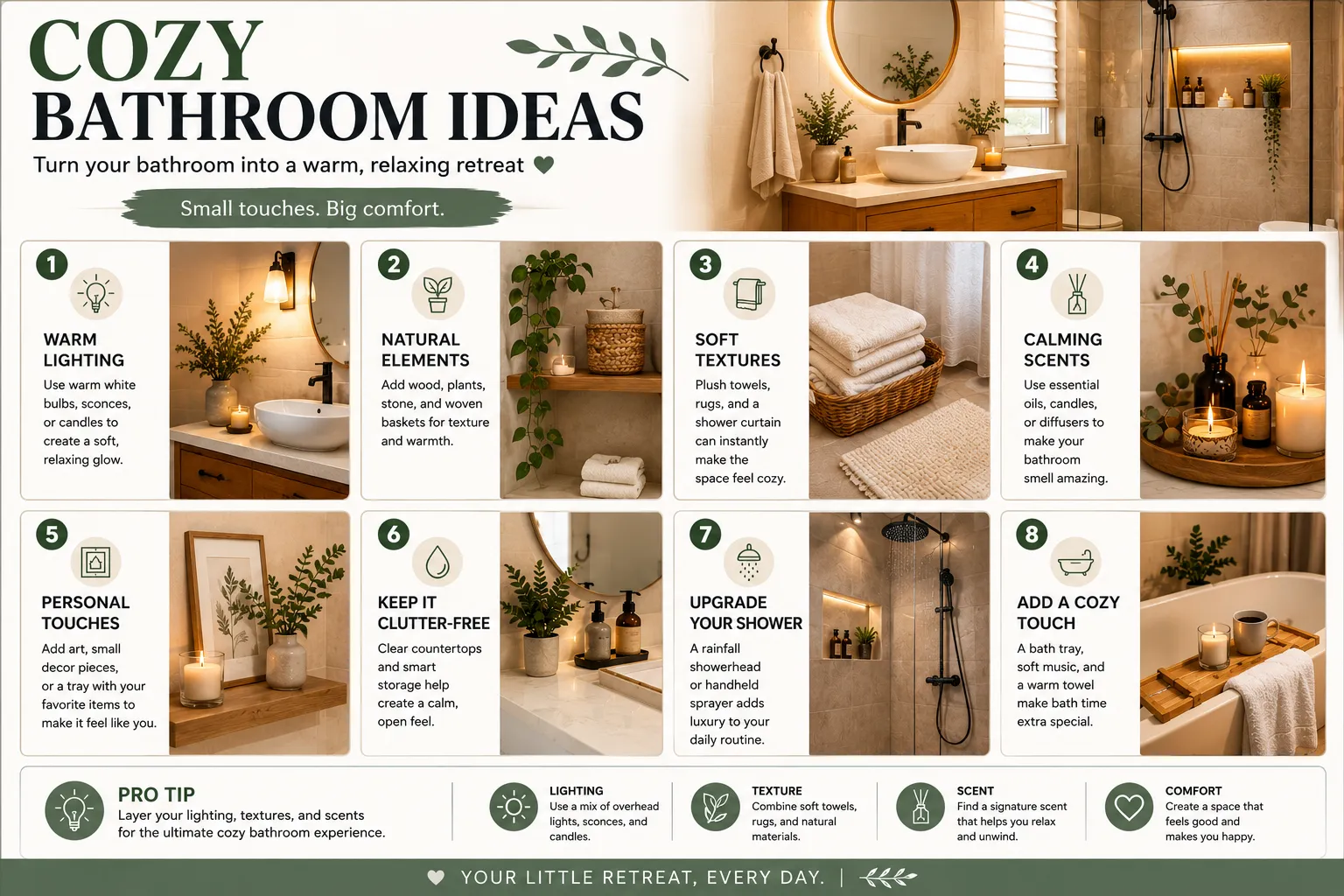
Every “cozy bathroom” list on the internet says the same five things: candles, plants, fluffy towels, warm lighting. None of them tell you what any of it costs, or whether it survives a room that doubles as a daily steam bath. This one does both, split into three budgets: free to $50, $50 to $500, and $500-plus for anyone ready to touch the plumbing.
We built it this way on purpose. Every ranking article on this topic is a flat numbered listicle, 10 ideas, 15 ideas, 30 ideas, in no particular order and with no sense of what any single idea actually costs to pull off. That works fine if you’ve got an unlimited weekend and an unlimited budget. Most people don’t, so the budget tier you’re in should decide where you start reading, not the order some blogger happened to type ideas into a draft.
What Makes a Bathroom Feel Cozy?
Most of that advice isn’t wrong. It’s just incomplete. A single candle next to a bare bulb and a cold tile floor doesn’t do much on its own. Real bathroom coziness, the hygge-for-a-bathroom version, comes from layering four things at once: warm light, soft texture underfoot and on skin, low-effort scent, and a layout that doesn’t feel like a hospital supply closet.
A cozy bathroom combines warm-toned lighting (2700K-3000K bulbs, not the blue-white 5000K kind), soft textiles like plush towels and a bath mat, decluttered counters, and at least one humidity-tolerant plant or diffused scent. None of it requires a remodel. Most of it costs under $50 and takes an afternoon.
If you’re searching “cosy bathroom ideas” instead, same list applies. It’s a spelling difference, not a different room.
Two things get left off most lists entirely: floor temperature and sound. Cold tile at 6am undoes every candle you own in about four seconds, which is exactly why heated flooring shows up later in this guide as the highest-impact remodel-level upgrade. And a bathroom with hard tile everywhere bounces sound in a way that reads as sterile even when the lighting is warm. A thick bath mat and a fabric shower curtain absorb some of that; a fully tiled, rug-free bathroom won’t feel cozy no matter what color the walls are.
Cozy Bathroom Ideas by Budget — Fast-Scan Summary
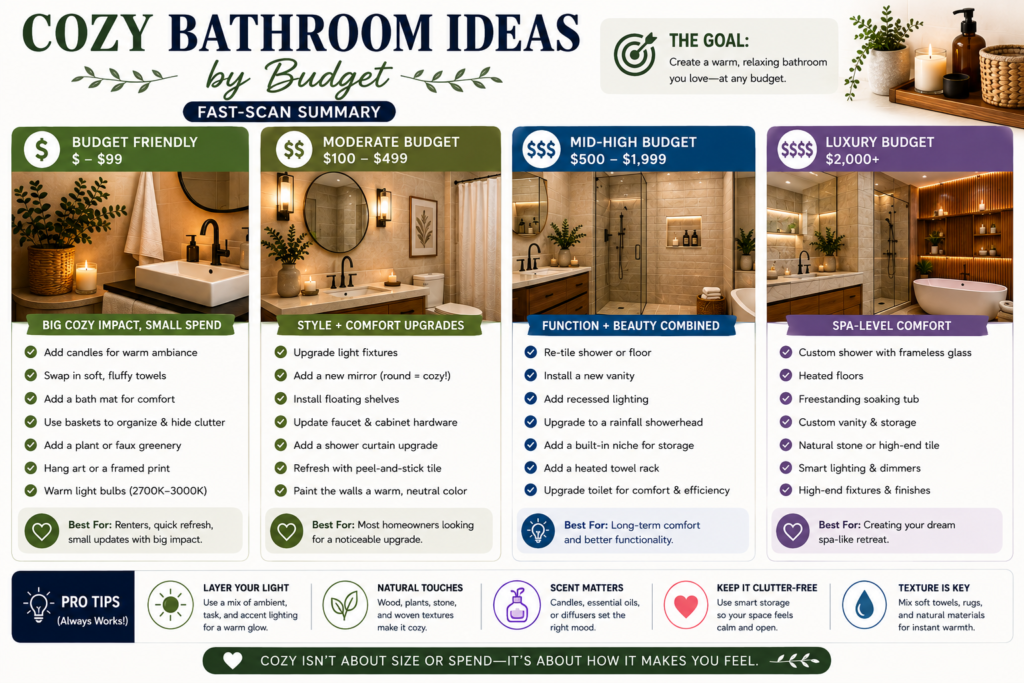
A cozy bathroom setup runs anywhere from $0, using what’s already in the linen closet, to $8,000-plus if you’re pulling in a heated floor or a custom shower. Run your own numbers through the bathroom remodel cost calculator any time you want figures specific to your layout. Here’s how the three tiers break down.
| Budget Tier | What You Get | Typical Cost | Best For |
|---|---|---|---|
| Free to $50 | Textiles, scent, decluttering, lighting swaps | $0 – $50 | Renters, first-time cozy-ers |
| $50 to $500 | Dimmers, warm bulbs, hardware, mirror, curtain | $50 – $500 | Owners wanting a weekend refresh |
| $500+ | Heated flooring, soaking tub, walk-in shower, smart toilet | $500 – $8,000+ | Anyone already planning a remodel |
Jump to whichever tier matches your actual budget this month. There’s no rule that says you have to work through them in order, and most people land somewhere in the middle: a few free swaps now, a mirror and a dimmer next paycheck, the walk-in shower whenever the current one finally fails.
Free to $50: Textiles, Scent, Light, and Decluttering
This is the saturated part of the internet, so we’ll move through it fast.
Swap your towels for something with real weight. Cotton at 600 GSM or higher runs $30-$50 for a two-pack, and hanging them on an open hook beats folding them into a cabinet every time. A bath mat with some pile, not the flat rubber kind, does more for the “feels cozy” factor than almost anything else on this list, and a decent one is $15-$25.
For scent, skip the plug-in air freshener. It just adds more moisture to a room that already has too much. A reed diffuser, an essential oil diffuser, or a beeswax candle ($10-$20) holds up better against bathroom humidity than a spray ever will. Keep any lit candle on a shelf away from the tub edge and the shower curtain, not balanced on the corner of the tub itself. It’s an easy detail to overlook until a curtain brushes against it.
Light is the cheapest fix with the biggest payoff. Cozy bathroom lighting comes down to color temperature more than fixture style. If your fixture takes a standard bulb, swap it for a 2700K warm LED ($3-$8 each). That one change outperforms any candle.
Then declutter. Three bottles on the counter reads as spa-like. Twelve reads as clutter, no matter how nice the bottles are. Move the rest into a woven storage basket under the sink, and add a small folded throw over a stool or hamper if you want texture without buying anything new.
Towel storage matters more than most guides give it credit for. A wall-mounted ladder rack ($20-$40) does two things a closet can’t: it keeps towels visible, so they actually get used instead of hoarded, and rolled towels on a ladder rack read as “boutique hotel” in a way that folded stacks in a cabinet never will. Layer a smaller bath mat inside a larger one at the tub’s edge if you want the same layered-texture look higher-end bathrooms use, without paying for a second full-size mat.
Renter-Safe Cozy Ideas (No Drilling Required)
This matters most in a cozy apartment bathroom, where every fixture belongs to the building and nothing gets touched without a fight over the security deposit.
Tension rods solve most storage and privacy problems that would otherwise need a drill. A second rod over the shower curtain rod holds a second curtain, which blocks drafts and adds texture. A tension rod mounted inside a cabinet doubles shelf space instantly. Command hooks handle towel bars, robe hooks, and small shelves, but check the label: bathroom-rated hooks are built for humidity, and standard ones aren’t.
Peel-and-stick removable wallpaper is the closest thing to a real transformation a renter can pull off. Stick to a small accent area, behind a mirror or on the lower third of one wall, rather than the whole room. Full-room peel-and-stick fights bathroom humidity constantly and tends to lift at the seams within a year.
Battery-powered LED puck lights along a mirror edge or under a cabinet add warm light without touching a single wire. A bath caddy or tub tray adds a spa-like shelf for a book and a candle without a single screw.
If the bathroom window looks straight into a hallway or a neighbor’s window, static-cling privacy film ($15-$30) fixes that without touching the glass permanently. It also softens harsh daylight into something closer to the warm, diffused light the rest of this list is built around, which is a side benefit most renters don’t expect until they’ve already put it up.
What Not to Alter in a Rental
- Don’t paint tile or grout, even with “tile paint.” It chips, and most leases charge you for the repair.
- Don’t drill into tile walls for shelving. Adhesive-mount shelves rated for at least 5 lbs hold more than people expect.
- Photograph the bathroom’s original condition before adding anything, including adhesive hooks. Residue disputes are the most common security-deposit fight.
$50 to $500: Lighting, Fixtures, and Small Swaps
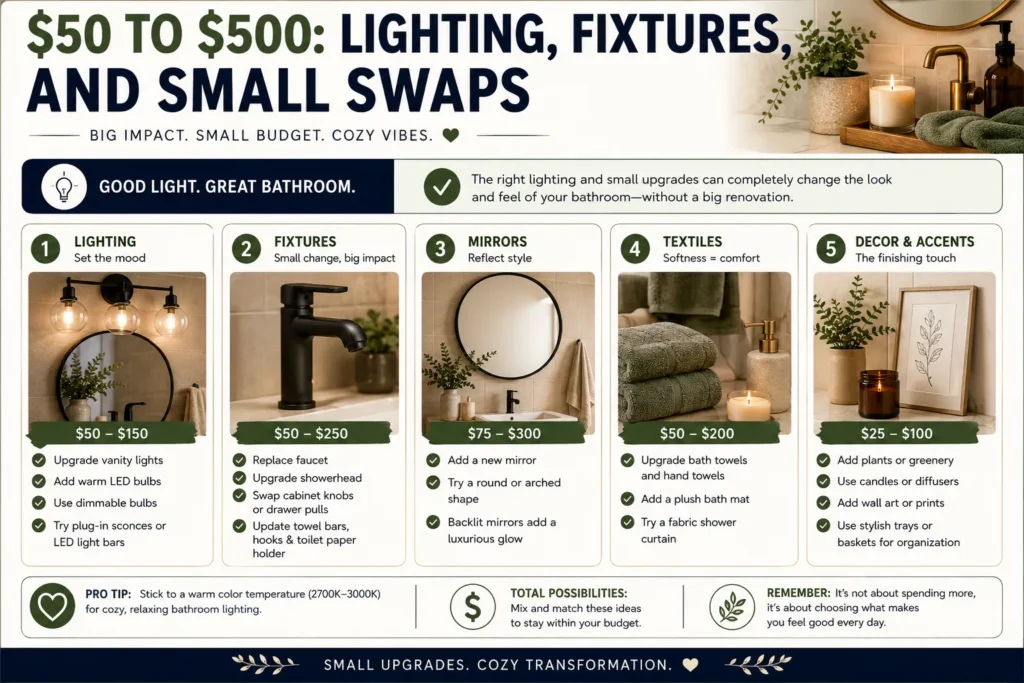
Past $50, the upgrades start changing actual fixtures instead of just accessories.
A dimmer switch is the single best sub-$500 upgrade in this whole guide. The part itself runs $15-$40. If you’re not comfortable with the wiring, an electrician typically charges $100-$200 for the swap. Pair it with warm-toned bulbs and one switch takes a bathroom from clinical to spa-like.
Cabinet hardware is next. Swapping builder-grade chrome knobs for warm brass or matte black pulls runs $50-$150 for a full vanity, and it’s a 20-minute job with a screwdriver.
A framed mirror swap ($100-$300) does more visually than almost anything else here, especially in a small bathroom where the mirror is doing double duty as a light-bounce tool. A heavier shower curtain and liner set ($40-$80) holds up better than thin vinyl and won’t billow when the water’s running, which matters more than it sounds like it should.
If there’s room for one splurge in this tier, make it a rain or waterfall showerhead ($40-$120). It doesn’t change how the room looks. It changes how the room feels to use, which is arguably the actual point of “cozy.”
A plug-in towel warmer rack ($80-$200) is the other contender for that splurge slot. It needs an outlet, not an electrician, so it stays in this tier instead of the next one, and it solves the cold-towel problem the same way heated flooring solves the cold-floor problem, just for less money.
$500+: Remodel-Level Cozy
Past $500, you’re not accessorizing anymore. You’re changing the bones of the room, and that’s where it’s worth pulling real numbers instead of guessing. “Get a heated floor” means something very different at $800 than it does at $3,000.
What Each Upgrade Actually Costs
| Upgrade | Typical Cost | What It Changes |
|---|---|---|
| Heated flooring | $800 – $1,800 | Removes the cold-tile-at-6am problem entirely |
| Freestanding or soaking tub | $1,000 – $5,000 | The single biggest “spa” signal in any bathroom |
| Custom tiled walk-in shower | $3,500 – $8,000 | Replaces a tub/shower combo with an open, warmer-feeling space |
| Smart or bidet toilet | $700 – $2,200 | A heated seat alone changes the daily routine more than people expect |
These numbers assume typical labor rates and mid-range materials. Your actual cost depends on your layout, your local labor rates, and what’s already behind the walls.
Heated flooring and a walk-in shower both usually need a permit and a licensed electrician or plumber in most municipalities, even if you’re doing some of the demo yourself. A freestanding tub is the one item on this table a confident DIYer can sometimes handle solo, since it’s often a drop-in replacement for an existing tub rather than a full re-plumb. Check your local codes before assuming either way.
Run your specific project through the cost calculator before you call a contractor. It breaks the estimate down by scope so you know which of these four is actually driving the total, whether that’s the freestanding tub, the walk-in shower, or the cozy bath upgrade nobody budgeted for.
What “Cozy” Materials Actually Fail in Bathroom Humidity
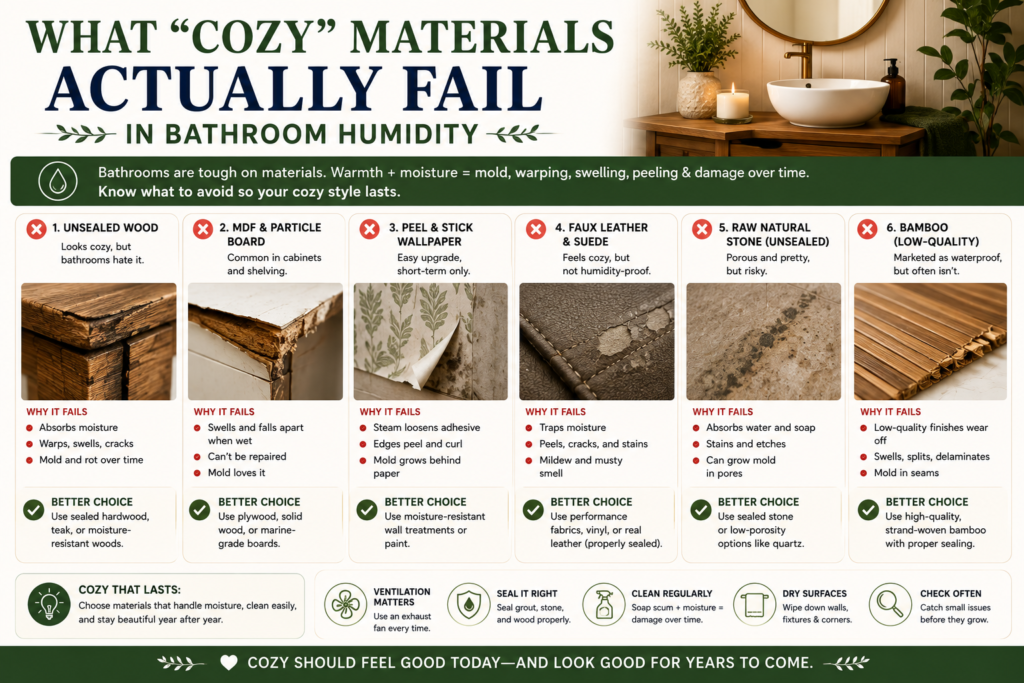
None of the competing “cozy bathroom” articles we checked mention this, and it’s a real gap. Half of what shows up on a cozy-bathroom mood board doesn’t survive an actual bathroom.
Unsealed wood accents are the biggest offender. Open shelving, a wood stool, a live-edge shelf, they all photograph warm and then swell, crack, or grow mold in a working bathroom. The EPA’s guidance on indoor moisture is specific about the window: dry a wet or damp material within 24-48 hours and, in most cases, mold won’t grow. Past that window, it usually does. A bathroom with a shower running daily rarely gets that dry-out unless it’s sealed or well-ventilated, which is also why the EPA recommends running the bathroom fan or cracking a window during showers, and keeping indoor humidity under 60% where possible. If you want the wood look, use marine-grade sealed teak (shower stools and bath mats made from it are built for this exact environment) or fully seal any porous wood with polyurethane, reapplied yearly.
Matte, non-mold-resistant paint is the second offender. It photographs better than eggshell or satin, but standard matte finishes trap moisture in the surface texture, and that’s exactly where mold takes hold first. Mold-resistant paint in a satin or eggshell finish costs a little more upfront and saves a repaint two years later. Our guide to small bathroom paint colors covers which finishes and LRV ranges actually hold up in a working bathroom, including the specific mold-resistant line we recommend.
Not every plant survives, either. Ferns and pothos genuinely like bathroom humidity. Succulents and cacti don’t. They’re built for dry air, and a humid bathroom will rot them from the roots up within weeks.
Fabric shower curtains without a liner mildew fast, usually within a month of daily use. Keep the plastic liner behind the fabric one and wash both monthly if you want the fabric look without the maintenance headache.
Unsealed grout and particleboard vanities round out the list, and they’re both easy to miss because the damage happens where you’re not looking. Grout that hasn’t been resealed in a couple of years absorbs water instead of shedding it, which is how tile floors that look fine start smelling musty. A quick yearly grout sealer application ($15-$25 for enough to cover an average bathroom) heads that off. Particleboard vanity cabinets, the kind under most builder-grade sinks, swell at the base the first time a sink overflows or a plumbing line sweats, so if a vanity swap is anywhere in your plans, solid wood or moisture-resistant MDF is worth the upcharge.
Frequently Asked Questions
How do you make a bathroom feel cozy?
Layer warm-toned lighting (2700K-3000K bulbs or a dimmer), soft textiles like plush towels and a bath mat, a decluttered counter, and a low-maintenance plant or diffused scent. All four together create the effect. Any one alone falls a little flat, which is the most common mistake: buying one nice candle and expecting it to carry the whole room.
How can I make a small bathroom feel cozy?
Small bathrooms fail on clutter and light more than layout, so fix those two first before spending on anything else:
- Use one focal light source at eye level, not just an overhead fixture
- Choose a mirror that reflects light back into the room
- Keep the color palette to two tones, max
- Use vertical storage instead of floor-standing pieces
- Add one plant, not three
How much does it cost to make a bathroom cozy?
Between $0 and $8,000-plus, depending on how far you go. The textile-and-lighting basics run under $50 and take about an afternoon. Fixture swaps land in the $50-$500 range and usually take a weekend. Structural changes like heated flooring or a new tub start around $800, involve a contractor, and can run past $5,000. See the budget breakdown above for the full split.
Can a rental bathroom be cozy without breaking the lease?
Yes. Stick to changes that come off as cleanly as they went on:
- Use tension rods and command hooks instead of drilling
- Add peel-and-stick wallpaper only on a small accent area
- Stick to plug-in or battery-powered lighting, not hardwired fixtures
- Photograph the original condition before adding anything adhesive
What plants survive bathroom humidity?
Pothos, snake plant, Boston fern, and ZZ plant all tolerate or actively prefer bathroom humidity, as long as there’s some indirect light. Succulents and cacti are the wrong choice here. They need dry air and will rot in this environment.
The Bottom Line
Cozy doesn’t have to mean expensive, but it also doesn’t mean a candle and calling it done. Start with the free-to-$50 tier if you’re renting or just testing whether you like the look. Move to the $50-$500 tier for a weekend refresh. And if you’re already planning to touch plumbing or flooring, run your numbers through our remodel calculator first, so you know whether that $800 heated floor is really $800 once labor and your specific layout get factored in.
Skip the materials that photograph well and fail fast: unsealed wood, matte non-mold-resistant paint, fabric curtains without a liner. Everything else on this list is a matter of picking the tier that matches what you’re actually willing to spend this month, not the tier a blogger with an unlimited renovation budget assumed you had.