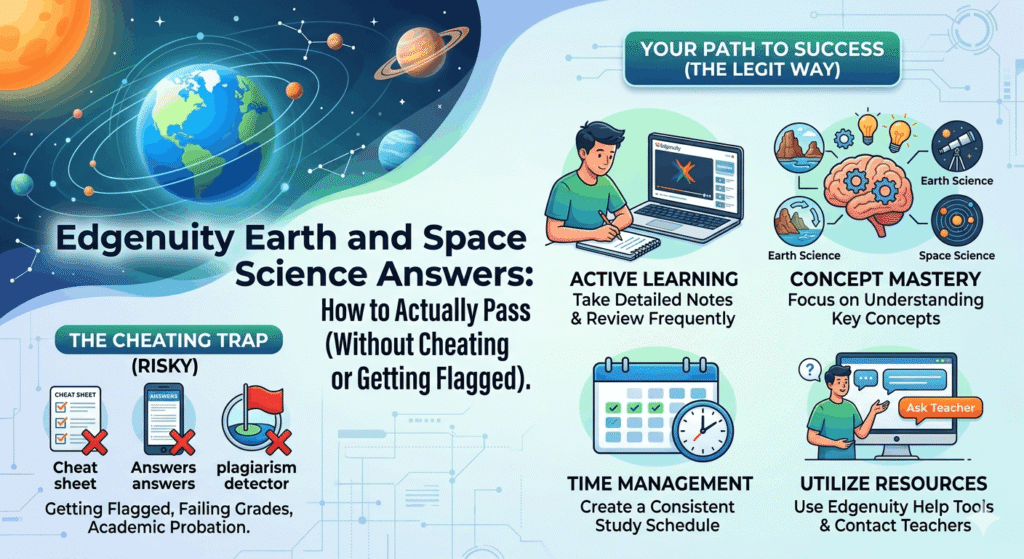
What You’ll Really Find When You Search “Edgenuity Earth and Space Science Answers”
If you’re Googling “edgenuity earth and space science answers,” you’re probably stressed, behind on work, or staring at a cumulative exam you’re not ready for. You might also be tempted to copy answers from a random site or AI tool and hope your teacher never finds out.
This guide explains what’s actually in the Edgenuity Earth & Space Science and Earth Science courses, what cumulative exams look like, how many questions to expect, and smart, safe ways to improve your scores—without getting nailed by academic integrity tools that Edgenuity and your school now actively use.
How Edgenuity Earth & Space Science Really Works
Edgenuity’s Earth and Space Science and Earth Science courses cover the basics of how Earth works and how it fits into space, including Earth’s structure, tectonic plates, rocks and minerals, weather and climate, oceans, and our place in the universe. These courses mix videos, notes, practice, labs or projects, quizzes, unit tests, and a cumulative or final exam.
Key things to know about the course structure:
- Content builds over time. Early lessons introduce core ideas like Earth’s layers, rock cycle, and basic astronomy, and later units connect them to climate, natural hazards, and human impact.
- Assessments are layered. You’ll usually see warm‑ups, assignments, quizzes, unit tests, and finally a cumulative exam or final.
- Labs and projects matter. Some teachers assign optional or teacher‑scored labs that ask you to apply the scientific method, interpret data, or explain real‑world scenarios, not just memorize facts.
If you understand the “story” of the course—how each unit connects to the next—you’ll need “answers” a lot less, because questions start to feel predictable instead of random.
“How Many Questions Are on Edgenuity Cumulative Exams?”
Many students ask this before they even open the review. Different courses and districts can tweak settings, but student reports and third‑party guides give a reasonable ballpark.
- Students commonly report around 50 questions on Edgenuity cumulative or final exams, often in multiple‑choice format.
- Guidance articles note that cumulative assessments can be split into parts (for example, a quiz portion and a test portion), with total time up to around 180 minutes (3 hours) for a full final‑style exam.
- Shorter quizzes typically allow about 60 minutes, unit tests about 120 minutes, and final‑style cumulative exams up to 180 minutes, depending on school settings.
So, if you’re wondering “how many questions are on Edgenuity cumulative exam,” plan for something like 40–60 questions, timed generously but not endlessly.
Why Copying “Edgenuity Answers” Is Riskier in 2026 Than You Think
You might see sites or videos claiming to give you edgenuity earth and space science answers, edgenuity earth science answers, edgenuity answers precalculus, or even answers for edgenuity algebra 2. The big problem: Edgenuity and its parent company Imagine Learning now build academic integrity tools right into the platform.
According to Imagine Learning, tools in their Academic Integrity Bundle can:
- Run a plagiarism checker on your written work and alert teachers when your answer matches online content.
- Use Speed Radar to flag tasks you complete much faster than expected, which can indicate copying answer keys.
- Scan submissions with a Generative AI detector to see if something looks like it was written by an AI tool rather than a student.
- Use secure browser solutions (SecureLock or Proctorio) to block new tabs, scripts, and bots while you’re taking assessments, especially on managed or locked‑down devices.
On top of that, many schools pair Edgenuity with an honor code or academic integrity contract that clearly says cheating—sharing or copying answers, having someone else do your work, or using unauthorized answer sites—can lead to serious penalties.
In the USA, that can mean:
- Getting a zero on the assignment or exam.
- Failing the course or losing credit for the semester.
- Academic discipline that can follow you in school records.
So instead of chasing full answer keys for Edgenuity biology, pre‑calc, or Earth and Space Science, it’s safer and more realistic to focus on understanding how questions are built and how to use the built‑in review tools to boost your scores.
Smarter Ways to Find Help for Edgenuity Earth & Space Science
You don’t need exact answer keys to improve your grades. You need to know where to look in the course and how to use the tools your teacher already gave you.
1. Use “View Course Structure” and Review Tools
Some guides explain how you can open the course structure and see the related quiz or assignment questions for each lesson, especially in review mode. In many districts, teachers also enable cumulative exam reviews or practice tests.
Practical steps (always follow your school’s rules):
- Open the course map or “View Course Structure” to see which lessons feed into a quiz, test, or cumulative exam.
- Re‑watch or skim the lesson videos and notes for those specific topics—Earth’s layers, rock types, plate boundaries, weather patterns, seasons, etc.
- Try any practice activities or review quizzes before attempting the cumulative exam; these often reuse question styles and even similar wording.
This approach works just as well for edgenuity earth science answers, edgenuity biology, or even math courses like edgenuity answers precalculus and edgenuity pre calc answers, because the platform tends to reuse formats and question banks across subjects.
2. Learn the “Big Ideas” That Questions Reuse
Instead of hoping to memorize hundreds of random answers, focus on the concepts that repeatedly show up:
- Earth structure and materials: layers of Earth, types of rocks (igneous, sedimentary, metamorphic), rock cycle.
- Plate tectonics and Earth changes: plate boundaries, earthquakes, volcanoes, mountain building, seafloor spreading.
- Weather and climate: weather vs climate, air masses, fronts, storms, climate zones, greenhouse effect.
- Water and oceans: water cycle, groundwater, watersheds, ocean currents, waves, tides.
- Space science basics: seasons, phases of the Moon, eclipses, solar system structure, galaxies, and the universe.
Once you can explain those topics in your own words, getting a passing or even high score on the cumulative exam becomes realistic—without hidden answer keys.
3. Ask for Teacher‑Approved Supports
In many U.S. schools, teachers are allowed to give:
- Guided notes or reference sheets for tricky units.
- Extra practice sets or retakes for low quiz scores.
- Adjusted pacing if you’re behind or dealing with life issues.
When you email or message your teacher, be honest: explain where you’re struggling in Earth and Space Science or Earth Science and ask for study guides or specific topics to focus on. Most teachers prefer that to catching you using unapproved Edgenuity answers later.
This is also a natural place to link to a separate “Edgenuity Study Tips” or “Online Course Success” guide if your site offers one.
What About Edgenuity Biology, Algebra 2, and Precalculus Answers?
The same principles apply across other popular Edgenuity courses: edgenuity biology, answers for edgenuity algebra 2, edgenuity answers precalculus, and edgenuity pre calc answers.
Here’s how they tend to line up with Earth & Space Science:
Because Edgenuity uses a common assessment framework, the cumulative exam structure and time limits are often similar: a sizable multiple‑choice section, around 50 questions, with a time window that can extend up to about 3 hours for final‑type exams.
If your site has separate subject‑specific study pages (for example, “Complete Guide to Passing Edgenuity Biology”), this is a natural place to link to them internally.
Study Plan to Prepare for an Edgenuity Earth & Space Science Cumulative Exam
The fastest way to raise your grade is to focus the week before your cumulative exam. Here’s a simple plan you can follow in the USA or anywhere Edgenuity is used.
Step 1: Map What’s on the Exam
- Open the course structure and list the units that feed into the cumulative exam—often all major units for the semester or year.
- For each unit, jot down the main topics (for example, “plate tectonics,” “weather and climate,” “space and the solar system”).
Step 2: Target Your Weakest Units
- Check your scores on quizzes and tests. Any unit where your score is low should go to the top of your review list.
- Prioritize topics that show up across multiple lessons, like the rock cycle, seasons, or water cycle, because they’re more likely to appear on cumulative questions.
Step 3: Use Active Review, Not Just Re‑watching
For each high‑priority topic:
- Re‑watch the video at 1.25x or 1.5x speed if you can still follow it.
- Pause and summarize in your own words: “Plate tectonics explains how Earth’s plates move and create earthquakes and volcanoes.”
- Make 3–5 flashcards per topic (digital or on paper) with definitions, diagrams, or example questions.
This same approach works in biology, algebra 2, and pre‑calc—adjusting the content, but keeping the method.
Step 4: Simulate Exam Conditions
- Take any available cumulative review, unit test retakes, or practice exams under timed conditions (for example, set a 60–90 minute timer).
- After each practice, write down:
- Topics you missed or guessed on.
- Question types that confuse you (graphs, diagrams, word problems).
- Go back into those lessons and do a short, focused review.
If your school in the USA uses proctoring or SecureLock/Proctorio, practicing without Google or notes will help you feel less panicked on test day.
Academic Integrity and AI in 2026: What You Should Assume
Because Edgenuity’s parent platform now openly talks about detecting AI‑generated work and suspicious behavior, you should assume:
- Long “perfect” answers copied from an AI or answer site are high‑risk, especially if they don’t match how you usually write.
- Submitting work too fast or jumping straight to correct answers after struggling can trigger Speed Radar flags.
- Using scripts, bots, or unauthorized browser tools on assessments can be blocked or reported by SecureLock or Proctorio features.
Schools are upgrading their policies and tools every year, not just in big districts but across the USA. In practice, that means your best long‑term strategy is to use AI and online resources for understanding and practice, not for direct copying.
If you run an educational site, this is a good section to internally link to a page about “How to Use AI for Studying Without Cheating” or “Academic Integrity in Online Learning.”
FAQ: Edgenuity Earth & Space Science and Answers
1. Can I get a full answer key for Edgenuity Earth and Space Science?
No legitimate source will give you a complete, current answer key for Edgenuity Earth and Space Science, and trying to use one can violate your school’s academic integrity rules. Edgenuity also uses tools like plagiarism checkers, AI detectors, and secure browsers to catch cheating attempts.
2. How many questions are usually on an Edgenuity cumulative exam?
Students often report around 50 questions on Edgenuity cumulative or final exams, usually multiple choice, though exact numbers can vary by course and school settings. Time limits for final‑style exams can reach up to about 180 minutes (3 hours).
3. Are Edgenuity cumulative exams proctored?
Whether an Edgenuity cumulative exam is proctored depends on your district, but many U.S. schools use proctoring or lockdown tools, including secure browsers and network restrictions, to prevent cheating during major assessments. If you’re unsure, ask your teacher how your exam will be monitored.
4. What’s the best way to study for Edgenuity Earth & Space Science?
The best approach is to review the course structure, identify weak units from your quiz and test scores, and actively study key topics like plate tectonics, weather and climate, the water cycle, and basic astronomy. Combine short video re‑watches, written summaries, and practice quizzes or review tests.
5. Does this advice also work for Edgenuity biology, algebra 2, and pre‑calc?
Yes. While the content is different, the Edgenuity platform, assessment structure, and academic integrity tools are similar across biology, algebra 2, precalculus, and Earth and Space Science. Using structured review, practice questions, and teacher‑approved supports is more effective and safer than looking for answer dumps.
Final Thoughts and a Helpful Next Step
Searching for “edgenuity earth and space science answers” is usually a sign you’re overwhelmed, not lazy. The good news is that once you understand how Edgenuity builds its Earth and Space Science and Earth Science courses—and how cumulative exams work—you can raise your grade without depending on risky answer keys.