Introduction
New Berlin sits at an interesting point in its own history. When the city grew rapidly in the 1960s and 70s — its population nearly doubling — developers planted trees everywhere. Maples, oaks, elms, and birches went into the ground alongside new homes and commercial buildings. Fifty to sixty years later, those same trees are mature, heavy, and in many cases showing their age.
Some are healthy and worth keeping. Others have become a genuine hazard — cracked limbs over driveways, root systems lifting sidewalks, trunks hollowed by years of fungal rot. Wisconsin winters don’t make things easier. Ice storms, heavy snow loads, and spring flooding stress trees year after year, and what looks stable in June can come down in December.
This guide walks through everything New Berlin homeowners should know about tree removal and tree service: when removal is actually necessary, how the process works, what other services matter, and how to pick a company you can trust.
Why New Berlin homeowners need professional tree removal
New Berlin’s tree landscape — aging trees and storm risk
The trees planted during New Berlin’s building boom are now 40 to 60 years old. That’s past the natural life expectancy for many city-lot species. Paper birch trees, for example, typically live 80 to 100 years in a forest setting but often only make it 30 to 40 years when planted in residential yards, where soil compaction, road salt, and restricted root space take a toll.
The City of New Berlin’s Forestry Department has tracked this shift and maintains a full street tree inventory across the city — noting species, health status, and ecological value. Many of the trees flagged in that inventory are in the neighborhoods developed between 1960 and 1980, where canopy density is highest and tree age is a growing concern.
Wisconsin’s climate adds to the risk. The state sees heavy ice storms, strong spring thunderstorms, and occasional straight-line winds that can bring down branches or whole trees with little warning. Storm-damaged trees sometimes fall partially, leaving heavy limbs suspended in the canopy — what arborists call “widow makers” — which can drop without notice days or weeks after a storm.
Signs a tree needs to be removed
Not every sick or damaged tree needs to come down. In many cases, treatment, pruning, or cabling can extend a tree’s life significantly — and that’s often cheaper in the long run than removal and replanting. A certified arborist can make that call accurately.
But some signs do point clearly toward removal:
Structural failure. A tree leaning sharply in a new direction after a storm, a trunk split at a major crotch, or a root plate that’s starting to heave out of the ground are all serious warning signs. These trees rarely recover.
Significant decay. Soft wood, hollow sections, mushrooms growing at the base, or large cavities in the trunk indicate advanced fungal decay. Decayed trees can fail suddenly and without the obvious warning signs of a live, healthy tree.
Dead or nearly dead. A tree that leafed out poorly two or three years in a row, or one that failed to leaf out at all, is usually not coming back. Dead trees dry out over time and become brittle, making them more dangerous and harder to remove safely.
Proximity to structures. Even a healthy tree can warrant removal if it overhangs a roof, grows toward power lines, or sits in a spot where a normal failure — a large branch drop, say — would land on a house, garage, or vehicle.
Disease. Emerald ash borer has hit Wisconsin hard, killing ash trees across all 72 counties in the state. Dutch elm disease and oak wilt are also present in Waukesha County. Trees affected by these diseases often can’t be saved, and in some cases removal is necessary to prevent spread to neighboring trees.
Tree removal in New Berlin WI — what the process looks like
Initial assessment and free estimates
Most reputable tree service companies in New Berlin offer free estimates. A crew member or arborist will walk your property, look at the tree or trees in question, assess access for equipment, and give you a price.
Some companies send a certified arborist for the initial visit; others send an experienced crew member. If you have questions about the tree’s health — not just whether it should come down, but why it’s struggling — ask specifically for an arborist. The Wisconsin Arborist Association maintains a searchable directory of certified arborists working in the state, including Waukesha County.
Pricing in the New Berlin area depends on tree size, location, and how much cleanup you want. A small ornamental tree in an open yard costs much less to remove than a 70-foot oak wedged between a house and a fence. Many companies offer hourly rates for removal without cleanup, with full-service cleanup available for an additional charge.
The removal process step by step
The specifics vary depending on the company and the job, but a standard residential removal in New Berlin generally goes like this:
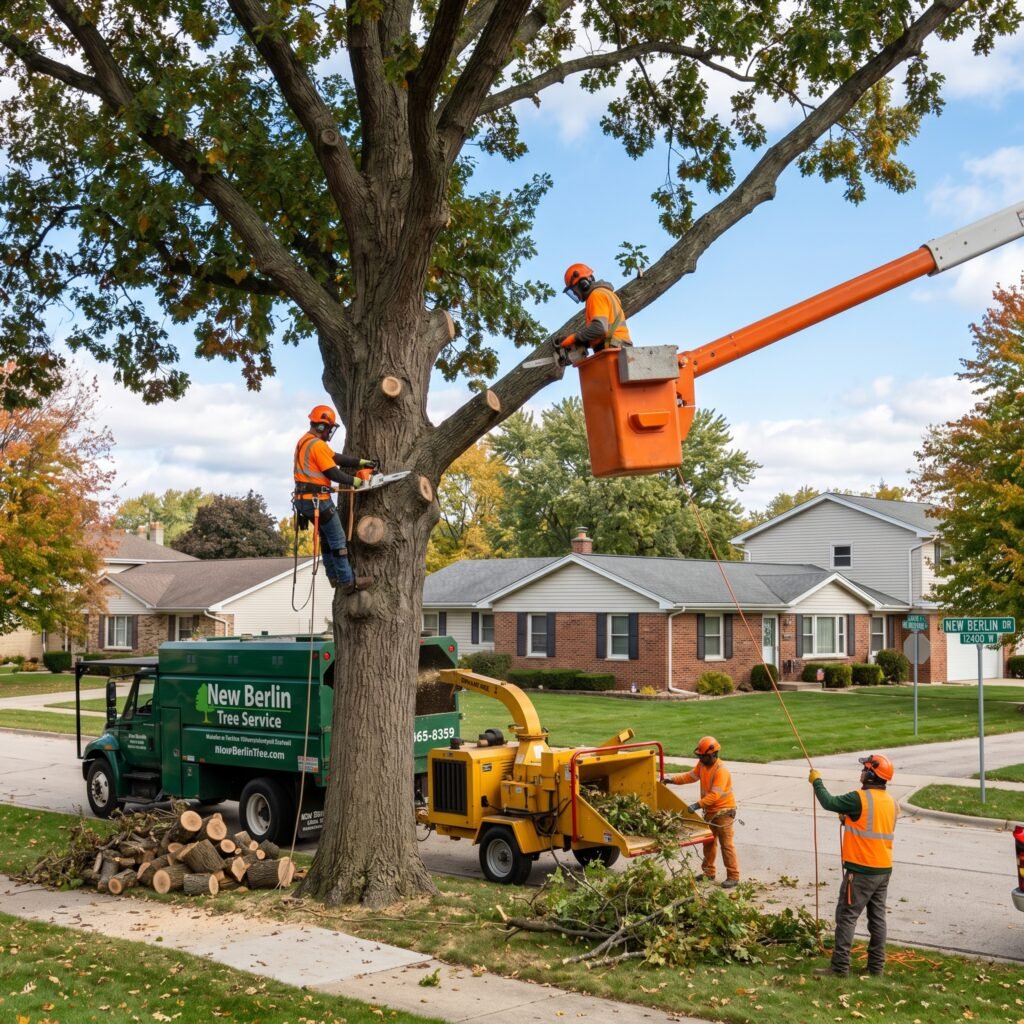
A crew arrives with a chipper, a bucket truck or crane if needed, and hand tools. They assess the site, identify where the tree or sections of it will fall, and set up any necessary rigging. Large trees are usually taken down in sections from the top down, with each section lowered to the ground in a controlled way. Smaller trees may be felled in one piece if there’s room.
Some companies in New Berlin use remote-controlled grapple saws and specialized equipment that allows for faster removal without having a climber in the tree — useful for trees near structures or in tight spaces. CutNGo Trees, for example, operates remote-controlled equipment that lets them work in confined areas while keeping workers and surrounding property safer.
Once the tree is down, wood is chipped or stacked depending on your preference and the company’s policy. Many companies will leave firewood-length pieces if you want them. Full cleanup — hauling all material off the property — is a separate service most offer for an additional fee.
Stump grinding and cleanup options
Most tree removal quotes do not automatically include stump grinding. Once a tree is removed, the stump is typically cut as close to ground level as possible, but the root system remains. You can leave it, or have it ground down.
Stump grinding uses a machine to chip the stump and the top portion of the roots into mulch. The result is a depression filled with wood chips that eventually decomposes. It’s the most common removal method and generally the most practical for residential yards.
If you want the area fully cleared — for replanting grass, laying a patio, or building anything — the stump and root flare need to come out. That’s a bigger job and costs more, but leaves the ground fully workable.
Some New Berlin tree companies handle stump grinding as a separate service. Get that price upfront so it’s not a surprise.
New Berlin tree services beyond just removal
Residential tree planting New Berlin WI
Tree removal gets the most attention, but planting is just as important — and in New Berlin, where so many older trees are reaching the end of their lives, planned replacement matters.
The right tree for a New Berlin yard depends on soil type, sun exposure, proximity to structures, and what you’re looking for: shade, privacy, ornamental interest, wildlife value. Species that do well in southeastern Wisconsin include sugar maple, red oak, serviceberry, white pine, and various native shrubs. The Wisconsin DNR’s urban forestry program offers guidance on species selection for urban and suburban plantings across the state.
A certified arborist can also walk your property and recommend species that will actually thrive in your specific conditions. Planting done well — the right depth, the right soil prep, proper staking if needed, and mulching — dramatically improves a tree’s chances of establishing successfully. A large percentage of trees planted by homeowners die within the first few years due to planting depth issues alone.
Tree trimming, pruning, and health care
Routine pruning extends the life of trees and reduces the risk of storm damage. Dead branches removed before they fall, co-dominant leaders addressed while a tree is young, and water sprouts cleared from the canopy all contribute to a tree that’s both healthier and less likely to fail.
Good pruning follows ISA (International Society of Arboriculture) standards and removes only what’s necessary. Be cautious of companies that recommend heavy topping — cutting back the main branches to stubs. Topping weakens a tree’s structure and creates a long-term liability rather than solving one.
Many tree companies in New Berlin also offer plant health care: soil aeration, fertilization, and treatment for pests and diseases including emerald ash borer and scale insects. For trees that are struggling but potentially saveable, a health care plan is worth asking about before agreeing to removal.
Emergency and storm damage tree service
Storms move through Waukesha County fast and leave damage behind. Most established tree companies in New Berlin offer 24/7 emergency service for situations where a fallen or partially fallen tree poses an immediate risk — on a roof, across a driveway, leaning on a power line.
For power line contacts, call We Energies first. Don’t touch the tree. The utility company handles anything touching their lines; the tree service handles everything else once the line is confirmed safe.
How to choose the right tree service in New Berlin WI
What to look for
Licensing and insurance. This is non-negotiable. A tree company working on your property should carry general liability insurance and workers’ compensation. Ask for a certificate of insurance before work starts. If a worker is injured on your property and the company doesn’t carry workers’ comp, you could be liable.
ISA Certification. An ISA Certified Arborist has passed a standardized exam and is required to maintain continuing education. Not every company employs a certified arborist, but for anything beyond simple removal — health assessments, disease diagnosis, planting recommendations — you want one involved. The ISA’s Trees Are Good site lets you search for credentialed arborists by zip code.
Local reputation. Companies that have been working in New Berlin and Waukesha County for years tend to have verifiable track records. Look at Google reviews, check with the Better Business Bureau of Wisconsin, and ask neighbors who they’ve used.
Clear written estimates. A reputable company gives you a written quote that specifies what’s included, what isn’t, and any conditions. Verbal quotes are harder to hold anyone to.
Questions to ask before hiring
Before signing anything or agreeing to a start date, it’s worth asking:
- Are you licensed and insured? Can you provide a certificate?
- Do you have a certified arborist on staff or available for consultation?
- What does cleanup include — is chipping and hauling in the quote?
- How do you handle stump removal — is that a separate cost?
- What’s your experience with trees in tight spaces or near structures?
- How do you dispose of wood — can I keep the firewood?
A company that answers these questions clearly and without pressure is usually one worth hiring. One that rushes past them or discourages questions is a flag.
FAQ — New Berlin tree removal
How much does tree removal cost in New Berlin WI?
Prices vary significantly based on tree size, location, and how much cleanup you need. Small trees — under 30 feet — typically start around $200 to $400 for removal alone. Medium trees (30–60 feet) commonly run $400 to $900. Large trees or those in difficult locations can run $1,000 and up. Full cleanup adds to that cost. Get at least two or three quotes for any significant job.
Do I need a permit to remove a tree in New Berlin?
For trees on private residential property, New Berlin generally does not require a permit. However, trees in the public right-of-way or on City property are a different matter. Under New Berlin’s tree ordinance (Chapter 185), no person may remove or alter a tree in a public area or City right-of-way without approval from the City Forester and the Department of Community Development. If you’re unsure whether your tree falls under those rules, contact the City of New Berlin Community Development Department before starting any work.
When is the best time for tree removal in Wisconsin?
Tree removal can be done year-round, but late fall and winter are often ideal. With no leaves on deciduous trees, it’s easier to assess the structure and direct the fall. Frozen ground also means less damage to your lawn from equipment. For pruning (not removal), late winter before bud break is generally the best window for most species. One exception: the Wisconsin DNR recommends avoiding pruning oak trees between April and July to reduce the risk of oak wilt transmission by picnic beetles.
Can CutNGo Trees handle emergency removals?
Yes. CutNGo Trees, based in New Berlin, offers 24/7 emergency tree removal service and specializes in removing large and difficult trees — including those other companies decline. Their remote-controlled equipment allows for precise removal in tight spaces, which is useful for trees close to structures or in confined yards.
Final thoughts
Tree removal is one of those jobs that looks manageable until it isn’t. The wrong cut, a shift in weight, a root system that’s undermined more of the ground than it appeared — these are the situations that send people to the hospital every year. Hiring a licensed, insured, experienced tree service in New Berlin isn’t just about convenience. It’s about doing the job safely and protecting your property in the process.
The same goes for the decisions leading up to removal. A good arborist will tell you honestly when a tree can be saved and when it can’t. That honest assessment — even if it means more work for them — is the mark of a company worth calling again.