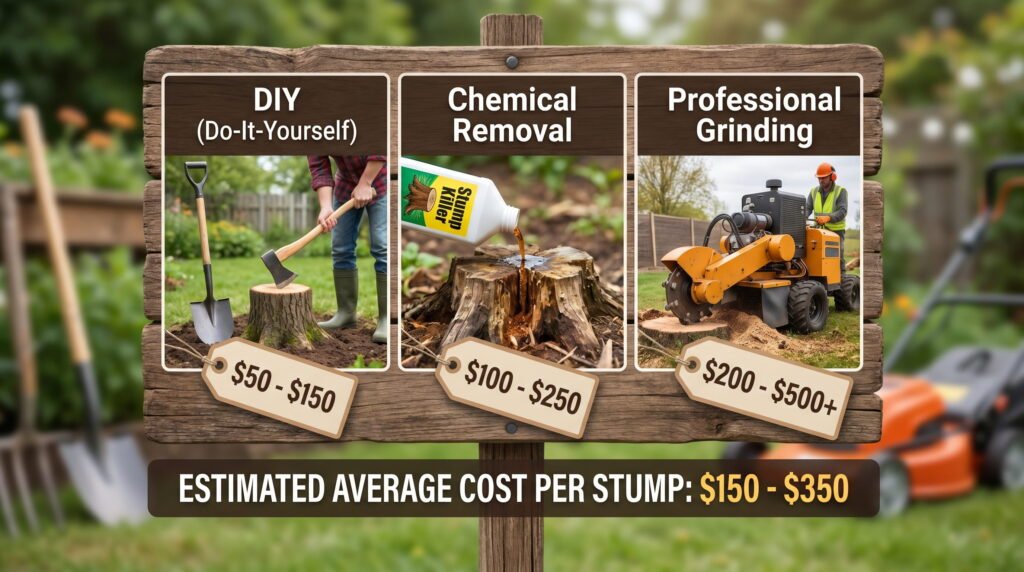
You had the tree taken down. The crew cleaned up. And now there’s that stump — sitting in the middle of your yard, killing grass, tripping guests, and quietly rotting.
Getting rid of it costs money. The frustrating part is that quotes from contractors vary wildly. One pro quotes $150. Another quotes $600. Both are for the same stump. Without a clear framework to estimate costs yourself, it’s almost impossible to know who’s being fair.
This guide works like a tree stump removal cost calculator in article form. By the end, you’ll know exactly how contractors price stump removal, what variables move the number up or down, and how to use that knowledge to get a fair quote — or decide whether to DIY.
How Much Does Tree Stump Removal Cost?
The short answer: most homeowners pay between $195 and $609, with a national average around $330 to $369, depending on who’s doing the estimate.
But that range is nearly useless on its own. The number that actually matters is the price per diameter inch — because that’s how most professionals charge.
According to HomeGuide data, professionals typically price stump removal at $2 to $6 per diameter inch of the stump, with minimum service fees running $80 to $160 to cover equipment transport and setup. A 12-inch stump runs $24–$72 on that formula alone — but the minimum fee kicks in, so you’ll rarely pay less than $100–$150 for a professional visit.
Here’s what that math looks like across common stump sizes:
| Stump Diameter | Estimated Cost Range |
|---|---|
| 6 inches | $45 – $100 |
| 12 inches | $100 – $180 |
| 18 inches | $150 – $280 |
| 24 inches | $200 – $380 |
| 36 inches | $300 – $500 |
| 48 inches | $420 – $700 |
These are baseline grinding estimates. Manual removal, root excavation, and hauling all add to that total.
Stump Grinding vs. Stump Removal: What’s the Difference?
People use “stump grinding” and “stump removal” interchangeably, but they’re different jobs — and that affects cost.
Stump grinding cost
Stump grinding is the most common method. A gasoline-powered grinder shreds the stump down to a few inches below soil level, leaving behind wood chips. It’s quick — usually one to two hours per stump — and it’s the cheapest professional option.
The average stump grinding cost runs $120 to $400 for the first stump, with rates dropping to $30 to $60 per additional stump if you have multiples. Some contractors charge a flat $3 to $5 per inch of diameter instead of a per-stump rate.
One important caveat: grinding does not remove the roots. The root system stays underground and slowly decomposes. For most homeowners, that’s fine. If you’re planting a new tree or building a structure in the same spot, you’ll need full removal.
Full stump removal cost
Manual removal digs out the entire root ball — stump, lateral roots, and taproot. It’s labor-intensive and, according to Angi’s cost guide, runs $200 to $700 per stump on average. Large hardwood stumps with deep root systems can push past that.
Root removal alone (without the stump) costs $100 to $185 per hour, depending on root complexity and proximity to structures or utility lines.
If you need to plant a replacement tree or pour a foundation in that spot, pay for full removal. If you just want the eyesore gone, grinding is the smarter, cheaper call.
What Factors Move the Cost Up or Down?
A tree stump removal cost calculator needs inputs to work. These are the variables contractors use to set their price.
Stump size
Diameter is the biggest driver. A 10-inch stump from a dogwood costs a fraction of what a 48-inch oak stump costs. Measure your stump at the widest point where it meets the ground — not just the flat cut surface at the top.
Tree type and wood density
Hardwood trees — oak, hickory, maple, elm, ash, birch — have dense wood and wide root systems. They take longer to grind and wear down equipment faster. Some contractors charge a premium for hardwoods, though many just bake it into their per-inch rate. Softwoods like pine grind faster and cost less overall.
Stump age and condition
Older, decaying stumps are softer and easier to break down. A fresh-cut stump from a recently removed tree is harder — and will cost more in time and blade wear. If your stump has been sitting for a few years, that actually works in your favor on price.
Soil conditions
Rocky terrain damages grinding equipment. If you’re in an area with heavy rock content in the soil, some contractors add a surcharge. Clay-heavy soil also increases root removal difficulty. LawnStarter notes that regional soil type is often already priced into local rates — so this factor tends to matter more if your specific yard is rockier than the norm for your area.
Accessibility
Can a machine drive straight to the stump? Or does it sit behind a fence, on a slope, or next to a structure that limits equipment movement? Poor access means more manual work, which costs more.
Number of stumps
Having multiple stumps is the clearest way to reduce per-unit cost. HomeAdvisor data shows that removing multiple stumps can drop the per-stump cost from the standard rate down to $40 to $75 each, versus $100–$150+ for a single-stump visit. Book all your stumps in one appointment.
Debris hauling
Most contractors charge extra to haul away chips and debris. Expect to pay an additional $1.50 to $4 per diameter inch for cleanup if you don’t want to manage the wood chips yourself. Alternatively, use the chips as mulch — it’s free organic material.
Average Price for Tree Stump Removal by Method
Here’s a clean comparison of the average price for tree stump removal across methods:
| Method | Cost Range | Best For |
|---|---|---|
| Stump grinding | $120 – $400 per stump | Most residential jobs |
| Manual/excavation removal | $200 – $700 per stump | New construction or replanting |
| Chemical rotting | $100 – $200 | Patience (takes months) |
| Burning | $50 – $200 | Rural areas (check local rules) |
| DIY (renting a grinder) | $75 – $200/day rental | Multiple stumps, physically demanding |
Chemical and burning methods are cheap but slow. Chemical stump removers take months to work. Burning is faster but carries fire risk and isn’t legal everywhere.
Renting a stump grinder runs $75 to $200 per day. That’s worth considering if you have three or more stumps and you’re comfortable operating heavy equipment. One stump? Just hire a pro — the rental cost barely beats what you’d pay a contractor, and the labor is genuinely hard.
How Much Does It Cost to Grind a Tree Stump? A Size-by-Size Breakdown
“How much to grind a stump?” is one of the most common questions homeowners ask, and the honest answer is that size decides most of it.
Here’s a more detailed look at stump grinding rates by diameter based on $3–$5 per inch pricing plus minimum service fees:
- Small stump (under 12 inches): $80–$150. Minimum service fees dominate here — the grind itself takes 20–30 minutes.
- Medium stump (12–24 inches): $150–$300. The sweet spot for most suburban tree removals.
- Large stump (24–36 inches): $250–$500. Expect at least a few hours of grinding.
- Extra-large stump (36+ inches): $400–$800+. Large oaks, elms, and maples with broad base flares can take a full day.
One thing that surprises homeowners: grinding cost scales with surface area, not just diameter. A 30-inch stump doesn’t cost twice as much as a 15-inch stump — it costs roughly four times as much, because the grinding surface grows with the square of the radius. That math explains why contractors rarely discount large stumps proportionally.
What Does a Stump Grinder Service Cost vs. DIY?
A stump grinder service cost from a licensed arborist or tree service typically includes the equipment, operator labor, and a basic cleanup of chips. Most quotes are all-in.
DIY costs look like this:
- Stump grinder rental: $75–$200/day
- Eye protection, gloves, steel-toed boots: $30–$60 if you don’t own them
- Physical labor: significant — plan 2–4 hours per medium stump
The math is closest for homeowners with three or more stumps in accessible areas. For one or two stumps, most people come out even at best and often spend more after factoring in time and effort. This Old House recommends hiring a pro for stumps near structures, utilities, or in rocky terrain — the equipment damage risk alone isn’t worth it.
What Happens If You Leave a Stump?
Skipping removal isn’t a neutral choice. Old stumps attract termites, carpenter ants, and wood-boring beetles. Once pests colonize a stump, they can spread to your deck, fence, or home. Fungi and mold follow — both on the stump and potentially on nearby soil.
Stumps also keep sprouting. Many trees send up new shoots from the root system for years after removal. Without grinding or chemical treatment, you’ll be cutting those sprouts back every season.
And practically: an old stump reduces usable yard space, creates a mowing obstacle, and tends to lower curb appeal. The cost of removal usually pays back in avoided pest treatment, reduced mowing hassle, and cleaner landscaping.
How to Get a Fair Quote
Use these steps before you call a contractor:
- Measure your stump. Tape the diameter at the widest ground-level point. Note whether roots are exposed above the soil.
- Count all stumps. Book everything at once for the best per-unit rate.
- Check access. Note any fences, slopes, or structures that limit machine access — and tell the contractor upfront.
- Ask what’s included. Does the quote cover debris hauling? How deep will they grind? Standard is 4–6 inches below grade; deeper costs more.
- Get three quotes. Prices vary more than you’d expect between contractors in the same zip code. According to Thumbtack data, national averages run $255 to $691 — meaning two pros quoting the same job could legitimately differ by $200 or more.
For construction projects, you’re probably already pricing out materials. The Concrete Price Calculator on ToolCalcPro can help you estimate the cost of filling or paving the area once the stump is out — especially useful if you’re building a patio or driveway over the removal site.
FAQ: Stump Removal Costs
Is stump grinding cheaper than stump removal?
Yes, by a significant margin. Grinding costs $120–$400 per stump on average. Full manual removal runs $200–$700. Grinding doesn’t remove roots, but for most yards it’s the right trade-off between cost and results.
How much do stump grinding rates change for multiple stumps?
Getting multiple stumps done together is one of the best ways to cut the per-unit cost. The first stump carries the minimum service fee ($80–$160). After that, each additional stump typically runs $30–$75 depending on size, compared to the standard per-inch rate. If you have five stumps, book them all at once — the savings are real.
Can I negotiate stump removal cost?
You can, and getting multiple quotes gives you real leverage. Some contractors will match a competing quote. Others will discount if you let them use the wood chips rather than haul them. Avoid contractors who won’t give a written estimate before starting — that’s a red flag regardless of price.
What’s the cheapest way to remove a stump?
Chemical rotting is the cheapest upfront cost ($15–$60 for DIY products), but it takes six months to two years. Grinding is the most cost-effective professional method. Burning is cheap but legally restricted in many areas and carries fire risk.
Final Takeaway
Using a tree stump removal cost calculator approach — measuring your stump diameter, knowing the per-inch rate, and accounting for root complexity and access — gives you a realistic number before you ever pick up the phone. Most homeowners pay $150–$500 for stump grinding. Full root removal pushes that higher, especially for large hardwoods.
The clearest way to save money: book multiple stumps in one appointment, get three written quotes, and ask upfront what debris hauling costs. Those three steps alone can cut your bill by 20–30% compared to booking blind.
If you’re planning to build or pave the cleared area, use the Concrete Price Calculator at ToolCalcPro to estimate your next step before materials prices shift.
Have a stump that got a surprisingly high quote? Drop the details in the comments — stump size, tree type, location — and we’ll help you figure out whether the number is fair.