Most people think they know what they spend each month. They’re usually off by $300 to $500.
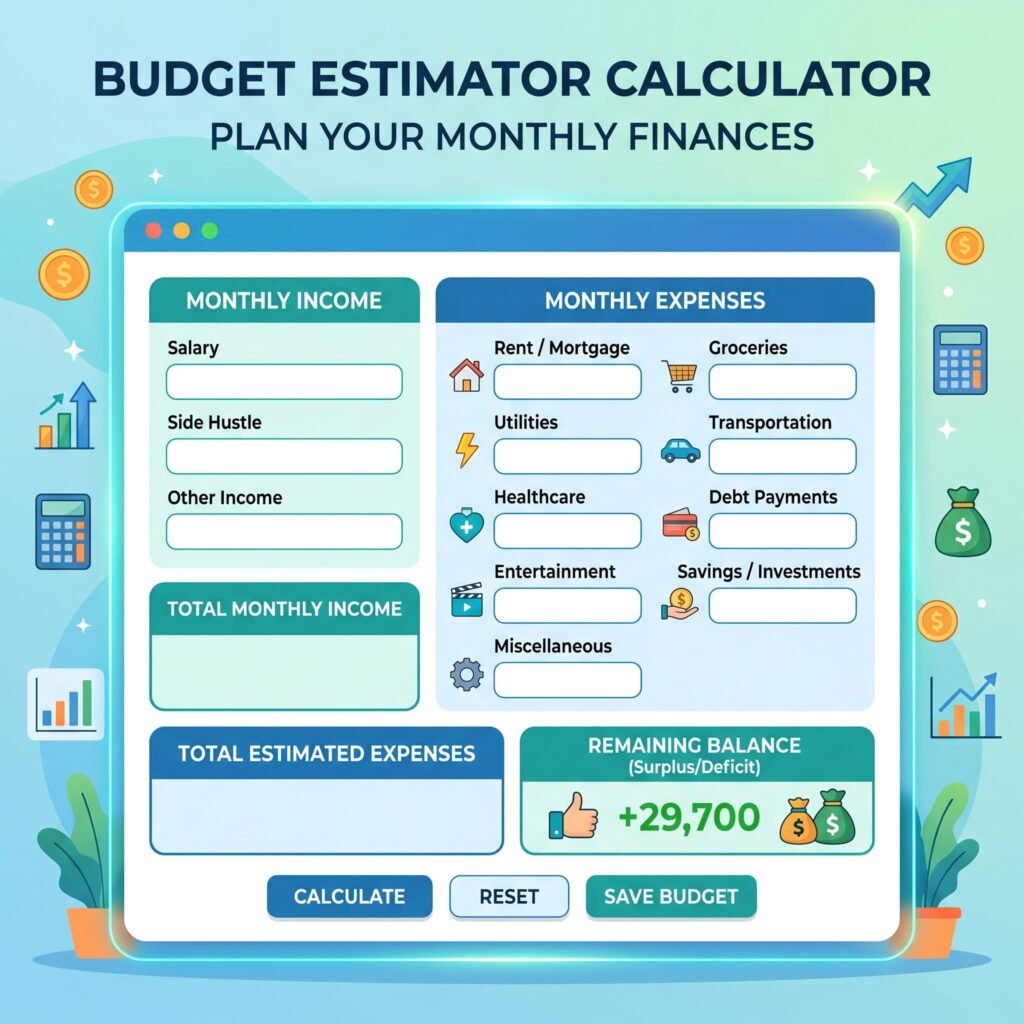
A budget estimator calculator fixes that. It takes your actual take-home pay, maps it across every expense category, and shows you clearly — in numbers — whether your spending plan works or whether you’re quietly heading toward a deficit.
This page covers how a budget estimator works, how to build one from scratch in four steps, what realistic budgets look like at different income levels, and the mistakes that blow up most budgets before the month even ends.
What is a budget estimator calculator?
A budget estimator calculator is a tool that projects how your monthly income should be divided across expenses, savings, and debt repayment. Enter your take-home pay and your spending categories — it tells you whether the plan balances or runs short.
The key difference from a budget tracker: an estimator is forward-looking. You’re building the plan before the month starts. A tracker records what happened after. Both are useful — but most people who struggle financially skip the planning step entirely.
How do you calculate a budget estimate? (4 steps)
Step 1 — Find your real monthly take-home income
After-tax income only. Your gross salary looks great, but it’s not what hits your bank account.
Add every income source: salary, freelance work, side income. If your pay varies, use your lowest recent month as your baseline — not the average. A budget built on a slow month holds up when things are tight. One built on your best month collapses.
Salaried: Divide annual take-home by 12. Hourly: Average weekly hours × hourly rate × 4.33.
Step 2 — List every monthly expense
Pull 3 months of bank and credit card statements. Don’t guess — look.
Split expenses into two groups:
Fixed costs — amounts that don’t change month to month: rent or mortgage, car payment, insurance premiums, loan minimums, subscriptions. You can’t cut these quickly.
Variable costs — amounts you control: groceries, gas, dining, clothing, entertainment, personal care. This is where budget adjustments actually happen.
One category people almost always forget: annual expenses. Car registration, insurance renewals, holiday spending, annual subscriptions. Divide each one by 12 and include it every single month. Skipping these is how budgets fall apart in November.
Step 3 — Apply the 50/30/20 rule
Once income and expenses are on paper, use the 50/30/20 framework as your benchmark.
50% to needs — rent, utilities, groceries, transportation, insurance, minimum debt payments. Anything you’d struggle to live without.
30% to wants — dining out, streaming services, hobbies, travel, gym memberships. Things you choose, not things you owe.
20% to savings and debt — emergency fund, retirement contributions, extra debt payments above the minimum.
These aren’t hard limits. On a lower income, needs often eat more than 50%. On a higher income, you might run wants at 15% and push savings to 35%. Start here, adjust from reality.
Step 4 — Adjust until the numbers balance
Add up all categories. If total expenses exceed income, you have a gap to close. If they come in under, you have surplus to assign.
Closing a gap: Cut variable spending first — it moves faster than fixed costs. Look for forgotten recurring charges. The average person has 3-4 subscriptions they haven’t used in months.
Deploying a surplus: Don’t leave it as floating money. Assign it: emergency fund, extra debt payment, a named savings goal. Unallocated money disappears into small purchases that don’t register until you check your balance.
What should every budget include?
A complete monthly budget covers these categories:
- Housing — rent or mortgage, renter’s insurance, HOA fees
- Transportation — car payment, gas, insurance, parking, public transit
- Food — groceries and dining out (track these separately — restaurant spending surprises people)
- Utilities — electricity, gas, water, internet, phone
- Health — insurance premiums, copays, prescriptions, gym
- Debt payments — minimums on all credit cards, student loans, personal loans
- Savings — emergency fund, retirement (401k/IRA), specific goals
- Personal — clothing, household supplies, haircuts, personal care
- Entertainment — streaming services, apps, hobbies, nights out
- Annual expenses — divide any yearly cost by 12 and include it every month
The categories you leave out are the ones that blow your budget. Annual expenses and irregular costs (car repairs, medical bills, home maintenance) top the list.
Sample budget estimates by income level
Here’s what balanced budgets look like at three common take-home levels, using 50/30/20 as the guide. Your numbers will shift based on location, debt, and household size — use these as a reality check against your own figures.
Budget estimate: $3,000/month take-home
At this income, needs typically push past 50%. Keeping rent under $900 is the priority — that often means a roommate or a lower-cost area.
| Category | Monthly Amount | % of Income |
|---|---|---|
| Rent / housing | $850 | 28% |
| Utilities + internet + phone | $175 | 6% |
| Groceries | $300 | 10% |
| Transportation | $250 | 8% |
| Health insurance + medical | $150 | 5% |
| Needs total | $1,725 | 57% |
| Dining + entertainment | $200 | 7% |
| Subscriptions + personal | $125 | 4% |
| Clothing + misc | $100 | 3% |
| Wants total | $425 | 14% |
| Emergency fund | $200 | 7% |
| Debt repayment (extra) | $350 | 12% |
| Retirement contributions | $150 | 5% |
| Savings/debt total | $700 | 23% |
| Buffer (irregular expenses) | $150 | 5% |
That $150 buffer isn’t extra spending money — it’s your protection against the first unexpected expense that would otherwise derail the whole plan.
Budget estimate: $5,000/month take-home
At $5,000, the 50/30/20 rule starts fitting reasonably well. Housing in major cities still compresses the numbers, but there’s real savings potential here.
| Category | Monthly Amount | % of Income |
|---|---|---|
| Rent / housing | $1,400 | 28% |
| Utilities + internet + phone | $225 | 4.5% |
| Groceries | $400 | 8% |
| Transportation | $350 | 7% |
| Health insurance + medical | $200 | 4% |
| Needs total | $2,575 | 51.5% |
| Dining + entertainment | $350 | 7% |
| Subscriptions + hobbies | $200 | 4% |
| Travel savings | $150 | 3% |
| Clothing + personal | $175 | 3.5% |
| Wants total | $875 | 17.5% |
| Emergency fund | $250 | 5% |
| Retirement (401k/IRA) | $500 | 10% |
| Extra debt payments | $350 | 7% |
| Savings/debt total | $1,100 | 22% |
| Buffer | $450 | 9% |
If you’re at $5,000/month and not seeing a buffer this size, the culprit is almost always rent. Anything over $1,500 at this income level starts crowding out savings.
Budget estimate: $8,000/month take-home
Here the focus shifts from survival to optimization. Maxing retirement contributions becomes realistic, and the question becomes how to allocate the surplus, not whether one exists.
| Category | Monthly Amount | % of Income |
|---|---|---|
| Rent / housing | $2,000 | 25% |
| Utilities + internet + phone | $275 | 3.4% |
| Groceries | $550 | 6.9% |
| Transportation | $500 | 6.3% |
| Health insurance + medical | $300 | 3.75% |
| Needs total | $3,625 | 45% |
| Dining + entertainment | $600 | 7.5% |
| Travel savings | $300 | 3.75% |
| Subscriptions + hobbies | $250 | 3.1% |
| Clothing + personal | $250 | 3.1% |
| Wants total | $1,400 | 17.5% |
| Emergency fund | $300 | 3.75% |
| Retirement (401k max) | $1,000 | 12.5% |
| Brokerage / investing | $500 | 6.25% |
| Extra debt payments | $400 | 5% |
| Savings/investment total | $2,200 | 27.5% |
| Buffer | $775 | 9.7% |
At this level, the buffer acts as both an irregular-expense fund and overflow savings. Any month it doesn’t get spent, move it to an investment account.
5 budgeting mistakes a budget estimator helps you avoid
1. Using gross income instead of net. You can’t spend your pre-tax salary. Always budget from take-home pay — what actually lands in your account.
2. Forgetting annual expenses. Car registration, holiday gifts, back-to-school supplies, quarterly insurance — they only feel surprising because you didn’t plan for them. Divide every annual cost by 12.
3. Treating savings as leftover money. Whatever’s left over usually becomes discretionary spending. Pay savings first — transfer it the day your paycheck arrives, before anything else.
4. Underestimating food costs. Most people track grocery trips and forget restaurants, work lunches, coffee shops, and convenience stores. Food is the most underestimated category in almost every first budget.
5. No buffer for irregular expenses. A zero-balance budget — where every dollar is assigned — collapses on the first car repair or medical bill. Keep 3–5% unallocated as a float.
Frequently asked questions
What is a budget estimator calculator?
A budget estimator calculator divides your monthly take-home pay across expense categories — housing, food, transportation, savings, debt — and shows whether the plan balances. It’s a planning tool, not a recording tool. You use it before the month starts to decide where money goes.
What is the 50/30/20 rule?
The 50/30/20 rule splits after-tax income into three buckets: 50% for needs (rent, groceries, utilities), 30% for wants (dining, entertainment, subscriptions), and 20% for savings and debt repayment. It’s a starting framework — adjust the percentages based on your income level and where you live.
How accurate is a budget estimator?
As accurate as the numbers you put in. Use real bank statement figures from the past 3 months — not guesses — and you’ll get a realistic plan. For irregular expenses like car repairs or medical bills, add a 10% buffer on top of whatever you estimate.
How much of my income should go to rent?
Keep housing at or below 28–30% of take-home pay. On a $5,000/month take-home, that’s $1,400–$1,500. In high-cost cities this is often impossible — if rent runs higher, cut variable spending categories like dining and entertainment to compensate.
What’s the difference between a budget estimator and a budget tracker?
A budget estimator creates the plan — you’re deciding where money will go. A budget tracker records what actually happened. Use an estimator to set targets, then track against them throughout the month. The gap between your estimates and actuals tells you exactly where to adjust.
Can a budget estimator help me pay off debt faster?
Yes. It shows exactly how much income remains after all expenses, which makes clear how much is available for extra debt payments. For fast payoff, redirect the full 20% savings allocation to your highest-interest debt (avalanche method) or your smallest balance (snowball method). Both work — pick the one you’ll stick with.
Start with a number, not a feeling
Budgeting works when it’s built on real figures, not estimates from memory. Pull 3 months of statements, run the numbers through our budget estimator calculator, and you’ll know inside 10 minutes whether your current spending plan is sustainable — or where it’s silently bleeding.
If you want to go deeper on the savings side, the 50/30/20 Rule Calculator lets you model different income scenarios and see exactly how the splits change. For tracking month-to-month after you’ve set your plan, try the Monthly Budget Planner.
Got a number that doesn’t look right or a category you’re not sure how to classify? Drop a question below — we read every one.
Related tools: 50/30/20 Rule Calculator · Budget Planner Calculator · Grocery Budget Calculator · Savings Goal Calculator