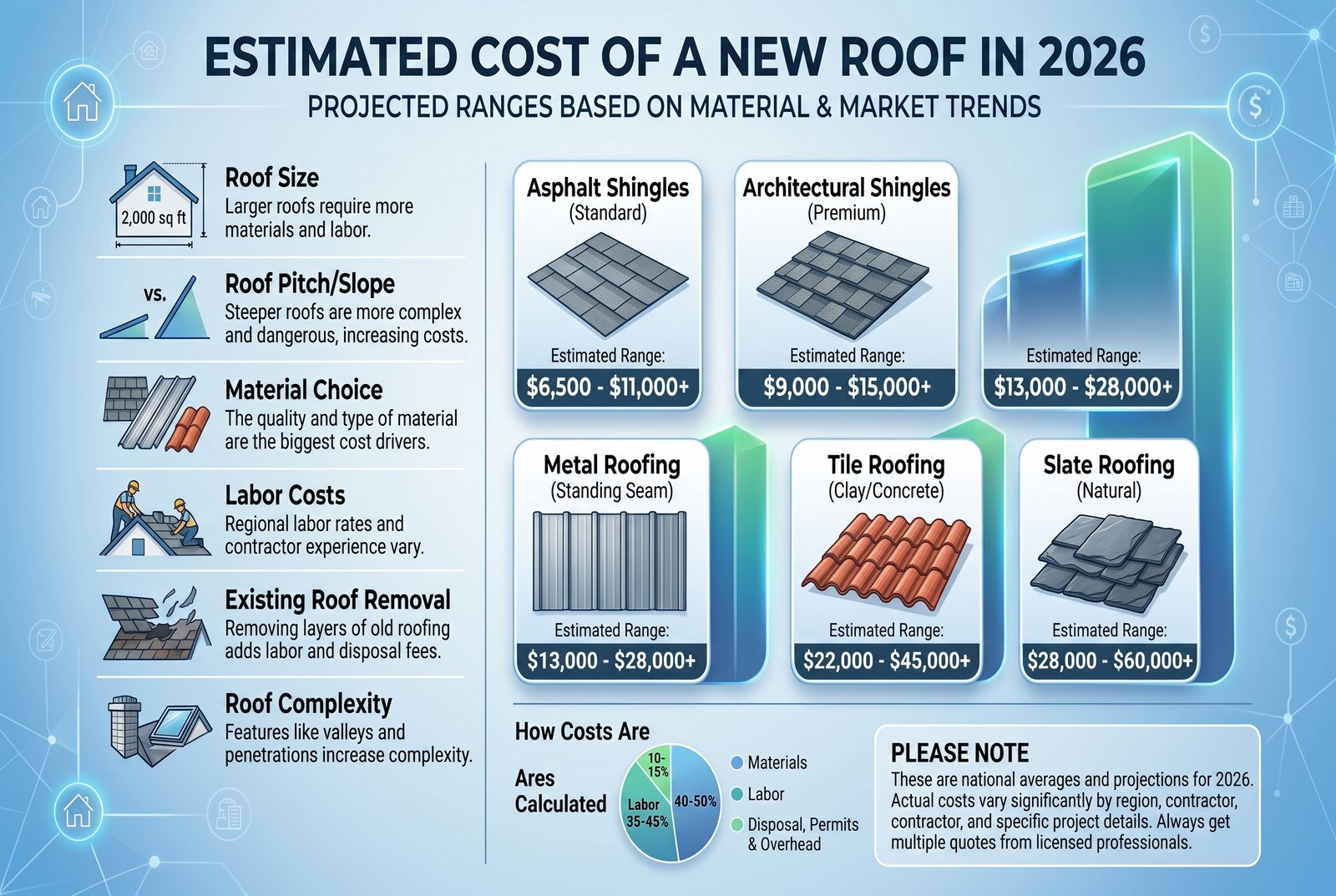
A new roof costs $5,900 to $46,000, with most homeowners landing around $9,600 for a standard asphalt shingle roof. That number comes from Angi’s survey of over 30,000 homeowners, and it moves up or down based mostly on three things: how big your roof is, what material you pick, and how much labor the job takes.
If you’re staring down a leak or a contractor’s quote that seems way too high, you want a real range before you make any calls. Below, you’ll find that range broken down by size and material, plus a calculator that plugs in your own numbers instead of a national average.
One quick distinction worth making up front: most of the pricing you’ll see, including the numbers here, covers roof replacement, which includes tearing off your old roof. A brand-new roof on new construction, with no tear-off involved, usually costs less.
Get your instant roof cost estimate
Enter your roof’s square footage, material, and number of stories below, and you’ll get a personalized estimate instead of a national average.
[CALCULATOR EMBED: Roof Cost Calculator — inputs: square footage, material, stories/pitch]
National averages are a starting point, not your price. A 3,000-square-foot roof in a high-labor-cost city and a 1,200-square-foot roof in a low-cost region can land on opposite ends of the range above.
New roof cost by size
Roofing contractors price jobs by the “square,” which equals 100 square feet of roof area. Here’s what that looks like across common home sizes, based on Angi’s roofing cost data:
| Roof size | Estimated cost |
|---|---|
| 1,000 sq ft | $4,000–$11,000 |
| 1,500 sq ft | $6,000–$16,500 |
| 2,000 sq ft | $8,000–$22,000 |
| 2,500 sq ft | $10,000–$27,500 |
| 3,000 sq ft | $12,000–$33,000 |
How to calculate your roof squares
Your roof isn’t the same size as your home’s floor plan. Because of overhangs and slope, roof area typically runs 1.1 to 1.2 times your home’s square footage.
Here’s what that looks like in practice. The median new single-family home in the US is 2,142 square feet, according to Census Bureau data. Multiply that by 1.15, and you get roughly 2,463 square feet of roof, or about 25 squares.
Grab your home’s square footage from a listing, an appraisal, or your county assessor’s site, then run the same math. Or skip the arithmetic and use the calculator above.
New roof cost by material
Material is usually the biggest lever you control. Here’s the installed cost per square foot for common options, based on NerdWallet’s roofing cost breakdown:
| Material | Cost per sq ft (installed) | Typical lifespan |
|---|---|---|
| Asphalt shingles | $3–$7 | 15–30 years |
| Architectural shingles | $4–$6 | 25–30 years |
| Metal | $7–$13 | 40–70 years |
| Synthetic | $5–$12 | 25–50 years |
| Wood shakes | $6–$13 | 30–50 years |
| Tile | $10–$20 | 50+ years |
| Slate | $15–$30 | 75+ years |
Asphalt shingles cover most US homes for a reason: they’re the cheapest option that still holds up for decades. Metal and tile cost more upfront but stretch that cost over a much longer lifespan, which matters if you plan to stay in the house.
What affects your total cost?
Size and material set the baseline. A few other factors move the number from there.
Labor and installation
Labor typically makes up 40 to 60% of your total bill, according to Bankrate’s roofing cost breakdown. Steep roofs, multiple stories, and complex rooflines with lots of valleys or dormers all add labor hours, and with them, cost.
Run your roof’s numbers through the Roof Pitch Calculator to see exactly how much pitch adds to your job. A professional roof inspection, which most contractors recommend before you commit to a full replacement, runs $125 to $325.
Permits, tear-off, and other add-ons
Beyond the roof itself, budget for:
- Permits: $100–$1,400, depending on your city
- Tear-off and removal of the old roof: $1,000–$3,000
- Hauling and disposal: $500–$1,500
- Deck repair, if rot or damage turns up once the old roof comes off
Who installs your roof matters too. Manufacturers like GAF certify contractors at different tiers, and only the top tier can offer their strongest warranties. A cheaper quote from an uncertified installer can mean a weaker warranty on the same shingles.
Does homeowners insurance cover a new roof?
Sometimes, depending on why you need one. If a covered event like a storm or fallen tree damages your roof, your policy typically pays for repair or replacement, minus your deductible.
What you get paid depends on your coverage type. Replacement Cost Value (RCV) pays what it actually costs to replace your roof today. Actual Cash Value (ACV) subtracts depreciation based on your roof’s age, which can mean a payout thousands of dollars lower on an older roof. Many insurers shift policies from RCV to ACV once a roof passes 15 to 20 years old.
Routine wear and tear isn’t covered by either type. If your roof is failing simply because it’s old, that replacement comes out of your own pocket.
How long does a new roof actually last?
Most new roofs are built for about 20 years of service, according to the National Roofing Contractors Association, though your actual lifespan depends heavily on material and climate.
Asphalt shingles, the most common choice, typically last 15 to 30 years. Metal roofs run 40 to 70 years. Tile and slate can outlast both by decades, sometimes topping 75 years, though they cost significantly more upfront.
Climate shortens all of these ranges. Heavy sun, hail, and freeze-thaw cycles wear down any roofing material faster than the manufacturer’s rating suggests.
Bottom line
A new roof costs $5,900 to $46,000 nationally, but your actual number comes down to three things: roof size, material, and labor in your area. Asphalt keeps costs lowest; metal and tile cost more but last two to three times as long.
Before you get quotes, run your own numbers through the calculator above and check whether your roof qualifies for insurance coverage if damage is what’s driving the replacement.
Have a quote in hand already? Drop the details in the comments and we’ll help you figure out if it’s in line.
Cost figures sourced from Angi, HomeAdvisor, NerdWallet, Bankrate, Insurance.com, the National Roofing Contractors Association, and the U.S. Census Bureau. Last updated August 2026.