Bitumen is a dense, black, highly viscous petroleum-based hydrocarbon used primarily as a binder in road construction and waterproofing. It exists either as natural deposits in oil sands and pitch lakes, or as the heavy residue left behind after crude oil is refined. At room temperature, it behaves somewhere between a thick liquid and a solid — pour it in a container and walk away for a week, and it’ll have moved, barely.
Most people encounter bitumen every day without realizing it. That road surface under your tires? Roughly 90–95% of it is aggregate — crushed stone, sand, gravel — held together by 5–10% bitumen. The flat roof above the car park you just walked through? Bitumen membrane. The airport runway that just took the weight of a fully loaded 777? Bitumen-bound asphalt, specifically formulated for load and heat.
Where Bitumen Comes From
Two sources: nature and oil refineries. The difference matters for quality, cost, and application.
Refined bitumen is far more common. When crude oil gets distilled, lighter fractions — gasoline, diesel, kerosene — boil off first. What remains at the bottom of the vacuum distillation column is bitumen. It gets further processed depending on what grade is needed. About 70% of all bitumen produced globally goes into road construction; the remaining 30% splits across roofing, waterproofing, and industrial uses.
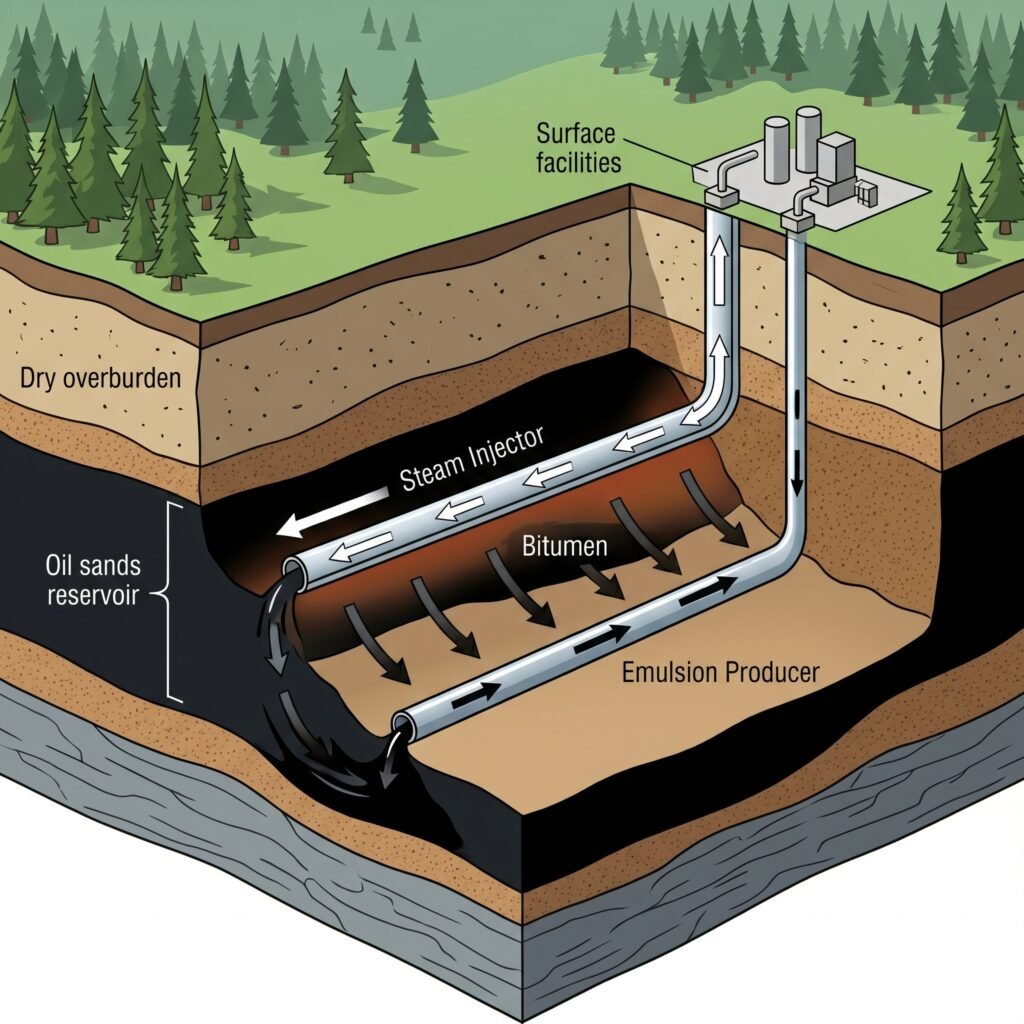
Natural bitumen is the stuff that seeped to the surface over millions of years as ancient organic matter broke down under heat and pressure. The Pitch Lake in Trinidad is the most famous example — roughly 10 million tons of bitumen sitting in a lake you can walk on (carefully). Canada’s Athabasca oil sands in Alberta hold far larger reserves: around 166 billion barrels spread across 142,000 square kilometres. Nearly all of it now goes to refineries, not roads directly.
The chemical makeup across both sources is broadly the same: about 80% carbon, 10% hydrogen, up to 6% sulfur, plus nitrogen, oxygen, and trace metals like vanadium and nickel. The key structural components are asphaltenes — large, heavy molecules that give bitumen its rigidity — and maltenes, the oily fraction that provides flexibility.
Types of Bitumen
There’s no single “bitumen.” There are at least seven distinct types in regular commercial use, each produced differently and suited to specific applications.
Penetration Grade Bitumen
The most widely used type. Classified by how far a standard needle penetrates into the bitumen at 25°C under controlled conditions — measured in tenths of a millimetre. Lower number = harder bitumen.
Common grades: 30/40, 40/50, 60/70, 80/100, 100/120, 160/220.
Grade 60/70 is the workhorse of road paving globally. It handles high-traffic loads across a wide temperature range and cures fast enough to open roads to traffic quickly. Grade 80/100 is softer — preferred in cooler climates where the pavement needs more flexibility to resist thermal cracking. Grade 30/40 sits at the harder end, used in airport runways and industrial-use roads where rutting under sustained load is the primary risk.
Viscosity Grade (VG) Bitumen
Developed in the US in the 1970s as an improvement on penetration grading. Instead of needle depth, VG bitumen is classified by viscosity at 60°C — a more direct measurement of flow behaviour at actual road temperatures. Four grades: VG 10, VG 20, VG 30, VG 40.
VG 30 is roughly equivalent to 60/70 penetration grade. India uses this system almost exclusively for national highway projects.
Performance Grade (PG) Bitumen
The most technically precise system. PG bitumen is graded by the actual temperature extremes it can handle: a PG 64-22 binder performs reliably up to 64°C high pavement temperature and down to -22°C without cracking. The US uses this system for federally funded highway projects under the AASHTO Superpave specification.
The logic is straightforward — match the binder to the climate, not a generic hardness number. PG 58-XX grades suit cold climates; PG 70-XX and above suit hot ones.
Polymer Modified Bitumen (PMB)
Standard bitumen modified with polymers — most commonly SBS (styrene-butadiene-styrene) or EVA (ethylene-vinyl acetate). The polymer network improves elasticity, resistance to rutting in summer, and resistance to thermal cracking in winter. PMB costs more per tonne, but on high-stress surfaces — bus lanes, airport aprons, intersections with heavy turning traffic — it lasts measurably longer and the life-cycle cost works out lower.
Oxidized (Blown) Bitumen
Made by passing hot air through bitumen at elevated temperatures. The oxidation process increases stiffness and raises the softening point, making it less temperature-susceptible than paving grades. It doesn’t flow like road bitumen — which is exactly the point. Oxidized bitumen is used in roofing membranes, pipe coatings, and industrial sealants where dimensional stability under temperature fluctuation matters more than flexibility.
Cutback Bitumen
Penetration-grade bitumen dissolved in a petroleum solvent (kerosene, naphtha, or diesel) to reduce viscosity for cold-mix applications. As the solvent evaporates after application, the bitumen sets. Three curing classes: rapid-curing (naphtha), medium-curing (kerosene), slow-curing (diesel). Largely replaced by emulsions in many markets because the solvents are flammable and VOC-emitting — but still used in cold-weather paving where emulsions can’t be applied.
Bitumen Emulsion
Bitumen droplets suspended in water with an emulsifying agent. Because it’s water-based, it can be applied cold, which makes it useful for surface dressing, slurry seals, tack coats, and waterproofing. Two charge types: cationic (positively charged particles, better adhesion to most aggregates) and anionic (negatively charged, older technology). Emulsions have become the preferred choice for environmentally sensitive projects — lower emissions, no flammable solvents, safe to store.
Key Properties of Bitumen
Understanding what makes bitumen work (and fail) comes down to a handful of physical properties.
Viscosity — Bitumen’s resistance to flow. At ambient temperatures, it’s extremely stiff. Heat it to 150–180°C and it becomes workable. Grade selection is partly about choosing the viscosity range that works at your climate’s highest summer pavement temperature without turning the road surface into a rutted mess.
Adhesion — Bitumen’s ability to coat and bond to aggregate particles. Poor adhesion causes stripping — the aggregate separates from the binder when water gets in. Aggregate type, surface moisture, and bitumen chemistry all affect adhesion. PMB and some additive treatments improve it.
Durability — Bitumen ages. Oxidation over time hardens the asphaltene fraction, making the pavement brittle and prone to cracking. Road surfaces typically have a design life of 15–25 years depending on traffic and climate. Understanding this aging process is why maintenance timing matters — a surface treated early with a preservation treatment extends life far more cost-effectively than waiting for full structural failure.
Softening Point — The temperature at which bitumen softens under a standardized load. Relevant for roofing and industrial applications where the material has to stay dimensionally stable on a hot summer day.
Penetration — Already covered under grading, but worth restating: it’s a quick and cheap proxy for hardness, which is why the penetration grading system has lasted 100+ years despite newer alternatives.
How Bitumen Is Used: Key Applications
Road Construction
The primary use by volume. Globally, around 85% of bitumen consumption goes into asphalt for roads, runways, and car parks. The bitumen acts as the binder — it coats each aggregate particle and holds the mix together through a combination of adhesion and cohesion.
Getting the mix right matters more than most people realize. Too little bitumen and the mix is brittle, cracks early, and lets water in. Too much and the pavement becomes unstable in heat, prone to rutting under wheel loads. Contractors use bitumen quantity calculators to estimate how much binder is required for a given area and mix design — inputting road dimensions, layer thickness, and aggregate type to get accurate tonnage before ordering. It’s one of those unglamorous steps that prevents costly over-ordering or, worse, running short mid-pour.
Waterproofing
The second major application. Flat roofs, basement walls, bridge decks, tunnels, and underground structures all use bitumen-based membranes or coatings. Modified bitumen membranes (SBS or APP-modified) dominate the commercial roofing market — they’re torched or cold-applied in overlapping sheets, creating a continuous waterproof layer.
Industrial Applications
Oxidized bitumen grades appear in pipe coatings, sound-deadening undercoats on vehicles, battery cases, and electrical cable insulation. Gilsonite — a naturally occurring solid bitumen with very high softening point — is used as an additive in oil-well drilling fluids and ink formulations.
Bitumen vs. Asphalt: What’s the Difference?
This confuses people constantly, and the answer depends on where you are.
In the US, “asphalt” and “bitumen” are often used interchangeably to refer to the black binder material. In the rest of the world, the distinction is sharper: bitumen is the binder alone, asphalt (or asphalt concrete) is the finished mixture of bitumen plus aggregate. So when a British engineer says “we’re laying asphalt,” they mean a bitumen-bound mix. When they ask for “bitumen,” they mean the binder itself.
Bitumen is also frequently confused with tar. Coal tar is a byproduct of coal processing — it looks similar and was widely used in road construction through the mid-20th century, but it’s chemically distinct. Coal tar contains high concentrations of polycyclic aromatic hydrocarbons (PAHs), some of which are carcinogenic. Its use in road construction has been phased out in most countries.
Frequently Asked Questions
Is bitumen the same as asphalt?
Not exactly. Bitumen is the binder; asphalt is the finished road material made by mixing bitumen with aggregate. In the US the terms are often used interchangeably, but technically they’re different things.
Is bitumen waterproof?
Yes. Bitumen is virtually insoluble in water and has strong waterproofing properties. This is why it’s used in roofing membranes, basement tanking systems, and bridge deck coatings.
What is the most common grade of bitumen used in roads?
Grade 60/70 penetration bitumen is the most widely used globally for general road paving. Airport runways and heavy industrial roads typically use harder grades like 40/50 or 30/40.
Is bitumen harmful?
At ambient temperatures, bitumen presents no significant health hazard. When heated for paving applications, it produces fumes that can contain polycyclic aromatic hydrocarbons (PAHs) — proper ventilation and respiratory protection are required for workers. Finished road surfaces pose no exposure risk to the public.
How much bitumen is needed per square metre of road?
It depends on the mix design, layer thickness, and aggregate gradation. A standard 50mm wearing course typically uses around 5–6 kg of bitumen per square metre, but the right figure for any specific project should be calculated from the mix specification. A bitumen calculator takes away the guesswork if you have the layer dimensions and mix details to hand.
Bitumen is one of those materials that modern infrastructure quietly depends on without attracting much attention. Every road you’ve driven, every flat roof you’ve sheltered under, every airport you’ve landed at — bitumen made it work. Getting the grade right for the application, the climate, and the traffic loading is the part that separates a road surface that lasts 20 years from one that needs patching in five.