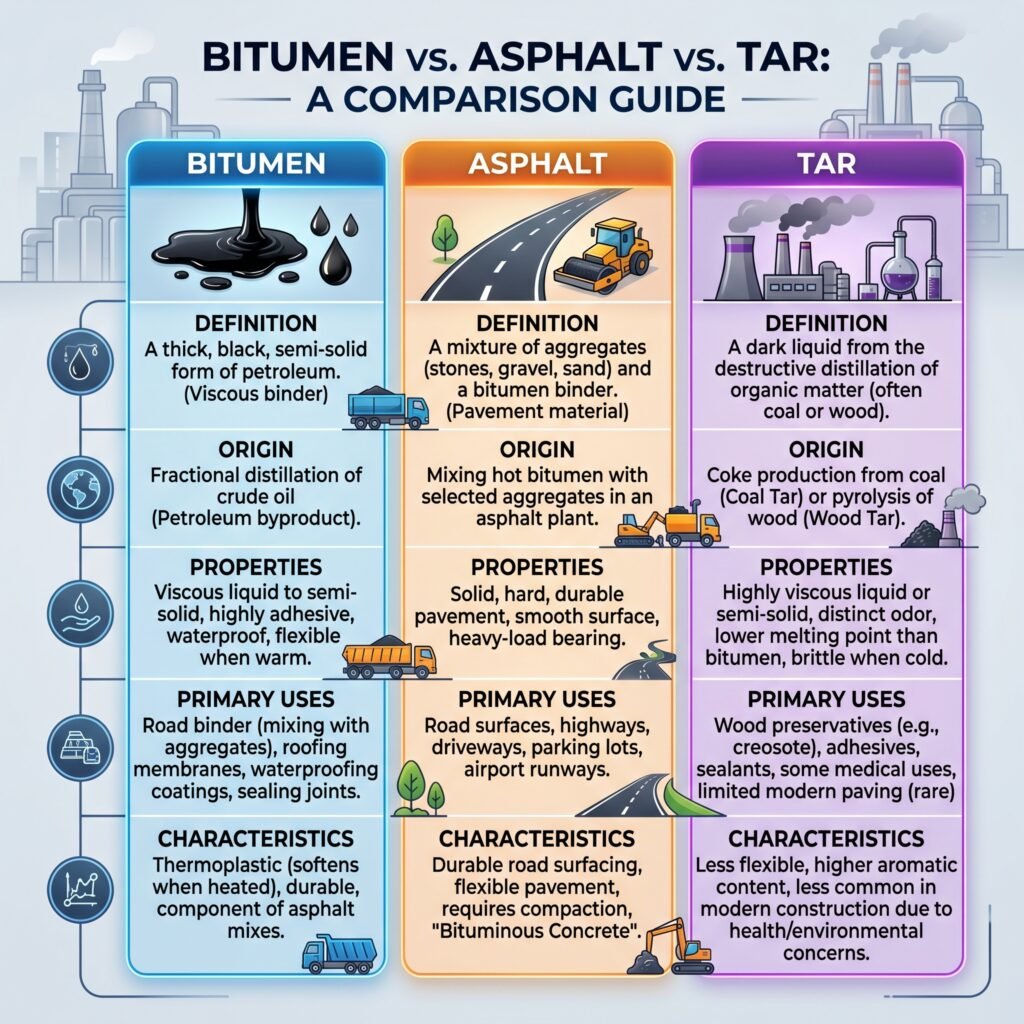
People use the words bitumen, asphalt, and tar as if they were the same thing. They aren’t.
Here’s the short answer in one sentence each:
- Bitumen is a sticky black binder made from crude oil.
- Asphalt is bitumen mixed with crushed stone — the actual road surface.
- Tar comes from coal, not oil, and has been phased out of modern road building because of health risks.
That’s the difference, written for anyone who has ever stood in a hardware store wondering which one they actually need. The rest of this guide breaks down what’s behind each material — where they come from, how they’re made, what they’re used for, and why mixing the terms can cost you money or land you with the wrong product.
Bitumen vs Asphalt vs Tar: Quick Comparison Table
| Property | Bitumen | Asphalt | Tar |
|---|---|---|---|
| Source | Crude oil refining | Bitumen + aggregate mix | Coal (destructive distillation) |
| State at room temp | Semi-solid, sticky | Solid road surface | Thick black liquid |
| Main use | Binder for asphalt, roofing, waterproofing | Roads, driveways, parking lots | Largely obsolete; legacy uses only |
| Density | 1.01–1.05 t/m³ pure | 2.30–2.45 t/m³ compacted | 1.15–1.20 t/m³ |
| Lifespan | 20+ years as binder | 15–25 years (paved surface) | Unstable, poor durability |
| Health rating | Low risk in cooled state | Low risk | Classified as carcinogenic |
| Cost (per ton) | $550–$750 | $100–$200 (delivered hot mix) | Rarely sold for paving today |
| Common in | Modern roads, roofs | Driveways, highways, runways | Historic roads, fence preservatives |
This table alone answers most of the questions readers have. The next sections explain the why behind each row.
What Is Bitumen?
Bitumen is a black, viscous hydrocarbon that’s left over after crude oil is distilled. Refineries pull off petrol, diesel, kerosene, and lighter fuels first. What remains at the bottom of the distillation tower — the heaviest, stickiest residue — is bitumen.
It’s the binder in 99% of paved roads on Earth. By weight, an asphalt road is about 5% bitumen and 95% crushed stone, but without the bitumen the stones wouldn’t stick together at all.
According to the U.S. Energy Information Administration, the world produces over 100 million tonnes of bitumen each year. For a deeper look at where bitumen comes from and how it’s made, see our complete guide on what bitumen is.
What Is Asphalt?
Asphalt is bitumen plus aggregate — the actual material that’s poured, raked, and rolled to make a road surface. The technical name is asphalt concrete or hot-mix asphalt (HMA).
A typical asphalt mix is:
- 5% bitumen (the binder)
- 40–50% coarse aggregate (crushed stone, gravel)
- 35–45% fine aggregate (sand, stone dust)
- 2–5% air voids (intentional, for flexibility)
- Additives (anti-strip agents, polymers in some mixes)
Asphalt is the finished product. Bitumen is one of its ingredients. Saying “they paved the road with bitumen” is technically incorrect — they paved it with asphalt that contained bitumen.
In North America, this distinction gets blurry because the industry sometimes calls bitumen “asphalt cement” or “asphalt binder.” That’s why a UK engineer asking for “bitumen” and a US engineer asking for “asphalt cement” are often asking for the same thing.
What Is Tar?
Tar is a dark, viscous liquid produced by heating coal in the absence of oxygen — a process called destructive distillation. It’s chemically distinct from bitumen, even though it looks similar.
Until the mid-20th century, coal tar was widely used for road surfacing. Today, it’s almost entirely phased out because tar contains polycyclic aromatic hydrocarbons (PAHs), several of which are classified as carcinogens by the International Agency for Research on Cancer (IARC).
Some legacy uses still exist:
- Pharmaceutical coal tar in dandruff shampoos and psoriasis treatments (regulated)
- Wood preservation for railway sleepers and fence posts (declining)
- Industrial coatings for specific corrosion-resistant applications
When someone today says “tar road,” they almost always mean a bitumen road. The word stuck around in everyday language even after the actual material disappeared from construction sites.
Bitumen vs Asphalt: What’s Actually Different
The relationship between bitumen and asphalt is like the relationship between flour and bread. One is an ingredient. The other is the finished product.
When to Use Each Term
- Use bitumen when talking about the binder being delivered in a tanker truck.
- Use asphalt when talking about the surface that’s been laid, rolled, and is ready to drive on.
- Use asphalt cement in a North American technical context when you specifically mean the binder.
Why People Confuse the Two
The confusion is mostly geographic. In the UK, Australia, India, and most of Europe, “bitumen” and “asphalt” mean clearly different things. In the US and Canada, “asphalt” sometimes refers to the binder and the finished surface, with “asphalt cement” used to disambiguate.
Both terms are technically valid in their respective regions. Just know which one you’re using and which one your supplier or contractor is using before money changes hands.
Bitumen vs Tar: Why They’re Not the Same
This is the comparison that matters most for safety. Bitumen and tar look almost identical to the untrained eye, but they’re chemically different and have very different health profiles.
Different Origins
- Bitumen comes from petroleum (crude oil) at temperatures around 350°C in a refinery distillation tower.
- Tar comes from coal at temperatures around 1,000°C in a coke oven or gas works.
Different Chemistry
Bitumen is dominated by saturates, aromatics, resins, and asphaltenes (the SARA fractions). It contains very low levels of polycyclic aromatic hydrocarbons.
Tar is dominated by aromatic compounds including high concentrations of PAHs. Some of these — like benzo[a]pyrene — are well-documented carcinogens.
Different Health Profiles
The IARC classifies occupational exposure to coal tar as Group 1 (carcinogenic to humans). It classifies occupational exposure to oxidised bitumen fumes as Group 2B (possibly carcinogenic). The first classification is much more serious. In practical terms: hot tar fumes are dangerous, hot bitumen fumes warrant respirators but aren’t in the same risk category.
For homeowners walking on a finished asphalt driveway, both materials are essentially inert once cooled. The risk applies to workers handling them hot.
How to Tell Bitumen, Asphalt, and Tar Apart in Real Life
Most people will never need to distinguish them. But if you’re inheriting an old roof or buying a property with a paved drive, here’s a practical guide.
On a road or driveway — almost always asphalt (bitumen + stone). If you can see crushed rock embedded in the surface, it’s asphalt.
On a flat roof — usually modified bitumen membrane, sometimes coal tar pitch on very old buildings. Coal tar pitch roofs are now rare and require specialist removal because of PAH content.
In a tin or bucket — bitumen paint is a thinned, brushable form of bitumen used for waterproofing. It’s labelled as such.
Smell test — coal tar has a sharper, more chemical smell than bitumen. Bitumen smells more like crude oil. This is a rough indicator only, never a definitive test.
If you’re unsure what’s on an old building, don’t disturb it without testing. A lab can confirm whether a material is bitumen or coal tar based product within a few days.
Estimating Asphalt and Bitumen Quantities
Once you know what material you actually need, the next question is how much. Asphalt and bitumen quantities are calculated the same way, using the same formula:
Tonnage = Length × Width × Thickness × Density
For compacted hot-mix asphalt, density is typically 2.36 tonnes per cubic metre. For pure bitumen binder, it’s about 1.03 t/m³.
A 50 mm thick, 100 m² driveway needs:
- 100 × 0.05 × 2.36 = 11.8 tonnes of asphalt
- Of which 5% is bitumen = 0.59 tonnes of binder
You don’t usually buy bitumen and aggregate separately for a residential project — you buy the finished hot mix. But on big road jobs, the binder is often supplied separately and mixed at a plant.
The bitumen calculator on ToolCalcPro handles both cases. Enter your dimensions and density — get tonnage, volume, and cost in seconds.
Frequently Asked Questions
Is asphalt made from bitumen?
Yes. Asphalt is roughly 5% bitumen by weight, plus aggregate (crushed stone, sand, and stone dust). Bitumen is the sticky binder that holds the aggregate together. Without bitumen, an asphalt mix would just be a pile of loose gravel.
Why do people call bitumen “tar”?
It’s a leftover habit from the early 20th century, when actual coal tar was used to surface roads. When tar was replaced with bitumen-based asphalt in the 1950s and 60s, the everyday name stuck around even though the material had changed. “Tar road,” “tar driveway,” and “tarmac” are all common terms that almost always refer to bitumen-based surfaces today.
Is asphalt the same as blacktop?
In American English, “blacktop” is an informal name for asphalt pavement, especially on driveways and parking lots. Technically there’s no difference — blacktop is asphalt. The term is rarely used in technical or industry contexts.
Does coal tar still exist on roads?
In most developed countries, no. The US, UK, EU, Australia, and Canada have effectively phased out coal tar for road construction. A few legacy applications exist (some sealant products, industrial coatings, niche pharmaceutical uses), but virtually every “tar road” you’ll drive on today is actually bitumen-based asphalt.
Is tarmac the same as asphalt?
Almost. Tarmac was originally a brand name for tar-bound macadam (a 19th-century paving method using coal tar over crushed stone). The name became generic in British English to mean any paved road surface — even though modern “tarmac” uses bitumen, not tar. The chemistry has changed; the word hasn’t.
The Bottom Line
Bitumen, asphalt, and tar are three different materials with one big visual similarity — they’re all black and sticky. That’s where the resemblance ends.
Bitumen is the petroleum-derived binder. Asphalt is the finished mix you actually pave with. Tar is the coal-derived material that’s been retired from modern construction.
When you’re buying, ordering, or estimating materials for a project, knowing the difference matters — both for ordering the right product and for getting accurate quantity estimates. Plug your project dimensions into the bitumen calculator and you’ll get tonnage and cost figures in seconds.
Got a paving project where you’re not sure which material applies? Drop the details in the comments and we’ll help you sort it out.