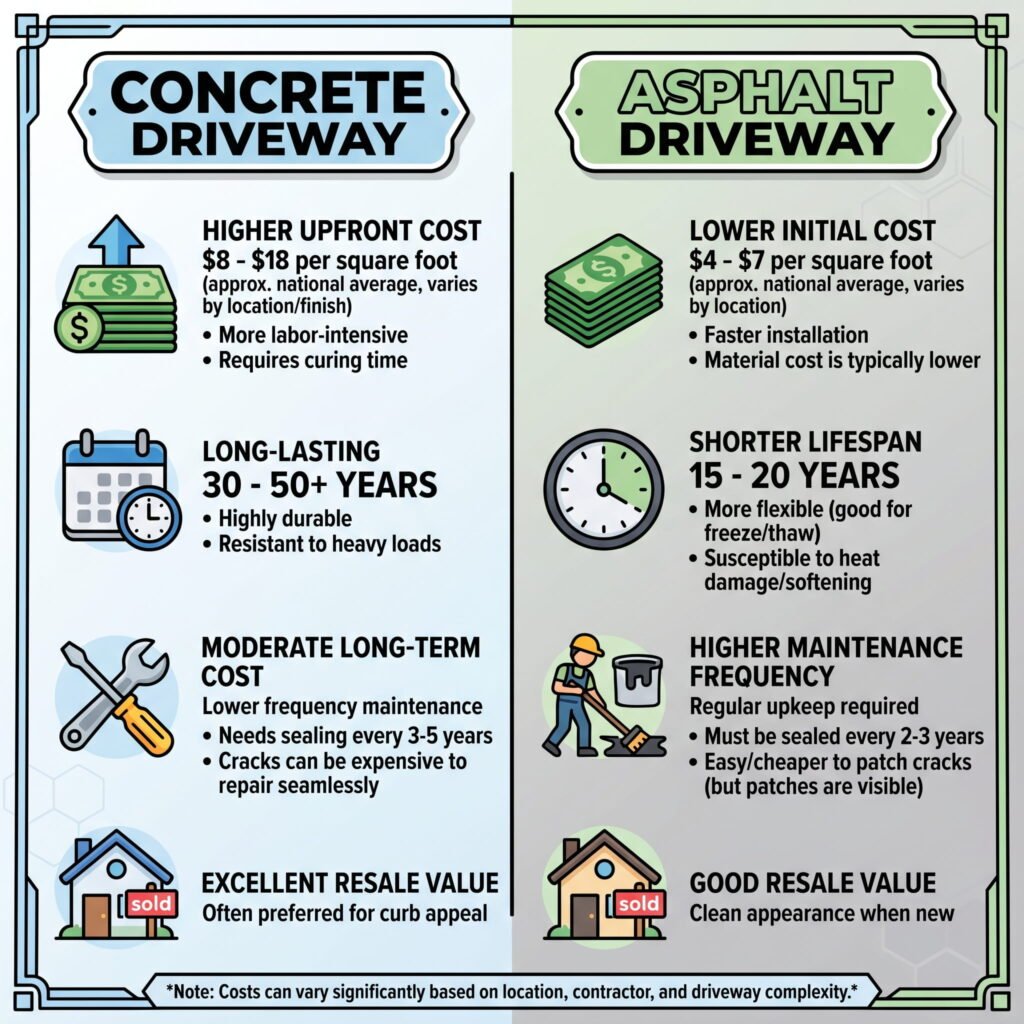
<div class=”direct-answer”> **Quick answer:** Asphalt costs $3–7/sq ft installed; concrete costs $6–12/sq ft. For a standard 1,000 sq ft driveway, that’s $3,000–7,000 for asphalt vs $6,000–12,000 for concrete. Asphalt wins on upfront price. Concrete lasts longer. Over 10 years, asphalt typically costs 40–50% less all-in. </div>
The decision comes down to three things: upfront budget, your climate, and how much maintenance you’re willing to do. This guide covers the full cost picture — installation, maintenance, and 10-year ownership — so you can make the right call for your property.
Use the asphalt calculator to run material costs, or keep reading for the side-by-side breakdown.
Asphalt vs concrete driveway cost at a glance
<div class=”quick-comparison”> The table below covers the core numbers for a standard 1,000 sq ft driveway (roughly 40 ft × 25 ft, enough for two cars side by side).
| Asphalt | Concrete | |
|---|---|---|
| Installation cost | $3–7/sq ft | $6–12/sq ft |
| 1,000 sq ft installed | $3,000–7,000 | $6,000–12,000 |
| Lifespan | 20–30 years | 30–50 years |
| Sealing cost (every 3–5 yrs) | $0.20–0.35/sq ft | Optional, $0.50–1.00/sq ft |
| Ready to drive on | 2–3 days | 7 days |
| Repair difficulty | Low–moderate | Moderate–high |
| Best climate | Cold/freeze-thaw | Hot/dry |
</div>
Asphalt wins on upfront price. Concrete wins on longevity. Neither wins cleanly on every metric.
How much does an asphalt driveway cost?
Asphalt driveways typically cost $3–7 per square foot installed, with the national average sitting around $4–5/sq ft for a standard residential job. The wide range reflects regional labor rates, base material prices, and whether you need a new gravel sub-base or are going over existing prepared ground.
For a 1,000 sq ft two-car driveway, the typical all-in breakdown looks like this:
| Line item | Typical cost |
|---|---|
| Gravel base (4 inches) | $400–800 |
| Hot mix asphalt material | $900–2,000 |
| Equipment and labor | $800–2,000 |
| Grading and prep | $200–600 |
| Total installed | $2,300–5,400 |
Resurfacing adds another $1–3 per square foot every 10–15 years. Sealcoating every 3–5 years runs $80–350 for a 1,000 sq ft driveway. Done on schedule, it protects the surface from oxidation and water intrusion and extends pavement life significantly.
The biggest variable in asphalt pricing is proximity to the plant. Hot mix must be laid while still hot. Longer haul distances mean higher delivery costs, which contractors pass through directly.
How much does a concrete driveway cost?
Concrete driveways run $6–12 per square foot installed, with most homeowners paying $8–10/sq ft for a plain broom-finished slab. Decorative finishes push that number higher:
| Finish type | Additional cost per sq ft |
|---|---|
| Broom finish (standard) | Included in base price |
| Exposed aggregate | +$1–2 |
| Stamped concrete | +$4–8 |
| Colored concrete | +$2–4 |
For a 1,000 sq ft driveway, a standard pour comes to $6,000–10,000 installed. A stamped decorative finish can reach $14,000–18,000.
Concrete also requires a 7-day cure before driving and reaches full strength at 28 days. That waiting period matters if you’re replacing an existing driveway — plan to be without it for at least a week.
Repairs are the main drawback. Concrete cracks, and matching a patch to aged concrete is nearly impossible aesthetically. A crack in asphalt can be filled and sealed for $50–200. The same repair in concrete often costs $300–1,000 and shows permanently.
Use the asphalt vs concrete driveway cost calculator
Every project is different. Enter your driveway dimensions to get a personalized side-by-side estimate — installation, sealing, and projected 10-year ownership cost for both materials.
→ Try the asphalt vs concrete driveway cost calculator
The calculator accounts for driveway size, regional labor rates, whether you need a new gravel base, and maintenance cycles over time. It’s the fastest way to see which material wins for your specific project before you call contractors.
For tonnage estimates on an asphalt-only project, the asphalt driveway calculator handles dimensions and material calculations directly.
10-year cost of ownership: asphalt vs concrete
The upfront gap narrows over time. Here’s how the math works for a 1,000 sq ft driveway over a decade:
Asphalt (10 years)
| Item | Cost |
|---|---|
| Installation | $4,000 |
| Sealcoating year 3 | $150 |
| Sealcoating year 6 | $160 |
| Crack repairs | $200 |
| Sealcoating year 9 | $175 |
| 10-year total | ~$4,685 |
Concrete (10 years)
| Item | Cost |
|---|---|
| Installation | $8,000 |
| Optional sealing year 5 | $400 |
| Minor crack repair year 8 | $400 |
| 10-year total | ~$8,800 |
Over 10 years, asphalt typically costs 40–50% less than concrete for comparable driveways. Over 30 years, the calculation shifts. Asphalt will likely need one full replacement ($4,000–7,000) while concrete may reach end of life without a total redo. Accounting for the longer lifespan, the 30-year cost gap narrows to roughly 20–30% in asphalt’s favor.
How climate affects the asphalt vs concrete decision
This is where the decision gets regional. Each material has a distinct failure mode, and your climate often determines which failure you’re more likely to face.
Cold climates (northern states, Canada, anywhere with hard winters): Freeze-thaw cycles are concrete’s main enemy. Water gets into small cracks, freezes, expands, and widens the crack. Over enough winters, this causes significant surface damage and heaving. Asphalt handles freeze-thaw better because it has more flexibility — it can move slightly with the ground without fracturing. Road salt compounds the problem for concrete: deicers react with cured concrete and cause surface scaling. Asphalt is far more salt-resistant. Across the northern half of the country, asphalt is the standard residential choice for exactly these reasons.
Hot climates (the Southwest, Texas, inland California): Asphalt softens in extreme heat. On days above 120°F, it can deform under vehicle weight, especially near curbs and in tight turning areas. Concrete holds its shape at high temperatures. UV degradation is also faster for asphalt in high-sun regions — regular sealing helps, but you’ll seal more often in Phoenix than in Minnesota.
Mild, wet climates (Pacific Northwest, Southeast): Both materials perform reasonably well. The choice comes down to budget and how hands-on you want to be with maintenance.
When concrete makes more sense
Concrete is worth the premium in a few specific situations.
If you want a decorative finish, asphalt offers no options: it stays black. Concrete can be stamped, stained, colored, or given an exposed aggregate finish that looks like polished stone. For homeowners focused on curb appeal or resale value, concrete’s aesthetic range is a genuine advantage.
If your HOA requires it, the decision is made for you. Many neighborhoods mandate concrete driveways for visual consistency. Check your HOA rules before pricing either material.
If you live in a high-heat climate (Arizona, New Mexico, inland California), concrete’s heat tolerance justifies the extra cost. Asphalt that softens on summer afternoons needs resurfacing sooner and gives a worse driving experience in the meantime.
If you want to minimize long-term maintenance, concrete’s lower upkeep profile is worth paying more for upfront. Asphalt requires sealcoating every 3–5 years and eventual resurfacing. Concrete can go years without any attention beyond occasional crack repair.
When asphalt makes more sense
Asphalt is usually the better choice when upfront cost is the main constraint. On a tight budget, the $3,000–7,000 vs $6,000–12,000 installed price is a real difference that’s often decisive.
Cold climates with harsh winters favor asphalt. The freeze-thaw performance advantage is well-documented, and road salt resistance makes it the practical choice across most of the northern US.
Quick turnaround matters too. If you’re tearing out an old driveway, being able to drive on new asphalt in 2–3 days vs 7 days for concrete affects how disruptive the project is.
The cost gap grows with project scale. For a long rural driveway or a private road, the price difference at $3–4/sq ft vs $8–10/sq ft adds up fast. A 300 ft private road at 14 ft wide (4,200 sq ft) costs roughly $14,700 in asphalt vs $37,800 in concrete at midpoint prices. At that scale, the choice is clear for most property owners.
FAQ: asphalt vs concrete driveway cost
Is asphalt or concrete cheaper for a driveway?
Asphalt is cheaper to install. A 1,000 sq ft driveway costs $3,000–7,000 in asphalt vs $6,000–12,000 in concrete. Over 10 years, asphalt typically costs 40–50% less including maintenance. Over 30 years, the gap narrows to 20–30% because concrete lasts longer and requires fewer full replacements.
How much does an asphalt driveway cost per square foot?
Asphalt driveways cost $3–7 per square foot installed, with a national average around $4–5/sq ft for standard residential work. Pricing varies by region, haul distance from the nearest asphalt plant, and whether the job requires a new gravel base or goes over existing ground.
How much does a concrete driveway cost per square foot?
A standard broom-finished concrete driveway costs $6–12 per square foot installed, with most homeowners paying $8–10/sq ft. Decorative finishes (stamped, colored, or exposed aggregate) add $2–8/sq ft on top of base concrete pricing.
Does asphalt or concrete last longer?
Concrete lasts longer. A well-maintained concrete driveway lasts 30–50 years. Asphalt lasts 20–30 years with regular sealing and occasional resurfacing. Asphalt is easier and cheaper to repair when damage does occur, which affects total lifetime cost.
Which is better for cold weather, asphalt or concrete?
Asphalt performs better in cold climates. It flexes with freeze-thaw ground movement rather than cracking, and it resists road salt better than concrete. In snowy regions, asphalt’s dark surface also helps melt ice faster when temperatures rise above freezing.
Can you put asphalt over concrete?
Technically yes, but most contractors advise against it. Cracks in the concrete will reflect through to the new asphalt surface over time — a problem called reflective cracking. If the concrete is in good condition and level, a 2-inch asphalt overlay can work reasonably well. If it’s cracked or uneven, removal and repaving produces better long-term results.
What is the cheapest type of driveway?
Gravel is the cheapest driveway surface at $0.50–2.00/sq ft for materials. Among paved surfaces, asphalt costs least to install at $3–7/sq ft, followed by concrete at $6–12/sq ft. Asphalt millings (recycled asphalt) fall between gravel and fresh asphalt at $1–3/sq ft installed and are a popular budget option for rural driveways and low-traffic areas.