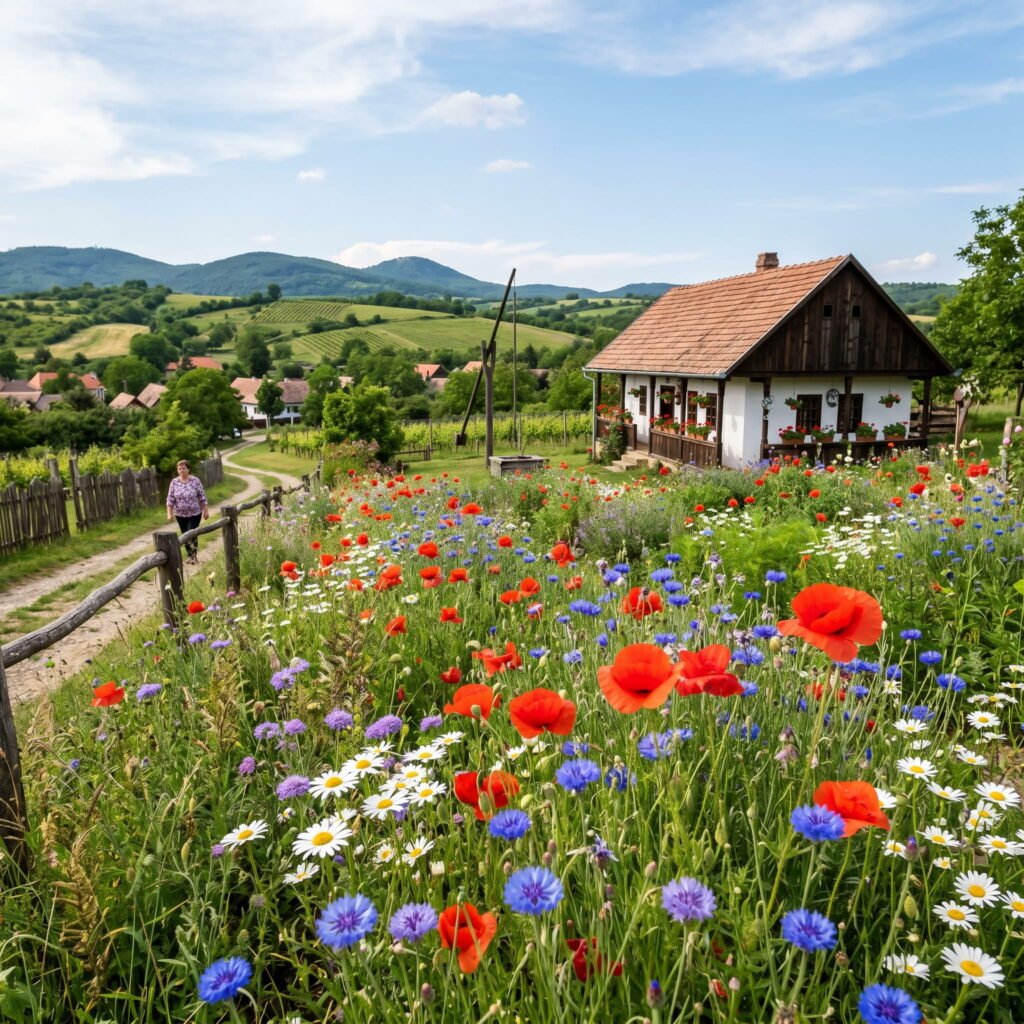
Hungary doesn’t get enough credit as a wildflower destination. Most people arrive expecting goulash and thermal baths — and then stumble into a meadow near the Buda Hills in April and just stop. The country sits at a crossroads of three biogeographical zones: continental, alpine, and Pannonian steppe. That overlap means you can find plants that would normally be separated by hundreds of kilometers of latitude all growing within a few hours of Budapest.
This guide covers everything in one place. The national flower, native species, wild blooms by season, plants that exist almost nowhere else on earth, and flowers protected by Hungarian law. Whether you’re trying to identify something you photographed, plan a nature trip, or just understand why the tulip is stitched onto every piece of Hungarian embroidery you’ve ever seen — you’ll find the answer here.
What Is the National Flower of Hungary?
The national flower of Hungary is the tulip (tulipán in Hungarian). It’s been the country’s official floral symbol since the 18th century and appears in Hungarian folk art, embroidery, architecture, and festivals across the country.
How Did the Tulip Become Hungary’s National Flower?
Tulip bulbs arrived in Hungary during the Ottoman conquest of the 15th century. The flower was among the most prized in the Ottoman Empire — the Sultan’s courts were filled with them — and as Ottoman influence spread across central Europe, the tulip came with it.
What’s interesting is the Hungarian word tulipán itself. According to Wikipedia’s etymology entry on the tulip, it may trace back to an Indo-Aryan root referencing resurrection, with tala meaning “underworld” and pAna meaning “defence.” The Hungarians, like other Finno-Ugrian peoples, had contact with Indo-Iranian religious traditions before arriving in the Carpathian Basin — so the flower carried symbolic weight before it was even physically growing in Hungarian soil.
By the 1600s, the tulip had become so embedded in Hungarian identity that it appeared on coins, royal kitchenware, and coats of arms. As Daily News Hungary reports, archaeological findings show the tulip motif on a sword hilt from Levédia — the assumed homeland of Hungarian tribes north of the Black Sea — dating to the 9th century. The motif is older than the flower’s physical arrival.
What Do Different Tulip Colors Mean in Hungarian Culture?
Color meaning was specific and widely understood. According to A-Z Animals, white tulips signified peace, yellow meant friendship, and red symbolized love. A large collection of mixed colors was historically a sign of wealth. Red tulips were given as declarations of deep affection; they still appear in bouquets for significant romantic occasions today.
In folk art, the tulip took on additional layers. Embroidered onto bridal linens and hope chests, it was believed to ward off the evil eye. When it appeared on a bride’s basket, the symbolism shifted to something more earthy: the tulip, alongside the lily, was used to represent femininity in every stage of life.
Native Hungarian Flowers: Species That Define the Landscape
Hungary is home to over 53,000 described species, with a significant portion of its plant life drawing from the unique conditions of the Carpathian Basin. These aren’t garden flowers that escaped — they’re genuinely wild, adapted over millennia to Hungary’s specific soils and seasons.
Cornflower (Búzavirág) — The Blue Wildflower of the Fields
The cornflower (Centaurea cyanus) is one of the most recognizable flowers in Hungary’s countryside. Its intense blue petals — technically a ring of spreading ray florets surrounding a central cluster — stand out sharply against the yellows and greens of summer fields. It grows 40–90 cm tall on grey-green branched stems and flowers all summer long.
The name tells the story: it used to grow as a weed in cornfields, and farmers knew it well. Daily News Hungary’s native plants guide notes it’s now endangered in its native habitat due to agricultural intensification and herbicide overuse. That’s a pattern across Hungary’s wildflowers — the species most associated with traditional farming landscapes are the ones disappearing fastest as those landscapes change.
Lily of the Valley (Gyöngyvirág) — Woodland Bells of Late Spring
Gyöngyvirág literally translates to “pearl flower,” which is apt. Lily of the valley (Convallaria majalis) produces small white bell-shaped flowers, just 5–10 mm wide, that hang from stems 15–30 cm tall. It flowers in late spring, spreads aggressively through underground stolons, and can form extensive colonies across forest floors.
Two things most people don’t know: it’s highly poisonous (every part of the plant), and it’s strongly scented. In Budapest, you can buy bunches of it from flower stalls in early May — it’s a traditional spring gift. Learning with Experts’ spring botany piece describes the smell as irresistible, with bowls of it appearing in every flower shop around Easter.
White Water Lily (Fehér Tündérrózsa) — Beauty of Hungary’s Lakes
Fehér tündérrózsa means “white fairy rose,” and the name fits the flower better than its English equivalent. The European white water lily (Nymphaea alba) grows in Hungary’s lakes, slow rivers, and ponds. It’s native to Europe, North Africa, and temperate Asia. The large white blooms float on the surface and open only during daylight hours.
Hungarian Lilac (Syringa josikaea) — A True Native Endemic
This one surprises people. Lilac feels like a garden plant you’d find anywhere in Europe, but Syringa josikaea — Hungarian lilac — is native specifically to Hungary and a narrow band of Eastern and Central Europe including Romania and Ukraine. It grows 2–4 meters tall, produces strongly fragrant dark pink flowers, and blooms in late spring. It’s not the common garden lilac; it’s a distinct species tied to this specific region.
What Wild Flowers Grow in Hungary by Season?
The wildflower calendar from Our Wanders, written by Hungarian nature writers with deep local knowledge, maps this out well. Hungary’s flowering season runs longer than most people expect — from late February through September, with something different happening almost every month.
Winter to Early Spring: Snowdrops and Pasque Flowers
Snowdrops arrive first, usually in late February, carpeting parks and forest floors with white before the snow has fully cleared. Spring snowflakes (Leucojum vernum) follow closely — they’re often confused with snowdrops but bloom slightly later, from early to mid-March.
Then come the pasque flowers. Pulsatilla species bloom from mid to late March in Hungary’s grassy meadows and the Buda Hills. Their Hungarian name — leánykökörcsin — refers to the beauty of young women. An older name, téltemető, means “winter burier.” The flowers are bell-shaped, typically purple or pink, and covered in silvery hairs that protect them from cold nights. A nature photographer writing for USRA’s Earth Science Picture of the Day describes photographing them by moonlight in Veszprém: the silver hairs and the silvery moonlight were in harmony. That’s the kind of specific beauty that doesn’t show up in general botany guides.
April–May: Forest Floors and Meadows Burst Open
April is the most crowded month for Hungarian wildflowers. Common lungwort, wood anemone, yellow wood anemone, spring vetchling, liverleaf, ground-ivy, pilewort, and wild garlic all appear within weeks of each other. Forest edges turn white from blackthorn blossom. Cuckooflowers emerge in moist grasslands.
By May, the whole country feels in bloom. Globe flowers (Trollius europaeus) appear in damp meadows and along forest edges in the Bükk Mountains and Zemplén Hills — bright yellow, globe-shaped, unmistakable. Common bluebells create carpets in woodlands. Wood anemone covers forest floors in white.
Summer: Lavender, Cornflower, and Meadow Saffron
Tihany, on a peninsula jutting into Lake Balaton, is famous for its lavender fields. They peak in early July. The purple rows and the lake backdrop make it one of the most photographed landscapes in Hungary — and lavender grows wild in some parts of the Balaton Uplands, not just in cultivation.
Cornflower blooms June through August. Goldenrod, hemp-agrimony, and purple loosestrife take over wetland areas through mid-summer into early autumn.
Autumn: The Final Bloom Before Winter
In late August and into September, meadow saffron (Colchicum autumnale) carpets grasslands in lilac. The wildflower guide from Magyarlukafa describes large patches of grassland turning lilac just as summer gives way to autumn — a final surprise before the landscape closes down for winter.
Are There Flowers Unique to Hungary?
Yes — several species are either endemic to Hungary or found in only a narrow range that includes the Carpathian Basin.
Tulipa hungarica — The Wild Danube Tulip
This is the wild ancestor, not the cultivated national symbol. Tulipa hungarica — also called the Danube tulip or Banat tulip — grows on rocky mountainsides along the gorges of the Danube, particularly at the Iron Gates. It has small bright yellow flowers in spring and blue-grey leaves, growing up to 60 cm tall.
Wikipedia’s entry on Tulipa hungarica notes it was first described in 1882 by Hungarian botanist Vincze von Borbás — the first tulip species described from the Balkan region. It’s now functionally extinct in Serbia, where flooding destroyed the last known populations. In Hungary and Romania, steep cliff faces along the Danube are what’s kept it alive: most tourists see it only from boats.
Hungarian Anemone (Pulsatilla hungarica)
Pulsatilla hungarica is a protected subspecies native to Hungary, found blooming in April in the Hajdúság Landscape Protection Area near Vámospércs. Its nature conservation value has been assessed at 100,000 forints per individual — a measure Hungary uses to quantify the replacement cost of protected species.
Janka’s Snowdrop
Discovered in 1867 by botanist Viktor Janka, this small lilac-colored flower blooms in early spring when the ground is still snow-covered. It’s protected in Hungary and appears on the reverse side of the two-forint coin — a quiet acknowledgment of its significance.
What Flowers Are Protected in Hungary?
Hungary’s Conservation Laws and Pannon Seed Bank
Hungary’s Nature Conservation Act (Act LIII of 1996) prohibits collecting, possessing, selling, or exporting protected plant species without specific authorization from regional nature directorates. This applies to flowers, fruits, seeds — any part that can be propagated.
On the ground, 22% of Hungary’s land is designated as protected area, above the EU average. The Pannon Seed Bank, established in 2010, preserves indigenous wild plant genetic material ex situ — a backup against habitat loss.
Despite this, 67% of endangered habitats in Hungary are in poor conservation condition, and 17% of evaluated species are globally endangered. Agricultural intensification since the 1980s has done more damage than any single policy could reverse quickly.
Endangered Species: Ghost Orchid, Hungarian Lily, Yellow Star-of-Bethlehem
Three species stand out as critically rare. The ghost orchid (Epipogium aphyllum) is one of the most elusive plants in Europe — it has no chlorophyll, lives entirely on fungal networks underground, and only surfaces to flower unpredictably. Finding one is partly skill, mostly luck.
The Hungarian lily and the yellow star-of-Bethlehem are both threatened primarily by urbanization and agricultural conversion. The yellow star-of-Bethlehem has bright star-shaped flowers and slender grass-like leaves — easy to overlook until it’s gone.
FAQ: Hungarian Flowers Quick Reference
What flower represents Hungary?
The tulip is Hungary’s national flower. It has represented the country since the 18th century and traces its cultural significance back to the Ottoman conquest of the 15th century, when tulip bulbs first arrived from Turkey. The tulip is also a dominant motif in Hungarian folk art, embroidery, and festivals.
What is the rarest flower in Hungary?
The ghost orchid (Epipogium aphyllum) is considered one of the rarest. Tulipa hungarica, the wild Danube tulip, is also critically rare — functionally extinct in Serbia and surviving mainly on inaccessible cliff faces along the Danube gorge in Hungary and Romania. The Hungarian anemone (Pulsatilla hungarica) is a protected endemic with populations concentrated in a single landscape protection area.
Where can you see wildflowers in Hungary?
The Buda Hills are the most accessible destination — pasque flowers, snowdrops, and violets appear there in early spring, with guided walks available from Budapest. The Hortobágy National Park and Bükk Mountains have the best summer wildflower displays. Tihany Peninsula on Lake Balaton is the place for lavender in July. For orchids and rare species, the Sopron region and Keszthely Hills have guided wildflower tours through Eco Tours Hungary. Three of Hungary’s ten national parks are UNESCO World Heritage Sites.
What flowers are used in Hungarian folk art?
The tulip is the dominant motif — it appears on embroidery, painted furniture, ceramics, and bridal items. The lily and chrysanthemum appear alongside it as the other two foundational folk art flowers. Cornflower blue is a color strongly associated with traditional Hungarian textile work, even when the actual cornflower isn’t depicted.
Putting It Together
Hungary’s flowers span national symbol to endangered rarity to seasonal spectacle. The tulip carries centuries of cultural weight — love, resilience, a connection to Ottoman history that most people don’t know about. The wild species — cornflower, lily of the valley, pasque flower, the tiny Danube tulip clinging to cliff faces — tell a different story about a landscape under real pressure from agriculture and urban growth.
If you’re planning a visit timed around flowers, March and April in the Buda Hills is the most accessible option. May in the Bükk Mountains rewards the extra travel. July in Tihany for lavender.
And if you’re growing any of these species at home, use the General Lighting Calculator at ToolCalcPro to check whether your indoor light levels are sufficient — Hungarian woodland species like lily of the valley need specific light conditions to thrive outside their native habitat.
Which of these flowers surprised you most? The ghost orchid that surfaces unpredictably, or the fact that Hungary’s national symbol arrived with an invading empire and stayed for six centuries?